


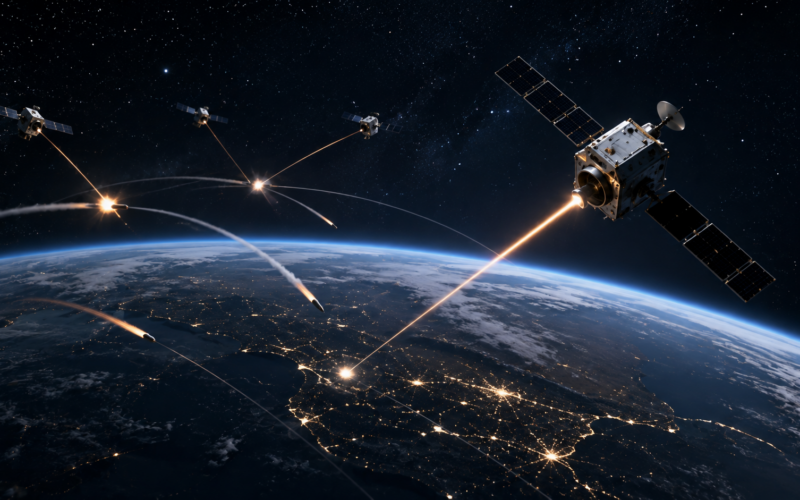
The United States Space Force’s Golden Dome space-based interceptor programme has moved through an early competitive milestone, with all 12 companies participating in the first phase of the orbital interceptor effort reported to have cleared the initial Gate 1 test. The contractor field includes publicly listed defence and technology companies such as Northrop Grumman Corporation, Lockheed Martin Corporation, RTX Corporation, Booz Allen Hamilton Holding Corporation and General Dynamics Corporation, alongside private and venture-backed players including SpaceX, Anduril Industries, True Anomaly, Quindar, Turion Space, GITAI USA and Sci-Tec. The programme is part of a wider Golden Dome missile-defence architecture intended to explore whether space-based interceptors can track and defeat advanced missile threats from orbit. The Space Force previously disclosed 20 other transaction authority agreements worth up to $3.2 billion across the 12 companies, with an initial demonstration target tied to 2028. With $NOC, $LMT and $RTX all trading below recent highs despite renewed missile-defence momentum, investors are being asked to price a programme that could become enormous, but only if affordability, scale, launch logistics and in-orbit performance can move beyond prototype confidence.
The development does not mean the United States has solved space-based missile defence. Gate 1 is an early design and component-level milestone, not an operational intercept demonstration. Its importance lies in the fact that the programme is moving from political ambition and contractor selection into technical filtering, where companies must prove whether their concepts can survive cost, schedule and performance scrutiny.
Why does Golden Dome’s Gate 1 progress matter for the U.S. missile-defence industrial base?
Golden Dome’s Gate 1 progress matters because it shows the United States is trying to test multiple space-based interceptor concepts in parallel rather than committing early to one prime contractor or one architecture. That is a different industrial approach from traditional large defence programmes that often narrow around an incumbent prime before competing technology paths have been fully tested.
The Space Force’s use of other transaction authority agreements gives the government more flexibility than a standard procurement route. It allows faster prototyping, more industry participation and competitive down-selection before the programme becomes a more formal acquisition pathway. In a technology area as difficult as space-based interception, that flexibility is not a procedural detail. It may determine whether the programme can learn fast enough before cost and physics overwhelm the schedule.
The contractor mix is also significant. Traditional defence primes bring missile, sensor, command-and-control and classified programme experience. SpaceX brings launch scale and space manufacturing expertise. Anduril Industries, True Anomaly, Quindar, Turion Space and other newer companies bring software, autonomy, space operations and faster development cultures. Booz Allen Hamilton and Sci-Tec add mission software, modelling, systems engineering and analytical depth.
That diversity is strategically useful because Golden Dome is not one product. It is a system-of-systems problem involving detection, tracking, command and control, battle management, launch, orbital manoeuvre, interceptor design, kill vehicles, secure communications, space-domain awareness and cost-per-shot discipline. No single company naturally owns the whole stack.
The risk is coordination. A broad contractor field helps avoid early lock-in, but the government must eventually integrate competing designs into one workable architecture. Competition is useful in the early gates. Fragmentation becomes dangerous if it persists into fielding.

What exactly is being tested in the space-based interceptor competition?
The Space Force’s space-based interceptor effort is intended to develop orbital systems that could engage missile threats from space, including threats in boost, midcourse or glide phases depending on the final architecture. The operational appeal is clear: a missile may be more vulnerable earlier in flight before it deploys countermeasures, manoeuvres or separates into more complex objects.
Gate 1 should be understood as an early technical screening stage rather than proof of an operational weapon. The first gate appears to focus on designs, component-level maturity and whether the competing teams can credibly proceed to more demanding test phases. Later stages are expected to examine launch, in-orbit performance and integration with the wider missile-defence architecture.
This sequence matters because the hardest parts of space-based interception occur after the slideware phase. Interceptors must survive launch, operate reliably in orbit, receive targeting data, manoeuvre quickly enough, distinguish threats, coordinate with sensors and command networks, and deliver a kill mechanism at the right time. Each part is difficult alone. Together, they create one of the most demanding missions in defence technology.
The 2028 initial demonstration target is ambitious. Space programmes can move quickly when commercial technology, rapid launch and modular satellite manufacturing are used well. However, space-based interceptors are not ordinary satellites. They are weapons systems that must work under extreme time pressure, in a contested environment and with national-security consequences if they fail.
The first gate therefore gives the programme momentum, not certainty. The most important proof points will come when contractors move from components and design reviews to flight-relevant demonstrations, orbital manoeuvre, integration with sensors and realistic intercept scenarios.
Why are Northrop Grumman, Lockheed Martin and RTX strategically important to Golden Dome?
Northrop Grumman, Lockheed Martin and RTX are central because they bring the missile-defence and sensor heritage that Golden Dome needs if the programme is to move beyond experimental space technology. Each company has deep exposure to interceptors, command systems, space payloads, radar, missile warning or battle management.
Northrop Grumman has a strong space and missile-defence base, including strategic missile, space systems and propulsion capabilities. Its role in the broader missile-defence ecosystem has become more visible after recent agreements tied to Patriot and THAAD production expansion. In Golden Dome, the company’s value lies in combining space systems knowledge with missile-related manufacturing and national-security programme discipline.
Lockheed Martin brings missile-defence experience across THAAD, PAC-3 and broader space systems. It is already one of the largest beneficiaries of the U.S. munitions and missile-defence production cycle. A successful space-based interceptor architecture could extend that role from ground and terminal missile defence into orbital engagement systems.
RTX, through Raytheon, brings radar, missile, seeker, sensor and integrated air-and-missile-defence capability. The company’s SPY-6, Patriot, Standard Missile and other defence electronics businesses make it relevant to the sensor and shooter ecosystem that Golden Dome would require. Space-based interception cannot work without tracking, discrimination and engagement logic.
These primes are not guaranteed winners simply because of incumbency. Golden Dome is being structured partly to test whether newer entrants can deliver cheaper, faster or more scalable solutions. However, the traditional primes are still likely to be essential in integration, classified systems, reliability, government assurance and future production.
The market will watch whether Golden Dome becomes another large prime-led missile-defence architecture or whether it genuinely shifts value toward newer space and autonomy companies. The first gate does not answer that question. It only keeps the competition alive.
How do SpaceX, Anduril and newer space companies change the procurement logic?
SpaceX’s involvement changes the programme because launch cost, launch cadence and satellite production are central to any large orbital missile-defence architecture. A space-based interceptor constellation would need not only effective weapons, but also a launch and replenishment model that can support a large number of assets over time.
Anduril Industries brings a different kind of relevance. It has built its defence brand around autonomy, software, rapid manufacturing and lower-cost systems. In a programme where affordability may determine whether space-based interceptors survive down-selection, companies with a lower-cost and faster-iteration culture could challenge the traditional primes.
True Anomaly, Quindar, Turion Space and GITAI USA represent the broader shift toward commercially influenced space operations. Their roles may involve autonomous spacecraft, mission operations, orbital logistics, robotics or supporting technologies rather than complete interceptor ownership. That matters because Golden Dome is likely to require a distributed industrial base rather than one vertically integrated contractor.
The newer companies also increase competitive pressure. Traditional defence primes cannot assume that complex equals expensive by default. If commercial-space firms can offer rapid design cycles and cheaper deployment options, they may force the entire field to sharpen cost discipline.
The challenge is mission assurance. Commercial speed is useful, but missile defence cannot tolerate fragile systems, unclear command authority or weak cybersecurity. Golden Dome will need commercial agility combined with military reliability.
This is the central procurement experiment. The government is trying to bring commercial space speed into a mission that historically belongs to the most controlled parts of the defence industrial base. If it works, Golden Dome could reshape future missile-defence acquisition. If it fails, the programme may return to a smaller, slower and more traditional architecture.
Why is affordability the biggest unresolved question in space-based missile defence?
Affordability is the decisive issue because a space-based interceptor shield can become extremely expensive if every layer requires large constellations, frequent replenishment, specialised launch, high-end sensors and complex command systems. The programme has already faced competing cost estimates, ranging from official budget framing to much larger outside projections.
The cost problem has several layers. First, the United States would need enough orbital coverage to make the system operationally meaningful. A handful of interceptors in space would not provide persistent protection against broad missile threats. Second, each interceptor must be replaced after use or after orbital life expires. Third, adversaries can adapt by increasing missile numbers, adding decoys, manoeuvring vehicles or targeting the space layer itself.
The cost-per-shot problem is especially important. A missile-defence system fails economically if the defender must spend vastly more than the attacker for every engagement and cannot sustain the exchange. Space-based interceptors may offer unique engagement opportunities, but they must still compete with ground-based interceptors, sensors, electronic warfare, boost-phase alternatives and other layered defences.
Affordability also affects contractor selection. The government may prefer a slightly less elegant system that can be produced and replenished at scale over a technically impressive design that is too expensive to field in meaningful numbers.
This is why Golden Dome should be judged by lifecycle cost, not only prototype success. A contractor can pass early gates with a promising design. The real question is whether that design can be manufactured, launched, operated, sustained and replaced at a cost the government can defend.
For investors, affordability is both risk and opportunity. Companies that can lower cost while meeting mission requirements may capture major future work. Companies that offer expensive but exquisite solutions may struggle if the architecture is forced to prioritise scale.
What does Golden Dome mean for defence stocks after the latest August 13 market moves?
The listed companies involved in Golden Dome entered August 14 with different market setups. Northrop Grumman closed at $574.74 on August 13, slightly lower on the day and still well below its 52-week high of $774.00. Lockheed Martin closed at $598.01, down 1.39% and about 13.6% below its 52-week high of $692.00. RTX closed at $220.48, down 1.01% and only about 2.8% below its recent 52-week high of $226.88.
General Dynamics closed at $392.96, also slightly lower, while Booz Allen Hamilton ended at $78.40. These moves suggest that Golden Dome progress did not produce a simple across-the-board defence-stock rally. The market is already balancing strong defence demand against valuation, execution, budget politics and company-specific issues.
RTX looks closest to a high-confidence defence and aerospace momentum stock, trading near its 52-week high after strong defence electronics and commercial aerospace performance. Lockheed Martin and Northrop Grumman have more obvious upside from missile-defence expansion, but both remain below earlier highs because investors continue to discount programme execution, margin pressure and capital allocation risk.
Booz Allen Hamilton has a different exposure. It is unlikely to be the hardware winner in a space-based interceptor programme, but its systems engineering, modelling, cyber and mission-integration role could be valuable if Golden Dome becomes a complex architecture requiring software-heavy command and control.
General Dynamics has potential through mission systems, secure communications and space-related work, but its current investor narrative is more dominated by submarines, combat systems and Gulfstream business jets than by Golden Dome.
The broader market message is that investors want evidence of funded conversion. Passing Gate 1 is strategically useful, but stock prices will move more meaningfully when programme roles, contract values, margins and production paths become clearer.
How could Golden Dome reshape competition between defence primes and venture-backed firms?
Golden Dome could become one of the most important tests of whether venture-backed defence companies can compete directly with traditional primes in a strategic weapons architecture. That does not mean a start-up will suddenly replace Lockheed Martin, Northrop Grumman or RTX. It means the value split could change.
In older programmes, primes often owned the architecture, with smaller companies supplying components or software. In Golden Dome, newer companies may compete for core parts of the mission, particularly where commercial space, autonomy, mission software, orbital operations and rapid manufacturing are central.
This could force primes into new partnership models. They may need to integrate venture-backed subsystems, buy smaller firms, license commercial technologies or accept more open architectures than they would prefer.
For venture-backed firms, the opportunity is large but demanding. Winning a prototype award or clearing an early gate is not the same as supporting a national missile-defence system. They must prove reliability, security, manufacturability, cost control and the ability to work inside classified government architectures.
The government benefits from keeping both groups in competition. Traditional primes provide assurance and scale. Newer companies provide speed and cost pressure. If the acquisition strategy is managed well, Golden Dome could capture the best of both.
The risk is that the programme becomes a coordination burden. Too many competing interfaces, architectures and data standards can create integration delays. The government will eventually need clear authority over design, command and control, interoperability and production responsibility.
Golden Dome may therefore become not only a missile-defence programme, but also a case study in whether the Pentagon can manage modern defence innovation without either smothering it or fragmenting it.
Why does command and control matter as much as the interceptor itself?
Space-based interceptors attract attention because they sound like the dramatic part of the architecture. However, the system will not work without command, control, battle management and communications that can detect threats, assign weapons, authorise engagement and coordinate with other missile-defence layers.
A missile launch creates a compressed timeline. The system must detect the launch, classify the object, calculate trajectory, determine whether engagement is possible, assign an interceptor, execute the engagement and update the broader defence network. In some scenarios, those decisions may need to occur in minutes.
That makes data architecture central. Golden Dome will need inputs from space sensors, ground radars, sea-based sensors, airborne platforms and intelligence systems. It must also avoid false positives and handle decoys, manoeuvring threats and electronic interference.
This is where companies such as Booz Allen Hamilton, Sci-Tec, Quindar and other mission-software or data-integration firms can become important even if they are not building the interceptor. A space weapon without trusted data and command authority is just an expensive object in orbit.
The command layer also raises policy questions. Missile defence involves escalation risk, rules of engagement, allied warning networks and potential nuclear deterrence implications. Automation can support speed, but human authority and auditability remain essential.
For investors, the lesson is that Golden Dome value may not flow only to hardware manufacturers. Software, cyber, systems engineering, modelling, simulation and mission operations could become significant revenue lanes as the architecture matures.
What technical and geopolitical risks could limit Golden Dome’s final architecture?
The first risk is physics. Space-based interceptors must manoeuvre in orbit, engage fast-moving targets and do so within tight timing constraints. Early design success does not guarantee realistic intercept performance.
The second risk is scale. A useful space-based layer may require large constellations, replenishment capacity and launch cadence. If the required scale becomes too expensive, the architecture may be reduced or redesigned.
The third risk is survivability. Orbital missile-defence assets could become targets in a conflict. Adversaries may use anti-satellite weapons, cyberattacks, jamming, dazzling, co-orbital threats or debris-generating tactics to degrade the system.
The fourth risk is cost realism. The programme will face continuing scrutiny if official cost estimates differ sharply from outside projections. A system perceived as unaffordable may lose political support even if technically promising.
The fifth risk is integration. Golden Dome must connect space-based interceptors with ground, sea, air and space sensors. A failure in data fusion or command-and-control could weaken the value of otherwise capable interceptors.
The sixth risk is strategic stability. Space-based missile defence can affect how rivals view deterrence, arms control and crisis stability. The programme may invite countermeasures or accelerate competing weapons development.
The seventh risk is contractor execution. A field of 12 companies creates useful competition, but the government must eventually choose which designs to scale. Down-selection can trigger protests, delays or political pressure if large companies and emerging firms are treated unevenly.
These risks do not mean Golden Dome cannot work. They mean that Gate 1 progress should be treated as an early filter, not a final validation.
What should executives and investors watch after Golden Dome’s Gate 1 milestone?
The first signal will be Gate 2 results. Investors should watch whether all 12 companies remain in the competition or whether technical, cost and schedule differences begin to narrow the field.
The second signal will be flight-relevant testing. Design reviews are useful, but launch, deployment, orbital operations and realistic engagement testing will carry far more weight.
The third signal will be cost disclosure. The programme’s future depends on whether the government can defend the cost of a scalable orbital interceptor layer.
The fourth signal will be architecture decisions. Golden Dome may include space, ground and possibly sea-based layers. The final architecture will determine which contractors capture the largest opportunity.
The fifth signal will be command-and-control awards. Battle management, data fusion and communications may become as valuable as interceptor hardware if the programme matures.
The sixth signal will be launch strategy. Space-based interceptors require launch capacity and replenishment plans. SpaceX’s role, and the government’s willingness to diversify launch dependence, will be important.
The seventh signal will be budget continuity. Golden Dome is politically prominent, but long-term fielding will require sustained appropriations across multiple years.
The eighth signal will be stock-market differentiation. $NOC, $LMT and $RTX may all benefit from missile-defence momentum, but actual share-price impact will depend on disclosed awards, margin potential and whether each company is selected for scaled roles.
Golden Dome’s first gate progress confirms that the United States is seriously testing the space-based interceptor concept. It does not yet prove that orbital missile defence is affordable, scalable or operationally mature. The programme has moved from theory into competition, and that is where the real industrial story begins.
Key takeaways on Golden Dome’s space-based interceptor Gate 1 progress
- The U.S. Space Force’s Golden Dome space-based interceptor competition has reportedly moved through Gate 1, with all 12 participating companies clearing the first test stage.
- The contractor field includes Northrop Grumman, Lockheed Martin, RTX, Booz Allen Hamilton, General Dynamics, SpaceX, Anduril Industries, True Anomaly, Quindar, Turion Space, GITAI USA and Sci-Tec.
- Space Systems Command previously disclosed 20 OTA agreements worth up to $3.2 billion across the 12 companies.
- The programme is intended to demonstrate an initial space-based interceptor capability integrated into the Golden Dome architecture by 2028.
- Gate 1 should be treated as an early design and component-level milestone, not proof of an operational intercept system.
- The main strategic challenge is whether space-based interceptors can be made affordable and scalable enough to justify inclusion in the final architecture.
- Traditional defence primes bring missile, sensor and classified programme depth, while newer companies bring commercial-space speed, autonomy and software-driven development.
- Command and control may become as important as interceptor hardware because Golden Dome requires fast threat detection, tracking, engagement assignment and battle management.
- Northrop Grumman closed at $574.74, Lockheed Martin at $598.01 and RTX at $220.48 on August 13, showing that missile-defence momentum is still being balanced against execution and valuation risk.
- Investors should watch Gate 2 results, flight testing, architecture decisions, cost estimates, command-and-control awards and whether prototype progress turns into funded production roles.
Discover more from Business-News-Today.com
Subscribe to get the latest posts sent to your email.
