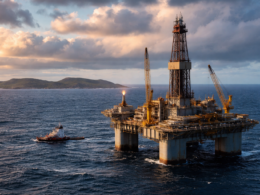



Frontline plc reported the strongest quarterly profit in its history as second-quarter net income surged to $659.2 million, or $2.96 per share, from approximately $77.5 million a year earlier. Reported revenue reached $943.3 million, almost double the prior-year level, while adjusted profit climbed to a record $580.2 million as extraordinarily high tanker rates flowed through the company’s large VLCC, Suezmax and LR2/Aframax fleet. Frontline declared a regular quarterly dividend of $2.61 per share and plans an additional $0.80 special dividend after agreeing to sell two 2017-built VLCCs for $270 million. The results show how geopolitical disruption, changing oil trade routes and constrained effective tanker availability have transformed the economics of crude transportation, while Frontline is using the cycle to secure high charter rates, dispose of selected older assets and return surplus cash directly to shareholders.
The earnings increase was not entirely recurring because Frontline recognized a $54.7 million gain from selling its two oldest Suezmax tankers during Q2. Even after adjustments, however, profit reached a company record of $580.2 million, demonstrating that exceptionally strong operating conditions rather than vessel sales alone drove the quarter. Frontline shares rose following the release and remained near their 52-week high, reflecting investor confidence that the tanker-rate strength is extending into the third quarter rather than ending with Q2.
VLCC rates above $150,000 per day turn tanker-market disruption into record operating earnings
Frontline’s average spot time charter equivalent rate for VLCCs reached $152,700 per day during Q2, up sharply from $103,500 during the first quarter. Suezmaxes earned an average $111,500 per day compared with $72,400 in Q1, while LR2 and Aframax vessels increased to $92,400 per day from $50,700.
Those numbers are exceptionally high relative to Frontline’s cash operating requirements. The company estimates average daily cash breakeven rates over the next 12 months of approximately $23,800 for VLCCs, $25,700 for Suezmaxes and $22,200 for LR2/Aframaxes, leaving an unusually wide spread between current charter revenue and the cash needed to operate and finance the vessels.
The spread helps explain why earnings have expanded so rapidly. A VLCC earning more than $150,000 per day while carrying a cash breakeven below $24,000 can generate extraordinary incremental cash flow during periods of strong utilization, particularly when that performance is repeated across a large fleet.
Geopolitical disruption has become an important part of that pricing environment. Frontline said uncertainty across the Middle East and broader energy complex is creating inefficiencies that increase tanker utilization, while energy-security considerations are changing trade routes and potentially extending the distances oil must travel between producing and consuming regions.
Longer voyages are favorable for tanker owners because they increase tonne-mile demand even if the number of physical barrels transported does not rise proportionally. A barrel redirected over a longer route effectively consumes more vessel capacity, reducing the number of ships available for other cargoes and supporting freight rates.
That market structure makes Frontline one of the clearest publicly traded beneficiaries of current oil-market disruption. It also creates significant cyclicality because the same economics can reverse if geopolitical tensions ease, trade routes normalize or a large amount of new tanker capacity enters service.
Q3 charter coverage suggests exceptional tanker economics are continuing beyond the record quarter
Frontline has already secured a substantial portion of its available Q3 vessel days at rates that remain near or above Q2 levels. Approximately 86% of VLCC spot days have been contracted at an average $156,900 per day, while 79% of Suezmax days are covered at approximately $117,400 and 70% of LR2/Aframax days at about $81,000.
The VLCC number is particularly notable because it exceeds Q2’s already exceptional $152,700 average. Suezmax contracted rates are also above the second-quarter average, giving Frontline significant near-term revenue visibility while retaining some exposure to further rate movements.
Management cautioned that realized full-quarter Q3 averages are expected to come in below the currently contracted figures because ballast days will affect the final calculation. Even with that adjustment, current bookings indicate that tanker-market profitability has not reverted toward historical levels.
Frontline has also used the rate environment to lock several vessels into longer contracts. Two newly delivered VLCCs secured one-year charters at $120,000 per day each, while two 2016-built VLCCs entered two-year and three-year contracts at approximately $90,000 and $75,000 per day respectively.
Those contracts reduce exposure to a sudden spot-market correction while preserving considerable profitability because the fixed rates remain far above the company’s estimated cash breakeven costs. The strategy reflects a balance between maximizing today’s extraordinary spot rates and protecting future cash flows before tanker markets eventually normalize.
The decision is particularly relevant after the rapid rise in rates during 2026. Frontline’s Q1 VLCC rate was already $103,500 per day, up dramatically from $37,200 in Q1 2025, before accelerating again during Q2.
Frontline turns $270 million VLCC sale into an additional $0.80 special dividend
Frontline agreed in July to sell two 2017-built VLCCs for a combined $270 million. Subject to completing those transactions, the company expects to receive approximately $179 million in cash proceeds and plans to distribute essentially that amount through a one-time $0.80-per-share special dividend.
That distribution comes on top of the $2.61 regular quarterly dividend declared alongside the Q2 results, taking the announced shareholder payout connected with the quarter and vessel sales to $3.41 per share. The regular dividend alone essentially matches Frontline’s record adjusted EPS of $2.61.
The asset sale is consistent with Frontline’s broader fleet-management strategy. During Q2, the company delivered its two oldest Suezmax tankers, built in 2014 and 2015, generating a $54.7 million gain above their carrying values.
Frontline had already been an active seller earlier in 2026. During Q1, it delivered eight older first-generation ECO VLCCs built between 2015 and 2016 and recognized approximately $210.9 million in gains, demonstrating how strong secondhand vessel values are creating another source of capital beyond charter earnings.
Selling vessels during strong asset markets can be attractive if the sale price adequately reflects the future earnings those ships would otherwise generate. Frontline can monetize older assets, reduce future maintenance requirements and redirect capital toward newer vessels with better fuel efficiency and longer remaining economic lives.
The strategy also limits the temptation to maximize fleet size simply because freight rates are high. Shipping cycles have historically punished companies that expand aggressively near market peaks, making disciplined asset recycling particularly important when both earnings and vessel prices are elevated.
Newer VLCC fleet and cheaper financing lower Frontline’s cash breakeven as earnings expand
Frontline is simultaneously modernizing the fleet rather than shrinking its tanker exposure permanently. The company agreed earlier this year to acquire nine latest-generation scrubber-equipped ECO VLCC newbuildings from affiliates of Hemen Holding, its largest shareholder, and arranged financing commitments of up to $737 million to partially fund those ships.
Several of those vessels have now entered service, including newbuildings delivered during the second and third quarters. The ability to immediately secure some of them on six-figure daily charter rates reduces initial employment risk while giving Frontline a younger fleet capable of operating more efficiently over the next stage of the tanker cycle.
Financing costs are also moving lower. Frontline said refinancing and amendments to existing facilities are reducing its weighted average interest-rate margin by approximately 52 basis points, from 178 basis points at the end of Q1 to about 126 basis points once the process is completed during Q3.
Lower borrowing spreads have a direct impact on vessel cash breakeven rates, particularly for a capital-intensive shipping company with billions of dollars invested in ships. Reducing financing expenses allows Frontline to retain a larger portion of charter revenue during strong markets and provides additional protection when freight conditions weaken.
Management has therefore used the tanker upcycle in several ways simultaneously: capturing high spot rates, locking selected ships into attractive contracts, refinancing debt at cheaper margins, selling older vessels at elevated valuations and investing in newer tonnage.
That combination is more strategically important than the headline $659 million profit alone. A shipping company cannot control the freight cycle, but it can use exceptional markets to improve the fleet and balance sheet before conditions eventually become less favorable.
Oil-security concerns support tanker demand but current profitability should not be treated as permanent
Frontline’s near-term outlook remains unusually strong, but management itself described the second quarter as volatile. The company believes energy security will increasingly influence oil-trade decisions and that inventory replenishment could provide additional tanker demand, particularly if countries prioritize diversified supply routes after recent geopolitical disruption.
That environment can extend voyages and create inefficiencies, both of which reduce effective vessel supply. The result is precisely what Frontline experienced during Q2, with charter rates rising far faster than operating expenses and producing record earnings.
The risk is that extraordinary daily rates can also encourage additional tanker orders. Frontline identifies vessel supply, newbuilding activity, oil production, consumption, geopolitical events and changes in global trade routes among the principal factors capable of materially changing future earnings.
Current shareholder returns should therefore be viewed through the shipping cycle rather than as a fixed dividend stream. Frontline’s policy allows distributions to move with earnings, which can produce extremely large payments during strong markets but considerably smaller dividends when tanker rates weaken.
The company appears to be acknowledging that reality through the special dividend structure. Instead of treating proceeds from the two VLCC sales as a permanent increase in the quarterly payout, Frontline plans to return the cash separately through a one-time $0.80 distribution.
Investor sentiment remains constructive because the immediate earnings picture is still exceptionally favorable. Following the results, Frontline shares advanced and remained near their 52-week high as record Q2 profit and strong Q3 rate coverage reinforced expectations for another highly profitable quarter.
The most important question for the remainder of 2026 is therefore not whether Frontline can repeat every element of the record Q2 result. It is whether tanker rates remain sufficiently above historical averages for the company to continue generating outsized free cash flow after vessel-sale gains normalize.
Key takeaways from Frontline’s record Q2 profit and extraordinary tanker-rate environment
- Q2 net profit reached a record $659.2 million, while adjusted profit hit $580.2 million, showing operating strength remained exceptional even after removing major non-recurring effects.
- Reported revenue reached $943.3 million, almost doubling year over year as dramatically higher tanker charter rates transformed Frontline’s earnings power.
- VLCC spot earnings averaged $152,700 per day, versus an estimated $23,800 cash breakeven, creating an unusually wide margin between vessel revenue and underlying cash costs.
- Q3 VLCC bookings have averaged $156,900 per day with 86% coverage, indicating that tanker-market strength has extended beyond the record second quarter.
- Frontline declared a $2.61 regular quarterly dividend, effectively distributing its record adjusted earnings directly to shareholders rather than accumulating the entire windfall.
- Two 2017-built VLCC sales for $270 million are expected to fund another $0.80 special dividend, taking announced distributions associated with the period to $3.41 per share.
- Q2 included a $54.7 million gain from selling two older Suezmaxes, so reported profit should not be treated as entirely recurring despite record underlying earnings.
- New VLCC deliveries and longer-term charters at rates between $75,000 and $120,000 per day provide future revenue visibility while Frontline continues modernizing its tanker fleet.
- Refinancing is reducing Frontline’s weighted borrowing margin by roughly 52 basis points, lowering cash breakeven costs and strengthening downside protection when tanker markets eventually normalize.
- Middle East disruption and changing oil trade routes remain major near-term catalysts, while geopolitical normalization and future vessel-supply growth represent the principal risks to current profitability.
Discover more from Business-News-Today.com
Subscribe to get the latest posts sent to your email.