
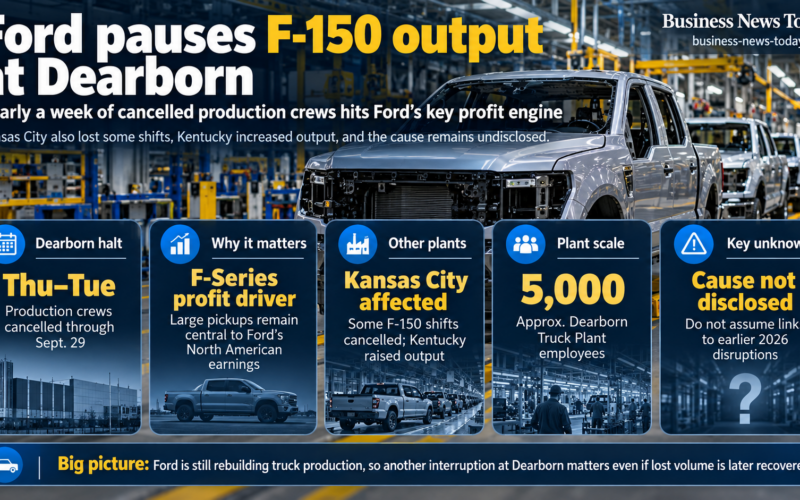
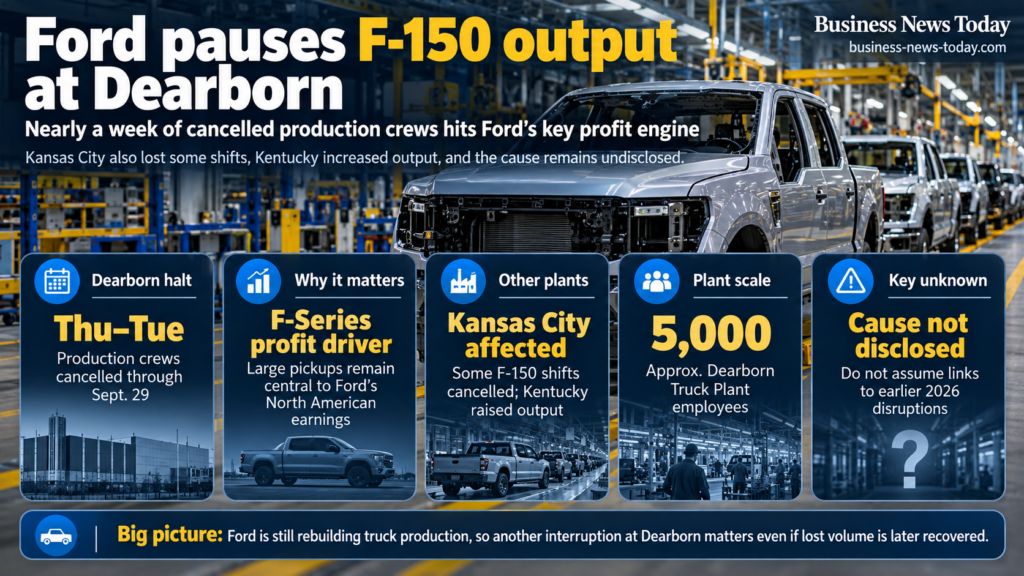
Ford Motor Company (NYSE: F) has halted production of its highly profitable F-150 pickup at the Dearborn Truck Plant for nearly a week, introducing another disruption just as the automaker has been trying to rebuild truck output after earlier supply problems. An internal memo reviewed by Reuters said all production crews at the Michigan plant were cancelled from Thursday through Tuesday, September 29.
The disruption is not confined to Dearborn. Reuters reported, citing a person familiar with the matter, that Ford’s Kansas City Assembly Plant also cancelled some F-150 shifts because of the same unidentified issue, while Kentucky Truck Plant increased production to offset some of the lost volume elsewhere. Reuters’ September 25 report did not establish the cause of the current disruption, making it important not to attribute it automatically to the supplier and tooling problems that affected Ford earlier in 2026.
Why does a one-week F-150 shutdown matter so much to Ford’s profitability?
The F-Series is not simply another Ford model. Large pickups generate some of the strongest margins in the company’s portfolio and have historically been central to Ford’s North American profitability.
Consumers frequently purchase higher trim levels, towing packages and other options that increase average transaction prices. Commercial buyers also rely heavily on F-Series trucks, providing Ford with demand extending beyond ordinary retail consumers.
That means each lost production day can remove vehicles from one of Ford’s most economically valuable assembly lines. The financial effect depends on whether the company eventually recovers those units through overtime or additional shifts, which helps explain why Ford is increasing output at Kentucky Truck Plant while Dearborn and Kansas City lose production.
Manufacturing interruptions become particularly significant when inventories are already being rebuilt following previous disruptions because the company has less flexibility to absorb another setback without affecting dealer supply.
How much F-150 production capacity does Ford have at Dearborn and Kansas City?
Ford’s Dearborn Truck Plant at the Rouge complex employs roughly 5,000 people and produces the F-150 and F-150 Raptor. Kansas City Assembly is even larger, employing more than 9,000 people while producing the F-150 alongside Transit commercial vans.
Ford added a third crew at Dearborn as part of a plan to increase F-Series output during 2026. The company previously said it intended to build more than 45,000 additional gas and hybrid F-150s at Dearborn, supported by approximately 1,200 employees on the new crew and additional staffing elsewhere across the Rouge complex.
That expansion makes the latest cancellation especially notable because Ford has spent the year trying to push more trucks through the plant rather than managing excess capacity.
Production had improved substantially by mid-2026. Industry reporting showed Dearborn F-150 output reaching 29,475 units during July, up around 3.5% from June, while Kansas City output increased to 26,677 units.
Why has Ford spent so much of 2026 rebuilding F-Series production?
Ford entered 2026 recovering from severe aluminum supply disruption linked to fires at a Novelis facility in Oswego, New York. The earlier interruption affected production of aluminum-intensive F-Series vehicles and pushed Ford to prioritize its most profitable gas and hybrid pickups over the electric F-150 Lightning.
The company announced plans to increase F-150 and Super Duty production by more than 50,000 vehicles during 2026 and add as many as 1,000 jobs across Michigan and Kentucky. That output increase was explicitly intended partly to recover production lost during the previous supply crisis.
Ford also encountered a separate interruption at Dearborn in May when a broken industrial die used to stamp aluminum hoods temporarily stopped production. That incident was repaired and should not be assumed to explain the current September shutdown because Reuters did not identify the cause of the latest disruption.
Taken together, the events demonstrate how vulnerable modern vehicle production can be to highly specific components or tooling. An assembly plant requires thousands of parts to arrive in sequence, meaning the absence of one critical item can idle thousands of workers and stop production of an otherwise complete vehicle.
Why is Ford prioritizing gasoline and hybrid F-150 trucks over the Lightning?
Profitability and demand are the main reasons. Ford previously chose to keep F-150 Lightning production paused while allocating scarce aluminum and manufacturing resources toward gas and hybrid F-Series models, which the company said were more profitable and used less aluminum.
Ford has since outlined a future extended-range electric F-150 Lightning architecture rather than continuing the current battery-electric model unchanged. That strategy reflects a broader reassessment of electric-vehicle economics as U.S. manufacturers attempt to balance regulatory requirements, consumer demand and the high cost of large pickup batteries.
The shift increases the importance of traditional F-Series production to Ford’s near-term earnings. While the company invests in new electric architectures, combustion and hybrid pickups continue generating much of the cash needed to fund that transition.
Every production interruption therefore affects more than current deliveries. It potentially reduces the cash contribution from the products supporting Ford’s wider investment programme.
Could Ford recover the lost Dearborn production later in the year?
Automakers frequently recover temporary production losses through overtime, additional shifts or higher line speeds if supplier availability permits. Ford’s use of Kentucky Truck Plant to compensate for some losses demonstrates that management is already attempting to manage the disruption dynamically.
The ability to recover F-150 volume is more complicated because different plants and truck variants are not perfectly interchangeable. Dearborn and Kansas City both build F-150s, but production schedules depend on parts, configurations and logistics arranged well in advance.
Dealer inventories also determine urgency. If Ford has sufficient F-150 stock, a short shutdown may have little effect on retail sales. If inventories are tight in popular configurations, the interruption can affect dealer availability more quickly.
The crucial unknown remains the underlying cause. A short-lived operational issue can be resolved without material financial impact, while a supplier disruption affecting multiple plants can become much more consequential.
What should Ford investors watch after the September F-150 production halt?
The first indicator is whether Dearborn production resumes as scheduled after September 29. Any extension would make the interruption more financially significant and raise additional questions about the underlying problem.
Kansas City should also be monitored because disruption across two F-150 plants has greater implications than a localized Dearborn issue. Ford’s ability to compensate elsewhere becomes progressively more limited as additional production sites are affected.
Management commentary will ultimately determine whether the incident changes Ford’s full-year output or financial outlook. Until then, the confirmed information supports a narrower conclusion: Ford has cancelled nearly a week of production for its most important vehicle at Dearborn, and related disruption has reached Kansas City, but the cause and final financial impact have not yet been publicly established.
Discover more from Business-News-Today.com
Subscribe to get the latest posts sent to your email.