




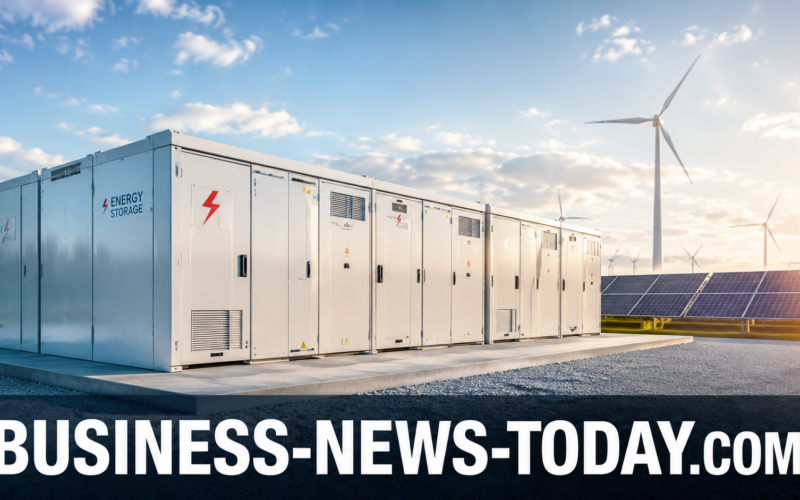
Fluence Energy, Inc. (NASDAQ: FLNC) has introduced Smartstack 10 MWh, expanding its grid-scale energy storage platform with a higher-density system designed to increase capacity without requiring a larger physical footprint. The new product joins the existing 7.5 MWh Smartstack configuration and is aimed at utilities, independent power producers and data centre developers facing land, power and deployment constraints. The launch matters because grid-scale storage is becoming more important as renewable energy growth, AI data centre demand and power-market volatility increase the value of flexible capacity. FLNC recently traded around $22.51, with intraday movement between $21.91 and $23.87, giving Fluence Energy, Inc. a market value of about $3.0 billion as investors evaluate whether energy storage demand can translate into stronger margins, more predictable revenue and better execution.
Why does Fluence Energy’s Smartstack 10 MWh launch matter for grid-scale storage economics?
Fluence Energy’s Smartstack 10 MWh launch matters because grid-scale storage economics increasingly depend on how much capacity developers can place on limited land. Battery projects are not only judged by megawatt-hours. They are judged by land use, interconnection availability, installation cost, fire safety, operational reliability and the ability to generate returns across multiple power-market services. A higher-density system can improve the business case if it allows developers to add more storage capacity without expanding the project footprint.
Smartstack 10 MWh is designed to increase capacity through an evolved pod design while maintaining the same broader platform architecture and deployment model. That is strategically important because customers often want higher energy density without having to redesign projects from scratch. A platform approach can reduce engineering complexity, shorten planning cycles and limit balance-of-plant disruption when newer battery components become available.
The new system achieves core site-level energy density of about 680 MWh per acre, which places it among the more density-competitive grid-scale storage options in the market. For energy developers, density can directly affect site return on investment. More storage capacity on the same land can improve project economics, particularly in urban-adjacent markets, congested grid areas, renewable hubs and data centre corridors where land and interconnection capacity are scarce.
For Fluence Energy, the launch strengthens its positioning as more than a hardware supplier. The company is trying to sell a configurable storage platform that combines battery systems, software, services and operational intelligence. That broader model matters because the storage market is becoming more competitive, and customers increasingly want systems that can deliver performance, safety and long-term economic value rather than only lower upfront pricing.
How could Smartstack 10 MWh help utilities and independent power producers manage land constraints?
Smartstack 10 MWh could help utilities and independent power producers manage land constraints by allowing more capacity to be installed within the same project area. This is especially important in markets where interconnection queues are long, land is expensive or siting approvals are difficult. Once a project has a viable site and grid connection, developers want to maximize the value of that location. Higher-density storage can make that possible.
The system’s ability to maintain the Smartstack deployment model gives customers a more practical path to capacity upgrades. Developers do not want every product evolution to require a complete redesign of electrical architecture, civil works, thermal management and operations planning. Fluence Energy is positioning Smartstack as a standardized platform that can absorb newer components while preserving familiar project execution. That can be valuable for repeat customers building portfolios across multiple markets.
Balance-of-plant costs are another key part of the value proposition. Fluence Energy says Smartstack 10 MWh can reduce balance-of-plant costs by up to 40% compared with standard DC blocks. In storage development, balance-of-plant costs can include electrical equipment, cabling, foundations, civil work and related infrastructure. Reducing those costs can make projects more competitive, especially when customers are under pressure to deliver storage at lower total installed cost.
The commercial appeal is strongest for customers that need to maximize capacity on constrained sites. Utilities may use storage to support grid reliability, renewable integration or peak demand management. Independent power producers may use it for arbitrage, capacity payments, ancillary services or hybrid renewable projects. In each case, site-level density can become a profit lever rather than a purely technical specification.
Why is high-density battery storage becoming more important for AI data centres?
High-density battery storage is becoming more important for AI data centres because power availability is now one of the biggest constraints on artificial intelligence infrastructure growth. AI workloads require large, reliable and increasingly continuous electricity supply. Data centre developers are searching for ways to secure power, manage peak demand, improve resilience and support grid interaction. Storage can play a larger role if it can deliver more capacity on limited land.
Fluence Energy’s Smartstack 10 MWh system is relevant to this trend because data centre developers often face tight site constraints. A large AI campus may need access to power, backup systems, cooling infrastructure, grid interconnection and physical security. Adding storage can help manage energy use and support resilience, but it must compete for space with other infrastructure. Higher energy density makes storage easier to justify in those environments.
The AI power story is not just about backup. Storage can help data centres participate in grid flexibility, reduce exposure to peak pricing, pair with renewable energy procurement and manage local capacity constraints. As AI infrastructure grows, utilities and regulators may also push data centre operators to contribute more actively to grid stability. Storage platforms that are safe, dense and software-enabled could become more attractive in that setting.
For Fluence Energy, AI data centre demand creates a new growth angle beyond renewable integration. The company already serves grid-scale storage and optimization markets, but data centres add another customer category with urgent power needs and strong capital spending. The challenge is converting that theme into signed projects, profitable deployments and durable service revenue. AI demand can support investor interest, but execution will decide whether it becomes a real earnings driver.
How does Fluence OS strengthen the Smartstack hardware strategy?
Fluence OS strengthens the Smartstack hardware strategy because grid-scale storage customers increasingly need integrated controls, monitoring and portfolio optimization. A battery system is not only a physical asset. It is a dispatchable energy resource that must respond to power prices, grid signals, reliability needs and contract requirements. Software can therefore influence revenue capture, uptime, risk management and long-term asset performance.
Smartstack and Fluence OS are engineered as a unified hardware-software platform. That integration gives Fluence Energy a way to differentiate from lower-cost hardware competitors by emphasizing system-level optimization and operational visibility. Customers managing large storage portfolios want to understand performance across projects, detect issues early and optimize assets for different market rules. A software layer can help turn storage from installed capacity into a managed revenue-generating fleet.
Availability is central to the business case. Fluence Energy has pointed to 99.3% availability across reviewed fleets of 50 MW and above based on an independent review. That kind of reliability metric matters because storage projects are often tied to contracts, market participation and grid obligations. If systems are unavailable during high-value periods, project economics can suffer. Reliability can therefore become a selling point, not just an engineering statistic.
The software strategy may also support recurring revenue. Hardware sales can be lumpy, especially in a project-based industry. Services, controls and asset optimization software can make revenue more durable if customers remain tied to the platform after installation. Fluence Energy’s long-term investment case depends partly on whether it can build a higher-quality revenue mix around software and services rather than relying only on storage system deliveries.
What does FLNC stock performance suggest about investor expectations for Fluence Energy?
FLNC stock performance suggests investors remain interested in Fluence Energy’s exposure to grid storage, but also cautious about profitability, project execution and margin visibility. The shares recently traded around $22.51, with intraday movement between $21.91 and $23.87. The company’s market value of about $3.0 billion shows that the market sees meaningful growth potential, but the negative earnings profile keeps the stock tied closely to execution risk.
The storage market is attractive because power grids need more flexibility. Renewable energy growth, electrification, AI data centre expansion and peak-demand pressure all support long-term battery storage demand. Fluence Energy is well positioned thematically because it operates across storage systems, services and software. However, investors have learned to separate strong end-market demand from company-specific financial performance. A growing market does not automatically create high-margin revenue.
Smartstack 10 MWh can help the stock narrative by showing that Fluence Energy is improving product density, standardization and customer economics. Product innovation matters in a competitive market where customers compare cost, safety, performance and vendor reliability. A stronger platform can support pricing power and repeat business if it delivers measurable benefits.
The stock still faces a credibility test. Investors will want to see whether higher-density systems improve gross margins, reduce deployment complexity and support larger customer commitments. Product launches are useful, but financial results will matter more. FLNC can gain attention from the AI power and grid storage themes, but it needs project execution and margin discipline to turn that attention into a stronger valuation.
Which safety and execution factors could shape Smartstack 10 MWh adoption?
Safety will be one of the most important adoption factors for Smartstack 10 MWh because grid-scale battery systems are under increasing scrutiny from customers, regulators, insurers and local communities. Higher-density systems can improve economics, but they must also demonstrate strong thermal risk management. Fluence Energy has completed Large-Scale Fire Testing for Smartstack 10 MWh, and the platform uses a compartmentalized design intended to limit thermal exposure and support containment.
This matters because energy storage projects can face permitting challenges if communities or authorities are concerned about fire risk, emergency response or site safety. Strong safety validation can help developers move projects through approval processes and reduce risk for utilities and financing partners. Safety is therefore not only a compliance issue. It can affect project timelines and bankability.
Execution will also shape adoption. Customers want systems that can be deployed efficiently across different markets, durations and grid requirements. Smartstack 10 MWh is commercially available for grid-scale applications worldwide and offers 2-, 4-, 6- and 8-hour storage durations. That flexibility can help Fluence Energy address different use cases, from short-duration grid support to longer renewable shifting and capacity applications.
Supply-chain flexibility remains another important factor. Battery chemistries, component availability and local content requirements can shift quickly. Fluence Energy is positioning Smartstack as a platform that allows customers to adopt newer higher-capacity components without resetting development cycles. That is valuable if it works as intended. The risk is that supply-chain disruptions, cost changes or technology transitions could still pressure project delivery.
What does Fluence Energy’s launch signal for the wider battery storage market?
Fluence Energy’s launch signals that the battery storage market is moving toward higher-density, standardized and software-enabled platforms. Earlier storage projects often focused heavily on proving basic viability. The next phase is more demanding. Developers now want higher energy density, stronger safety validation, faster deployment, lower balance-of-plant costs and better operational performance across portfolios.
This shift reflects a maturing market. Utilities, independent power producers and data centre developers are no longer asking whether battery storage has a role. They are asking which systems can deliver the best economics at scale. That moves competition toward total cost of ownership, availability, service quality and long-term flexibility. Fluence Energy’s Smartstack 10 MWh launch is designed to compete on those terms.
The broader industry is also being shaped by power demand from AI data centres. Storage cannot solve every power constraint, but it can become part of the toolkit for managing grid stress, renewable variability and site-level resilience. As data centre developers look for energy solutions, battery storage companies may find new demand beyond traditional utility procurement.
For competitors, the message is clear. Density, safety and software are becoming central battlegrounds. Companies that can offer modular platforms with strong economics and credible operating data may gain an advantage. Companies that rely only on low-cost hardware may face more pressure unless they can match performance and bankability. Fluence Energy is trying to move the market conversation toward platform value. The next test is whether customers and investors reward that strategy.
Key takeaways on what Smartstack 10 MWh means for Fluence Energy, FLNC stock and grid storage
- Fluence Energy has introduced Smartstack 10 MWh as the latest expansion of its grid-scale Smartstack energy storage platform.
- The new system joins the existing 7.5 MWh configuration and is designed to increase capacity without expanding the physical footprint.
- Smartstack 10 MWh achieves core site-level energy density of about 680 MWh per acre.
- The platform is aimed at utilities, independent power producers and data centre developers facing land, interconnection and deployment constraints.
- Fluence Energy says the system can reduce balance-of-plant costs by up to 40% compared with standard DC blocks.
- Smartstack 10 MWh has completed Large-Scale Fire Testing and uses a compartmentalized design for thermal containment and risk mitigation.
- The system is commercially available worldwide for 2-, 4-, 6- and 8-hour grid-scale storage applications.
- Fluence OS strengthens the hardware platform through controls, optimization and portfolio-level visibility.
- FLNC recently traded around $22.51, giving Fluence Energy a market value of about $3.0 billion.
- The main investor test is whether product innovation can improve margins, support larger deployments and convert strong storage demand into more durable financial performance.
Discover more from Business-News-Today.com
Subscribe to get the latest posts sent to your email.


