



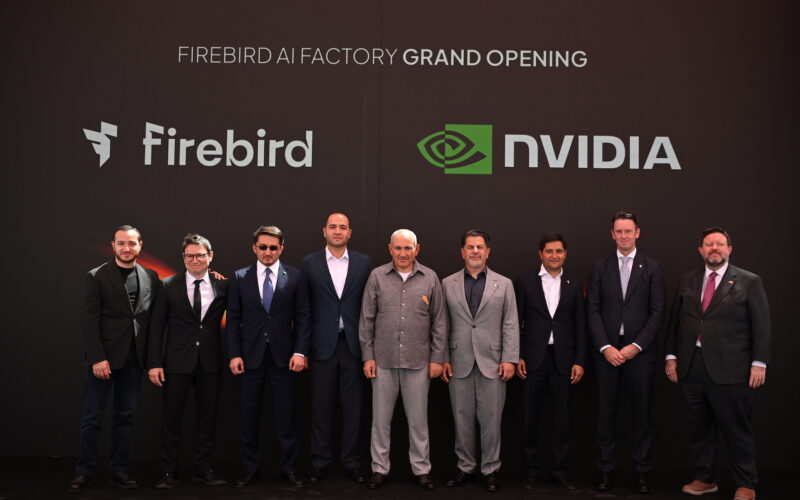
Firebird, Inc., the United States-based artificial intelligence cloud and infrastructure company, has officially opened its first AI factory in Hrazdan, Armenia, bringing 6,144 NVIDIA B200 graphics processing units and 15 megawatts of infrastructure into its operating platform. The launch moves Firebird beyond project announcements and into live infrastructure while setting up a far larger expansion intended to take Armenia beyond 70,000 NVIDIA Rubin and Blackwell GPUs and 300 MW by the end of 2027. NVIDIA has also said it intends to invest in Firebird, following an earlier investment by CoreWeave, while Perplexity has emerged as one of the platform’s first announced customers. The central question is therefore shifting from whether Firebird can build an AI factory to whether it can scale the model from 15 MW to hundreds of megawatts in Armenia and eventually around 2 GW globally while maintaining power availability, customer demand and deployment economics.
The opening on 8 August 2026 is particularly significant because the Hrazdan facility represents physical infrastructure that is already operating rather than another future capacity commitment. Firebird describes DC-1 as its flagship Armenian AI factory, with 6,144 NVIDIA B200 GPUs across 15 MW and a liquid-cooled architecture designed for large-scale artificial intelligence training and inference.
That starting point is small relative to Firebird’s ultimate ambition. The company is planning an Armenian buildout exceeding 70,000 NVIDIA GPUs and 300 MW by the end of 2027, while its broader international pipeline is targeted at approximately 2 GW by the end of 2028 across Armenia, Kazakhstan and additional markets under development.
The speed and scale create the investment story, but they also create the execution challenge. Firebird has demonstrated that it can put an initial AI computing cluster into operation quickly. Its next phase requires something substantially harder: securing huge amounts of power, deploying successive generations of NVIDIA hardware, financing capital-intensive infrastructure, attracting enough paying workloads to support utilisation and reproducing the Armenian deployment model in several jurisdictions.
How important is Firebird’s 6,144-GPU Armenia AI factory compared with the much larger expansion still planned?
The distinction between Firebird’s operating capacity and its announced future capacity is important. DC-1 currently represents 15 MW and 6,144 NVIDIA B200 GPUs, while the company’s longer-term Armenian roadmap points toward more than 70,000 GPUs and 300 MW.
That means the commercial significance of the August opening lies less in the absolute size of the first cluster than in the fact that Firebird has completed the transition from development to operation. Infrastructure businesses are ultimately judged on what gets energised, commissioned and sold rather than the maximum capacity shown in future plans.
Firebird said the Armenian facility moved from construction site to operational readiness in just over six months. NVIDIA also highlighted the deployment speed when announcing the opening, giving Firebird an important proof point as it approaches governments and infrastructure partners in additional markets.
Firebird is using NVIDIA’s DSX AI Factory reference architecture, with NVIDIA Spectrum-X Ethernet networking and infrastructure supplied through partners including Dell Technologies, Schneider Electric and Vertiv. Firebird says the DSX design can support up to 40% more GPUs within the same physical footprint by integrating compute, networking, power and cooling more efficiently.
For Firebird, improving compute density has direct economic relevance. AI infrastructure increasingly competes not merely on the number of installed GPUs but on how effectively operators convert scarce electricity, cooling capacity and data-centre space into usable computing output.
The more GPUs Firebird can operate productively within a given megawatt and building footprint, the better its potential infrastructure economics. However, theoretical density gains still need to translate into sustained customer utilisation and reliable operating performance.

Why do NVIDIA, CoreWeave and Perplexity matter more than the headline GPU count for Firebird?
Perhaps the strongest commercial element in Firebird’s announcement is the ecosystem forming around the infrastructure.
NVIDIA intends to invest in Firebird, although the value and detailed terms of the proposed investment were not disclosed. Firebird also said CoreWeave invested in the company earlier in 2026. Those relationships are strategically important because both companies understand the economics and operational demands of deploying high-density artificial intelligence infrastructure at scale.
NVIDIA’s role goes considerably beyond supplying processors. Firebird’s infrastructure is based around NVIDIA architectures, while the chipmaker is publicly supporting the company’s expansion into Armenia, Kazakhstan and other markets. That gives Firebird valuable technological alignment as GPU architectures evolve from Blackwell toward Rubin.
The planned NVIDIA investment should nevertheless be treated precisely. Firebird announced an intention by NVIDIA to invest rather than disclosing a completed investment with published valuation, ownership percentage or transaction size. The financing significance therefore cannot yet be quantified.
Perplexity provides a different kind of validation. Firebird identified the artificial intelligence company as one of its first customers, with Perplexity expected to use the infrastructure for its answer engine and AI-powered agent platform.
That matters because capacity without workloads creates a very different economic profile from capacity contracted by sophisticated artificial intelligence customers. Perplexity does not by itself establish the utilisation profile of the wider project, and Firebird has not disclosed contract value or committed capacity, but the relationship demonstrates that the Armenian infrastructure is being positioned for international AI-native workloads rather than only domestic computing requirements.
Customer diversification will become increasingly important as Firebird expands. A 15 MW facility can operate with a relatively concentrated customer base. Hundreds of megawatts require much deeper demand across model developers, enterprises, research organisations, governments and inference providers.
Can Firebird realistically scale Armenia from 15 MW to more than 300 MW of artificial intelligence infrastructure?
Power may become the most important constraint in the next stage.
Scaling from 15 MW to 300 MW represents a twentyfold increase in planned Armenian infrastructure capacity. That expansion needs more than GPUs. It requires grid access, substations, cooling systems, networking, land, construction capacity, equipment supply and sufficient redundancy to support demanding workloads continuously.
Firebird has already outlined additional infrastructure beyond DC-1. Its current platform describes a Phase 2 Armenian expansion based around 75,000 NVIDIA VR200 GPUs across 125 MW, while another planned site is also described as having capacity for 75,000 VR200 GPUs across 125 MW.
The precise configuration is likely to evolve as technology generations, delivery schedules and power availability change. That is common in fast-moving artificial intelligence infrastructure projects, particularly when computing architectures are advancing faster than traditional data-centre development cycles.
The larger strategic point is that Firebird is trying to establish a repeatable infrastructure platform rather than a single Armenian data centre. Its architecture combines bare-metal GPU access, cloud capacity, networking, storage, orchestration and managed inference services. That creates the possibility of monetising infrastructure across different customer requirements rather than depending entirely on long-duration dedicated GPU leases.
Execution will determine whether that flexibility becomes an advantage. High-density artificial intelligence facilities absorb capital rapidly, and new GPU generations can alter customer preferences before older infrastructure has fully matured economically. Fast deployment therefore matters, but matching deployment timing with contracted demand matters even more.
Why has Armenia become the starting point for Firebird’s attempt to build a global AI infrastructure network?
Armenia sits at the intersection of several factors supporting Firebird’s initial strategy: government backing, access to advanced United States technology under export approvals, an established engineering community and a national ambition to build domestic artificial intelligence capability.
The Armenian government has publicly described itself as a strategic partner supporting the formation of advanced AI infrastructure. The United States export-control dimension is equally important because Firebird’s ability to procure advanced NVIDIA processors depends on regulatory authorisation for the destination and hardware involved.
In February 2026, Firebird announced that Phase 2 of the Armenian programme had secured United States export licensing and regulatory approvals covering an additional 41,000 NVIDIA GB300 GPUs. At that stage, the company described the expanded programme as a $4 billion project targeting approximately 50,000 GPUs.
The roadmap has since moved further. Firebird is now targeting more than 70,000 Rubin and Blackwell GPUs and 300 MW in Armenia by the end of 2027.
This progression illustrates both the opportunity and the complexity. Sovereign artificial intelligence has become a strategic priority for governments that do not want domestic companies, universities and public institutions to depend entirely on overseas computing infrastructure. Firebird is effectively attempting to turn that policy demand into a commercial infrastructure model.
Armenia therefore functions as more than Firebird’s first site. It is the company’s reference deployment. If the business can demonstrate reliable operations, competitive economics and international customer demand there, it has a stronger template for entering other markets seeking domestic AI capacity.
How does Kazakhstan fit into Firebird’s plan to build roughly 2 GW of global AI capacity by 2028?
Kazakhstan is already becoming the first major test of whether the Armenian model can travel.
Firebird says it has secured 125 MW of artificial intelligence infrastructure capacity at Kazakhstan’s planned Data Center Valley, along with relevant government approvals and export authorisation from the United States Department of Commerce’s Bureau of Industry and Security.
The Kazakhstan government has separately outlined a much larger artificial intelligence infrastructure programme centred on Data Center Valley in Ekibastuz. In June, Kazakhstan announced agreements involving Firebird and NVIDIA valued collectively at about $10 billion, with plans that include data centres and a computing cluster using next-generation GPUs.
Firebird’s participation gives the company exposure to another country seeking to convert energy availability into artificial intelligence infrastructure and digital-service exports.
That strategy could become increasingly important. AI factories require enormous quantities of electricity, making geography a meaningful competitive variable. Regions capable of combining available power, government support, regulatory compatibility, connectivity and reasonable construction economics could attract infrastructure that historically concentrated around established hyperscale data-centre markets.
Firebird appears to be targeting precisely those markets.
Its approximately 2 GW target by the end of 2028 would place the company into an entirely different operating category from the current Hrazdan facility. Achieving that goal would require multiple large developments progressing simultaneously rather than sequentially.
The gap between today’s 15 MW operating base and the stated 2 GW ambition is therefore the clearest measure of both Firebird’s opportunity and its risk.
What would prove that Firebird’s AI factory strategy is becoming a scalable infrastructure business?
The August opening resolves one of the most important early questions because Firebird now has an operating artificial intelligence factory rather than only an announced development pipeline.
The next evidence needs to become increasingly commercial.
Further customer announcements would demonstrate whether Firebird can attract international workloads beyond Perplexity. Capacity commitments or other disclosures giving greater visibility into utilisation would help establish whether deployment is being matched by demand.
Progress on the next Armenian phases will provide another measurable test. Moving from 15 MW toward 300 MW requires much larger power and infrastructure commitments, while the introduction of Rubin-generation systems will test Firebird’s ability to manage rapid hardware transitions.
Kazakhstan provides the international test. If Firebird advances its 125 MW capacity there while Armenia continues scaling, management will have demonstrated that the company’s development model can function in more than one regulatory and operating environment.
Funding also deserves attention. Firebird is privately held and does not publish the type of financial statements available from listed infrastructure companies. NVIDIA’s intended investment and CoreWeave’s earlier investment improve strategic credibility, but Firebird has not disclosed enough financial detail to assess how much of the multi-gigawatt pipeline is fully funded.
The distinction matters because a 2 GW artificial intelligence infrastructure network represents an enormous capital commitment even before accounting for continuing upgrades in processors, networking and cooling systems.
Firebird’s first factory therefore changes the quality of the story. The company has demonstrated that it can take a highly ambitious Armenian AI infrastructure proposal and turn its first phase into operating compute in a short period.
The next stage is less forgiving. Moving from 6,144 GPUs and 15 MW to more than 70,000 GPUs and 300 MW in Armenia, while simultaneously entering Kazakhstan and developing further markets, will require power, capital, hardware and customers to arrive in unusually close coordination.
If Firebird can achieve that coordination, Armenia could become the first node of a significant new AI infrastructure network focused on markets outside the industry’s traditional data-centre centres. If deployment moves faster than power availability or commercial utilisation, the scale of the expansion itself could become the constraint.
For now, the most important proof point is tangible: the first Firebird AI factory is operating. The next one will be whether the company can convert that successful 15 MW launch into the first meaningful portion of the 300 MW Armenian platform it says will be in place by the end of 2027.
What are the key takeaways from Firebird’s Armenia AI factory and global expansion strategy?
- Firebird has opened its first operational AI factory in Hrazdan, Armenia, with 6,144 NVIDIA B200 GPUs across 15 MW of infrastructure.
- The company is targeting more than 70,000 NVIDIA Rubin and Blackwell GPUs and 300 MW of Armenian AI infrastructure by the end of 2027.
- Firebird’s longer-term target is approximately 2 GW of infrastructure across Armenia, Kazakhstan and additional markets by the end of 2028.
- NVIDIA intends to invest in Firebird, following an earlier investment by CoreWeave, although the size and terms of the investments have not been publicly disclosed.
- Perplexity has been announced as an early customer, giving Firebird an important initial signal of international commercial demand for the Armenian facility.
- Firebird’s AI factory uses NVIDIA DSX architecture and infrastructure from partners including Dell Technologies, Schneider Electric and Vertiv.
- United States export approvals remain strategically important because Firebird’s international expansion depends on access to advanced NVIDIA computing hardware.
- Kazakhstan is Firebird’s second announced market, where the company says it has secured 125 MW of capacity at the Data Center Valley development.
- The largest execution challenge is the enormous gap between Firebird’s current 15 MW operating base and its planned hundreds of megawatts in Armenia and roughly 2 GW globally.
- Customer utilisation, power availability, funding and completion of the next Armenian expansion phases will provide the clearest evidence of whether Firebird can turn a fast first deployment into a scalable global infrastructure business.
Discover more from Business-News-Today.com
Subscribe to get the latest posts sent to your email.