


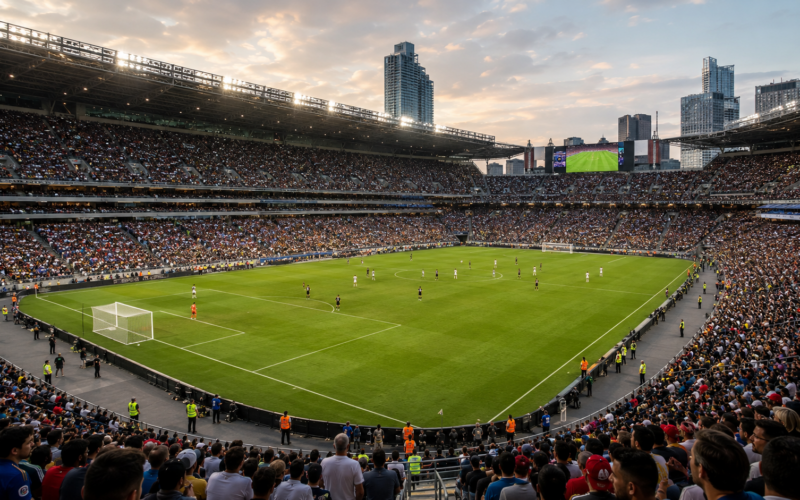
Nikola Vlašić headed an 83rd-minute winner as Croatia defeated Ghana 2-1 in their final FIFA World Cup 2026 Group L match at Philadelphia Stadium on Saturday, June 27, 2026. The victory secured second place for Croatia and extended their run of reaching the knockout stage at four consecutive World Cups.
Petar Sučić opened the scoring in the 31st minute with a controlled long-range finish after receiving possession from Mateo Kovačić. Ghana produced a stronger second half and equalised through Derrick Luckassen in the 73rd minute following Ernest Nuamah’s free-kick.
Luckassen’s goal was initially flagged for offside, leading to a lengthy VAR review. Referee Drew Fischer ruled that the Ghana defender had started from an onside position and that Kwasi Sibo, who was offside, had not interfered with play.
Croatia regained the lead ten minutes later when Luka Modrić delivered a corner towards the back post and Vlašić directed his header down and inside the post. England won Group L with seven points, Croatia finished second with six and Ghana progressed from third place with four.
FIFA World Cup 2026 Croatia 2-1 Ghana full match scorecard and key incidents
Why did Ghana’s cautious first-half approach allow Croatia to control the match?
Ghana had already secured a place among the eight best third-placed teams before kick-off. A draw would also have kept the Black Stars above Croatia and delivered second place, encouraging Carlos Queiroz to begin with a conservative structure.
Thomas Partey operated in front of the defensive line, while Elisha Owusu and Kwasi Sibo remained close enough to protect the central spaces. Jordan Ayew and Kamaldeen Sulemana rarely advanced together, leaving Semenyo isolated whenever Ghana recovered possession.
Croatia were allowed to circulate the ball through Modrić, Kovačić and the centre-backs without facing aggressive pressure. Ghana prevented a large number of clear chances, but their passivity allowed Croatia to determine where and when the match was played.
The Black Stars did not register a first-half shot until Semenyo moved inside and fired narrowly wide in the 40th minute. By then, Croatia had already converted the territorial advantage into the opening goal.
How did Petar Sučić punish Ghana for defending too far from the ball?
The opening goal developed from a patient Croatian possession sequence rather than a rapid counterattack. Kovačić received centrally and passed towards Sučić outside the penalty area.
Ghana’s midfield did not close the Inter midfielder quickly enough. Sučić was given time to position the ball, assess the bottom corner and strike accurately with his right foot.
The shot travelled beyond Asare and into the bottom-left corner. It was Sučić’s only attempt of the match, but its quality justified Croatia’s first-half superiority.
Sučić also contributed to Croatia’s midfield control by moving between Ghana’s wide midfielder and central line. His positioning gave Stanišić and Baturina additional passing options and prevented Ghana from concentrating entirely on Modrić.
Why did Ghana look like a different team after two half-time substitutions?
Queiroz reacted by introducing Fatawu for Owusu and Oppong for Jonas Adjetey at half-time. The changes moved Ghana towards a more proactive shape and increased the speed available on the right.
Fatawu immediately attacked Ivan Perišić and reached the byline several times. One low cross travelled narrowly beyond Semenyo, while another Ghana attack forced Modrić to make a defensive intervention inside his own penalty area.
The Black Stars also began pressing Croatia’s first pass rather than waiting near the halfway line. Croatia consequently found it more difficult to progress through Kovačić and spent longer periods defending.
The improved approach raised questions about why Ghana had played with so little ambition before half-time. Their second-half performance showed that they possessed enough pace and physicality to unsettle Croatia.
Why did Derrick Luckassen’s equaliser require such a long VAR review?
Ghana won a free-kick on the left in the 73rd minute, and substitute Nuamah delivered an inswinging ball beyond Croatia’s defensive line. Luckassen arrived at the back post and directed a left-footed finish across Livaković.
The assistant referee raised the flag because several Ghana players had moved beyond the defensive line. Luckassen himself had timed his run correctly, but Sibo was standing in an offside position near the central area.
VAR asked Fischer to examine whether Sibo had challenged for the ball, obstructed a defender or affected Livaković’s ability to react. The referee decided that he had not interfered and awarded the goal.
The decision briefly moved Ghana back into second place and left Croatia third. It also gave Luckassen a goal on his international debut after he had been selected partly because Queiroz rested players carrying yellow cards.
How did Mario Pašalić and Luka Modrić create Croatia’s decisive response?
Croatia did not react to the equaliser by retreating and protecting third place. Zlatko Dalić introduced Mario Pašalić for Kovačić, adding another player capable of reaching the edge of Ghana’s penalty area.
Pašalić produced Croatia’s best chance of the second half in the 82nd minute. His powerful effort forced Asare to dive and push the ball behind for a corner.
Modrić delivered the resulting set-piece beyond the penalty spot towards the back-post area. Vlašić escaped his marker and used the side of his head to direct the ball down, across the goalkeeper and inside the post.
The move demonstrated how substitutions and set-piece quality changed the outcome. Pašalić created the corner, Modrić supplied the delivery and Vlašić completed the decisive action.
What did Luka Modrić’s performance show at 40 years of age?
Modrić completed his first full match of the tournament and controlled Croatia’s passing through both defensive and attacking phases. His influence became especially important when Ghana pressed higher after half-time.
The captain repeatedly moved behind the first Ghanaian pressure and used early passes to change the direction of play. He also made important defensive interventions when Fatawu and Semenyo attempted to combine.
His corner for Vlašić made him the oldest player to record an assist at a men’s FIFA World Cup. The record added another milestone to a tournament career that began in 2006.
Dalić protected several experienced players during the group stage, but Modrić’s 90-minute performance showed he can still manage an entire high-pressure match. Croatia will nevertheless need to balance his minutes carefully during the knockout phase.
Why did Antoine Semenyo’s late injury create concern despite Ghana’s qualification?
Semenyo carried most of Ghana’s attacking responsibility during the first half and remained their principal transition threat after the interval. His strength allowed Ghana to retain direct passes even when supporting players were positioned deep.
The forward went down during the closing minutes and required treatment for an apparent ankle problem. Although he returned and completed the match, his discomfort was visible.
Ghana’s Round of 32 prospects depend heavily on Semenyo’s ability to lead the line. Ayew, Nuamah, Fatawu and Thomas-Asante provide alternatives, but none offers exactly the same combination of power, speed and direct shooting.
The medical assessment will therefore be one of the most important developments before Ghana face the Group K winners.
How did England’s result complete the final Group L qualification order?
England defeated Panama 2-0 in the simultaneous match and finished first with seven points. Bellingham and Kane scored during the second half after Panama had kept the match goalless at the interval.
Croatia’s victory lifted them to six points and second place. Their goal difference remained neutral after scoring five and conceding five across three matches.
Ghana finished third with four points and also had a neutral goal difference. Four points were sufficient to guarantee progression through the ranking of third-placed teams.
Panama finished last without a point or a goal. Croatia’s victory also removed Scotland from contention for one of the remaining best-third-place positions.
FIFA World Cup 2026 Group L final points table
What awaits Croatia and Ghana in their FIFA World Cup 2026 knockout matches?
Croatia will face the team finishing second in Group K in Toronto on July 2. Ghana will meet the Group K winners in Kansas City on July 3.
Colombia, Portugal, DR Congo and Uzbekistan were still completing the final Group K fixtures when Croatia and Ghana’s knockout positions were established. The exact opponents therefore remained unconfirmed at the time of publication.
Croatia’s midfield control and set-piece quality could be decisive in the Round of 32, but the second-half pressure created by Ghana showed that Dalić’s team remains vulnerable when opponents increase the speed of wide attacks.
Ghana will enter their knockout match with confidence from qualifying for the first time since 2010. Queiroz must nevertheless decide whether the cautious approach used in the first half against Croatia can succeed against a Group K winner possessing greater attacking quality.
Key takeaways from Croatia vs Ghana at FIFA World Cup 2026
- Croatia defeated Ghana 2-1 and finished second in FIFA World Cup 2026 Group L.
- Petar Sučić opened the scoring in the 31st minute from Mateo Kovačić’s pass.
- Ghana failed to register a first-half shot until Antoine Semenyo’s effort in the 40th minute.
- Abdul Fatawu and Kojo Peprah Oppong helped Ghana increase their attacking intensity after half-time.
- Derrick Luckassen equalised from Ernest Nuamah’s free-kick in the 73rd minute.
- VAR confirmed that Luckassen was onside and that Kwasi Sibo had not interfered with play.
- Mario Pašalić forced a save that produced Croatia’s decisive corner in the 82nd minute.
- Nikola Vlašić headed the winner from Luka Modrić’s delivery one minute later.
- Modrić became the oldest player to record an assist at a men’s FIFA World Cup.
- Croatia and Ghana both advanced, while England won Group L and Panama were eliminated.
Discover more from Business-News-Today.com
Subscribe to get the latest posts sent to your email.