



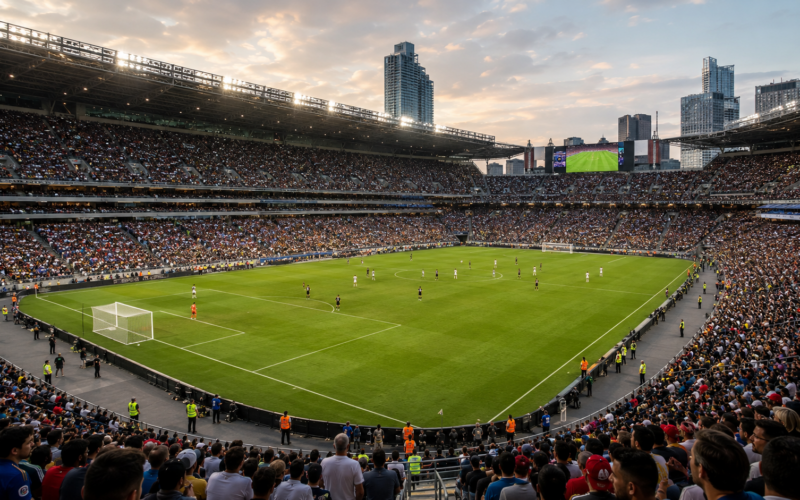
Portugal were held to a 1-1 draw by DR Congo at Houston Stadium on June 17, 2026, as Yoane Wissa’s first-half stoppage-time header delivered the African nation’s first goal and first point in men’s World Cup history. João Neves had given Portugal a sixth-minute lead from Pedro Neto’s cross, but Roberto Martínez’s side failed to build on its dominant start and ended the FIFA World Cup 2026 Group K opener with only one shot on target.
The result marked a remarkable return to the tournament for DR Congo after 52 years away. Sébastien Desabre’s side recovered from early nerves, defended with discipline and grew increasingly dangerous on the counterattack, with Cédric Bakambu later hitting the post as Portugal struggled to regain control.
Cristiano Ronaldo became the oldest player to start a men’s World Cup match and appeared at a record-equalling sixth tournament, but the 41-year-old endured a quiet afternoon. He missed two second-half chances as Portugal’s attacking rhythm slowed, leaving one of the pre-tournament favourites under immediate pressure before facing Uzbekistan and Colombia.
How did Portugal lose control after João Neves delivered the perfect early start?
Portugal appeared ready for a comfortable opening victory when Neves scored after only six minutes. Neto attacked the left side and delivered a precise cross, allowing Neves to rise in front of Axel Tuanzebe and direct a header beyond Lionel Mpasi from around 15 metres.
The early goal should have given Portugal the freedom to control the tempo and force DR Congo to abandon their compact shape. Instead, Martínez’s side became increasingly predictable. Portugal circulated the ball across midfield but did not move it quickly enough to disturb the Congolese defensive block.
Vitinha, Bruno Fernandes and Bernardo Silva were frequently involved in possession, yet the passing often remained in safe areas. Portugal had control without penetration, allowing DR Congo to settle after an initially nervous opening.
The most revealing statistic was that Neves’ goal remained Portugal’s only shot on target. For a team carrying Ronaldo, Fernandes, Neto, Silva and a deep group of attacking substitutes, that lack of clear chances was a major failure.
Portugal also lost urgency after going ahead. Rather than pursuing the second goal, they allowed the match to develop at a pace that suited DR Congo. Desabre’s side became more confident with every defensive clearance and increasingly willing to attack the spaces Portugal left behind.
Martínez acknowledged after the match that Portugal had stopped showing the intention required to score again. The problem was not simply poor finishing. Portugal did not create enough situations from which a second goal looked likely.
Why was Yoane Wissa’s equaliser a defining moment in DR Congo’s World Cup history?
Wissa’s equaliser arrived in the fifth minute of first-half stoppage time and instantly became one of the most important goals in Congolese football history.
DR Congo had previously appeared at the World Cup in 1974 under the name Zaire. That campaign ended with three defeats, no points and no goals. Wissa’s header therefore ended a 52-year wait while delivering both the country’s first World Cup goal and the foundation for its first point.
The move reflected DR Congo’s growing confidence. Samuel Moutoussamy forced Portugal to defend successive corners, and the second was played short to Arthur Masuaku. The left-back produced an inswinging cross, and Wissa escaped his marker before powering a header beyond Diogo Costa.
The timing made the goal even more damaging for Portugal. Martínez’s team had expected to enter half-time with a narrow but manageable lead. Instead, the equaliser changed the emotional balance and sent DR Congo into the interval believing they could earn much more than a respectable defeat.
Wissa’s contribution extended beyond the goal. He worked tirelessly without the ball, helped protect wide areas and remained available for counterattacks whenever Portugal committed players forward.
For DR Congo, the goal was not merely symbolic. It was the reward for a tactical plan that improved as the first half progressed. The team survived Portugal’s early pressure, stayed organised and eventually punished the favourites when their intensity dropped.
What did Cristiano Ronaldo’s quiet display reveal about Portugal’s attacking problem?
Ronaldo’s appearance carried historic weight. At 41, he became the oldest player to start a men’s World Cup match and joined Lionel Messi in appearing at six editions of the tournament.
The sporting impact was far more limited. Ronaldo struggled to find space against Chancel Mbemba, Tuanzebe and the wider DR Congo defensive structure. He recorded only 25 touches, the fewest among Portugal players who spent more than 45 minutes on the pitch.
Two second-half chances offered Ronaldo an opportunity to win the match. Francisco Conceição delivered dangerous balls from the right, but Ronaldo sent both efforts wide from close range. Neither chance was straightforward, yet an earlier version of Ronaldo may have adjusted more sharply.
The wider problem was that Portugal’s attacking system became too focused on supplying him from crossing positions. DR Congo understood the pattern and crowded the central area, forcing Ronaldo to receive under pressure or wait for deliveries that never arrived cleanly.
Martínez kept Ronaldo on while substituting Vitinha and introducing Gonçalo Ramos late in the match. That decision increased debate over whether Portugal’s commitment to their captain limits the flexibility of an otherwise talented attacking squad.
Ronaldo remains the leading goalscorer in men’s international football and possesses unmatched tournament experience. However, Portugal must determine whether that experience is best used from the start, from the bench or within a system less dependent on building every final-third move around him.
The draw does not make Ronaldo solely responsible. Portugal’s midfielders and wide players also failed to create enough. But his quiet performance sharpened a question that will follow the team throughout FIFA World Cup 2026: can Portugal pursue a first world title while adapting their attack around a 41-year-old centre-forward?
How did Sébastien Desabre’s tactical plan neutralise Portugal’s creative players?
Desabre organised DR Congo to protect central spaces, stay narrow without the ball and counter through Wissa and Bakambu. The plan required patience because Portugal scored before the Congolese structure had fully settled.
Rather than abandon the approach, DR Congo continued to defend compactly. Mbemba led the back line, Aaron Wan-Bissaka protected the right side and Moutoussamy covered large areas in midfield.
The defensive shape forced Portugal to move the ball sideways. Fernandes and Vitinha rarely found the space required to play through the lines, while Bernardo Silva struggled to accelerate the attack before being replaced at half-time.
Wan-Bissaka produced one of the match’s most important defensive interventions when Nuno Mendes threatened to burst into the penalty area. That type of recovery defending prevented Portugal from generating the cutbacks that might have exposed DR Congo’s central defenders.
The African side also carried a genuine counterattacking threat. Bakambu forced Costa into a save and later struck the post, coming close to converting the draw into an even larger upset.
Desabre’s team therefore did more than defend. They made Portugal anxious. Once the match reached the second half at 1-1, the favourites began playing with the fear of losing rather than the confidence required to win.
That psychological shift was one of DR Congo’s greatest achievements. A side returning after 52 years turned Portugal’s early certainty into visible frustration and ended the match looking fully deserving of its point.
Why was DR Congo’s performance more significant than a conventional opening-round upset?
DR Congo’s preparation had been disrupted before the tournament, including a period spent in Belgium because of an Ebola outbreak at home. That reduced the travelling support and created logistical complications during an already demanding build-up.
The team nevertheless arrived with considerable experience. Mbemba, Wan-Bissaka, Wissa, Bakambu, Masuaku and Moutoussamy have played at high levels in European football, giving Desabre a group capable of understanding complex defensive assignments.
Their performance showed that the expanded FIFA World Cup 2026 field is not simply producing ceremonial appearances. DR Congo did not earn its point through luck alone. The team defended intelligently, created dangerous counterattacks and came closer than Portugal to scoring the decisive second-half goal.
The historical context also matters. The country’s only previous appearance, under the Zaire name, became associated with heavy defeat and controversy. This generation immediately created a different World Cup identity.
Wissa’s goal and the first point provide an emotional milestone, but Desabre made clear that DR Congo do not intend to treat the draw as the peak of their campaign. Their next matches against Colombia and Uzbekistan will determine whether this historic night becomes the beginning of a knockout challenge.
What does the draw mean for the FIFA World Cup 2026 Group K qualification race?
Portugal and DR Congo both begin Group K with one point. Uzbekistan and Colombia were still awaiting their opening match when this result was completed, making the table provisional.
| Team | Played | Won | Drawn | Lost | Goal difference | Points |
|---|---|---|---|---|---|---|
| Portugal | 1 | 0 | 1 | 0 | 0 | 1 |
| DR Congo | 1 | 0 | 1 | 0 | 0 | 1 |
| Colombia | 0 | 0 | 0 | 0 | 0 | 0 |
| Uzbekistan | 0 | 0 | 0 | 0 | 0 | 0 |
Portugal next face Uzbekistan in Houston on June 23. The match now carries more pressure because another draw would leave Martínez’s side vulnerable before their final group game against Colombia.
DR Congo next meet Colombia in Guadalajara. The opening point gives Desabre’s team tactical flexibility. They do not need to chase recklessly, and they have already demonstrated that their defensive structure can frustrate technically superior opponents.
The expanded tournament format offers possible qualification routes to some third-placed teams, but Portugal will not want to depend on that safety net. A team viewed as a potential champion should be competing to win the group rather than calculating third-place rankings.
For DR Congo, the situation is different. One point against Portugal is an excellent foundation. Another result against Colombia would turn their historic return into a serious qualification campaign.
Why does Portugal’s FIFA World Cup 2026 draw matter beyond the Group K table?
The result matters because Portugal entered the tournament with one of its deepest squads and genuine expectations of challenging for the title. Drawing with DR Congo does not end that ambition, but the performance exposed problems that stronger opponents could punish.
Portugal had possession without speed, famous attackers without enough chances and an experienced captain who struggled to influence the match. Martínez must find a better balance between respecting Ronaldo’s record and using the younger attacking options around him.
DR Congo leave Houston with the opposite emotional experience. Their players transformed an early setback into a national milestone and showed that organisation, resilience and Premier League-level experience can close the gap against a tournament favourite.
The editorial view is that Portugal should be more concerned by the performance than the result. A draw can be recovered. A predictable attacking system and visible fear after conceding are more serious issues.
DR Congo, meanwhile, should celebrate without becoming satisfied. Their first point and first goal are historic, but the greater opportunity is still ahead. If Desabre’s team maintain this level against Colombia and Uzbekistan, their World Cup return may extend well beyond the group stage.
Key takeaways from Portugal vs DR Congo at FIFA World Cup 2026
- Portugal and DR Congo drew 1-1 at Houston Stadium on June 17, 2026, in their FIFA World Cup 2026 Group K opener.
- João Neves headed Portugal ahead in the sixth minute from Pedro Neto’s cross, but the favourites failed to build on the early goal.
- Yoane Wissa equalised in first-half stoppage time, scoring DR Congo’s first goal in World Cup history and helping secure the country’s first tournament point.
- Portugal dominated possession but finished with only one shot on target, exposing a serious lack of final-third urgency and creativity.
- Cristiano Ronaldo became the oldest player to start a men’s World Cup match and appeared at his sixth tournament, but he missed two second-half chances and had limited influence.
- Cédric Bakambu hit the post after half-time as DR Congo came close to completing a major upset.
- Portugal next face Uzbekistan under increased pressure, while DR Congo meet Colombia with genuine belief that they can compete for qualification.
Discover more from Business-News-Today.com
Subscribe to get the latest posts sent to your email.