





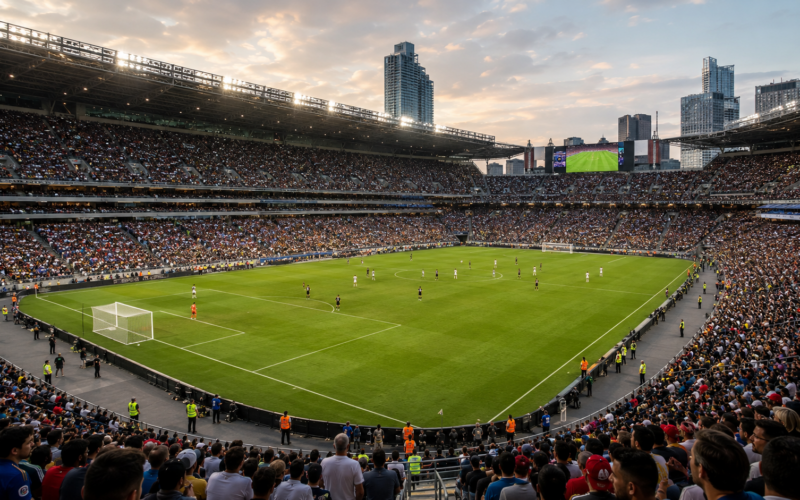
Austria beat Jordan 3-1 at San Francisco Bay Area Stadium in Santa Clara on June 16, 2026 local time, June 17 in India, as Marko Arnautovic came off the bench to transform a difficult FIFA World Cup 2026 Group J opener. Romano Schmid gave Austria the lead with a spectacular first-half strike, Ali Olwan scored Jordan’s first-ever World Cup goal shortly after the interval, and Austria eventually regained control through a Yazan Al-Arab own goal and Arnautovic’s penalty in the 12th minute of stoppage time.
The victory marked Austria’s return to the World Cup after a 28-year absence and delivered their first win at the tournament since 1990. However, the 3-1 scoreline disguised how seriously Jordan tested Ralf Rangnick’s side during an end-to-end contest in which the tournament debutants repeatedly threatened through Olwan and Mousa Al-Tamari.
Austria move to three points and second place in Group J behind Argentina, whose 3-0 victory over Algeria gave the defending champions a slightly better goal difference. Jordan remain without a point but leave their first World Cup match with evidence that they can still compete for qualification, particularly ahead of a crucial second fixture against Algeria.
How did Marko Arnautovic change Austria’s difficult FIFA World Cup 2026 opener?
Arnautovic changed the balance of the match after being introduced at half-time. Austria had gone into the interval leading 1-0, but the score did not reflect the discomfort Rangnick’s side had experienced against Jordan’s pace, counterattacking movement and willingness to commit players forward.
The veteran forward immediately gave Austria a more physical and direct focal point. His movement forced Jordan’s central defenders to protect deeper spaces and created more room for Marcel Sabitzer, Konrad Laimer and Austria’s attacking midfielders to operate around the penalty area.
Arnautovic thought he had restored Austria’s lead in the 68th minute when he converted from close range after a crowded penalty-area sequence. VAR intervened, however, and the goal was disallowed because the ball had struck Stefan Posch’s hand during the buildup.
The cancelled goal could have increased Austria’s frustration, but Arnautovic continued to influence the match. His positioning contributed to the pressure that led to Al-Arab diverting an Austrian corner into his own net in the 77th minute.
Arnautovic then sealed the victory deep into an unusually long period of stoppage time. A VAR review identified a handball after an Austrian shot struck Saleem Obaid’s raised arm, and Arnautovic converted the resulting penalty into the top corner.
The penalty made the result look more comfortable than the match had been, but it also demonstrated why Rangnick retained faith in the 37-year-old forward. Austria needed experience, physical presence and composure during the most difficult phase of the contest. Arnautovic supplied all three.
Why was Ali Olwan’s equaliser one of Jordan’s most important football moments?
Olwan’s 50th-minute equaliser gave Jordan their first goal in men’s World Cup history. It also briefly placed the tournament debutants in a position where they could realistically imagine earning a point or even defeating Austria.
The goal came from an assertive individual move. Olwan accelerated down the left, drove into a shooting position and fired across Alexander Schlager, with the ball striking the far post before entering the net. The finish reflected Jordan’s attacking confidence and their refusal to approach the match merely as a ceremonial first appearance.
Jordan had already created opportunities before the equaliser. Captain Ehsan Haddad threatened inside the opening minutes, while Olwan, Al-Tamari and Odeh Al-Fakhouri repeatedly looked to exploit spaces behind Austria’s defensive line.
Their performance was particularly impressive because Austria entered the match with significantly greater World Cup experience and a squad containing established European-level players. Jordan nevertheless generated more shots and more attempts on target, repeatedly forcing Austria to defend transition situations.
Olwan’s goal therefore represented more than a historic statistic. It confirmed that Jordan’s counterattacking plan could work against strong opposition. It also gave the team an attacking foundation ahead of their decisive meeting with Algeria.
The disappointment is that Jordan could not protect the momentum. Austria gradually pushed them deeper after Arnautovic’s introduction, and Al-Arab’s own goal turned the match before Jordan could find another decisive break.
How did Romano Schmid give Austria control with one of the tournament’s best early goals?
Schmid opened the scoring with a powerful strike from outside the penalty area in the 21st minute. The midfielder found space after Austria worked possession through the centre and sent the ball into the top corner beyond Yazeed Abulaila.
It was a goal that Austria needed because their early performance had been vulnerable rather than dominant. Jordan were attacking quickly and had already demonstrated that they could create danger when Austria lost possession.
Schmid’s finish temporarily changed the rhythm. Austria began circulating the ball more confidently, Sabitzer became increasingly influential between midfield and attack, and Jordan were forced to take greater risks when breaking forward.
The goal also strengthened Austria’s threat from midfield. Rangnick’s side cannot depend solely on Arnautovic or another central striker to produce their attacking output. Goals from Schmid, Sabitzer, Christoph Baumgartner and other midfield runners will be crucial if Austria are to progress from a group containing Argentina.
Schmid was eventually withdrawn late in the match after contributing both defensive work and attacking energy. His goal remained the cleanest piece of Austrian quality during a game otherwise decided by pressure, an own goal and a late penalty.
Why did the 3-1 scoreline flatter Austria after Jordan’s impressive World Cup debut?
Austria deserved credit for finding a way to win, but the two-goal margin did not fully reflect the contest. Jordan created 11 attempts compared with Austria’s 10 and put four efforts on target, while Austria managed only two.
Those numbers illustrate how effectively Jordan competed. Jamal Sellami’s side defended with organisation, attacked the spaces left by Austria’s press and remained dangerous whenever Al-Tamari or Olwan received the ball facing forward.
Austria’s defensive structure was repeatedly tested. David Alaba brought experience and distribution, but Jordan’s speed made it difficult for Austria to maintain a high line without exposing space behind it. Rangnick eventually adjusted personnel and asked his side to protect the lead more conservatively.
Jordan were still searching for an equaliser when the match entered stoppage time. Austria dropped deeper, limited space around their penalty area and looked to counter through Arnautovic and Laimer as Jordan committed more players forward.
The final penalty came after more than 100 minutes of play and effectively added statistical distance between teams that had been closely matched for most of the night.
For Austria, that does not reduce the value of the result. Tournament football rewards teams that manage pressure and convert decisive moments. But it does mean that improvement will be required before facing Argentina.
What did the VAR decisions reveal about the pressure surrounding Austria vs Jordan?
VAR played an important role during the second half. Austria initially believed they had gone 2-1 ahead when Arnautovic finished from close range, but the review identified a handball by Posch during the buildup and the goal was correctly removed.
The decision gave Jordan fresh belief because Austria’s strongest period had appeared to produce a breakthrough. Instead, the score remained level and the match continued to move quickly between the two penalty areas.
Austria did not have to wait long for the legitimate second goal. Their sustained set-piece pressure led to the corner that Al-Arab turned into his own net under pressure from Arnautovic and other Austrian attackers.
VAR returned in stoppage time when Obaid blocked an Austrian effort with a raised arm. The referee reviewed the incident and awarded the penalty that Arnautovic converted.
The long checks contributed to at least 10 minutes of added time, with the final goal officially arriving in the 12th minute of stoppage time.
For Jordan, the sequence was especially painful. They had survived Austria’s disallowed goal and remained within one goal of an equaliser, only for the late penalty to remove any remaining possibility of a comeback.
What does Austria’s win mean for the FIFA World Cup 2026 Group J qualification race?
Argentina and Austria both opened Group J with victories, creating an immediate divide in the table. Argentina lead on goal difference after beating Algeria 3-0, while Austria sit second following their 3-1 win.
| Team | Played | Points | Goal difference |
|---|---|---|---|
| Argentina | 1 | 3 | +3 |
| Austria | 1 | 3 | +2 |
| Jordan | 1 | 0 | -2 |
| Algeria | 1 | 0 | -3 |
Austria next face Argentina in one of the most important matches of the second group round. A victory would put Rangnick’s team close to qualification and could move them above the defending champions. A draw would also be valuable, especially given Austria’s opening three points.
However, Austria will need greater defensive control against Lionel Messi, Julián Álvarez and Argentina’s midfield. Jordan created several dangerous counterattacks, and Argentina possess the quality to convert similar spaces far more ruthlessly.
Jordan’s match against Algeria has already become a high-pressure contest. Both teams have zero points, and defeat would leave either side close to elimination. Jordan can take confidence from their attacking performance, while Algeria must recover after a 3-0 loss to Argentina.
The expanded FIFA World Cup 2026 format may offer qualification routes to some third-placed teams, but neither Jordan nor Algeria will want to depend on ranking calculations. Their second match represents the clearest opportunity to enter the qualification race directly.
Why does Austria’s FIFA World Cup 2026 victory matter beyond the three points?
Austria’s victory ended a 28-year wait to play at the World Cup and a 36-year wait to win a match at the tournament. Those numbers explain the relief visible after the final whistle.
Rangnick’s team have developed an identity based on aggressive pressing, midfield intensity and quick forward movement. The Jordan match showed the strengths of that approach but also its risks. Austria created pressure and eventually forced mistakes, yet they were also exposed when Jordan escaped the press.
For Jordan, the result should not overshadow the achievement of reaching the tournament or the quality of their debut. Olwan’s historic goal, the speed of their counterattacks and the support inside the stadium gave the country a meaningful first chapter on the World Cup stage.
The editorial view is that Austria earned the result without producing a fully convincing performance. Arnautovic’s introduction gave them the experience and presence required to overcome a difficult opponent, but Argentina will demand a much higher level.
Jordan lost the match but strengthened their credibility. They showed they are capable of competing with established teams and created enough chances to believe that their qualification campaign remains alive.
Key takeaways from Austria vs Jordan at FIFA World Cup 2026
- Austria beat Jordan 3-1 at San Francisco Bay Area Stadium in their FIFA World Cup 2026 Group J opener.
- Romano Schmid opened the scoring with a powerful long-range finish before Ali Olwan scored Jordan’s first goal in men’s World Cup history.
- Marko Arnautovic changed the match after coming on at half-time, pressuring Jordan’s defence and converting a stoppage-time penalty.
- Austria had an Arnautovic goal disallowed by VAR for a handball in the buildup before Yazan Al-Arab’s own goal restored their lead.
- Jordan created more shots and more efforts on target than Austria, showing that the final 3-1 scoreline did not reflect how close the match was.
- Austria recorded their first World Cup victory since 1990 and now sit second in Group J behind Argentina on goal difference.
- Austria next face defending champions Argentina, while Jordan meet Algeria in a match that could determine both teams’ qualification prospects.
Discover more from Business-News-Today.com
Subscribe to get the latest posts sent to your email.


