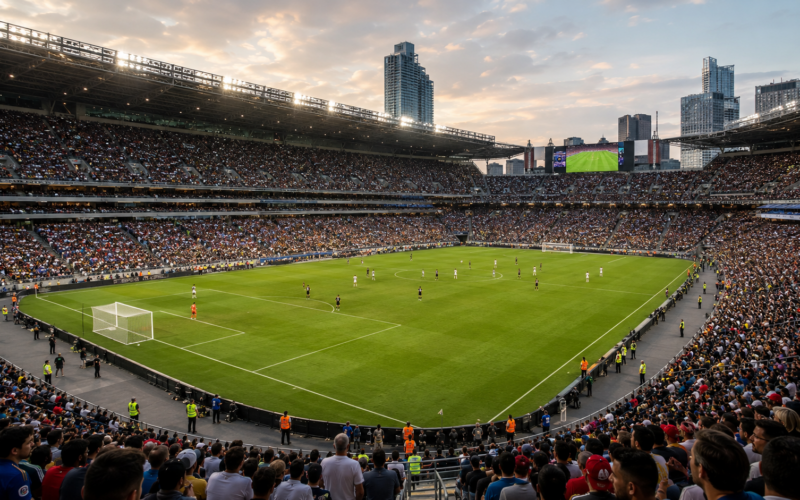
Argentina reached the FIFA World Cup 2026 final with a dramatic 2-1 win over England at Atlanta Stadium in Atlanta, Georgia, on Wednesday, July 15, 2026. Anthony Gordon gave England the lead in the 55th minute, but Enzo Fernández equalised in the 85th minute before Lautaro Martínez scored the winner in the second minute of stoppage time.
The semi-final had been goalless at half-time after a physical opening period that produced 19 fouls, two yellow cards and no shots on target. England then appeared to seize control when Gordon finished from Morgan Rogers’ cross after Declan Rice’s quick pass released the attack.
Argentina’s response came through Lionel Messi, who did not score but shaped the decisive phase from the right side. Messi set up Enzo Fernández for a powerful equaliser and then crossed for Lautaro Martínez, who had come off the bench only minutes earlier, to head Argentina into a second consecutive World Cup final.
The result sends Argentina into Sunday’s final against Spain at East Rutherford, New Jersey, where Lionel Scaloni’s defending champions will try to retain the title. England move into the third-place match against France in Miami Gardens, after another late collapse in a major tournament knockout game.
FIFA World Cup 2026 England 1-2 Argentina full match scorecard and decisive incidents
How did England’s physical first-half plan slow Argentina without creating enough attacking control?
England’s first-half plan was built around physicality, compact spacing and making sure Argentina could not feed Messi between the lines. It worked in one important sense: Argentina struggled to create clean shots, Harry Kane and Messi were both quiet, and the teams reached half-time without a shot on target.
But the cost of that plan was limited attacking rhythm. England disrupted Argentina, yet they did not establish a sustained route to goal of their own. The first half became more about fouls, territory and emotional control than about high-quality attacking sequences.
The bookings for Elliot Anderson and Lisandro Martínez captured the tone of the match. Referee Ismail Elfath had to step in early to calm the tempo, and both teams played with the edge expected from one of international football’s most loaded rivalries.
For Thomas Tuchel, the first half was acceptable but incomplete. England had stopped Argentina from flowing, but they had not built the kind of scoreboard pressure that could force the defending champions to abandon their structure.
Why did Anthony Gordon’s 55th-minute goal look like England’s route to the final?
Gordon’s goal came from the kind of quick wide attack England had been trying to find all night. Rice helped release the ball toward the flank, Rogers delivered across the face of goal, and Gordon arrived sharply to finish past Emiliano Martínez.
The goal changed the emotional weight of the semi-final. England were suddenly 35 minutes from a first men’s World Cup final since 1966, and Argentina had to chase a game in which their captain had been well controlled for long stretches.
Gordon’s finish also validated Tuchel’s selection call. England had started Rogers on the right and used Gordon’s direct running from the opposite side to stretch Argentina’s defence. In that moment, the balance looked right.
The problem was what came next. Instead of using the goal as a platform to keep Argentina under pressure, England dropped deeper and allowed Messi to move into the zone where he eventually decided the match.
How did Messi move to the right and turn Argentina’s late pressure into two goals?
Messi’s decisive influence came after Argentina went behind. Rather than staying centrally and waiting for service, he drifted toward the right side, where he could receive with a little more space and shape crosses into England’s penalty area.
That shift changed the match. England’s back line began defending repeated deliveries instead of stepping out with the confidence they had shown earlier. Messi did not need to run past players. He needed only enough room to pick the correct pass.
The equaliser came in the 85th minute after a quick corner sequence. Messi worked the ball from the right toward the box and found Enzo Fernández, who struck powerfully with his right foot and beat Pickford high toward the far side.
Seven minutes later, Messi produced the winner. He kept the ball alive, gathered himself on the right and crossed for Lautaro Martínez, who headed in from close range. In a match where Messi did not score, he still controlled the ending.
Why did Enzo Fernández’s equaliser punish England’s retreat after taking the lead?
Enzo Fernández’s goal was not just a moment of individual quality. It was the consequence of England defending too passively after going ahead. The deeper England dropped, the more Argentina could keep recycling possession and choosing when to cross, switch or shoot.
The strike itself was excellent. Fernández received from Messi around the edge of the box and hit a right-footed shot that bent beyond Pickford. It was the kind of finish that changes the story of a match instantly because England had spent half an hour trying to protect rather than extend their advantage.
England’s decision to add defensive bodies before the equaliser will be debated. Konsa replaced Gordon, and later Burn and O’Reilly came on for James and Rice. Those moves made England look more protective, but they also reduced their ability to threaten Argentina in transition.
Once Fernández scored, the entire emotional balance flipped. Argentina suddenly looked like the side with more energy, more conviction and more clarity. England, who had been minutes from the final, looked as if they were trying to survive stoppage time.
Why did Lautaro Martínez’s stoppage-time winner expose England’s late-game weakness?
Lautaro Martínez’s winner came from a classic late knockout-game pattern: one side defending too deep, one elite creator delivering into the box, and one substitute striker attacking the decisive space. Messi’s cross was precise, but Martínez still had to time the run and header under enormous pressure.
The fact that Martínez had only recently come on made the moment more painful for England. Argentina used their bench to add a penalty-box finisher, while England’s substitutions narrowed their attacking options. Scaloni’s late move produced the winning goal. Tuchel’s late moves left England pinned back.
The winner also exposed England’s loss of control after the 55th minute. The Guardian’s running account noted that England had only 12% possession between Gordon’s goal and Martínez’s winner, which explains why the ending felt increasingly inevitable. England had the lead, but Argentina had the game.
For Argentina, the goal reinforced a tournament pattern. They have repeatedly survived uncomfortable knockout phases and still found decisive late actions through Messi, Lautaro, Álvarez, Enzo Fernández and other senior players. That resilience now takes them to another final.
What did Argentina’s comeback say about Scaloni’s squad depth and tactical nerve?
Argentina’s comeback was not only a Messi story, even if Messi provided the two assists. Scaloni had to change the match from the bench, and his substitutions helped Argentina turn pressure into goals.
Nicolás González gave Argentina more direct presence after replacing Paredes. Later, Montiel, Otamendi and De Paul added legs, experience and structure, while Lautaro’s arrival gave Argentina the box striker they needed for the final push.
That mattered because Argentina had looked frustrated for long spells. Their first-half possession lacked incision, and England’s physical plan had forced the defending champions into a choppy rhythm. Scaloni resisted panic, then gradually loaded the pitch with players who could sustain pressure.
The late goals showed the value of that patience. Argentina did not simply throw players forward. They built pressure, kept Messi on the ball in the right areas and trusted that one clean delivery could decide the match.
What does Argentina 2-1 England mean for the FIFA World Cup 2026 final route?
Argentina will face Spain in the FIFA World Cup 2026 final at East Rutherford, New Jersey, on Sunday, July 19. It is a heavyweight final between the defending world champions and the 2010 champions, with Messi’s possible final World Cup match now carrying even greater weight.
The final also creates a compelling tactical contrast. Spain have controlled opponents through possession, pressing and defensive structure, while Argentina have leaned heavily on late-game resilience, Messi’s decision-making and a squad that keeps finding answers under pressure.
England’s route now shifts to the third-place match against France in Miami Gardens. That is a difficult emotional assignment because Tuchel’s side were five minutes from the final before Fernández and Martínez changed everything.
The broader consequence is harsh for England. Their latest tournament exit adds another chapter to a run of near-misses, while Argentina move one win away from becoming the first men’s team since Brazil in 1962 to retain the World Cup.
FIFA World Cup 2026 Argentina and England knockout progression table after the semi-final
What must Argentina improve before facing Spain in the World Cup final?
Argentina’s biggest issue before the final is starting faster in possession. Against England, they were slowed by physical pressure and did not produce a shot on target in the first half. Spain are unlikely to give them the same late-game crossing rhythm if they control the ball for long stretches.
Scaloni also has to decide how much risk to carry in midfield. Paredes helped with structure but was sacrificed after England scored, while De Paul’s energy arrived later. Against Spain, Argentina may need both control and legs from the opening whistle.
The positive is obvious: Messi can still decide the biggest matches without scoring. His two assists moved Argentina into the final, and his ability to create from the right gives Scaloni another tactical route if central lanes are crowded.
Argentina’s bench has also become a major weapon. Lautaro scored the winner, González added pressure, and the late changes gave Argentina a stronger finish than England. That depth will matter against a Spain side that also uses substitutions well.
What must England address after another painful late tournament collapse?
England’s immediate issue is game management after taking the lead. Gordon’s goal should have given them a platform to keep Argentina stretched, but the team retreated, lost the ball too easily and allowed Messi to dictate the final phase from the right.
Tuchel will face scrutiny for the substitutions, especially the decision to add defensive bodies while removing attacking outlets. The idea was understandable because Argentina were crossing repeatedly, but the effect was to make England more passive rather than more secure.
England also need to examine why Kane and Bellingham became peripheral late in the match. In knockout football, the best teams need their biggest players to help control emotional momentum, not only attack when the game is open.
The third-place match against France now becomes a test of response rather than reward. England’s campaign showed quality, resilience and depth, but this semi-final will be remembered for how quickly a lead became another major-tournament heartbreak.
Key takeaways from England vs Argentina at FIFA World Cup 2026
- Argentina beat England 2-1 at Atlanta Stadium on Wednesday, July 15, 2026, to reach the FIFA World Cup 2026 final.
- Anthony Gordon gave England the lead in the 55th minute after Morgan Rogers crossed from the right following Declan Rice’s quick release.
- The first half was scoreless and highly physical, with 19 combined fouls, two yellow cards and no shots on target.
- Elliot Anderson was booked for England in the 38th minute, while Lisandro Martínez was booked for Argentina in the 42nd minute.
- Lionel Messi did not score but assisted both of Argentina’s late goals from right-sided positions.
- Enzo Fernández equalised in the 85th minute with a powerful right-footed strike after Messi’s pass from a quick-corner sequence.
- Lautaro Martínez came on in the 81st minute and headed in Messi’s cross in the second minute of stoppage time.
- England had only 12% possession between Gordon’s goal and Martínez’s winner, showing how deeply they retreated after taking the lead.
- Argentina will face Spain in the final at East Rutherford, New Jersey, on Sunday, July 19.
- England will face France in the third-place match in Miami Gardens on Saturday, July 18.
Discover more from Business-News-Today.com
Subscribe to get the latest posts sent to your email.