


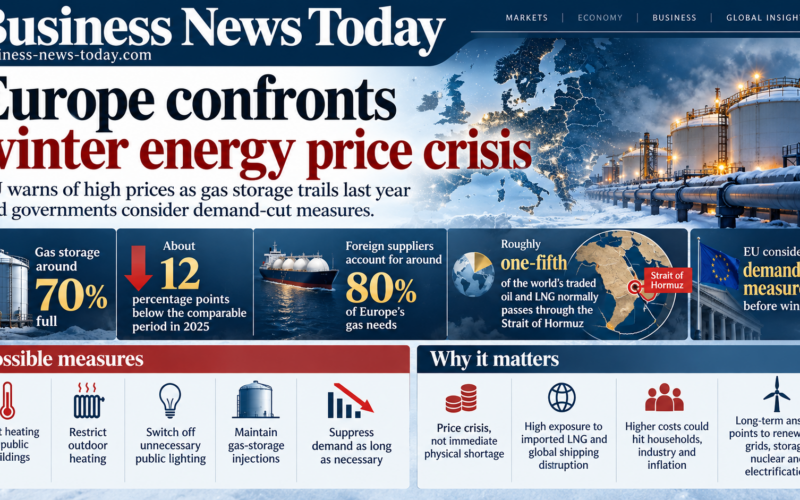
The European Union is confronting what its energy commissioner has described as an energy price crisis linked to global supply disruption, prompting Brussels to urge member governments to consider reducing gas and electricity consumption as winter approaches. EU Energy Commissioner Dan Jorgensen told national energy ministers that governments should consider measures that maintain gas-storage injections or suppress demand for as long as necessary, including limits on heating in public buildings, restrictions on outdoor heating and switching off unnecessary public lighting.
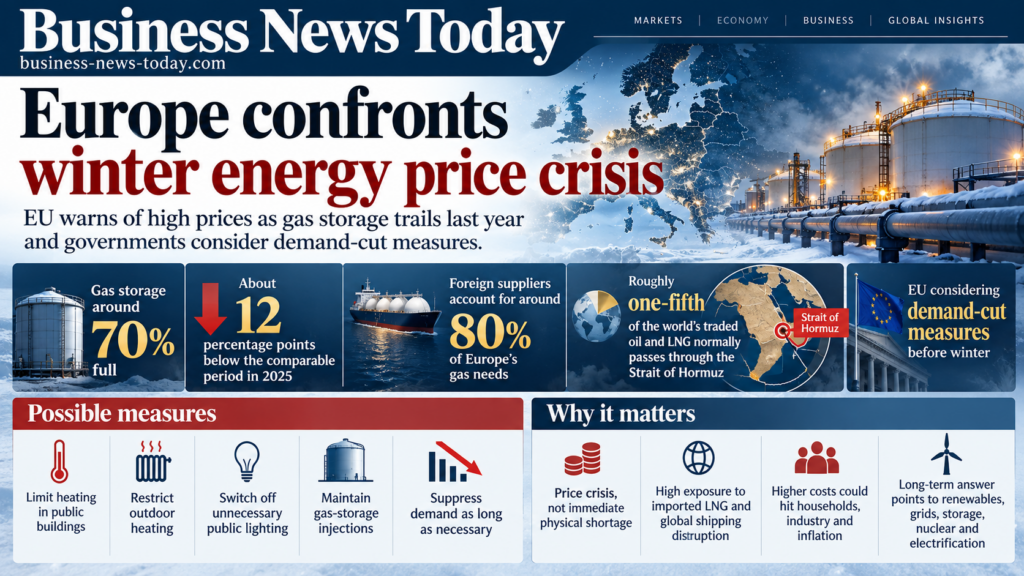
The concern is increasingly visible in Europe’s storage data. EU gas facilities are around 70% full, approximately 12 percentage points below the comparable period in 2025, while the bloc remains heavily dependent on imported energy. Foreign suppliers account for around 80% of Europe’s gas needs, leaving prices highly exposed to the Iran war and the effective disruption of the Strait of Hormuz, through which roughly one-fifth of the world’s traded oil and liquefied natural gas normally passes.
Why is the European Union describing the latest energy shock as a price crisis rather than a physical shortage?
Europe currently has access to enough energy to avoid an immediate supply emergency. The European Commission says diversified suppliers, expanded liquefied natural gas infrastructure, strategic reserves and reduced consumption have made the system substantially more resilient than during the Russian gas crisis earlier in the decade.
The immediate problem is therefore cost. Oil and gas prices have risen sharply because Middle Eastern supply routes are disrupted, meaning European households and industrial companies can face severe financial pressure even when fuel remains physically available.
That distinction matters for policy. A physical shortage requires rationing or emergency supply allocation, while a price crisis may initially be addressed through demand reduction, targeted household support, state aid or temporary tax and regulatory measures.
Why does Europe remain so vulnerable to disruption in the Strait of Hormuz?
Europe substantially reduced dependence on Russian pipeline gas after the Ukraine invasion, but replacing Russian supplies increased reliance on globally traded liquefied natural gas. LNG gives Europe more geographic flexibility, yet it also exposes the region more directly to global competition and maritime chokepoints.
Hormuz is particularly important because Qatar and other Gulf producers export enormous volumes of LNG through the strait. When shipping becomes unsafe or restricted, cargo availability tightens across international markets rather than only in Europe.
European buyers must then compete with Asian importers including Japan, South Korea, China and India. Higher prices become the mechanism that decides where flexible LNG cargoes are delivered.
Why is 70% gas storage becoming a concern before the European winter begins?
Europe usually builds gas inventories during warmer months and draws them down during winter when heating demand rises. A lower starting point means governments have less cushion if temperatures turn unusually cold or if imported LNG becomes more difficult to obtain.
Storage at roughly 70% is not itself evidence of an imminent shortage, but being 12 percentage points below last year reduces flexibility. Governments therefore have an incentive to keep injecting gas while encouraging consumers to avoid unnecessary use.
The danger comes from combinations of risks. A cold winter, prolonged Hormuz disruption and unexpected infrastructure outages would be considerably harder to manage together than any one of those events individually.
What demand-reduction measures could European governments actually introduce?
Jorgensen suggested measures including reducing heating temperatures in government buildings, stopping outdoor heaters and turning off unnecessary public lighting. These are relatively visible interventions designed to reduce consumption without immediately restricting essential industrial or residential demand.
Member states retain substantial authority over how they respond. Some governments could also offer incentives for industrial demand reduction, accelerate fuel switching or provide support to vulnerable households while discouraging excessive consumption.
Europe used comparable strategies during the earlier Russian gas crisis, when voluntary demand reduction helped prevent shortages. The experience provides governments with an operational template even though the geopolitical cause of the 2026 crisis is different.
Could European airlines and travellers also feel the energy crisis through higher fuel costs?
Yes. The Commission has acknowledged that higher fuel prices are affecting aviation, although it says there is currently no EU-wide jet fuel shortage. EU passenger-protection rules continue to require airlines to offer refunds or rerouting for cancellations, and high fuel prices by themselves are not treated as extraordinary circumstances exempting airlines from compensation.
Airlines cannot simply add retroactive fuel surcharges to tickets that have already been sold under EU pricing rules. That means part of the cost shock initially falls on airline margins unless carriers adjust future ticket prices or capacity.
The aviation issue reinforces the breadth of the crisis. Expensive energy moves through transport, manufacturing, agriculture and household utility bills long before Europe experiences an outright physical shortage.
What are the key takeaways from Europe’s September energy-crisis warning?
Europe is better protected against physical shortages than it was during the earlier Russian supply shock, but it is still highly vulnerable to global pricing because most gas is imported. Gas storage at around 70% provides a buffer, although inventories are materially lower than at the same point last year.
Brussels is therefore returning to demand-management tools before winter begins. Restrictions on public heating and outdoor energy use are being discussed as precautionary measures rather than evidence that formal rationing has started.
The economic risk is broader than household energy bills. Persistent high prices can damage industrial competitiveness, worsen inflation and force governments with already strained budgets to choose which consumers and companies receive support.
Could the 2026 energy crisis permanently change Europe’s industrial and energy strategy?
Every major energy shock changes investment incentives. Expensive imported gas strengthens the economic case for renewable generation, grids, energy storage, nuclear power and electrification because reducing fossil-fuel dependence becomes a security objective as well as a climate policy.
The difficulty is timing. New power plants and transmission infrastructure take years to build, while businesses and households face prices immediately.
Europe therefore confronts a familiar contradiction: the long-term answer is structural energy independence, while the short-term response still depends on imported LNG, storage management and reducing consumption. The September warning shows that this vulnerability remains unresolved even after years of diversification.
Discover more from Business-News-Today.com
Subscribe to get the latest posts sent to your email.