


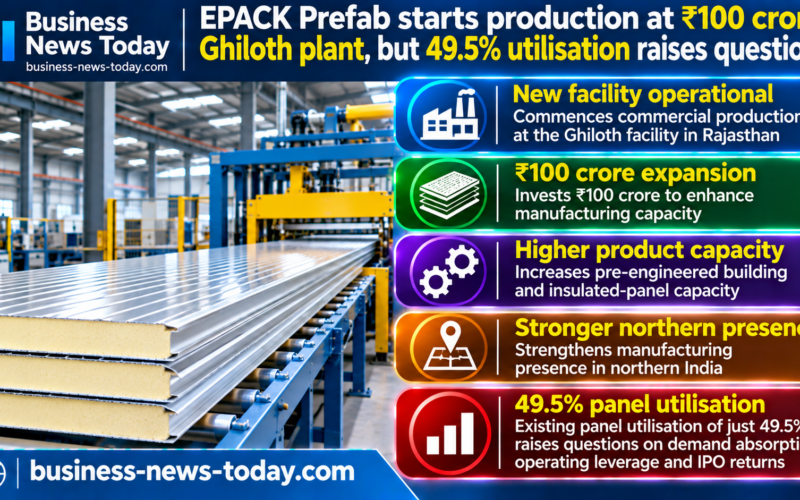
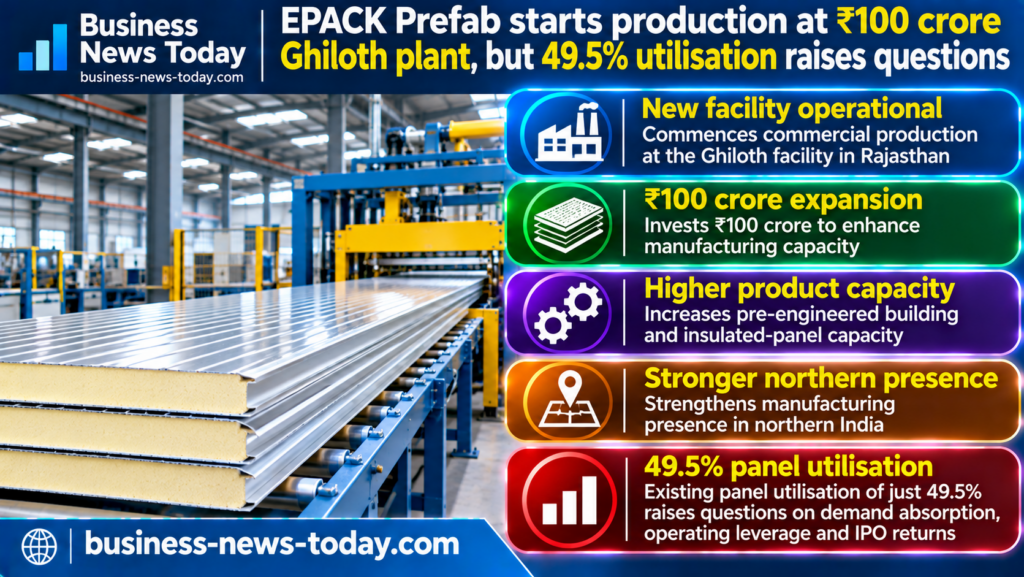
EPACK Prefab Technologies Limited (NSE: EPACKPEB, BSE: 544540) has commenced commercial production at its Ghiloth manufacturing facility in Rajasthan following an investment of approximately ₹100 crore funded through initial public offering proceeds. The facility, operational from 28 October 2026, adds 11,300 tonnes of annual pre-engineered building capacity and 800,000 square metres of polyurethane foam insulated-panel capacity, expanding the company’s ability to serve industrial and infrastructure projects across northern India. The commissioning increases aggregate installed capacity to 158,422 tonnes of pre-engineered building structures and 2.11 million square metres of insulated panels annually. However, while existing structural steel manufacturing utilisation stood at approximately 77.5%, panel utilisation was only 49.5% before the latest addition, creating a significant challenge in absorbing additional output. The operational milestone arrives ahead of second-quarter FY27 results scheduled for 2 November, with investors assessing whether increasing production capability can support management’s revenue ambitions without further weakening operating margins.
The facility represents a completed construction and commissioning milestone rather than another proposed capital expenditure announcement. EPACK Prefab has received Consent to Operate from the Rajasthan State Pollution Control Board, allowing commercial production to begin at the site in the RIICO Industrial Area at Ghiloth, within Kotputli-Behror district. The development also advances the company’s regional manufacturing strategy, under which facilities in Uttar Pradesh, Andhra Pradesh, Rajasthan and the planned Gujarat expansion are intended to serve industrial customers with shorter delivery distances and more flexible production arrangements.
How does EPACK Prefab Technologies’ ₹100 crore Ghiloth plant change manufacturing capacity across India?
The latest expansion increases EPACK Prefab’s annual pre-engineered building manufacturing capacity from 147,122 tonnes to 158,422 tonnes, representing an addition of approximately 7.7%. The increase in insulated-panel production capability is proportionately much larger, rising from 1.31 million square metres to 2.11 million square metres annually. This represents growth of approximately 61.1%, making insulated panels the most consequential component of the latest capacity announcement.
The difference between the two product categories is commercially important. Pre-engineered buildings involve fabricated structural steel components used in industrial factories, warehouses, logistics facilities and other engineered structures. Insulated panels, meanwhile, form part of building envelopes, providing thermal insulation and other specified performance characteristics for facilities such as cold-storage warehouses, food-processing plants and industrial buildings.
EPACK Prefab operates an integrated business model involving structural design, fabrication, supply and erection. Its ability to manufacture both structural steel and insulated panels can support the delivery of projects requiring multiple building components. However, steel fabrication capacity measured in tonnes and insulated-panel capacity measured in square metres cannot be combined into a single production figure.
The Ghiloth addition also follows previous investment in the company’s Mambattu manufacturing facility in Andhra Pradesh. A brownfield production line commissioned there in April 2026 increased its structural steel manufacturing capability. The latest Rajasthan commissioning extends the company’s manufacturing capacity further, although the actual distribution of future production among its facilities will depend on customer locations, product specifications and utilisation.
The investment is particularly relevant to northern India because Ghiloth is located within an established industrial corridor near the National Capital Region. The location provides access to industrial activity across Rajasthan, Haryana, Uttar Pradesh and neighbouring markets. The potential commercial benefit lies in serving customers through a regional manufacturing network rather than relying exclusively on production from distant facilities.
Why does 49.5% panel utilisation create an important test for EPACK Prefab Technologies’ expansion strategy?
EPACK Prefab’s exchange filing disclosed existing pre-engineered building manufacturing utilisation of approximately 77.5% before the new capacity became operational. The corresponding utilisation rate for polyurethane foam panels was approximately 49.5%. These figures indicate substantially different demand absorption and operating conditions across the two manufacturing categories.
At the disclosed utilisation rates, the existing structural steel production base corresponds to approximately 114,000 tonnes of annualised output, while insulated-panel production corresponds to approximately 648,000 square metres. These are indicative calculations using the company’s reported capacity and utilisation percentages rather than independently reported production figures for a specific financial period.
If insulated-panel production remained at the same indicative annualised level after the Ghiloth capacity addition, utilisation across the enlarged 2.11-million-square-metre base would fall to approximately 30.7%. This is a mathematical illustration, not a forecast, because the new production line has only recently commenced commercial operations and its actual output is not yet available.
The implication is that EPACK Prefab must grow insulated-panel sales considerably to make full commercial use of its larger manufacturing footprint. Producing additional panels without sufficient orders could increase the burden of manufacturing overheads, maintenance and depreciation relative to revenue. Higher utilisation would instead allow fixed costs to be spread across greater production volumes.
The company’s FY26 annual report identified insulated-panel utilisation as an area requiring improvement. Management had targeted higher production activity at its Mambattu continuous-panel line, supported by additional customer acquisition and a stronger focus on cold storage, food processing, renewable energy and industrial projects.
The latest investment increases the importance of those commercial initiatives. Ghiloth strengthens the company’s ability to serve northern markets, but a geographically wider manufacturing footprint does not automatically eliminate existing spare capacity elsewhere. The next evidence of operational success will be rising panel volumes and improved utilisation, rather than the new installed capacity figure alone.
Can EPACK Prefab Technologies’ ₹1,376 crore order book support the newly commissioned Rajasthan facility?
EPACK Prefab reported an outstanding order book of approximately ₹1,376.4 crore at 30 June 2026, compared with ₹1,112.7 crore at the end of March. The increase of approximately 23.7% during the first quarter of FY27 indicates that fresh orders were exceeding the value of contracts converted into revenue and other backlog movements.
The company also reported strong new-order acquisition during the quarter, with order bookings of approximately ₹578 crore. The expanding backlog provides visibility into future project execution and supports management’s decision to invest in manufacturing capability. However, the order book includes different types of construction and engineering work and cannot be interpreted as a dedicated order pipeline for the new Ghiloth insulated-panel line.
A key commercial consideration is the composition of future orders. A contract for a large industrial building may involve extensive structural steel fabrication but relatively limited insulated-panel requirements. Cold-storage and temperature-controlled facilities can have different material requirements, creating opportunities for a greater contribution from insulated building-envelope products.
EPACK Prefab’s FY26 order bookings reflected participation across industrial manufacturing, renewable energy, logistics, electronics and other infrastructure categories. Industrial manufacturing accounted for approximately ₹475 crore of new prefab orders, while renewable energy contributed ₹394 crore and logistics and warehousing generated ₹280 crore.
These sectors provide several potential routes for future capacity utilisation. Industrial facilities require buildings and associated infrastructure, renewable energy manufacturing projects involve sizeable factory construction, and logistics investments create demand for warehousing structures. Insulated-panel consumption within those projects will depend on their individual technical specifications rather than the overall contract value.
The ₹1,376 crore order backlog is substantial relative to the company’s FY26 revenue of approximately ₹1,525 crore. Nevertheless, the pace of project execution, customer approvals and construction schedules will determine how much revenue can be recognised in subsequent quarters.
A stronger assessment of Ghiloth’s commercial contribution will require disclosure of regional order intake, insulated-panel bookings and actual manufacturing output. Such information would show whether the new facility is meeting additional demand or primarily increasing the company’s available production capacity.
What do EPACK Prefab Technologies’ latest financial results reveal about growth and margin pressure?
EPACK Prefab delivered significant growth during FY26, with consolidated revenue from operations increasing approximately 34.5% to ₹1,525.3 crore from ₹1,133.9 crore in FY25. EBITDA increased to approximately ₹159.4 crore, while the reported EBITDA margin remained around 10.5%. Profit after tax increased approximately 56% to ₹92.8 crore, supported by business growth and improved financial performance.
The first quarter of FY27 continued the revenue expansion, although profitability grew more slowly. Consolidated revenue from operations increased 23.9% year on year to approximately ₹365.8 crore during the three months ended 30 June 2026. EBITDA increased 11.7% to ₹34.5 crore, while profit after tax rose approximately 13.8% to ₹18.2 crore.
The EBITDA margin declined from 10.5% to 9.4%, representing a contraction of approximately 110 basis points. The profit after tax margin also moderated from 5.4% to 5%. These movements show that the company generated higher absolute earnings but retained a smaller proportion of revenue as operating profit.
Management attributed the margin pressure partly to higher input costs, particularly movements in steel prices. The company indicated that price adjustments in pending contracts and changes to procurement arrangements were intended to mitigate the impact. However, the financial results did not yet establish a sustained return to the previous margin level.
Steel price movements are particularly relevant to pre-engineered building manufacturers because steel represents a substantial component of production expenditure. Where contracts are agreed before material purchases are completed, subsequent increases in input costs can affect project margins unless pricing or escalation arrangements provide sufficient protection.
The Ghiloth commissioning introduces additional operating capacity at a time when margins are already below the company’s previous-year level. Higher production volumes could improve cost absorption, but only if they are supported by appropriate selling prices and a commercially attractive product mix. Additional output sold at weak margins would contribute less to profitability than the capacity expansion headline might suggest.
How will IPO funding and EPACK Prefab Technologies’ net cash position influence the Rajasthan investment?
EPACK Prefab stated that the approximately ₹100 crore Ghiloth investment was financed through net proceeds from its initial public offering. The funding structure is relevant because the newly commissioned capacity is not dependent on a separately announced debt-raising arrangement.
The company raised approximately ₹300 crore through the fresh-issue component of its 2025 IPO. According to its FY26 annual report, approximately ₹155 crore had been deployed by 31 March 2026, including share-issuance expenses, while the remaining proceeds were held for specified purposes. These included repayment of borrowings and manufacturing expansion at Ghiloth and Mambattu.
Management had outlined approximately ₹150 crore of capital expenditure for FY27 across Ghiloth, Mambattu and Gujarat, funded through remaining IPO proceeds and internal accruals. The ₹100 crore associated with Ghiloth should not automatically be added to that FY27 budget as entirely separate spending, because the announced investment and the annual capital expenditure programme cover related projects and potentially different expenditure periods.
EPACK Prefab ended FY26 with a reported net cash position of approximately ₹201 crore, including short-term treasury investments. The position reflected debt repayments and financial resources following the IPO. At the end of June 2026, management reported a net cash position of approximately ₹103.2 crore.
The change in net cash occurred during a period of continued manufacturing investment, but it should not be attributed entirely to Ghiloth without a detailed cash-flow reconciliation. The company’s financial position must be assessed alongside payments for ongoing projects, working capital requirements and other investing activities.
The manufacturing programme could improve future returns on capital if new facilities generate sufficient incremental operating profit. However, the assets will also increase the amount of capital employed in the business. A higher production base will not automatically produce higher return ratios until sales and earnings justify the investment.
The immediate financial benefit of commissioning is that the Ghiloth project has moved beyond the construction stage and can begin contributing to production. The next stage involves demonstrating how effectively the invested capital is converted into revenue and cash flow.
Why does the Ghiloth plant matter for EPACK Prefab’s expansion into data centres, cold storage and renewable energy infrastructure?
EPACK Prefab has identified several industrial categories as potential growth markets, including renewable energy, data centres, cold-chain infrastructure, automotive manufacturing and electronics facilities. These sectors require different combinations of structural steel, building-envelope products and installation services. The company’s integrated manufacturing capabilities allow it to participate in projects where multiple prefabricated construction components are required.
The expansion into insulated panels is particularly relevant for temperature-controlled environments. Cold-storage facilities and food-processing buildings require building envelopes capable of meeting defined thermal performance requirements. Depending on the design, insulation specifications can influence energy consumption and operating costs over the building’s lifecycle.
Data centres present another potential market for specialised construction solutions, including prefabricated structures and certain insulated building components. EPACK Prefab has indicated that it is pursuing opportunities in this sector and has previously undertaken data-centre-related construction work. However, the company’s involvement in a data-centre project should not be interpreted as participation in every part of the facility’s technical infrastructure.
In August 2026, EPACK Prefab’s board also approved a proposal to enter the data-centre solutions business through a dedicated subsidiary, with an in-principle investment commitment of up to ₹75 crore. That proposal represents a separate strategic initiative from the ₹100 crore Ghiloth commissioning. Its eventual financial contribution will depend on implementation and customer contracts.
The opportunities in renewable energy are more closely established through the company’s existing order portfolio. EPACK Prefab has undertaken projects involving solar manufacturing and related industrial infrastructure, providing operational experience in large construction assignments. Such projects can require significant structural fabrication capacity, while insulated-panel requirements vary according to facility design.
The wider industrial opportunity could support demand for the company’s products, but new manufacturing capacity must still compete for orders on price, quality, specifications and delivery performance. Commercial success will depend on winning contracts that make productive use of the additional facilities rather than simply participating in sectors with strong investment activity.
Can EPACK Prefab Technologies achieve its FY27 revenue guidance after a slower first-quarter start?
EPACK Prefab’s FY26 annual report outlined a management revenue target of approximately ₹1,925 crore to ₹1,950 crore for FY27. Compared with FY26 revenue of ₹1,525.3 crore, the target implies annual growth of approximately 26% to 28%. The company also outlined an EBITDA margin objective around 10.5%, supported by operational improvements and capacity expansion.
The first-quarter results provide an important benchmark. Revenue of approximately ₹365.8 crore represented 23.9% year-on-year growth, but only about 19% of the lower end of the full-year revenue target. The annual objective therefore requires a stronger absolute revenue contribution over the remaining nine months.
To achieve ₹1,925 crore in full-year revenue, EPACK Prefab would need to generate approximately ₹1,559 crore during the final three quarters. This translates into an average quarterly revenue requirement of roughly ₹520 crore. The upper target of ₹1,950 crore would require an average of approximately ₹528 crore per quarter over the same period.
These calculations do not represent company guidance for individual quarters. Construction execution can be uneven across reporting periods, with revenue affected by project schedules, monsoon conditions, customer requirements and the timing of manufacturing and installation activity.
Nevertheless, the figures illustrate the pace of activity needed to achieve the company’s annual ambition. Average quarterly revenue over the remaining period would need to be more than 40% above the June-quarter level. The strong order book supports the possibility of increased execution, but whether that acceleration occurs remains to be demonstrated.
Ghiloth’s late-October commissioning also means the facility could not have contributed to first-quarter revenue and would have no commercial production contribution to the September quarter. Its impact on FY27 performance will therefore depend primarily on activity during the second half, following commissioning.
The company’s ability to achieve its targets will also depend on maintaining margins as production increases. Higher revenue at the first-quarter EBITDA margin of 9.4% would generate a different earnings outcome from the same revenue delivered at the targeted 10.5% margin.
Why did EPACK Prefab Technologies shares decline despite the Rajasthan plant commissioning?
EPACK Prefab Technologies shares closed at ₹208.42 on the National Stock Exchange of India on 30 October 2026, declining approximately 3.4% from the previous close of ₹215.73. The stock had closed at ₹218.53 on 28 October, the date commercial production commenced, taking the cumulative decline across the following two trading sessions to approximately 4.6%.
The shares also declined approximately 14.3% over the preceding month, indicating that the weakness was not limited to the immediate period surrounding the commissioning announcement. Trading volume reached approximately 2.36 lakh shares on 30 October, compared with 3.39 lakh shares on 29 October.
At the 30 October closing price, EPACK Prefab had an equity market capitalisation of approximately ₹2,097 crore. The market valuation was equivalent to roughly 1.4 times FY26 revenue, although revenue multiples alone cannot establish whether a construction and manufacturing business is attractively valued.
The company’s share-price performance reflects a period of competing operational developments. Revenue and order bookings have increased, but first-quarter margins weakened and substantial manufacturing investments are still moving through different stages of commissioning and commercial ramp-up.
The market decline cannot be attributed conclusively to the Ghiloth announcement. Broader equity market conditions, changes in earnings expectations, valuation considerations and trading activity may all contribute to short-term movements. The available information does not establish a single dominant explanation.
A sustained improvement in investor sentiment would be more convincingly supported by evidence that the company can achieve higher manufacturing utilisation while restoring operating margins. The new facility provides additional production capability, but the financial impact will only become visible as new orders are manufactured, delivered and recognised in reported earnings.
What will EPACK Prefab Technologies’ November 2026 results reveal about the benefits of its new manufacturing capacity?
EPACK Prefab has scheduled a board meeting for 2 November 2026 to consider unaudited financial results for the quarter and half-year ended 30 September. The company has also scheduled an earnings conference call with investors and analysts for 4 November at 4:30 p.m. IST.
The September-quarter results will precede the start of commercial production at Ghiloth, meaning they cannot establish the new facility’s actual contribution to revenue or profitability. They can, however, provide an updated assessment of the company’s existing business performance, order-book conversion and ability to restore margins following the weaker June quarter.
A recovery in EBITDA margin towards the company’s previously indicated range would strengthen the financial foundation for the additional manufacturing capacity. Higher revenue accompanied by continued margin pressure would present a more complicated picture, particularly as the company increases its asset base.
The updated order book will also be relevant. The June backlog of ₹1,376.4 crore provided significant revenue visibility, but its value changes as projects progress, new contracts are secured and existing orders are completed. An updated figure will help establish whether demand is keeping pace with the company’s broader growth targets.
The Ghiloth expansion represents meaningful operational progress because the facility has received its environmental operating consent and commenced production. However, the largest capacity addition is in insulated panels, a category where the previously disclosed utilisation rate was substantially below the structural steel business.
EPACK Prefab has the advantage of a sizeable order backlog, an established industrial customer base and a manufacturing network positioned across multiple regions. These capabilities could support higher production volumes, particularly if demand from industrial manufacturing, logistics and temperature-controlled infrastructure continues expanding.
The decisive operational evidence will emerge through higher panel sales, improved utilisation, stable project margins and stronger operating cash generation. The November results will establish the financial starting point, while subsequent quarters will show whether the newly commissioned Ghiloth facility converts its additional capacity into profitable revenue rather than simply increasing the company’s manufacturing footprint.
What should investors know about EPACK Prefab Technologies’ ₹100 crore Rajasthan plant, 61% panel capacity increase and Q2 earnings?
– EPACK Prefab Technologies Limited commenced commercial production at its Ghiloth manufacturing facility in Rajasthan on 28 October 2026, following an investment of approximately ₹100 crore.
– The facility adds 11,300 tonnes of annual pre-engineered building capacity and 800,000 square metres of insulated-panel capacity, supported by IPO funding.
– Aggregate installed pre-engineered building capacity increases to 158,422 tonnes annually, representing growth of approximately 7.7% over the previously disclosed capacity.
– Insulated-panel capacity rises approximately 61.1% to 2.11 million square metres annually, making this the more significant addition in proportional terms.
– Existing structural steel manufacturing utilisation stood at approximately 77.5%, compared with only 49.5% for insulated panels, creating different challenges for the two product categories.
– The company reported a pending order book of approximately ₹1,376.4 crore at 30 June 2026, providing future project visibility but not a guaranteed sales pipeline for the additional panel capacity.
– Consolidated Q1 FY27 revenue grew 23.9% to ₹365.8 crore, while EBITDA margin declined to 9.4% from 10.5% a year earlier.
– Management’s FY27 revenue target of ₹1,925 crore to ₹1,950 crore requires a substantial acceleration in quarterly revenue during the remaining financial year.
– EPACK Prefab shares closed at ₹208.42 on 30 October 2026, down approximately 3.4% for the session and 14.3% over the preceding month.
– The 2 November financial results and 4 November earnings call will provide the next evidence on margins, backlog conversion and the financial capacity to support further manufacturing growth.
Discover more from Business-News-Today.com
Subscribe to get the latest posts sent to your email.