


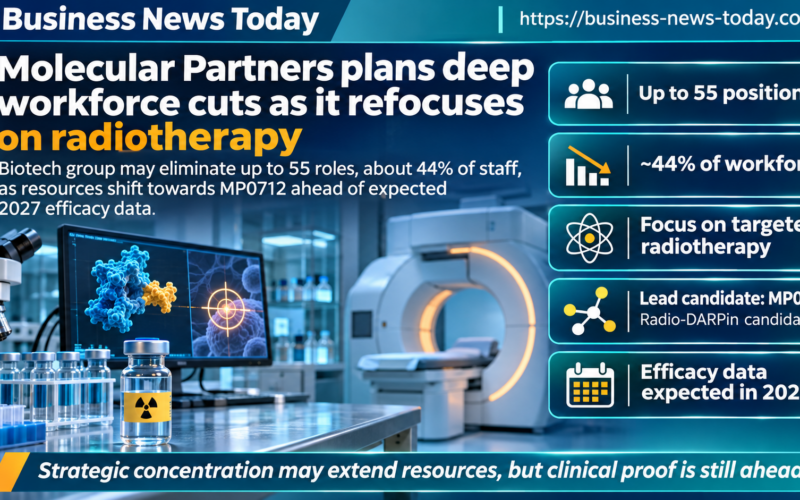
Molecular Partners AG (SIX: MOLN; NASDAQ: MOLN) plans to reduce its workforce by up to 55 positions, representing as much as approximately 44% of current roles, as the Swiss biotechnology company concentrates resources around targeted radiotherapy. The company has begun the employee consultation required under Swiss employment law and expects the organisational changes to be implemented by the second quarter of 2027, with associated savings becoming fully effective early in the second half. The restructuring follows what management describes as an encouraging emerging clinical profile for MP0712, its lead DLL3-targeting Radio-DARPin therapy being developed with Orano Med for small cell lung cancer and other neuroendocrine cancers. The strategic tension is unusually clear: Molecular Partners is preparing to shrink substantially around radiopharmaceuticals before public efficacy data from MP0712 are expected in 2027, making the next clinical readouts increasingly important to both the pipeline and the future shape of the company.
Why is Molecular Partners cutting up to 44% of its workforce while expanding its radiotherapy pipeline?
Molecular Partners is not presenting the proposed workforce reduction as a response to the failure of MP0712 or a sudden liquidity crisis. Management is instead using the organisational reset to concentrate staff, spending and management attention on the Radio-DARPin portfolio while pursuing other DARPin programmes increasingly through partnerships, investigator-led development or possible spin-out structures. The change represents a narrowing of strategic scope rather than a retreat from drug development.
The company notified the Office for Economic Affairs of the Canton of Zurich of its intention to remove no more than 55 positions. Because the consultation process is still underway, 55 should be treated as the maximum proposed reduction rather than a final confirmed number of employees who will leave. Molecular Partners expects the programme to be fully implemented by the second quarter of 2027.
The timing reflects a change in management’s assessment of where the DARPin platform offers the strongest opportunity. Radiopharmaceuticals have moved from being one part of Molecular Partners’ research portfolio to the principal internal development focus, supported by MP0712, the MSLN-targeting MP0726 programme, CD70-targeting MP0730 and additional multispecific Radio-DARPin work.
That concentration reduces the resources needed to maintain several unrelated internal therapeutic strategies simultaneously. It also makes Molecular Partners more dependent on the clinical validation of a therapeutic modality whose most advanced internal programme remains in Phase 1/2a development.
MP0712 has produced reassuring early safety observations, but efficacy remains the bigger unanswered question
MP0712 targets delta-like ligand 3, or DLL3, and carries the alpha-emitting isotope lead-212. DLL3 is expressed in small cell lung cancer and other neuroendocrine tumours, making it a target for therapies designed to deliver radiation selectively to tumour cells while limiting exposure to surrounding healthy tissue.
The ongoing US multicentre Phase 1/2a study has fully recruited its second dose level at 105 MBq per dose, with eight clinical sites open and nine expected during 2026. Molecular Partners reported that all patients treated in the first 75 MBq dose level passed the specified safety observation period without dose-limiting events and that adverse events reported to date were mild to moderate and transient.
Those observations support continued dose escalation, but they do not yet establish anticancer efficacy. Initial safety data are scheduled for presentation at the IASLC and ASCO North America Conference on Lung Cancer in December 2026, while efficacy data are expected during 2027.
That chronology makes the workforce decision strategically notable. Molecular Partners is reorganising around radiotherapy before investors have access to the efficacy dataset that would provide stronger evidence about whether MP0712 can produce clinically meaningful tumour responses. Management is effectively making a portfolio-allocation decision based on the broader emerging profile of the programme and platform rather than waiting for mature efficacy evidence.
Why the Orano Med partnership reduces some of the financial and manufacturing burden around MP0712
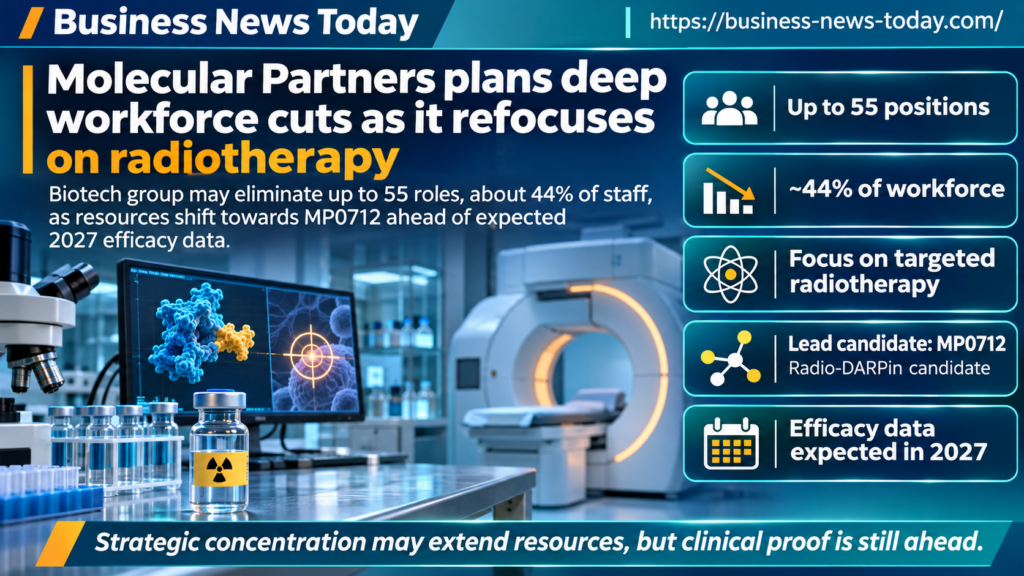
Molecular Partners’ strategic relationship with Orano Med is an important part of the economics behind the radiotherapy pivot. The companies began collaborating on lead-212 Radio-DARPin therapeutics in 2024 and subsequently broadened their arrangement to cover a larger portfolio of potential programmes.
For MP0712, the two companies share preclinical and clinical development costs and commit their respective technology and materials. Orano Med contributes experience with lead-212 targeted alpha therapies and isotope supply, while Molecular Partners contributes the DARPin targeting platform. Molecular Partners retains commercialisation rights to MP0712.
Cost sharing does not eliminate Molecular Partners’ development expenditure, but it reduces the burden compared with independently creating the full radiopharmaceutical infrastructure. During the first nine months of 2026, Orano Med reimbursed approximately CHF710,000 of research and development expenditure under the collaboration.
The relationship also addresses one of the practical challenges in radiopharmaceutical development: isotope availability and manufacturing. A therapeutic concept can be clinically attractive yet commercially difficult if radioactive material cannot be produced, processed and delivered reliably. Orano Med’s specialised infrastructure therefore adds operational value beyond conventional co-development funding.
How large is Molecular Partners’ remaining cash runway after the strategic reset?
Molecular Partners reported CHF57.5 million of cash and cash equivalents at September 30, equivalent to roughly $69 million at the company’s stated conversion. Management expects that position to fund operating expenses and capital expenditure into late 2027 under its current assumptions.
The cash balance has already been declining as development advances. Molecular Partners held CHF67.9 million at June 30, meaning cash fell by CHF10.4 million during the third quarter. At the half-year point, the company had used CHF25 million of cash in operating activities during the first six months of 2026.
The first-half operating loss was CHF27 million and net loss was CHF26.7 million. Research and development expense reached CHF19 million while selling, general and administrative expense was CHF8 million, reflecting the economics of a clinical-stage company without meaningful product revenue.
For full-year 2026, management now expects total operating expenses of CHF50 million to CHF55 million, including approximately CHF5 million of non-cash costs related to share-based payments, pension accounting and depreciation. The workforce restructuring is intended to reduce the future expense base, although the company has not yet quantified either the restructuring charge or the annual savings.
The important financial implication is therefore runway rather than immediate earnings. A smaller organisation should allow Molecular Partners to direct a larger proportion of remaining capital toward MP0712 and the wider radiotherapy platform while delaying the point at which additional funding may be required.
Molecular Partners is becoming a radiopharmaceutical company rather than simply adding radiotherapy assets
The strategic change goes beyond prioritising one clinical candidate. Molecular Partners now describes its objective in terms of building a focused radiopharmaceutical business around its Radio-DARPin technology, creating a portfolio rather than a single-asset programme.
MP0726 targets mesothelin, an antigen expressed in cancers including ovarian malignancies, and is advancing toward first-in-human imaging. The programme provides a second clinical test of whether DARPins can function effectively as targeted radioactive delivery vehicles beyond DLL3.
MP0730 adds another target, CD70, which is associated with clear cell renal cell carcinoma and other cancers. Molecular Partners expects the programme to enter first-in-human development around the middle of 2027, subject to the usual development and regulatory requirements.
The company is also exploring different radioactive isotopes, including lead-212 and actinium-225, rather than tying the platform to a single payload. That isotope-agnostic approach could allow Molecular Partners to match radioactive half-life and biological characteristics more closely with individual tumour targets.
This portfolio breadth reduces dependence on MP0712 alone at the technology level, but most of the additional programmes remain substantially earlier in development. MP0712 therefore carries disproportionate near-term importance because it will generate the first meaningful clinical evidence capable of validating or challenging the wider strategic pivot.
What happens to Molecular Partners’ immune-cell engager programmes after the restructuring?
Molecular Partners is not abandoning every programme outside radiotherapy. Instead, management intends to explore the potential of its broader DARPin technologies through strategic collaborations, external development and possible platform-derived spin-outs where appropriate.
MP0317, a FAP-localised CD40 agonist, continues in an investigator-initiated randomised Phase 2 study in advanced cholangiocarcinoma. The programme is being evaluated alongside standard treatment to determine whether it can improve progression-free survival.
MP0533, a tetra-specific T-cell engager targeting acute myeloid leukaemia, has completed the dose-escalation portion of its Phase 1/2a programme. Molecular Partners has indicated that external groups have shown interest in studying the candidate in combination with other AML treatments.
MP0632, meanwhile, is a logic-gated T-cell engager targeting combinations of tumour-associated antigens, with preclinical data scheduled for presentation during November. These programmes retain scientific optionality but are no longer competing equally for the company’s internal capital and staffing.
The restructuring therefore changes how value may be extracted from non-radiotherapy assets. Instead of funding every programme directly, Molecular Partners can seek partners or other structures that preserve some economic participation while protecting the cash required for its chosen core platform.
Does cutting nearly half the workforce increase execution risk for an expanding clinical portfolio?
Reducing up to 44% of positions inevitably creates a smaller organisational base from which Molecular Partners must manage clinical trials, regulatory work, partnerships and manufacturing relationships. The effect will depend heavily on which functions are reduced during the Swiss employee consultation process.
A focused company can sometimes operate more efficiently than a broader research organisation because fewer programmes require specialised teams and competing management attention. Molecular Partners is also supported by partners and academic institutions that perform parts of development outside its internal organisation.
The counterweight is that radiopharmaceutical development is operationally demanding. Clinical sites require radioactive-material logistics, specialised handling and careful coordination between manufacturing and patient dosing. As MP0712 and subsequent programmes move into larger studies, those requirements can increase rather than decline.
Management has said existing clinical timelines remain unchanged despite the restructuring. Maintaining those schedules while substantially reducing headcount will therefore provide an early operational measure of whether the organisation can become leaner without creating development bottlenecks.
Molecular Partners shares remain close to a 52-week low despite the radiotherapy focus
Molecular Partners’ Nasdaq-listed American depositary shares closed at $3.58 on October 30, just above the $3.51 52-week low reached during the same session. The shares declined approximately 8.4% over the preceding month and about 17.9% from the end of 2025.
The stock fell 4.9% on October 29, the session when the restructuring and Q3 update were released, before recovering 1.4% the following day. Trading volumes were low, however, so the movement should not be treated as a definitive assessment of the strategy by a broad investor base.
At the October 30 close, Molecular Partners carried a Nasdaq market value of roughly $134 million. That remains materially above its reported CHF57.5 million cash balance, meaning investors continue to assign value to the pipeline and technology platform rather than valuing the company only on cash.
A more durable rerating is likely to require clinical evidence because workforce savings alone do not establish that Radio-DARPins work as cancer therapies. The December safety presentation can add detail, but the more consequential evidence arrives with efficacy data during 2027.
December safety data and 2027 efficacy results will determine whether the workforce reset looks early or well timed
Molecular Partners’ next near-term clinical checkpoint is the December presentation of MP0712 safety data. Investors will be looking for confirmation that higher-dose treatment remains tolerable as the Phase 1/2a study progresses.
Efficacy evidence during 2027 will carry substantially greater strategic weight. Demonstrating meaningful activity in small cell lung cancer or other neuroendocrine cancers could validate the decision to concentrate resources around radiotherapy and strengthen the rationale for advancing MP0726, MP0730 and subsequent Radio-DARPin programmes.
Weak efficacy would create a more difficult problem because the company is simultaneously reducing the internal breadth that previously gave it more therapeutic diversification. Other radiotherapy candidates target different tumour antigens, but the underlying proposition that DARPins can serve as effective radioactive delivery vehicles would face greater scrutiny.
The workforce consultation, cost reduction and clinical programme therefore converge on the same timeline. By late 2027, Molecular Partners expects to have a substantially leaner organisation, much of the current cash will have been deployed and MP0712 should have produced the efficacy evidence needed to judge whether radiotherapy deserves its new position at the centre of the company.
Key takeaways from Molecular Partners’ proposed 44% workforce reduction
- Molecular Partners intends to reduce its workforce by up to 55 positions, representing approximately 44% of current roles.
- The proposed reductions remain subject to the employee consultation process required under Swiss employment law.
- Management expects implementation to be completed by Q2 2027, with savings fully effective early in H2 2027.
- The company is concentrating internal resources around targeted radiotherapy and its Radio-DARPin platform.
- MP0712 is in a US Phase 1/2a study for small cell lung cancer and other neuroendocrine cancers.
- Early disclosed MP0712 observations principally concern safety and tolerability, while efficacy data are expected during 2027.
- Molecular Partners and Orano Med share development costs for MP0712, with Molecular Partners retaining commercialisation rights.
- Cash and cash equivalents totalled CHF57.5 million at September 30, with management forecasting runway into late 2027.
- MOLN closed at $3.58 on October 30, close to its 52-week low and down about 18% year to date.
- December MP0712 safety data and 2027 efficacy results will provide the clearest evidence on whether the radiotherapy-focused restructuring was strategically justified.
Discover more from Business-News-Today.com
Subscribe to get the latest posts sent to your email.

