


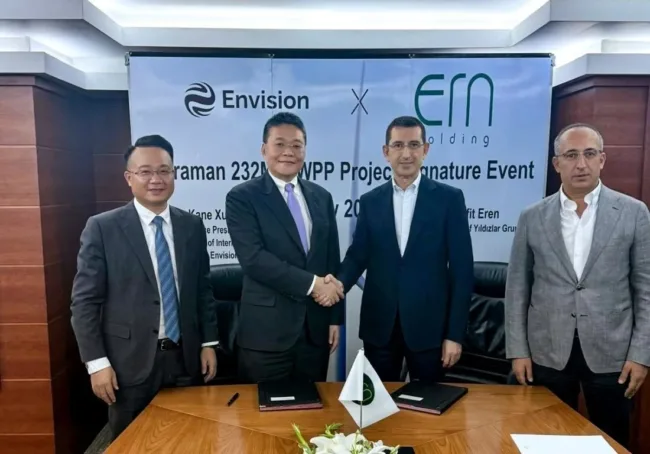
Envision Energy has officially entered the Turkish wind power market through a landmark 232-megawatt (MW) project in Karaman, developed in partnership with ERN Holding and Yildizlar Group. Announced during the Turkish Wind Energy Congress (TWEC) in Izmir, this marks the first wind project by Envision Energy in Turkey and signals the start of what the Chinese green technology multinational calls a “long-term strategic presence” in the region.
The project is not only a milestone for Envision Energy but also a reflection of Turkey’s growing role as a regional renewable energy hub bridging Eastern Europe and Central Asia. With this agreement, Envision Energy joins a select group of international technology providers now actively backing Turkey’s energy diversification efforts.
Envision Energy’s senior vice president and president of international product lines, Kane Xu, described the move as “a breakthrough in a new market” and emphasized its role in accelerating regional net-zero ambitions. He framed the collaboration as central to the company’s global expansion strategy, stating that the Turkish project will serve as a launchpad for growth across Eastern Europe and Central Asia.

How does this project support Turkey’s wind energy goals and energy independence strategy?
Turkey has set an ambitious target to reach 30 gigawatts (GW) of installed wind capacity by 2035. As of May 2025, the country had already surpassed the 13GW mark, with wind power supplying more than 11% of national electricity demand. This surge is backed by government policy that prioritizes renewable investments, including generous incentives, grid access reforms, and local manufacturing provisions.
The 232MW Karaman project adds material scale to these efforts, especially as it taps into global engineering expertise through Envision Energy’s turbine technology and project management systems. According to Mufit Eren, chairman of Yildizlar Group, the partnership will strengthen Turkey’s energy independence while delivering “long-term value” to citizens.
By leveraging local development capabilities and Envision’s international experience, the project is designed to meet both national capacity goals and grid modernization requirements. Institutional stakeholders are viewing such partnerships as key enablers of Turkey’s path toward becoming a net energy exporter in the broader Eurasian energy corridor.
What role does Yildizlar Group play in Turkey’s energy transition, and why partner with Envision?
Yildizlar Group, in conjunction with ERN Holding, has emerged as one of the most prominent developers of wind and energy storage infrastructure in Turkey. The firm has already participated in multiple wind tenders and has a portfolio of clean energy assets under development across multiple provinces.
In selecting Envision Energy, Yildizlar is aligning with a globally recognized leader in wind turbine manufacturing and renewable project execution. The two companies intend to create a replicable model that combines global turbine technology with local development and permitting knowledge—especially valuable in Turkey, where environmental and municipal approvals vary widely by region.
Eren described Envision as a “reliable and visionary partner” and noted that the agreement goes beyond short-term business metrics. He characterized the project as a joint responsibility toward national development and sustainability.
How does Envision Energy’s entry into Turkey reflect its broader global clean energy strategy?
The Karaman project marks a critical geographic expansion for Envision Energy, which has steadily grown its global footprint across Asia, Europe, and Latin America. While Envision’s wind turbines are already operating in markets such as Vietnam, Mexico, and Kazakhstan, this is the first time the company is directly executing a utility-scale project in Turkey—a market often seen as a gateway to both European and Central Asian renewables demand.
Institutional observers noted that Turkey’s strategic location and growing domestic wind supply chain make it an ideal base for regional operations. For Envision, this is not just a market entry—it’s a statement of intent. The company is positioning itself to participate in large-scale public-private partnerships across the region and to supply smart turbine systems for hybrid wind-storage deployments.
The partnership with Yildizlar also mirrors Envision’s model in other markets where it co-develops projects while offering digital operation platforms and performance analytics—turning turbines into smart grid nodes.
What is the institutional sentiment toward this deal, and how does it align with energy investor strategies?
The announcement has been viewed positively by clean energy investors and institutional players tracking the Turkish renewables market. While no public financials have been disclosed for the 232MW project, past deals in the region of similar scale have ranged between $250 million and $350 million depending on land and interconnection costs. Analysts note that Turkey’s stable feed-in tariff framework and grid integration momentum reduce risk premiums for such projects.
From a geopolitical lens, Turkey’s increasing alignment with European climate directives, alongside its push for energy autonomy from imported fossil fuels, makes it a compelling investment arena for foreign renewable developers. Institutional flows into Turkish energy infrastructure have increased over the past year, with foreign direct investment focusing on wind, solar, and grid modernization.
The Envision–Yildizlar announcement is expected to boost confidence further by demonstrating the feasibility of high-tech cross-border collaboration in a heavily regulated energy sector. While Envision is not publicly listed, the deal’s visibility may indirectly influence peer companies in China, Europe, and the Middle East that are exploring expansion into Turkey’s liberalizing power market.
What can we expect next from Envision Energy in Turkey and the broader region?
While this is Envision Energy’s first project in Turkey, it is unlikely to be the last. The company hinted at deeper involvement in Turkey’s energy ecosystem, including the potential for storage and digital grid management offerings. Analysts also expect Envision to bid in upcoming YEKA wind tenders and potentially set up local assembly or R&D centers depending on demand trajectories.
Beyond Turkey, the firm’s expansion strategy appears aimed at the larger Eastern Europe and Central Asia region, where renewable targets are being raised amid tightening EU emissions directives and growing regional energy demand. Envision’s ability to deploy integrated solutions—including turbine hardware, storage systems, and AI-based energy management—may offer it a competitive edge in these increasingly complex procurement environments.
With energy security and decarbonization both high on national agendas, stakeholders see the Envision–Yildizlar model as a replicable blueprint for other middle-income economies seeking to scale wind power without sacrificing project efficiency or cost control.
Discover more from Business-News-Today.com
Subscribe to get the latest posts sent to your email.

