Elementl Power has started developing a privately financed nuclear power plant of up to 1.5 gigawatts in Meigs County, Ohio, using GE Vernova Hitachi Nuclear Energy’s BWRX-300 small modular reactor technology. The independent developer has signed an Early Works Agreement with GE Vernova Hitachi Nuclear Energy and agreed to acquire a nearly 700-acre site from American Municipal Power along the Ohio River in Letart Township. Elementl Power has also requested permission from PJM Interconnection to connect an initial 600 megawatts of generation to the regional transmission network. Construction of the first reactor is targeted to begin in 2030, subject to financing, regulatory approvals and a final investment decision, with completion expected in 2034. The proposal gives GE Vernova Inc. (NYSE: GEV) another potentially large deployment opportunity, but Elementl Power must still convert an early-stage development platform into a licensed, contracted and fully financed nuclear project.
Why does Elementl Power’s 1.5 GW Ohio nuclear proposal matter for the US power market?
The scale of the proposal immediately separates it from many early small modular reactor announcements. A completed 1.5-gigawatt facility would be equivalent to five 300-megawatt BWRX-300 reactors, creating a multi-unit nuclear campus rather than a single demonstration plant. That configuration could provide enough continuous generation to support a significant regional load while allowing Elementl Power to build capacity in stages.
The staged structure is commercially important because nuclear developers do not necessarily need to finance and construct all five units simultaneously. Elementl Power could initially focus on the first two reactors represented by its 600-megawatt PJM Interconnection request, establish a regulatory and construction template, and then add subsequent units if costs, demand and project performance justify expansion.
That approach could reduce the amount of capital exposed before the first unit demonstrates operational reliability. It could also create repeatable engineering, procurement and workforce benefits across later reactors. The theoretical advantage of small modular reactors is not merely smaller unit size. It is the opportunity to repeat a standardised design rather than treating every reactor as a largely bespoke megaproject.
The Ohio proposal also arrives as electricity demand is rising across the PJM Interconnection region. Data centres, artificial intelligence infrastructure, manufacturing investment and wider electrification are increasing pressure on utilities and grid operators to secure dependable capacity. Wind, solar and battery projects will remain essential, but corporate buyers and utilities are also seeking generation capable of operating through nights, seasonal weather changes and extended periods of low renewable output.
A multi-unit nuclear facility could meet that need, but its relevance will depend on timing. A first unit completed in 2034 does little to resolve near-term supply constraints. Elementl Power must therefore convince customers and investors that demand will remain strong enough over the following decades to justify committing capital several years before commercial operation.
What does the Early Works Agreement with GE Vernova Hitachi actually accomplish?
The Early Works Agreement gives Elementl Power a defined reactor technology and allows project-specific development work to move forward with GE Vernova Hitachi Nuclear Energy. The companies have not disclosed the financial value or detailed scope of the agreement, meaning it should not be confused with a final reactor supply contract or an irreversible construction order.
Its strategic value is still substantial. Nuclear development requires the plant design, site characteristics, regulatory strategy, grid connection and construction plan to advance together. Selecting the BWRX-300 allows Elementl Power to begin aligning the Meigs County site with a specific reactor configuration rather than continuing with a technology-neutral concept.
GE Vernova Hitachi Nuclear Energy can contribute design information, licensing support, site integration work and early engineering needed for future regulatory submissions. Elementl Power can use that work to refine land requirements, cooling arrangements, transmission infrastructure, construction sequencing and cost assumptions.
The agreement also gives GE Vernova Hitachi Nuclear Energy another potential fleet-scale customer in the United States. A five-unit deployment would be more commercially meaningful than a single demonstration reactor because it would create recurring demand for reactor components, engineering services, fuel-related support and long-term maintenance.
However, the agreement does not guarantee that all five reactors will be ordered. Elementl Power must complete due diligence on the property, secure regulatory permissions, negotiate grid arrangements, identify power buyers and raise construction capital. If these conditions do not produce an acceptable risk-adjusted return, the project could be delayed, reduced in scale or abandoned.
The next contractual milestone will therefore matter more than the Early Works Agreement itself. Investors should watch for a detailed development agreement, reactor supply contract, engineering and construction appointment, or final investment decision that commits significantly larger amounts of capital.
Why is the 700-acre Meigs County site commercially relevant to the project strategy?
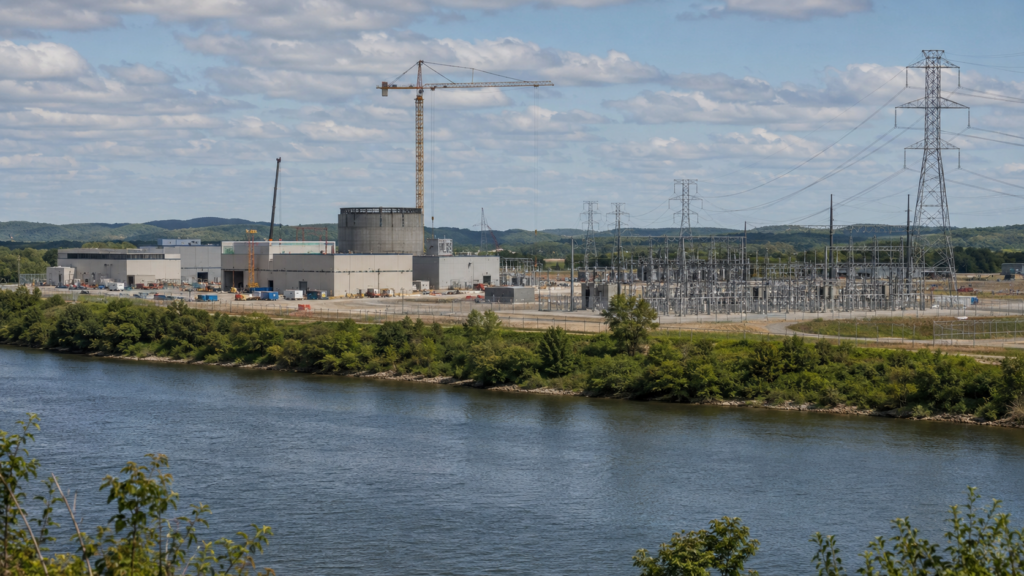
The proposed property is located along the Ohio River in Letart Township, around 100 miles southeast of Columbus. River access can support cooling-water planning and heavy-component logistics, although the eventual cooling design and environmental conditions have not yet been disclosed.
The property’s size provides space for multiple reactor units, supporting infrastructure, security zones, construction laydown areas and transmission equipment. A five-reactor campus requires more than reactor buildings. It also needs turbine systems, cooling facilities, warehouses, emergency infrastructure, roads, workforce facilities and areas for major component assembly.
Elementl Power has agreed to purchase the site from American Municipal Power, but the announcement did not confirm that the acquisition has closed. Completion of the purchase, environmental investigations, geological studies and title-related due diligence remain important development steps.
The location has a long energy-development history. American Municipal Power previously pursued a large coal-fired generation project in Meigs County before cancelling that plan. Reusing land originally considered for major power infrastructure could provide advantages if existing studies, transportation access or transmission planning remain relevant. It does not automatically make the property suitable for nuclear development, because nuclear projects require a much more demanding site assessment.
The Ohio River location also introduces responsibilities around flooding, water use, aquatic ecosystems and emergency planning. Elementl Power will need to demonstrate that the site can safely support the BWRX-300 design under extreme weather, seismic and hydrological conditions.
Community acceptance will be another decisive factor. Nuclear facilities can provide high-value employment, local tax revenue and long operating lives, but residents will expect credible answers on safety, water use, waste management, construction traffic and emergency preparedness. Early engagement is particularly important because the regulatory process will provide several opportunities for public scrutiny.
How could Elementl Power finance the Ohio nuclear plant without charging ratepayers?
Elementl Power has said the proposed plant would be privately financed and would not be paid for through electricity customer rates. This is a strategically attractive promise, but it creates a demanding capital-formation challenge because the developer must secure investors and lenders willing to absorb development, regulatory and construction risk.
The total project cost has not been disclosed. That absence is understandable at this stage because the final number will depend on the number of units included in each phase, site conditions, labour agreements, financing costs, equipment pricing and the extent of shared infrastructure between reactors.
Elementl Power’s business model focuses on developing and financing utility-scale nuclear plants from site selection through commercial operation. The company presents itself as a capital-efficient developer that can use joint-development and build-transfer structures, allowing utilities, data-centre operators or infrastructure investors to participate without carrying all early-stage development risk.
In practical terms, the Ohio project could require several layers of capital. Elementl Power and its investors may fund early development and licensing. A large technology company, utility or power buyer could provide additional development capital or sign a long-term electricity agreement. Infrastructure funds could contribute equity once regulatory and construction risks become clearer, while debt financing would probably become more realistic after revenue contracts and major approvals are secured.
Elementl Power is backed by Energy Impact Partners, an investment platform with more than $4 billion under management. The developer also has a separate strategic agreement under which Google is providing early-stage capital for three potential advanced nuclear sites, each targeting at least 600 megawatts.
Elementl Power has not identified the Ohio plant as one of those three Google-supported sites, and no project-specific Google power contract has been announced. That distinction matters. The wider relationship demonstrates access to sophisticated corporate energy buyers, but it should not be treated as evidence that the Meigs County project already has an offtaker.
The most important commercial milestone may therefore be a long-term power purchase agreement or similar revenue contract. Private financing becomes easier when lenders can rely on predictable cash flows from a creditworthy buyer. Without contracted revenue, investors would be exposed to wholesale electricity prices more than a decade into the future.
Why has Elementl Power selected the BWRX-300 rather than remaining technology neutral?
Elementl Power promotes a technology-neutral development model, allowing it to select reactor designs based on project requirements rather than committing its entire pipeline to one supplier. Choosing the BWRX-300 for Ohio indicates that the company believes this design currently offers the strongest combination of licensing maturity, construction readiness and potential fleet deployment.
The BWRX-300 is a roughly 300-megawatt water-cooled boiling-water reactor that relies on natural circulation and passive safety systems. GE Vernova Hitachi Nuclear Energy has designed the reactor to reduce the number of components and the volume of construction materials compared with conventional large reactors.
Simplification is central to the investment case. Large nuclear projects have frequently suffered from complex construction interfaces, site-specific redesigns and extensive field fabrication. GE Vernova Hitachi Nuclear Energy is attempting to reduce those risks through standardisation, modular construction methods and greater use of repeatable equipment.
The design is no longer supported only by studies and marketing material. Ontario Power Generation has started construction-related work for the first BWRX-300 at the Darlington New Nuclear Project in Canada, with commercial service targeted by the end of 2030. Tennessee Valley Authority has also submitted a construction permit application for a BWRX-300 at the Clinch River Nuclear Site in Tennessee.
These projects could materially benefit Elementl Power. Licensing reviews, component manufacturing and construction experience from Darlington and Clinch River may reduce uncertainty before the Ohio project reaches its planned 2030 construction start.
The risk is that Elementl Power’s schedule depends partly on those earlier deployments progressing successfully. Cost overruns, design modifications, supply-chain delays or licensing complications at the first projects could affect later customers. A standardised fleet creates learning benefits when the design performs well, but it can also transmit common problems across multiple developments.
What does the initial 600 MW PJM Interconnection request reveal about project phasing?
Elementl Power has requested a connection for the first 600 megawatts of output, which corresponds to two BWRX-300 units rather than the full five-reactor plan. PJM Interconnection is expected to review the request and provide a response later in 2026.
This suggests the initial commercial phase could comprise two reactors. A 600-megawatt first phase would be large enough to support a significant industrial, utility or data-centre customer while limiting the capital required before the construction process has been demonstrated.
The connection request is an essential step because new generation cannot create value without a viable route into the grid. PJM must assess whether the existing transmission network can accept the output and whether additional substations, lines or system upgrades are required.
Those upgrades can materially affect project cost and schedule. If the site requires extensive new transmission infrastructure, Elementl Power may need to fund or negotiate responsibility for that work. Delays in grid studies could also complicate licensing, power contracting and financial close.
A 1.5-gigawatt nuclear site could eventually become a substantial regional generation hub. The first 600 megawatts would establish the grid interface, while later units could use shared transmission and site infrastructure if capacity is available.
However, Elementl Power should not assume that approval for 600 megawatts guarantees a straightforward route for the remaining 900 megawatts. Each expansion phase may require additional studies and system investment, especially as PJM’s future generation and load mix evolves.
Which regulatory approvals could determine whether construction begins in 2030?
The project requires approvals from the United States Nuclear Regulatory Commission, the Ohio Power Siting Board and other state and federal agencies. Elementl Power has not yet disclosed which Nuclear Regulatory Commission licensing pathway it will use or when it expects to submit its principal application.
The Nuclear Regulatory Commission process will examine reactor safety, site characteristics, environmental impacts, emergency planning, security and the developer’s technical and financial qualifications. Even though the BWRX-300 is being reviewed through other United States activities, Elementl Power must still obtain site-specific authorisation.
The Ohio Power Siting Board will evaluate the project’s state-level implications, including transmission facilities, environmental effects and public-interest considerations. Additional permits may cover water withdrawals, discharges, wetlands, construction activity and endangered species.
The four-year period between the announcement and the targeted 2030 construction start is ambitious. Site studies, licensing documents, public consultations, engineering development and commercial negotiations must proceed in parallel rather than sequentially.
Elementl Power can improve schedule credibility by using regulatory work already completed for the BWRX-300 and by engaging agencies before formal applications are submitted. Early discussions can identify information gaps before they become reasons for delay.
However, regulatory acceleration cannot substitute for complete technical evidence. A project intended to operate for several decades must demonstrate safety and environmental compliance under normal and extreme conditions. The investment case depends on regulatory predictability, not on lowering the approval standard.
What does the Ohio opportunity mean for GE Vernova and GEV investor sentiment?
GE Vernova Inc. shares closed at $1,109.73 on June 18, 2026, after gaining approximately 5.8% during the session. The stock had advanced around 22.4% over five trading days and approximately 9.6% over one month, while its 52-week range stood between $479.04 and $1,181.95.
The shares were therefore trading less than 7% below their 52-week high when the Elementl Power project was announced. That reflects strong investor enthusiasm around electricity demand, grid equipment, gas turbines, nuclear technology and the infrastructure required for artificial intelligence data centres.
The Ohio agreement supports the long-term nuclear component of that investment case, but it does not create near-term reactor revenue on the scale implied by a five-unit project. The Early Works Agreement is an initial development arrangement, and construction of the first unit is not expected to begin before 2030.
GE Vernova investors should view the project as pipeline validation rather than booked certainty. If Elementl Power secures licensing, financing and power contracts, the opportunity could evolve into reactor equipment, engineering and service revenue. If the project stalls, the current commercial contribution may remain limited to early development work.
The wider value lies in fleet effects. GE Vernova Hitachi Nuclear Energy is building a network of BWRX-300 projects across Canada, the United States and Europe. Each additional customer can increase manufacturing volume, spread engineering costs and strengthen the supply chain.
The market has already priced significant growth into GE Vernova shares. Strong five-day momentum and proximity to the 52-week high indicate bullish sentiment, but they also raise the risk of disappointment if order conversion, margins or project schedules fail to meet expectations. Nuclear announcements are valuable, but investors eventually require binding contracts, deposits and revenue.
What milestones would show that the Ohio BWRX-300 project is moving beyond an announcement?
Completion of the land acquisition would be an early confirmation that Elementl Power is committing further capital to the site. Detailed environmental, geological and water studies would then demonstrate whether the property can support the proposed reactor campus.
A favourable response from PJM Interconnection on the initial 600-megawatt request would clarify grid-upgrade requirements and provide a stronger basis for customer negotiations. A difficult or expensive connection study would not necessarily stop the project, but it could alter the economics.
The next major milestones should include a defined Nuclear Regulatory Commission licensing strategy, submission schedule and formal engagement with the Ohio Power Siting Board. Elementl Power will also need to identify engineering, procurement and construction partners capable of executing a multi-unit nuclear programme.
A named power buyer would materially improve project credibility. Utilities, data-centre operators and major industrial customers are logical candidates because they value long-duration, around-the-clock electricity supply. The contract structure must support debt repayment while preserving acceptable returns for equity investors.
Financing disclosure will be the decisive test. Elementl Power has stated that the plant will be privately financed, but it has not identified committed construction investors or lenders. A credible financing plan should explain how development capital, equity, debt, government support and customer contracts will interact.
The final investment decision will separate a potentially valuable project from a development-stage proposal. Until then, the Ohio plant should be viewed as a strategically credible opportunity with meaningful site, technology and grid progress, but with substantial capital and regulatory work still ahead.
What are the key takeaways from Elementl Power’s proposed Ohio nuclear project?
- Elementl Power is developing an Ohio nuclear campus of up to 1.5 gigawatts using five GE Vernova Hitachi BWRX-300 reactors.
- The initial PJM Interconnection request covers 600 megawatts, suggesting the first commercial phase may contain two reactors.
- Construction of the first unit is targeted for 2030, with completion expected in 2034, subject to licensing and investment approval.
- The nearly 700-acre Ohio River site offers room for a multi-unit campus but still requires extensive environmental and technical assessment.
- Elementl Power intends to use private financing rather than recovering construction costs directly from electricity ratepayers.
- No project cost, power buyer or committed construction financing package has yet been disclosed.
- Elementl Power’s backing from Energy Impact Partners strengthens its capital-development credentials, while its wider Google relationship demonstrates access to large electricity buyers.
- GE Vernova gains another potential fleet-scale BWRX-300 customer, but the Early Works Agreement is not yet a final reactor order.
- GE Vernova shares were trading near their 52-week high, reflecting bullish power-infrastructure sentiment and elevated execution expectations.
- Land completion, PJM studies, regulatory filings, an offtake agreement and financial close are the milestones that would materially de-risk the project.
Discover more from Business-News-Today.com
Subscribe to get the latest posts sent to your email.