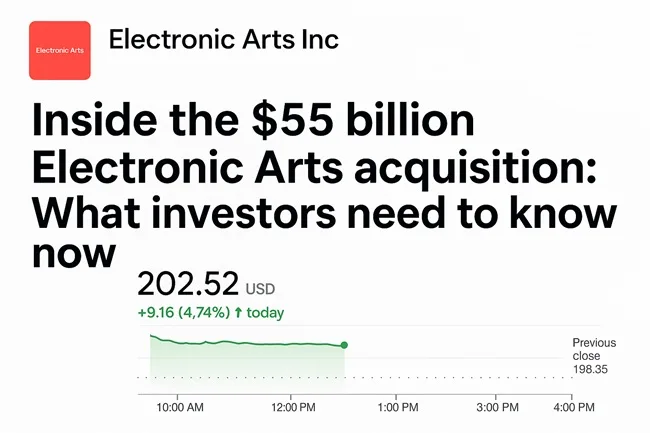



Electronic Arts Inc. (NASDAQ: EA) has moved closer to completing its US$55 billion sale to a consortium led by Saudi Arabia’s Public Investment Fund, Silver Lake and Affinity Partners. The European Commission is expected to approve the transaction without conditions under both its merger-control and foreign-subsidy frameworks, according to people familiar with the regulatory reviews. No formal European decision has yet been announced, with the preliminary competition review scheduled to conclude on July 22 and the foreign-subsidy review expected to end on July 30. Electronic Arts shares closed at US$208.90 on July 17, leaving investors just US$1.10 below the consortium’s US$210 cash offer. The central question is shifting from whether Europe will block the largest leveraged buyout in history to whether the remaining US national-security process can be completed before the transaction’s outside date.
Why would European Union clearance materially improve the outlook for Electronic Arts’ US$55 billion buyout?
Unconditional European approval would eliminate two important sources of regulatory uncertainty from the Electronic Arts transaction. The European Commission has been assessing the acquisition through its conventional merger-control process and through the Foreign Subsidies Regulation, which gives regulators additional authority to investigate whether financial support from a non-European government could distort competition inside the European Union.
The competition review appears relatively straightforward because the buyers are primarily financial investors rather than competing video-game publishers. The consortium is not combining Electronic Arts with another major developer or transferring its franchises to a direct industry rival. That reduces the horizontal competition concerns that complicated Microsoft Corporation’s acquisition of Activision Blizzard.
The foreign-subsidy review is more strategically significant because the Public Investment Fund is Saudi Arabia’s sovereign wealth fund and will provide most of the capital supporting the transaction. European regulators have demonstrated that they are prepared to investigate state-backed acquisitions closely, particularly when government-linked funding could give a buyer financing advantages unavailable to private competitors.
If the reported expectation of unconditional clearance proves correct, the decision would suggest that the Commission found insufficient evidence that the consortium’s financial support would distort the European gaming market. It would also prevent the deal from becoming another prolonged foreign-subsidy investigation requiring governance commitments, financial remedies or restrictions on the target’s European operations.
How is the PIF, Silver Lake and Affinity Partners acquisition of Electronic Arts being financed?
The consortium agreed to acquire Electronic Arts for US$210 per share in cash, valuing the company at approximately US$55 billion, including debt. The offer represented a 25% premium to Electronic Arts’ unaffected closing price of US$168.32 on September 25, 2025, shortly before reports of the transaction emerged.
The financing structure combines approximately US$36 billion of equity with as much as US$20 billion of committed debt financing. JPMorgan Chase Bank is providing the debt commitment, with approximately US$18 billion expected to be funded when the acquisition closes. The Public Investment Fund will also roll over its existing 9.9% Electronic Arts stake rather than cashing out alongside other shareholders.
The scale of the equity contribution provides the transaction with more financial support than a conventional private-equity buyout. Nevertheless, the debt component would still represent a substantial increase from Electronic Arts’ existing borrowings and would materially change the company’s capital structure.
The acquisition is expected to become the largest all-cash sponsor take-private transaction and the largest leveraged buyout ever completed. Its scale explains why the consortium needs a combination of sovereign capital, private-equity funding and one of the largest acquisition-financing packages assembled for a technology or entertainment company.
Electronic Arts shareholders overwhelmingly approved the transaction in December 2025. The agreement also includes termination protections and an outside date of September 28, 2026, which can automatically extend to December 28 if required regulatory approvals remain outstanding and the other closing conditions have been satisfied or remain capable of being satisfied.
Why does Electronic Arts’ business model support a record leveraged buyout despite the debt burden?
Electronic Arts offers several characteristics that are attractive to leveraged-buyout investors. Its annual sports releases, live-service games, downloadable content and recurring digital spending generate cash flows that are more predictable than those of publishers relying exclusively on occasional blockbuster launches.
For the financial year ended March 31, 2026, Electronic Arts reported record net bookings of US$8.026 billion, representing 9% annual growth. Net revenue increased 1% to US$7.531 billion, while operating cash flow climbed 23% to US$2.553 billion. Those results demonstrate why lenders may be comfortable supporting an unusually large debt package.
Battlefield 6 became the best-performing Battlefield title within a single Electronic Arts financial year. The company also recorded mid-single-digit growth in global football net bookings, supported by EA Sports FC 26, FC Online and FC Mobile. Apex Legends delivered its strongest bookings quarter of the financial year during the fourth quarter.
These franchises provide multiple revenue streams across consoles, personal computers and mobile devices. Electronic Arts also controls valuable intellectual property through The Sims, Madden NFL, College Football and other established series, reducing its dependence on a single product.
The risks remain substantial. Video-game development costs continue to rise, release delays can disrupt annual financial targets and players can quickly reject aggressive monetisation strategies. A heavily leveraged Electronic Arts would have less flexibility to absorb several underperforming launches, especially if interest and principal payments consume a larger share of operating cash flow.
What does the European Union’s foreign-subsidy review reveal about sovereign-backed acquisitions?
The Electronic Arts review is becoming an important test of how European regulators approach large technology and entertainment acquisitions financed by sovereign wealth funds. The Foreign Subsidies Regulation was designed to prevent companies supported by non-European governments from gaining an unfair advantage when buying European assets, competing for public contracts or operating within the single market.
Electronic Arts is headquartered in the United States, but it has a large European customer base, regional operations and substantial revenue exposure to the European gaming market. That gives the Commission jurisdiction to examine whether Saudi state-linked funding could distort competition even though the target itself is not European.
The Commission has previously imposed closer scrutiny on major state-backed transactions involving groups such as Abu Dhabi National Oil Company and Emirates Telecommunications Group. Those cases demonstrated that foreign-subsidy reviews can produce lengthy investigations and binding commitments involving governance, financing and commercial conduct.
A clean Electronic Arts approval would not remove regulatory scrutiny from future sovereign-backed acquisitions. It would, however, show that the presence of government capital is not automatically enough to trigger remedies. Regulators must still identify a credible connection between the financial contribution and a potential distortion of competition inside Europe.
Why does CFIUS approval remain the most consequential unresolved condition for Electronic Arts?
The expiration of the US Hart-Scott-Rodino waiting period in February removed the principal American antitrust obstacle. However, the Committee on Foreign Investment in the United States, or CFIUS, remains a critical part of the closing process because the transaction would transfer control of a major American interactive-entertainment company to a consortium dominated by a foreign sovereign investor.
CFIUS reviews transactions for national-security concerns rather than traditional competition issues. Potential considerations could include the handling of user information, access to technology, cybersecurity practices, relationships with American sports organisations and the governance rights granted to foreign investors.
There is no formal indication that CFIUS intends to block the acquisition. The significance of the review arises from the transaction’s size, the proposed ownership structure and the Public Investment Fund’s expected controlling position. Regulatory filings have indicated that PIF would own more than 90% of the acquiring entity after completion.
The passing of the transaction’s originally anticipated closing window increases the importance of the remaining timetable. The contractual extensions provide additional flexibility, but investors will want evidence that the parties can obtain CFIUS approval before the final December deadline.
Possible outcomes include unconditional approval, approval subject to mitigation agreements, an extended investigation or a recommendation against the transaction. Mitigation measures could address data access, board representation, security protocols or the separation of sensitive operations, although no such requirements have been publicly announced.
What does Electronic Arts’ US$208.90 share price reveal about investor confidence in the transaction?
Electronic Arts closed at US$208.90 on July 17, up 0.51% during the session, after touching a record intraday high of US$209.19. The stock is now only US$1.10, or approximately 0.53%, below the US$210 cash consideration.
The narrow spread indicates that investors assign a high probability to completion. Electronic Arts shares have gained approximately 1.2% over five trading days, 2.9% over one month and 39.2% over the past 52 weeks. The stock’s 52-week range is US$146.97 to US$209.19.
That performance reflects the takeover premium and the gradual removal of regulatory uncertainty. Expected European approval offers another reason for merger-arbitrage investors to accept a relatively small remaining return.
The risk-reward profile is nevertheless asymmetric. Investors buying near US$209 can earn only about US$1 per share if the acquisition closes at US$210. If the deal collapses, the shares could lose a much larger amount as the takeover premium unwinds.
Electronic Arts’ improved financial performance may support a higher standalone valuation than the unaffected US$168.32 reference price used when the acquisition was announced. However, record bookings would not necessarily prevent a significant decline if investors were suddenly required to value the company without the certainty of a cash offer.
How could private ownership reshape Electronic Arts’ studios, franchises and investment priorities?
Private ownership could allow Electronic Arts to make decisions across longer development cycles without managing quarterly public-market expectations. The company could invest more aggressively in new intellectual property, gaming technology, artificial intelligence, global distribution and the expansion of its largest franchises into broader entertainment ecosystems.
Chief executive Andrew Wilson is expected to continue leading the business, while Electronic Arts will remain headquartered in Redwood City, California. That continuity reduces near-term operational disruption and gives the consortium an experienced management team with established relationships across sports, technology and entertainment.
The debt structure creates a competing pressure. The new owners will need Electronic Arts to preserve margins, produce reliable cash flow and avoid expensive development failures. That could encourage tighter studio oversight, portfolio reviews, selective cost reductions and a stronger emphasis on proven franchises.
Players and employees will therefore watch whether private ownership increases creative investment or produces more aggressive monetisation and efficiency measures. The most likely outcome is a combination of both. The consortium can provide patient capital for high-value projects, but the acquisition financing will still demand financial discipline.
The transaction could also reduce transparency. Once Electronic Arts is removed from Nasdaq, investors, employees and industry observers will receive less detailed financial information about individual franchises, restructuring programmes and capital-allocation decisions.
What would the Electronic Arts acquisition mean for Saudi Arabia’s wider gaming and entertainment strategy?
The acquisition would give the Public Investment Fund control of one of the world’s most influential video-game publishers. That would significantly expand Saudi Arabia’s position across gaming, esports, sports entertainment and digital media.
Electronic Arts’ portfolio is particularly relevant because several of its largest franchises are connected to global sports. EA Sports FC, Madden NFL and College Football sit at the intersection of gaming, media rights, sponsorship, fan engagement and live events. Those characteristics could support PIF’s broader effort to create links between physical sports, esports, tourism and entertainment.
Electronic Arts would also give PIF exposure to large communities of players across North America, Europe and Asia. Its franchises offer opportunities for mobile expansion, regional esports competitions, licensing agreements and new forms of digital entertainment.
The strategic logic should not be confused with guaranteed operational synergies. Electronic Arts’ value depends on maintaining player trust, preserving creative talent and delivering technically reliable games. Attempts to force connections with unrelated portfolio assets could damage individual franchises if they are not supported by authentic consumer demand.
The acquisition’s success will ultimately be judged by whether Electronic Arts can continue growing bookings and cash flow while improving the quality and durability of its games. Financial engineering alone will not protect the consortium from the hit-driven risks of interactive entertainment.
What are the key takeaways from the expected European clearance of Electronic Arts’ US$55 billion buyout?
- The European Commission is expected to approve the acquisition without conditions under both its competition and foreign-subsidy reviews, although formal decisions have not yet been announced.
- The US$210 cash offer values Electronic Arts at approximately US$55 billion and represents the largest proposed leveraged buyout in corporate history.
- The consortium is supporting the acquisition with approximately US$36 billion of equity and as much as US$20 billion of debt financing committed by JPMorgan Chase Bank.
- Electronic Arts’ record US$8.026 billion of annual net bookings and US$2.553 billion of operating cash flow strengthen the financial case for the transaction.
- CFIUS approval remains the most consequential outstanding condition because the acquisition would place a major American gaming company under foreign sovereign-backed control.
- Electronic Arts shares finished at US$208.90, leaving only 0.53% of potential upside to the offer while exposing investors to a substantially larger decline if the transaction fails.
- Private ownership may support longer-term investment in franchises and technology, but acquisition debt will increase pressure for dependable releases, strong margins and disciplined spending.
- Control of Electronic Arts would significantly expand PIF’s global gaming strategy, particularly across the intersection of sports, esports, entertainment and digital fan engagement.
Discover more from Business-News-Today.com
Subscribe to get the latest posts sent to your email.