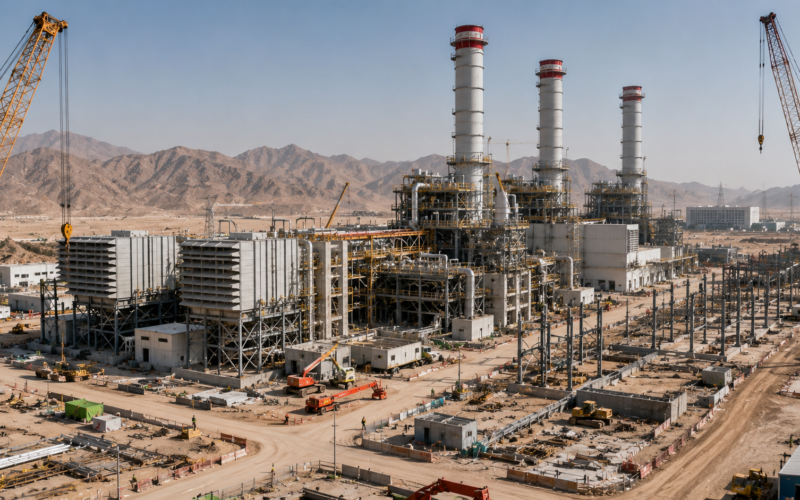
Doosan Enerbility Co., Ltd. (KRX: 034020) has secured a KRW928.14 billion, approximately $670 million, engineering, procurement and construction contract for the 1,700 MW Misfah Independent Power Project in Oman, only two months after winning the 870 MW Duqm combined-cycle power project in the same country. The contract with project company Jabel Power SAOC runs from August 20, 2026 to April 1, 2029 and represents 5.4% of Doosan Enerbility’s 2025 consolidated revenue, making it a materially significant order rather than another routine entry in the company’s large project backlog. Doosan will execute the project with SEPCO3 and directly supply steam turbines and generators for the combined-cycle facility.
Misfah will be built roughly 20 kilometres west of Muscat and is intended to strengthen Oman’s dispatchable generation capacity as electricity demand grows alongside industrial expansion and renewable-energy development. The project developer structure includes Qatar’s Nebras Power QSC, Emirates Utilities Development Company and Oman’s Bahwan Infrastructure Services, with Jabel Power SAOC serving as the contractual project entity.
How large is Doosan Enerbility’s Misfah EPC contract relative to its business?
The exact disclosed contract value is KRW928,136,466,540 excluding value-added tax. The consideration comprises $284.25 million and €323.346 million, with the Korean won figure calculated using exchange rates prevailing on the August 20 contract date. Payments will be invoiced according to construction progress, and there is no disclosed contract deposit or advance payment.
Doosan’s filing places the award at 5.4% of 2025 consolidated revenue, a ratio large enough for execution quality and margin discipline to have a visible influence on future results. The comparison also explains why the announcement deserves attention even though Doosan operates across nuclear, gas turbines, construction, services and other large industrial businesses.
Revenue will not arrive all at once. The contract extends into April 2029, meaning earnings recognition should be spread according to project progress, accounting policies and milestone achievement. The absence of an advance payment also reinforces the importance of working-capital management during the construction period.

What is Doosan Enerbility actually supplying at the 1.7GW Misfah project?
Doosan Enerbility and SEPCO3 will undertake the project on a turnkey EPC basis, covering the engineering, procurement and construction responsibilities required to deliver the combined-cycle facility. Doosan will also directly supply the steam turbines and generators, allowing the company to capture value both as an EPC participant and as an original equipment supplier.
That vertical exposure can be commercially attractive because equipment manufacturing and EPC execution generate different revenue and margin profiles. It also increases responsibility: delays in equipment manufacturing, site construction or systems integration can all affect the same project schedule.
Misfah’s full commercial-operation milestone is tied to April 2029 under the contract disclosure. Oman’s planning documents have separately indicated that approximately 1,203 MW of early capacity could become available during the second quarter of 2028 before the complete 1.7 GW development reaches commercial operation.
Why does Misfah matter more after Doosan’s earlier Duqm contract?
Doosan Enerbility secured an approximately KRW530 billion EPC contract in June for the 870 MW Duqm combined-cycle power plant, also working with SEPCO3 and supplying its own steam turbines and generators. Duqm is planned for the Duqm Special Economic Zone and is likewise targeted for completion in 2029.
Combining the disclosed Misfah and Duqm awards gives Doosan approximately KRW1.46 trillion of recent Oman power EPC contracts covering 2,570 MW of generation capacity. Misfah accounts for about two-thirds of that new capacity and roughly 64% of the combined disclosed contract value.
The pair of contracts therefore changes Doosan’s position in Oman substantially. Instead of supplying a single isolated plant, the Korean group now has major roles in two of the country’s largest upcoming gas-fired generation developments, creating potential procurement, engineering and project-management efficiencies while also concentrating execution exposure within the same national market.
Why is Oman adding 2.57GW of new gas-fired capacity while expanding renewables?
Oman is increasing solar and wind development but still requires dispatchable generation that can respond when renewable output falls or demand rises sharply. Combined-cycle gas plants offer higher fuel efficiency than older thermal technologies and can support a system with increasing variable renewable generation, particularly where storage and transmission infrastructure are still expanding.
Misfah and Duqm are part of a broader generation plan responding to forecast electricity-demand growth. The two projects are also geographically complementary: Misfah supports the main interconnected system near the capital, while Duqm serves a rapidly industrialising economic zone more than 500 kilometres south of Muscat.
Gas generation does create long-term fuel and emissions exposure, so the economic value of these plants will depend partly on utilisation as Oman’s renewable fleet grows. Their role is likely to shift increasingly toward firm capacity and system flexibility rather than simply supplying continuous baseload electricity.
What does the Misfah win say about Doosan Enerbility’s Middle East strategy?
Doosan has been deliberately expanding its gas-power and equipment footprint across the Gulf. Its ability to combine EPC capability with turbine and generator manufacturing gives the company access to projects where customers want a single delivery structure while still procuring critical equipment directly from the contractor.
The company has already cited its project-execution experience in Saudi Arabia, Qatar and neighbouring markets as part of its competitive position in Oman. Misfah strengthens that installed base and could subsequently create service and maintenance opportunities after commercial operation, although no long-term service agreement has been disclosed as part of the current EPC award.
The contract also arrives while Doosan is investing heavily in nuclear and small modular reactor manufacturing, including recent work for TerraPower. Gas-fired EPC therefore remains an important cash-generating part of a portfolio whose strategic narrative increasingly includes nuclear, SMRs and other lower-carbon technologies.
What are the biggest execution risks between now and April 2029?
Misfah’s roughly two-and-a-half-year EPC schedule creates exposure to equipment delivery, civil construction, labour availability, foreign exchange movements and coordination between Doosan Enerbility and SEPCO3. The contract itself states that value and schedule may change as the project proceeds, standard language that nevertheless acknowledges the uncertainty inherent in large turnkey construction programmes.
Foreign exchange deserves particular attention because the contract consideration is split between dollars and euros while Doosan reports in Korean won. Revenue recognition and procurement costs may therefore respond differently to currency movements, depending on the company’s hedging structure and the currencies in which project costs are incurred.
The strategic upside is straightforward: Doosan has secured an order equivalent to 5.4% of annual revenue and lifted its recent Oman CCGT workload to 2.57 GW. The harder task is turning that headline backlog into acceptable margins and on-time commercial operation. For large EPC contractors, winning the project is only the first half of the economics; execution determines whether the order eventually strengthens earnings or merely enlarges revenue.
Discover more from Business-News-Today.com
Subscribe to get the latest posts sent to your email.