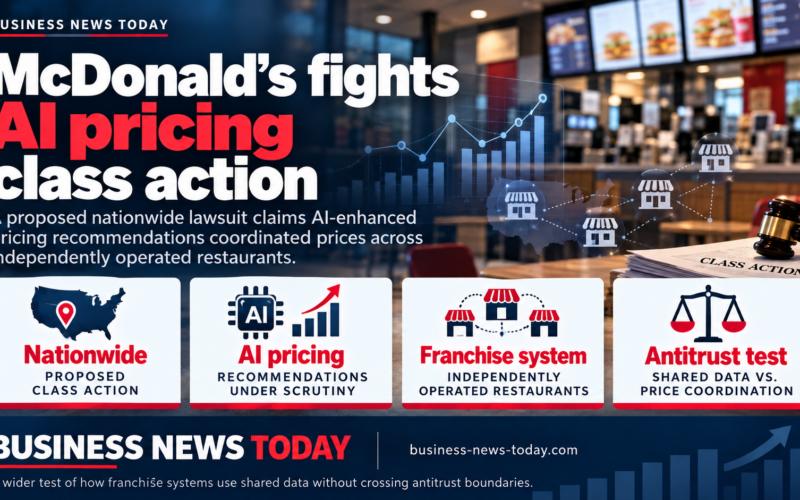
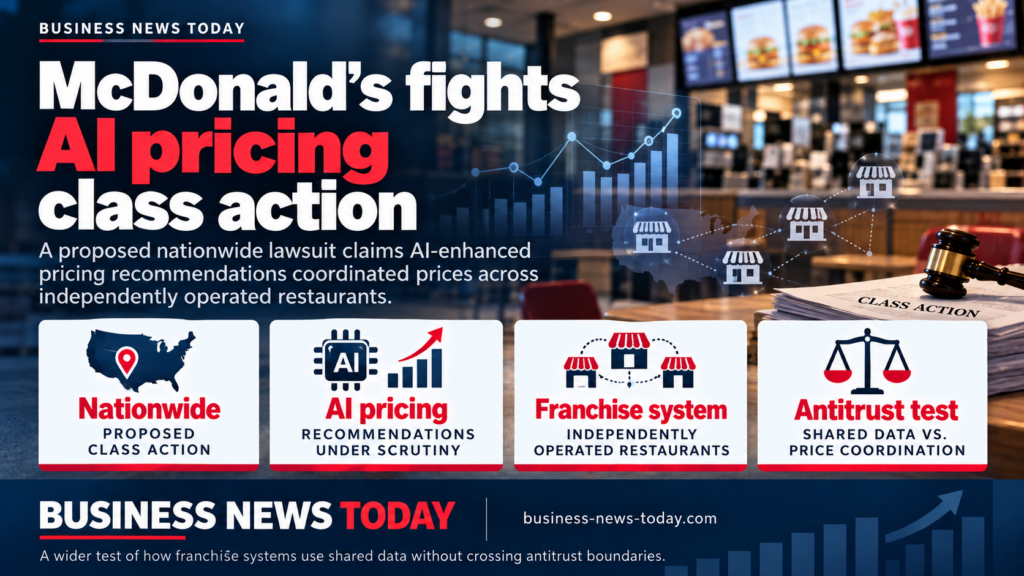
McDonald’s Corporation (NYSE: MCD) is facing a proposed nationwide antitrust class action alleging that its AI-enhanced pricing recommendation system unlawfully coordinates menu prices across independently operated U.S. restaurants. The complaint, filed in the United States District Court for the Northern District of Illinois, alleges that McDonald’s combines nonpublic restaurant information inside a central pricing engine and uses the resulting recommendations in a way that reduces competition among franchisees that would otherwise make pricing decisions independently. McDonald’s Corporation strongly disputes those allegations, maintains that its tools do not set or automatically change menu prices, and says franchisees remain responsible for deciding what customers pay. McDonald’s shares closed at $235.23 on October 9, down about 7% over one month and only around 2.6% above their 52-week low of $229.20, although the legal action has not been established as the primary cause of that weakness. The case matters beyond one burger chain because it could help define how far large franchise systems can use artificial intelligence, transaction data and centralized pricing recommendations without creating new antitrust exposure.
What exactly does the McDonald’s AI pricing lawsuit allege about menu prices and franchise competition?
The case was filed by Illinois consumer Michael Thomas against McDonald’s Corporation and McDonald’s USA, LLC on October 2, 2026. The complaint alleges that the company has operated a centralized machine-learning pricing engine that draws on information from restaurants across the McDonald’s system and generates recommendations for menu prices. The plaintiff argues that independently owned restaurants can compete with one another for customers and that aggregating commercially sensitive information through a common pricing platform could reduce the independence that normally exists between those businesses.
That allegation goes to the heart of Section 1 of the Sherman Act, which broadly prohibits agreements that unreasonably restrain competition. Traditional price-fixing cases usually involve competitors communicating directly or agreeing on prices, but algorithmic pricing creates a more complicated question because the coordination, if any, may occur through shared software rather than through restaurant owners sitting together and discussing menu boards. The complaint seeks damages, class certification and injunctive relief, but those requests remain allegations in an early-stage lawsuit and no court has determined that McDonald’s violated antitrust law.
The plaintiff’s theory also relies heavily on the structure of McDonald’s U.S. restaurant network. Around 95% of McDonald’s restaurants globally are franchised, and the U.S. system is overwhelmingly operated by independent business owners rather than by McDonald’s Corporation itself. That model gives McDonald’s enormous brand and technology influence while leaving individual franchisees responsible for many restaurant-level decisions, which is precisely why the degree of actual pricing independence may become central to the case.
Why does McDonald’s insist that its AI recommendation tool is different from dynamic or personalized pricing?
McDonald’s has responded unusually directly to the broader controversy surrounding its pricing technology. The company says AI does not set the price of a Big Mac, does not change restaurant prices automatically and does not determine what an individual customer pays. McDonald’s also says it does not operate dynamic pricing in which menu prices rise or fall automatically based on factors such as demand, time of day or an individual consumer’s behaviour.
That distinction matters because several different technologies are increasingly being grouped together under the phrase AI pricing even though their commercial and legal implications are different. A recommendation system might analyse restaurant sales, local competitive conditions and other information before suggesting a price to an operator. Dynamic pricing changes prices in response to changing conditions, while personalized pricing can theoretically use information about an individual customer to determine what that particular customer sees or pays.
McDonald’s position is that its system belongs in the first category. Franchisees receive restaurant-specific analysis and recommendations but can choose whether to follow them, meaning people rather than algorithms retain final pricing authority. If that description is borne out through discovery, the company will have a stronger argument that it is supplying business intelligence rather than administering a common price-setting mechanism.
The plaintiff is challenging the practical effect rather than merely the technical description. The key question may become whether recommendations are genuinely optional in commercial reality, how much nonpublic competitor information feeds the model, and whether corporate systems or franchise standards create meaningful pressure to follow suggested prices. Antitrust analysis often depends on what businesses actually do rather than the label attached to a particular software product.
Why could McDonald’s franchise structure make this AI antitrust dispute unusually important?
McDonald’s is not organised like a company that owns 46,000 restaurants and directly dictates every menu price. At June 30, 2026, the system contained 46,028 restaurants worldwide, of which 44,016 were franchised and only 2,012 were company owned and operated. The heavily franchised structure is central to McDonald’s economics because the corporation receives rents, royalties and fees while franchisees commit much of the restaurant capital and absorb substantial local operating risk.
That arrangement has created one of the strongest cash-generating business models in global restaurants, but it also creates legal complexity. Franchisees operate beneath a common brand, share products and technology, participate in national promotions and depend heavily on corporate systems, yet they remain separate businesses in many respects. A pricing platform therefore exists at an awkward intersection between legitimate franchise coordination and competition among independent operators.
McDonald’s has strong reasons to help franchisees make better pricing decisions. Poor pricing can damage traffic, value perception, franchisee profitability and ultimately royalty revenue, while excessively low prices can leave restaurant owners unable to absorb labour, beef, rent and occupancy costs. Centralized analytics can theoretically help restaurants avoid both problems by giving local owners much more sophisticated information than an individual operator could economically assemble alone.
The antitrust question is whether better information becomes too much coordination. If hundreds or thousands of nominally independent restaurants increasingly rely on recommendations generated from shared nonpublic information, courts may have to decide where legitimate system support ends and commercially sensitive information exchange begins. That question could affect franchised hotels, convenience stores, automotive services and other industries just as much as quick-service restaurants.
How does the lawsuit collide with McDonald’s push to improve value and restaurant economics?
The timing is awkward because menu affordability has already become one of McDonald’s most important strategic issues. Consumer pressure from food, housing and energy costs has made value a major battleground across U.S. restaurants, particularly among lower-income customers who can reduce restaurant visits quickly when prices move beyond their budgets. McDonald’s has been trying to rebuild value perceptions without forcing franchisees into promotions that undermine store-level profitability.
That creates a genuine economic tension. A global restaurant company wants recognizable price points and national offers that consumers can understand, while franchisees operate in markets where wages, rents, taxes and competitor prices can vary dramatically. Greater local pricing flexibility can protect franchisee economics, but highly inconsistent pricing can create consumer frustration when customers expect a national brand to offer roughly comparable value from one location to another.
McDonald’s latest corporate strategy places even greater emphasis on restaurant productivity and franchisee returns. McDonald’s NEXT, unveiled in September, links menu development, consumer relationships, restaurant modernization and employee operations with a goal of generating more guest visits while improving restaurant-level efficiency. The company has also outlined billions of dollars of support intended to help franchisees finance the next phase of restaurant investment.
The lawsuit therefore lands while McDonald’s is asking the franchise system to make important capital and operating decisions together. If litigation forces the company to modify how pricing information is gathered or distributed, management may have to preserve local pricing independence while still giving operators enough data to run increasingly complex restaurants. That is a far more consequential business issue than the simplistic question of whether a computer chooses the price of french fries.
Could the McDonald’s lawsuit change how restaurant chains use artificial intelligence for pricing?
The restaurant industry is adopting artificial intelligence because it generates enormous quantities of usable data. Large chains know transaction volumes by daypart, product, store, geography, loyalty profile, weather condition and promotional period, while digital ordering creates even richer information about how consumers respond to prices and offers. AI can analyse those data sets at a scale that restaurant managers could never replicate manually.
Pricing is one of the most economically attractive applications because tiny improvements can become substantial when multiplied across billions of annual transactions. A recommendation that increases average ticket by only a few cents without reducing traffic can create significant systemwide value. Conversely, an overly aggressive price recommendation can damage traffic and customer trust much faster than traditional annual menu adjustments.
That economic potential explains why the McDonald’s case deserves attention even if the company ultimately prevails. Restaurant groups may become more cautious about what information feeds centralized algorithms, how recommendations are communicated and whether franchisees can demonstrate that they genuinely make independent decisions. Technology governance could increasingly become part of franchise compliance rather than something handled exclusively by data-science teams.
The industry may also need clearer language when communicating with consumers. Dynamic pricing, personalized pricing and AI-assisted recommendations generate very different reactions, yet businesses frequently use technical descriptions consumers do not distinguish. Once customers believe an algorithm is calculating the maximum they can be persuaded to pay, reputational damage can emerge even where the underlying technology is considerably less aggressive.
Does McDonald’s latest financial performance give it room to absorb another legal and technology challenge?
McDonald’s enters the litigation with substantial financial strength. Second-quarter revenue increased 4% to approximately $7.1 billion, global systemwide sales reached roughly $37 billion and global comparable sales increased 1.3%. U.S. comparable sales increased 0.8%, a modest result that helps explain why management remains focused on improving domestic traffic and value despite stronger performance elsewhere.
Operating income increased to approximately $3.34 billion in the second quarter, while net income rose to $2.36 billion and diluted earnings per share reached $3.32. For the first six months of 2026, McDonald’s generated $13.62 billion of revenue and $6.29 billion of operating income, illustrating why the company has financial capacity to defend significant litigation and continue investing in technology simultaneously.
The more important financial risk is therefore unlikely to be legal fees alone. If a court eventually restricted the way McDonald’s uses restaurant-level information for pricing recommendations, the economic effect could come through franchisee decision-making, value strategy and technology architecture rather than a single litigation charge. It is far too early to quantify such an outcome, and the company has said it intends to vigorously defend the case.
McDonald’s also has a powerful incentive to protect trust with franchisees. Franchised restaurants generated approximately $4.39 billion of McDonald’s second-quarter revenue through rents, royalties and initial fees, compared with about $2.53 billion of sales from company-operated restaurants. The legal dispute therefore touches a relationship that sits directly at the centre of McDonald’s profit model.
Why is $MCD trading close to a 52-week low despite relatively resilient earnings?
McDonald’s shares closed at $235.23 on October 9, down 0.7% for the session after jumping 2.6% a day earlier. Over the five trading sessions from October 2, the stock has gained about 1.4%, suggesting the immediate market response around the lawsuit has been volatile but not consistent with investors treating the filing as an existential legal shock.
The longer picture is considerably weaker. McDonald’s traded at $253.05 on September 10, putting the October 9 close roughly 7% lower over one month. The stock’s 52-week range stands at approximately $229.20 to $341.75, which means McDonald’s is only around 2.6% above its annual low and approximately 31% below the 52-week high.
That weakness predates the antitrust lawsuit and should not be attributed primarily to the case. Investors have been weighing sluggish restaurant traffic, inflation, pressure on value-conscious consumers, franchisee investment requirements and the substantial capital commitments contained in McDonald’s NEXT strategy. The company’s September strategic update also triggered investor concern around the scale of long-term spending required to modernise the restaurant network.
The AI pricing litigation adds another layer rather than replacing those existing issues. For shareholders, the central question is whether technology continues improving franchisee economics and customer engagement or becomes another area requiring costly adjustment. With the shares already close to a 52-week low, even relatively small changes in expectations around restaurant traffic or franchise profitability can have an outsized effect on sentiment.
What could happen next in Thomas v. McDonald’s before the case affects consumers or franchisees?
The lawsuit remains at the complaint stage, which means the plaintiff’s allegations have not been tested through discovery or ruled upon by a judge. McDonald’s can seek dismissal, challenge the legal theory, contest class certification and dispute the factual characterization of its pricing technology. The company’s public response indicates it intends to defend the case aggressively rather than settle the underlying question immediately.
Class certification will be an important threshold. A single consumer claim has a very different financial profile from a nationwide class covering potentially millions of restaurant purchases. The court would need to determine whether the proposed group satisfies procedural requirements and whether common issues can appropriately be resolved together.
Discovery could become equally important because the dispute revolves around how the pricing system actually functions. Internal documentation could clarify what data are collected, how recommendations are calculated, how franchisees interact with the tool and whether refusal to follow recommendations carries any practical consequences. Those facts will matter more than public shorthand describing the system as either AI price fixing or merely an optional calculator.
No consumer should interpret the filing as evidence that a court has found McDonald’s guilty of fixing prices. Equally, businesses should not dismiss the litigation simply because franchisees technically click the final button. The emerging legal issue is whether a centralized algorithm can influence independent competitors strongly enough to create the economic equivalent of coordination.
Why could the McDonald’s dispute become a defining test for AI pricing across consumer industries?
Algorithmic pricing has moved faster than the legal frameworks used to evaluate it. Antitrust statutes were written long before machine-learning systems could analyse millions of transactions and generate recommendations for thousands of businesses simultaneously, but the basic legal question remains familiar: are competitors independently deciding what to charge, or has a mechanism reduced meaningful competition between them?
McDonald’s provides an unusually powerful test case because the restaurant system sits somewhere between a single corporation and a collection of independent businesses. Consumers see one brand, one menu architecture and one set of Golden Arches, while the underlying restaurant ownership can be fragmented among separate franchisees. Technology makes that boundary even less obvious because corporate systems increasingly connect operations that are legally independent.
A McDonald’s victory could give franchise businesses greater confidence that centralized analytical tools remain permissible when final decisions stay with individual operators. A plaintiff victory, especially one focused on nonpublic data sharing rather than direct algorithmic price setting, could force much wider redesign of pricing technology across franchised industries.
That is why this case carries more strategic weight than the price of a particular Big Mac. McDonald’s is effectively confronting a question that many consumer businesses will eventually face: when artificial intelligence knows what every store is selling, what competitors charge and what customers are willing to pay, how much of that knowledge can be shared before smarter pricing starts looking like coordinated pricing?
What are the key takeaways from the McDonald’s AI pricing antitrust lawsuit?
- McDonald’s Corporation faces a proposed nationwide class action alleging that its centralized pricing technology unlawfully coordinates menu prices among restaurants that should compete independently.
- The complaint was filed on October 2 in the United States District Court for the Northern District of Illinois and remains at an early stage, with no finding that McDonald’s violated antitrust law.
- McDonald’s says AI does not set menu prices, does not automatically change prices and is not used for dynamic or individualized customer pricing.
- Franchisees operate roughly 95% of McDonald’s global restaurant system, making franchisee pricing independence central to both the legal dispute and the company’s economic model.
- The case could turn on how nonpublic restaurant information enters the pricing model and how much practical freedom franchisees have to reject recommendations.
- McDonald’s generated approximately $7.1 billion of second-quarter revenue and $3.34 billion of operating income, giving it substantial financial capacity to defend the litigation.
- The larger business risk is not near-term legal expense but whether antitrust scrutiny limits how McDonald’s uses data and AI to improve restaurant pricing and franchise profitability.
- $MCD closed at $235.23 on October 9, about 7% below its September 10 level and only around 2.6% above its 52-week low.
- The lawsuit comes while McDonald’s is already trying to improve consumer value perception and fund major restaurant modernization through McDonald’s NEXT.
- The eventual legal outcome could influence pricing technology far beyond restaurants because hotels, retail chains and other franchise systems increasingly use centralized data to guide local commercial decisions.
Discover more from Business-News-Today.com
Subscribe to get the latest posts sent to your email.