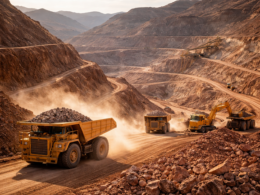



Denarius Metals Corp. (Cboe Canada: DMET) (OTCQX: DNRSF) has filed its first quarter 2026 interim financial statements, management discussion and analysis, and Zancudo technical report, shifting investor attention from project promise to operating execution. The Canadian junior miner reported first quarter revenue of $3.5 million from early production at its Zancudo gold-silver project in Colombia, compared with $1.7 million for all of fiscal 2025. The company also reported a wider net loss of $18.4 million, largely shaped by non-cash financial instrument losses and a quarterly gold premium on convertible debentures settled in shares. With DMET trading around CA$0.83 on May 15, 2026, below its 52-week high of CA$1.17 but well above its 52-week low of CA$0.41, the market is treating Denarius Metals as a high-beta execution story rather than a simple production update.
Why do Denarius Metals Q1 2026 results matter for the Zancudo gold-silver project in Colombia?
The most important change in Denarius Metals’ first quarter update is that Zancudo is now producing measurable revenue, not just technical reports and exploration optionality. That matters because junior mining valuations often swing sharply when a company moves from resource definition to early production. In Denarius Metals’ case, the first quarter showed 2,337 tonnes of mined material delivered for sale to Trafigura Pte. Ltd., containing approximately 863 ounces of gold and 20,237 ounces of silver.
That is still a small production base, but it gives investors a working data point. Zancudo generated $3.5 million of revenue in the quarter, supported by an average realised gold price of $4,870 per ounce sold. The company also reported gross profit of $1.5 million, equivalent to roughly 51% of gold revenue, with total cash costs of $2,386 per ounce of gold sold. For a junior miner in early production, that combination is important because it shows the asset can contribute operating cash flow before the larger processing plant is commissioned.
The catch is payability. During the early production phase, Denarius Metals is crushing mined material onsite and shipping it to a local port for sale to Trafigura. Gold payability currently ranges from 30% to 70%, while silver payability ranges from 20% to 40%, depending on material grade. Once the company begins shipping concentrates, gold payability is expected to increase to 86% to 90%, while silver payability is expected to move to 35% to 45%. That makes the third quarter 2026 commissioning target for the 1,000 tonnes per day processing plant the real operational hinge in this story.
How does the Zancudo technical report change the long-term investment case for Denarius Metals?
The Zancudo technical report gives Denarius Metals a larger economic framework around what is still a relatively young production profile. The updated preliminary economic assessment outlines an 11-year mine life, expected net revenue of $2.0 billion, approximately 466,000 payable ounces of gold, and 2.2 million payable ounces of silver. On the company’s assumptions of $4,000 per ounce gold and $50 per ounce silver, the project is expected to generate life-of-mine gross profit of $723 million and after-tax undiscounted free cash flow of $452 million.
That looks attractive on paper, but investors should read the numbers with discipline. A preliminary economic assessment is not the same as a bankable construction guarantee, and junior mining history is full of projects that looked beautiful in spreadsheets before capital cost, permitting, metallurgy, underground productivity, or contractor performance had their say. Denarius Metals has improved its investment narrative by filing the technical report, but the report also raises the bar. The company now has to prove that Zancudo can move from early production into repeatable concentrate production at scale.
The 15,000-metre drilling campaign that began in April 2026 is therefore more than a resource expansion exercise. The programme is focused primarily on in-fill drilling to convert additional inferred resources into the indicated category, with 3,200 metres of brownfield drilling aimed at increasing resources in the next mineral resource estimate expected in late 2026. For investors, this means the next phase of value creation is not just higher tonnage. It is resource confidence, mine planning reliability, and whether underground continuity supports the production profile embedded in the PEA.
Why is Denarius Metals’ balance sheet still the harder question after Zancudo’s revenue ramp-up?
Denarius Metals ended March 31, 2026, with cash and cash equivalents of $17.9 million, up from $6.9 million at the end of 2025. The cash position was helped by $15.1 million received from warrant exercises during the first quarter, followed by approximately CA$4.0 million of additional warrant proceeds in April 2026. The company also has $3.4 million of additional funding available under the Zancudo prepayment facility with Trafigura to fund construction at Zancudo.
That is useful funding, but it does not remove balance-sheet complexity. Denarius Metals reported convertible debentures at a fair value of $67.9 million at March 31, 2026, up from $55.6 million at the end of 2025. The increase reflected the rise in the company’s share price from CA$0.71 at December 31, 2025, to CA$1.01 at March 31, 2026. This is the slightly awkward side of a rising junior mining stock: a stronger share price can lift investor confidence, but it can also increase the accounting value of share-linked liabilities.
The first quarter net loss of $18.4 million should therefore not be read as a clean operating loss. Much of the damage came from a $13.5 million non-cash loss on financial instruments and a $4.4 million quarterly gold premium on convertible debentures settled with shares. Still, the dilution question is real. Warrant exercises bring in cash, but they also expand the share base. For retail investors, that means Denarius Metals is not just a gold-silver production story. It is a capital structure story with a mining asset attached, and sometimes that is where the real suspense hides.
What does the Aguablanca restart in Spain add to the Denarius Metals growth strategy?
Denarius Metals is not trying to be a single-asset Colombia story. In Spain, the company is operator of the Aguablanca Project through Rio Narcea Recursos, S.A., and is targeting a restart of operations in the first half of 2027. Aguablanca includes a 5,000 tonnes per day processing plant and the rights to exploit the historic Aguablanca nickel-copper mine in Extremadura. The project has also been recognised by the European Union as a Strategic Project, which gives it relevance in the region’s broader critical minerals agenda.
The financing steps around Aguablanca are important because they indicate that Denarius Metals is trying to assemble a multi-jurisdiction production platform. Rio Narcea Recursos closed a $7.5 million private placement of five-year, 12% secured notes in late March and early April 2026. Insiders including Executive Chairman Serafino Iacono and Chief Executive Officer Federico Restrepo-Solano acquired approximately $2.7 million of those notes, which provides a degree of insider alignment, although debt financing at 12% also signals the cost of capital facing smaller miners.
The company is also pursuing a EUR 20 million senior secured facility for Rio Narcea Recursos, expected to be finalised in the second quarter of 2026. If that financing lands, the joint venture would be positioned to begin dewatering the underground mine and restart activities around the processing plant. Strategically, Aguablanca gives Denarius Metals exposure to nickel and copper at a time when Europe wants more secure domestic sources of critical minerals. Operationally, it also means management is juggling Colombia ramp-up risk, Spain restart risk, and capital sourcing risk at the same time. That is ambition, but ambition in mining tends to send invoices.
How could the ProGrowth Saudi collaboration reshape Denarius Metals’ capital and project pipeline?
Denarius Metals’ collaboration with ProGrowth Ltd. Company adds a geopolitical and capital-access layer to the story. ProGrowth is a Saudi-based diversified group with experience across construction, infrastructure, oil and gas, petrochemicals, mining, trading, and technology-enabled services. Denarius Metals has framed the alliance as a platform to develop and commercialise its portfolio of projects in Spain and mining concessions in Saudi Arabia.
The proposed initial equity investment of up to 10% through a private placement could matter for two reasons. First, it may provide balance-sheet support at a time when Denarius Metals is trying to fund Zancudo, Aguablanca, and broader development activity. Second, it gives the company a potential route into Saudi Arabia’s mining diversification strategy, where the government has been trying to position mining as a pillar of industrial policy beyond hydrocarbons.
The risk is that strategic collaborations can look more valuable in headlines than in execution. The key tests will be whether ProGrowth’s investment closes, whether board representation improves project access or only adds another stakeholder, and whether Saudi concessions can become investable assets rather than long-dated optionality. For now, the collaboration strengthens the narrative. It does not yet de-risk the operating model.
What does Denarius Metals stock sentiment suggest after the Q1 2026 filing?
Denarius Metals’ share price context shows why the Q1 update has produced a more nuanced investor setup. At about CA$0.83 on May 15, 2026, DMET is trading meaningfully above its 52-week low of CA$0.41 but below its CA$1.17 high. That suggests the market has already rewarded the transition toward production, while also pulling back from the most aggressive optimism priced earlier in the year.
The stock’s volatility is consistent with its stage of development. Denarius Metals has operating revenue, but it is not yet a mature producer. It has a promising PEA, but still needs to execute the plant commissioning, improve payability through concentrate sales, keep drilling on track, and manage capital structure pressures. That makes the stock attractive to risk-tolerant investors looking for gold-silver and critical minerals optionality, but less comfortable for investors who want clean earnings, predictable free cash flow, and low dilution risk.
A neutral reading is that market sentiment remains constructive but conditional. The company has improved its credibility by generating revenue at Zancudo and by filing the technical report behind the PEA. However, the next re-rating probably depends less on another optimistic resource narrative and more on whether Denarius Metals can commission the 1,000 tonnes per day plant, increase payable metal recoveries, control cash costs, and show that early production can become repeatable operating performance.
What should investors watch next as Denarius Metals moves from early production to execution?
The next phase for Denarius Metals will likely be judged across four linked milestones. The first is the Zancudo processing plant commissioning target in the third quarter of 2026. If the plant begins producing high-grade gold-silver concentrates on schedule, Denarius Metals should improve payability and potentially strengthen operating margins. If commissioning slips, the early production model may continue to generate revenue, but at weaker commercial terms.
The second milestone is the late 2026 mineral resource estimate update. In-fill drilling that converts inferred resources into indicated resources would improve confidence in the mine plan and support the 11-year production narrative. Brownfield drilling that expands the resource would add exploration upside, but only if the market believes the company can fund and mine that upside efficiently.
The third milestone is Spain. Aguablanca’s restart pathway gives Denarius Metals a critical minerals angle that could broaden investor interest beyond precious metals. However, restarting a historic underground operation and processing plant is not a desk exercise. Dewatering, refurbishment, staffing, metallurgical performance, and permitting discipline will all matter.
The fourth milestone is financing. Between Zancudo, Aguablanca, convertible debentures, warrant exercises, and the proposed ProGrowth investment, Denarius Metals remains heavily exposed to capital structure outcomes. The strongest version of the story is one where Zancudo begins funding more of the company’s growth internally. The weaker version is one where dilution remains the bridge between ambition and execution.
Key takeaways on Denarius Metals Q1 2026 results, Zancudo production and investor sentiment
- Denarius Metals has crossed an important threshold by turning Zancudo into a revenue-generating gold-silver asset rather than a purely technical development story.
- The $3.5 million of first quarter revenue gives investors early operating evidence, but the current payability structure means the processing plant commissioning remains the real inflection point.
- The $18.4 million net loss looks severe, although much of it reflects non-cash financial instrument losses and convertible debenture accounting rather than pure operating deterioration.
- The Zancudo PEA gives Denarius Metals a larger valuation narrative, with an 11-year mine life and $452 million of expected after-tax undiscounted free cash flow, but execution risk remains high.
- The Trafigura relationship is strategically useful because it supports early sales and provides prepayment facility funding, although concentrate production is needed to improve commercial terms.
- Aguablanca gives Denarius Metals a European critical minerals angle, but the restart plan adds another major execution front alongside the Zancudo ramp-up.
- The ProGrowth Saudi collaboration could improve capital access and international project optionality, but its practical value depends on closing the proposed investment and converting access into assets.
- DMET stock sentiment remains constructive but volatile, reflecting the market’s interest in the production transition and caution around dilution, funding, and delivery risk.
- The next major investor catalysts are Zancudo plant commissioning, drilling conversion results, Aguablanca financing, and evidence that early cash flow can become repeatable mine-level performance.
- For Denarius Metals, the story is no longer only about whether the ground contains value. The question now is whether the company can mine, process, finance, and scale that value without letting dilution steal the plot.
Discover more from Business-News-Today.com
Subscribe to get the latest posts sent to your email.