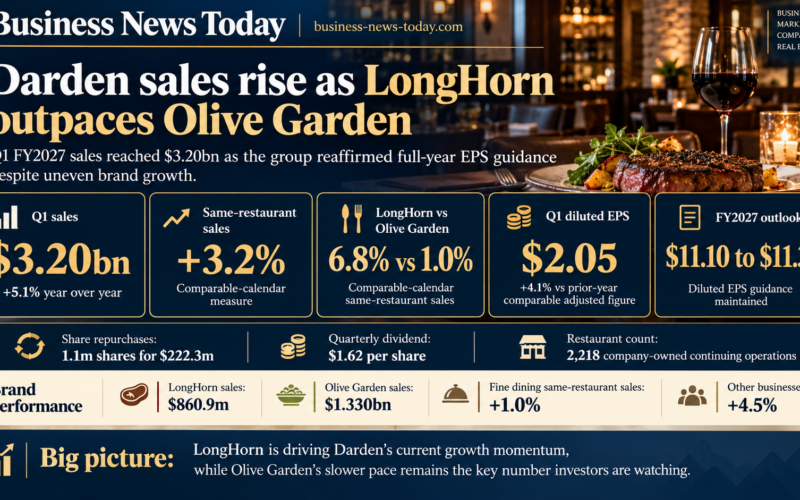
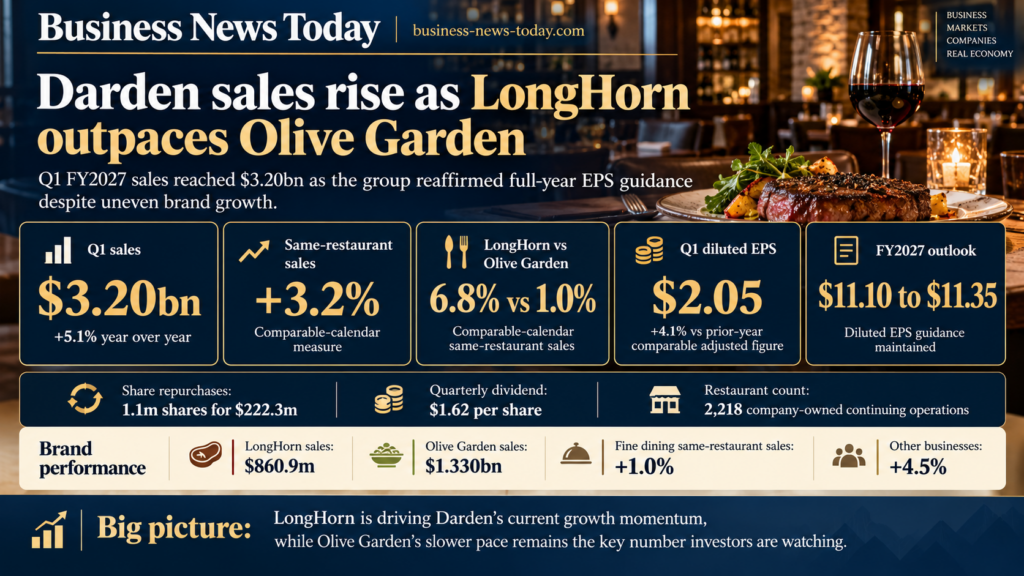
Darden Restaurants, Inc. (NYSE: DRI) has reported a 5.1% increase in fiscal first-quarter 2027 sales to $3.20bn while reaffirming its full-year earnings outlook, as LongHorn Steakhouse continued to grow materially faster than Olive Garden. Blended same-restaurant sales increased 3.2% on the comparable-calendar measure that Darden says gives a clearer year-on-year comparison because the company is transitioning from a 53-week to a 52-week fiscal year.
The brand-level numbers reveal a notably uneven growth profile. LongHorn Steakhouse comparable-calendar same-restaurant sales increased 6.8%, compared with 1.0% at Olive Garden. Darden’s fine-dining segment also increased 1.0%, while its other businesses produced 4.5% growth. Diluted earnings per share from continuing operations reached $2.05, 4.1% above the comparable adjusted figure from a year earlier.
Darden maintained its fiscal 2027 expectation for diluted earnings per share from continuing operations of $11.10 to $11.35. It also repurchased approximately 1.1 million shares for $222.3m during the quarter and declared a quarterly dividend of $1.62 per share.
Why is LongHorn Steakhouse growing faster than Olive Garden?
LongHorn has emerged as one of the strongest operating engines inside Darden’s portfolio. First-quarter LongHorn sales increased to $860.9m from $776.4m a year earlier, while segment profit rose to $154.6m from $134.9m. Olive Garden remained much larger, generating $1.330bn of sales, but that represented only a modest increase from $1.301bn, while segment profit moved from $267.6m to $270.8m.
The comparison matters because Olive Garden remains Darden’s largest individual brand and a major contributor to group cash flow. A 1% comparable-sales increase is still positive, but it places greater importance on LongHorn and portfolio growth if Darden is to sustain group sales expansion above the pace of its flagship brand.
LongHorn is also expanding its physical estate. Darden operated 624 LongHorn Steakhouse restaurants at August 30, up from 595 a year earlier, while Olive Garden increased from 933 to 953 locations. Across continuing operations, Darden’s company-owned restaurant count rose to 2,218 from 2,165.
That means LongHorn’s revenue growth is benefiting from both additional locations and substantially stronger sales at established restaurants. Investors evaluating Darden therefore need to distinguish unit expansion from comparable performance rather than looking only at consolidated revenue.
Why is the comparable-calendar number important for Darden’s earnings?
Darden reported blended same-restaurant growth of 3.1% on its fiscal calendar and 3.2% using comparable calendar periods. The difference appears small at group level but becomes more noticeable for individual brands, with LongHorn at 6.2% on the fiscal calendar versus 6.8% on the comparable calendar.
The adjustment exists because Darden is moving from a 53-week fiscal year to a 52-week year, causing year-on-year fiscal periods to be offset by one week. Seasonal demand can vary significantly around holidays and travel periods, so comparing matching calendar weeks can provide a cleaner view of restaurant performance.
This is a useful example of why same-store sales should not be treated as a single unquestionable number. Calendar effects, store closures and portfolio changes can all influence reported comparisons.
Darden also excludes Bahama Breeze from the same-restaurant-sales metric because the company expects all remaining locations to be closed or converted to other brands by the fourth quarter of fiscal 2027. The Bahama Breeze estate declined to 10 restaurants from 28 a year earlier.
Can Darden maintain earnings growth if Olive Garden remains slower?
The group’s portfolio structure gives it some protection against weakness in any one concept. LongHorn, Cheddar’s Scratch Kitchen, Chuy’s, Yard House, Ruth’s Chris Steak House and several fine-dining brands diversify the revenue base, while Darden’s scale allows restaurants to share procurement, technology, real estate expertise and corporate infrastructure.
Yet Olive Garden remains too large to become strategically irrelevant. Its $1.33bn of quarterly sales represented more than 40% of Darden’s group sales. Even small changes in traffic, pricing or restaurant-level profitability can therefore influence consolidated results.
The first quarter shows how the portfolio can compensate when growth rates diverge. LongHorn added roughly $84.5m of year-on-year sales, far more than Olive Garden’s approximately $28.7m increase, despite LongHorn being the smaller business.
The question for the remainder of fiscal 2027 is whether LongHorn can continue delivering high-single-digit comparable growth while Olive Garden remains positive. If both strengthen simultaneously, Darden gains considerable operating momentum. If LongHorn cools before Olive Garden accelerates, consolidated growth becomes more dependent on new restaurant openings and contributions from other brands.
What does Darden’s buyback say about capital allocation?
Darden spent $222.3m repurchasing approximately 1.1 million shares during the quarter. The company said roughly $1.3bn remained under its current $1.5bn repurchase authorisation at quarter-end.
That is substantial relative to quarterly earnings and indicates management continues to return capital while investing in restaurant expansion. The $1.62 quarterly dividend provides a second shareholder-return channel.
Buybacks can increase per-share earnings by reducing the number of shares outstanding, but their economic value depends partly on the price at which shares are repurchased. Investors therefore need to evaluate repurchases alongside restaurant investment opportunities and valuation rather than assuming that a larger buyback is automatically superior capital allocation.
Why did Darden stock fall despite reaffirmed guidance?
Darden shares closed September 24 at $207.24, down 3.02% on the day the company reported results. The stock had finished the previous session at $213.69.
The reaction came despite Darden matching the widely cited $2.05 earnings expectation and reaffirming full-year guidance. That suggests investors were looking beyond the headline EPS figure toward the composition of growth, including the modest Olive Garden comparable-sales increase and a quarterly revenue result that was close to, but slightly below, some consensus estimates.
One session cannot isolate every reason for a share move, particularly in a consumer stock exposed to interest rates, wage costs, food inflation and broader discretionary spending. Still, the decline indicates that maintaining guidance alone was not sufficient to produce an immediate positive re-rating.
Darden’s next few quarters will therefore be watched through two lenses: whether LongHorn Steakhouse can preserve its standout momentum and whether Olive Garden can produce stronger comparable growth. The first quarter was profitable and positive across every segment, but the performance gap between Darden’s two biggest restaurant brands is now the most useful number to watch.
Discover more from Business-News-Today.com
Subscribe to get the latest posts sent to your email.