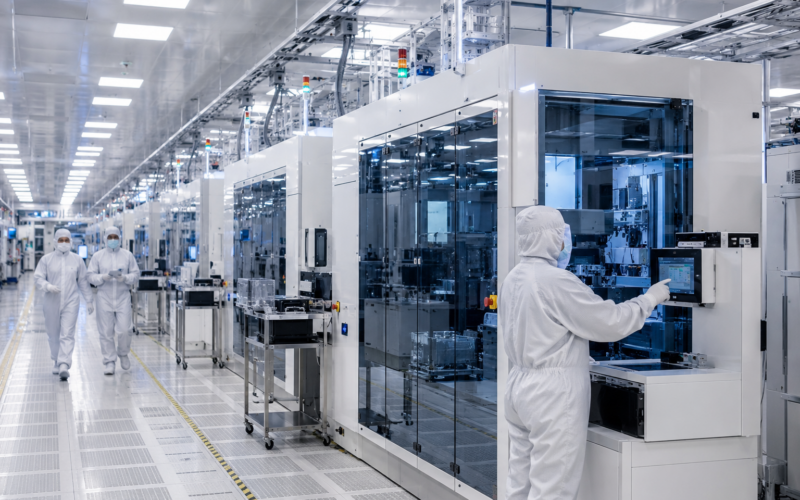
Applied Materials, Inc. (NASDAQ: AMAT) has expanded its manufacturing and research operations in Singapore with a new US$500 million Tampines Campus built to support semiconductor equipment demand linked to artificial intelligence infrastructure. The facility more than doubles Applied Materials, Inc.’s advanced cleanroom capacity in Singapore and is already operating at volume production for chipmakers expanding AI-related capacity. The investment strengthens Singapore’s role in the global semiconductor supply chain at a time when chipmakers are racing to add capacity for advanced logic, memory, packaging, and high-bandwidth computing needs. With AMAT recently trading around $499.21 and carrying a market capitalization near $398.9 billion, investors are likely to view the expansion as another signal that Applied Materials, Inc. is scaling its manufacturing footprint to match the AI chip cycle rather than merely benefiting from a short-term demand spike.
Why Applied Materials’ Singapore expansion matters for the AI semiconductor equipment cycle
Applied Materials, Inc.’s Singapore expansion matters because the AI chip cycle is increasingly constrained by manufacturing equipment availability, cleanroom capacity, and complex supply-chain execution. AI accelerators, high-bandwidth memory, advanced logic chips, and chiplet-based architectures require sophisticated deposition, etch, metrology, inspection, and packaging-related equipment. Applied Materials, Inc. sits directly inside that capital equipment chain, which means its ability to produce, ship, and support tools can influence how quickly customers bring new chip capacity online.
The US$500 million Tampines Campus gives Applied Materials, Inc. more advanced manufacturing capacity in a region that already serves as a major semiconductor hub. Singapore has long been important to semiconductor equipment, wafer fabrication, memory manufacturing, and regional logistics. Expanding cleanroom capacity there allows Applied Materials, Inc. to support Asian customers while maintaining a broader global footprint across the United States, Europe, Israel, Taiwan, and Southeast Asia.
The strategic logic is straightforward but important. AI demand is not just increasing the number of chips required. It is increasing the complexity of chip production. As device architectures become more advanced, the value of equipment suppliers rises because process control, materials engineering, yield improvement, and production reliability become harder. Applied Materials, Inc. is effectively building more capacity for the part of the supply chain where complexity translates into pricing power, customer stickiness, and long-cycle demand visibility.
How the Tampines Campus strengthens Singapore’s role in Applied Materials’ global footprint
The Tampines Campus reinforces Singapore’s position as a strategic manufacturing and R&D hub for Applied Materials, Inc. The company has operated in Singapore for decades, but this expansion makes the country more central to its global response to AI-driven semiconductor investment. The facility includes advanced cleanroom production capacity and R&D capabilities that can support both global and regional customers.
This matters because semiconductor supply chains are becoming more geographically diversified while still requiring deep technical clusters. Companies want resilience, but they cannot simply move advanced manufacturing capacity anywhere with an empty industrial park and a ribbon-cutting ceremony. Semiconductor equipment production requires skilled labor, suppliers, logistics, cleanroom expertise, and strong institutional support. Singapore offers that combination, which helps explain why Applied Materials, Inc. is expanding there rather than treating the country only as a regional office base.
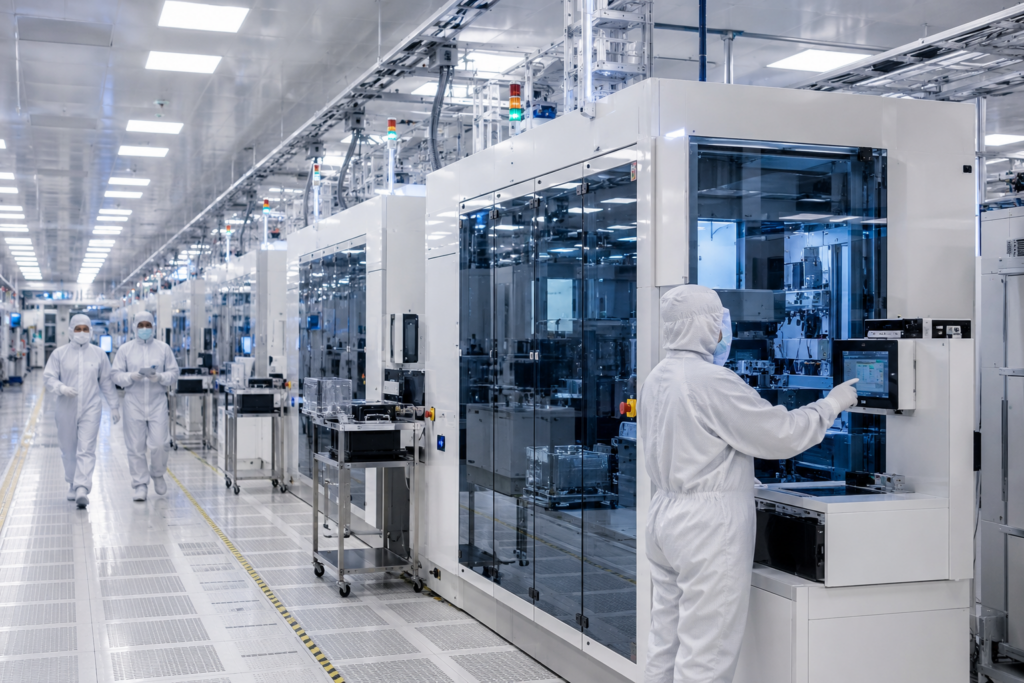
For Singapore, the investment also reinforces the country’s role as a high-value semiconductor node rather than a low-cost manufacturing location. The planned addition of about 1,000 local jobs over the next few years points to demand for engineering, production, automation, R&D, and technical support roles. That has wider economic significance because semiconductor equipment manufacturing creates knowledge-intensive employment and strengthens Singapore’s position in the AI hardware supply chain.
Why AMAT stock sentiment is tied to AI demand and equipment capacity discipline
AMAT stock has benefited from investor confidence that artificial intelligence will drive sustained demand for semiconductor manufacturing equipment. At around $499.21, Applied Materials, Inc. is trading with a market capitalization near $398.9 billion, which shows how much value the market is assigning to the company’s role in the AI infrastructure cycle. The Singapore expansion supports that narrative because it shows Applied Materials, Inc. is adding capacity to meet demand rather than relying only on existing production.
However, the stock’s strong valuation also increases investor sensitivity to execution risk. When a semiconductor equipment company trades on AI-driven visibility, the market expects revenue growth, margin discipline, timely tool shipments, and strong customer demand to continue. A new manufacturing campus helps support those expectations, but it also raises the bar. Investors will want to see whether added capacity turns into sustained revenue growth rather than excess capacity if the chip cycle cools.
The important distinction is that Applied Materials, Inc. is not expanding for a generic semiconductor recovery. It is expanding against a backdrop of more complex AI chip requirements, advanced packaging needs, and long-term capacity planning by customers. If AI infrastructure spending remains durable, the Tampines Campus could improve customer responsiveness and supply-chain resilience. If demand normalizes faster than expected, the market may question whether equipment suppliers scaled too aggressively. Semiconductor cycles have a habit of looking permanent right before they become cyclical again.
How Singapore capacity could help Applied Materials serve chipmakers faster
The Tampines Campus could improve Applied Materials, Inc.’s ability to serve customers that are accelerating AI-related production plans. Semiconductor manufacturers need equipment availability, installation support, process optimization, and rapid response as they expand capacity. Having additional production and R&D capability in Singapore can shorten coordination loops for customers across Asia, where much of the world’s advanced semiconductor manufacturing base remains concentrated.
Speed matters because AI chipmakers and foundries are trying to avoid becoming bottlenecks for cloud providers, data center operators, and hardware companies. Capacity expansions require coordinated delivery of tools, components, facilities, technicians, and process recipes. If equipment suppliers cannot deliver on schedule, customer fab ramps can slip. Applied Materials, Inc.’s Singapore expansion is therefore not only a facilities story. It is a customer execution story.
The facility’s automation and AI-assisted quality inspection capabilities also suggest that Applied Materials, Inc. is using the campus to improve manufacturing productivity, not just add square footage. Autonomous mobile robots, automated assembly and testing, augmented and virtual reality training, and precision maintenance tools can reduce variability and improve output consistency. That may matter more as tools become more complex and customers demand tighter timelines.
Why advanced packaging and memory demand could make the expansion more valuable
The Singapore expansion is especially relevant because AI demand is not limited to leading-edge logic. High-bandwidth memory, advanced packaging, interconnect density, and heterogeneous integration are becoming central to AI system performance. Applied Materials, Inc. has already pointed to strong growth expectations in its semiconductor equipment business and advanced packaging-related opportunities, making the Tampines Campus part of a wider capacity strategy.
AI accelerators increasingly depend on the ability to connect compute, memory, and packaging technologies efficiently. That increases the importance of equipment used in materials engineering, deposition, inspection, and advanced process integration. Applied Materials, Inc.’s broader portfolio gives it exposure to several layers of this transition, which is why AI demand can support multiple product categories rather than one narrow equipment niche.
The risk is that advanced packaging and memory investment can still move in cycles. High-bandwidth memory demand is currently strong because of AI server growth, but capacity additions across the industry can eventually create periods of oversupply if customer forecasts prove too optimistic. Applied Materials, Inc.’s advantage is that it serves a broad set of semiconductor processes, but the company still needs to manage capacity with discipline. Expanding in Singapore improves readiness, but it does not repeal semiconductor cyclicality.
How sustainable manufacturing fits into Applied Materials’ semiconductor equipment strategy
The Tampines Campus has been designed to pursue Singapore’s Building and Construction Authority Green Mark Platinum Certification, with features such as onsite solar panels, LED lighting, low-carbon concrete construction, closed-loop water reclamation, and real-time energy and water monitoring. These features may sound like facilities details, but they carry strategic weight in semiconductor manufacturing. Chip supply chains are increasingly scrutinized for energy use, water intensity, emissions, and resource efficiency.
For Applied Materials, Inc., sustainable facility design can support customer expectations and regulatory positioning. Large chipmakers face pressure from governments, investors, and customers to reduce environmental impact while expanding capacity. Equipment suppliers that demonstrate their own operational discipline can strengthen their standing with customers that are trying to reduce supply-chain emissions and improve sustainability metrics.
There is also a practical benefit. Energy and water efficiency can reduce long-term operating costs and improve resilience in regions where utility constraints may become more important. Semiconductor manufacturing is resource-intensive, and AI demand is placing new strain on both chip production and data center infrastructure. Applied Materials, Inc.’s Singapore facility therefore fits into a broader industry reality: the AI economy needs physical infrastructure, and that infrastructure must increasingly be built with resource constraints in mind.
What competitive pressure could mean for Applied Materials after the Singapore expansion
Applied Materials, Inc. is expanding in a highly competitive semiconductor equipment market that includes Lam Research Corporation, KLA Corporation, ASML Holding N.V., Tokyo Electron Limited, and other specialized suppliers. The AI cycle is benefiting the broader wafer fabrication equipment industry, but competition remains intense because chipmakers are selective about performance, yield impact, service reliability, and total cost of ownership.
The Singapore expansion may help Applied Materials, Inc. defend its position by improving manufacturing scalability and customer support. Customers expanding AI chip production need suppliers that can deliver tools reliably across multiple geographies. If Applied Materials, Inc. can reduce lead times, improve service responsiveness, and support customer ramps more efficiently, the facility could become a competitive advantage rather than a simple capacity addition.
Still, competitors are also expanding, innovating, and aligning with the same AI-driven demand signals. Applied Materials, Inc. must ensure that the Tampines Campus supports differentiated technology delivery, not only volume. The strongest market position will come from combining capacity, process leadership, services, and customer intimacy. In semiconductor equipment, the factory matters, but the tool performance matters more.
What investors should watch after Applied Materials expands in Singapore
Investors should watch whether the Singapore expansion supports sustained revenue growth in Applied Materials, Inc.’s semiconductor systems business. The company’s recent results already showed strong AI-linked demand, and the Tampines Campus gives it more operating capacity to serve customers. The question is whether that capacity translates into higher shipments, stronger backlog conversion, and better customer execution over the next several quarters.
Margin performance will be just as important as revenue growth. Expanding manufacturing capacity can improve scale economics, but new facilities also bring costs, workforce needs, depreciation, and operating complexity. Applied Materials, Inc. will need to show that the added capacity supports profitable growth rather than simply increasing fixed costs during a hot cycle. Investors will watch gross margin, operating margin, and commentary on utilization.
The final signal will be customer demand durability. AI infrastructure spending has created strong visibility, but semiconductor equipment investors know that demand can shift if chipmakers slow capital expenditure. Applied Materials, Inc.’s Singapore expansion looks strategically well aligned with current demand, but its long-term value depends on whether AI-related chip complexity continues driving multiyear equipment spending. For AMAT investors, the campus is a strong signal of confidence. The proof will come through orders, margins, and cycle resilience.
Key takeaways on Applied Materials’ Singapore expansion and AMAT stock sentiment
• Applied Materials, Inc. has expanded its Singapore manufacturing and R&D operations with a new US$500 million Tampines Campus.
• The facility more than doubles Applied Materials, Inc.’s advanced cleanroom capacity in Singapore and is already operating at volume production.
• The expansion supports chipmakers increasing production for AI infrastructure, advanced logic, memory, and packaging-related demand.
• Applied Materials, Inc. expects to add approximately 1,000 local jobs in Singapore over the next few years.
• Singapore becomes more important to Applied Materials, Inc.’s global manufacturing footprint across the United States, Europe, Israel, Taiwan, and Southeast Asia.
• AMAT stock sentiment is closely tied to whether AI-driven semiconductor equipment demand remains durable after a major rally.
• The campus could improve Applied Materials, Inc.’s customer responsiveness, regional production flexibility, and supply-chain resilience.
• Sustainable manufacturing features may support customer and regulatory expectations as semiconductor supply chains face energy and water scrutiny.
• Competitive pressure from Lam Research Corporation, KLA Corporation, ASML Holding N.V., and Tokyo Electron Limited means Applied Materials, Inc. must convert capacity into differentiated execution.
• Long-term value will depend on whether the Singapore expansion supports profitable growth, backlog conversion, and resilience through the semiconductor cycle.
Discover more from Business-News-Today.com
Subscribe to get the latest posts sent to your email.