


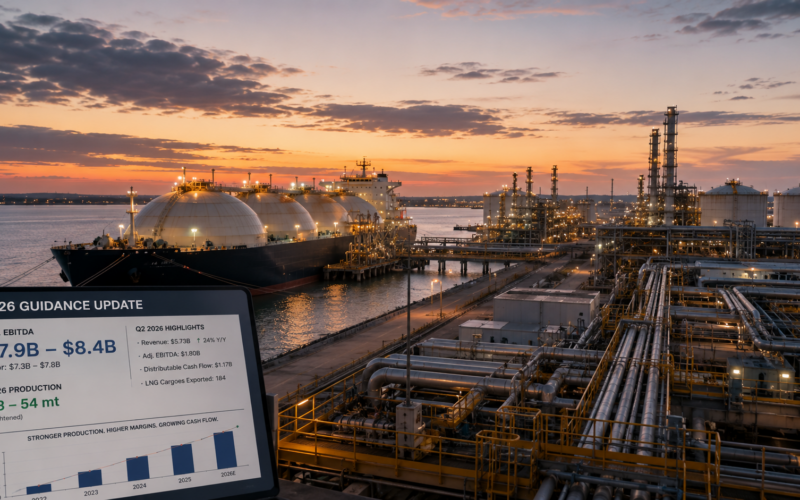
Cheniere Energy, Inc. (NYSE: LNG) has raised its 2026 consolidated adjusted EBITDA guidance to between $7.9 billion and $8.4 billion after stronger production, higher LNG margins and continued ramp-up of the Corpus Christi Stage 3 expansion lifted second-quarter performance. Revenue increased 24% year on year to $5.73 billion, adjusted EBITDA rose by $388 million to approximately $1.80 billion and distributable cash flow reached $1.17 billion, while Cheniere exported 184 LNG cargoes during the quarter. The company has also tightened its 2026 production forecast to 53 million to 54 million tonnes and now operates six of the seven Stage 3 midscale trains, with the final train moving toward first LNG. The results show that Cheniere is converting construction spending into physical production at precisely the moment when international gas-market volatility is supporting stronger margins. The central tension is whether this combination can produce durable per-share cash-flow growth when the company is simultaneously committing billions of dollars to another generation of Corpus Christi and Sabine Pass capacity.
Why did Cheniere Energy raise its 2026 EBITDA guidance for the second time this year?
The latest guidance increase is substantial rather than cosmetic. Cheniere began 2026 expecting consolidated adjusted EBITDA of between $6.75 billion and $7.25 billion, raised that range to $7.25 billion to $7.75 billion after the first quarter and has now lifted it again to between $7.9 billion and $8.4 billion. At the current midpoint of $8.15 billion, the company is forecasting approximately $1.15 billion more adjusted EBITDA than the midpoint of its original full-year range. Distributable cash flow guidance has followed the same pattern, rising to between $5.3 billion and $5.8 billion from the previous $4.75 billion to $5.25 billion range.
The improvement is being supported by a combination of structural volume growth and favourable market conditions. Cheniere said higher margins on LNG delivered reflected both increased production from additional Corpus Christi Stage 3 trains and higher margins per million British thermal units. Its first-half operating cash flow increased by $599 million year on year to $2.66 billion, with higher cash receipts from LNG sales linked to production growth, optimisation activity and global pricing. That means the guidance upgrade is not merely a derivative-accounting effect, although Cheniere’s reported GAAP earnings remain heavily influenced by changes in the fair value of commodity agreements.
The distinction between adjusted EBITDA and reported net income is especially important this quarter. Cheniere reported $3.07 billion of second-quarter net income but a $434 million net loss for the first half, with large fair-value movements in derivative and integrated production marketing agreements affecting both periods. The operating picture is therefore clearer through production volumes, adjusted EBITDA, distributable cash flow and operating cash flow than through one quarter of GAAP net income alone.

How much of Cheniere Energy’s earnings improvement is coming directly from Corpus Christi Stage 3?
Corpus Christi Stage 3 is now making a measurable operating contribution. Cheniere has completed six of the project’s seven midscale trains, with Trains 1 through 4 completed during 2025, Train 5 reaching substantial completion in March 2026 and Train 6 following in June. At June 30, Stage 3 was 98.4% complete overall, including 99.8% engineering completion, 100% procurement and 96% construction completion. The remaining Train 7 is expected to bring the full project to substantial completion during the second half of 2026.
That physical progress is translating into more LNG available for sale. Cheniere loaded 672 trillion British thermal units of LNG during the second quarter, including commissioning volumes, compared with 550 TBtu a year earlier. Volumes recognised under long-term third-party agreements increased to 534 TBtu from 496 TBtu, while volumes sold by Cheniere’s integrated marketing operation under shorter-term arrangements more than doubled to 123 TBtu from 54 TBtu.
The second figure is particularly relevant to the current earnings environment. New Stage 3 volumes can enter the market before all associated long-term sales contracts commence, allowing Cheniere Marketing to sell some additional production at prevailing global prices. When international LNG pricing is favourable relative to United States feed-gas costs, those uncontracted or shorter-term volumes can create additional margin upside. The same mechanism can work in reverse if global spreads narrow, which is why it would be premature to treat every dollar of current margin expansion as permanently recurring.
Stage 3 itself is designed to add more than 10 mtpa of LNG production capacity once all seven trains are complete. With six already operating, most of the physical production uplift has now moved from development expectation into operating infrastructure, making Train 7 the final major execution milestone for the project rather than the beginning of its commercial case.
Why does the new 5 mtpa FERC authorisation matter beyond the existing Stage 3 construction programme?
In June, the Federal Energy Regulatory Commission authorised Cheniere to increase the aggregate production capacity of the already-approved Corpus Christi Stage 3 and Midscale Trains 8 and 9 projects by approximately 5 mtpa. This is important because the additional capacity is not another entirely separate greenfield LNG terminal. It represents greater production potential from infrastructure already approved and either operating or under construction.
Cheniere now describes Corpus Christi as having more than 30 mtpa of total expected production capacity, including estimated debottlenecking opportunities. The ability to raise output through engineering optimisation can be particularly attractive because incremental tonnes may require less capital than building entirely new liquefaction trains, storage tanks, berths and pipelines from scratch. The exact investment required to capture the newly authorised 5 mtpa has not been separately disclosed, so the eventual return cannot yet be calculated independently.
The regulatory authorisation also increases the strategic value of Corpus Christi before the company takes a final investment decision on its much larger Stage 4 proposal. Cheniere can therefore pursue three layers of growth at the same site: finishing Stage 3, building Midscale Trains 8 and 9, and extracting authorised debottlenecking capacity while Stage 4 progresses through federal review. That sequencing provides considerably more flexibility than depending on one large expansion reaching approval and construction on a single timetable.
Can Midscale Trains 8 and 9 extend Corpus Christi growth smoothly into 2028?
The Midscale Trains 8 and 9 project is the next committed Corpus Christi growth phase. Cheniere took a positive final investment decision in June 2025 and expects the two trains, together with estimated debottlenecking opportunities, to add approximately 5 mtpa. The project was 48.3% complete at June 30, although the headline figure reflects engineering and procurement moving much further ahead than field construction. Engineering stood at 91.5%, procurement at 69.9% and construction at only 6.7%.
That mix is normal for an LNG project whose large equipment and engineering work precede much of on-site construction, but it creates a different execution profile from Stage 3, which is almost complete. Midscale Trains 8 and 9 are expected to reach substantial completion during the second half of 2028, giving Cheniere another production step after Stage 3 finishes ramping. The company spent approximately $554 million on the project during the first half of 2026, primarily on procurement and engineering.
The strategic benefit is continuity. Cheniere does not need to allow the Corpus Christi construction organisation, supplier relationships and Bechtel execution platform to dissipate after Train 7 before beginning another project. Maintaining construction momentum can reduce mobilisation inefficiencies and preserve institutional knowledge from Stage 3, although it also means large capital requirements continue after the current expansion reaches completion.
The financial test will be whether the next 5 mtpa enters service at returns comparable with Cheniere’s earlier brownfield expansions. The company has consistently stated that it seeks long-term commercial contracts supporting unlevered returns above its cost of equity and prevailing share-repurchase economics. That hurdle becomes increasingly important as investors compare additional LNG construction with the alternative of returning more cash through the company’s enlarged repurchase programme.
Is Cheniere Energy’s proposed 24 mtpa Corpus Christi Stage 4 project becoming the next major growth engine?
Cheniere has applied for federal authorisation for another Corpus Christi expansion comprising four large liquefaction trains with peak production capacity of up to approximately 24 mtpa, together with two new 220,000-cubic-metre LNG storage tanks, another loading jetty and supporting infrastructure. The associated Corpus Christi Pipeline expansion would add approximately 3 Bcf/d of gas-delivery capacity through a new 42-inch pipeline loop and compression facilities.
This project remains a proposal rather than approved capacity. Federal Energy Regulatory Commission staff accepted the application into the formal certificate proceeding in February 2026 and currently expect to issue a draft environmental impact statement in September 2026, followed by a final environmental impact statement in March 2027. Federal authorisation decisions would follow the regulatory review, and Cheniere would still need acceptable commercial and financing arrangements before reaching a positive final investment decision.
The distinction is crucial because adding 24 mtpa would represent another major increase in Cheniere’s production base. It could deepen the company’s position as the largest United States LNG exporter, but it would also require billions of dollars of new construction spending and additional long-term customer commitments. The project should therefore be treated as a strategic option being actively permitted, not as future production already included in current earnings.
Timing could become the most important variable. A large volume of United States, Canadian, Qatari and other LNG capacity is scheduled to enter the global market during the second half of this decade. Cheniere’s advantage is that Corpus Christi Stage 4 would be built beside an existing operating terminal with established pipelines, tanks, marine infrastructure, staff and customer relationships. Whether that brownfield advantage is enough to support attractive returns in a better-supplied global LNG market will determine whether the company ultimately sanctions all four trains.
How protected is Cheniere Energy if global LNG prices weaken after today’s strong market conditions?
Cheniere’s business model provides considerably more protection than a producer dependent entirely on spot LNG prices. Through long-term sales and purchase agreements and integrated production marketing contracts, the company has contracted 90% or more of anticipated production from Sabine Pass and Corpus Christi through the mid-2030s, excluding certain shorter-duration and expansion-dependent contracts. The weighted average remaining life of the relevant long-term agreements was approximately 15 years at June 30.
Traditional Cheniere sales agreements typically include a fixed liquefaction fee that customers are generally required to pay for contracted volumes even if they cancel or suspend a cargo, together with a variable component linked primarily to Henry Hub natural gas. This structure largely passes through United States feed-gas costs and gives Cheniere a substantial contracted cash-flow foundation. Volumes outside that contracted base can be sold through Cheniere Marketing, creating additional exposure to international price spreads.
The result is a hybrid model. Long-term contracts protect the infrastructure investment and debt service, while marketing and optimisation create upside when global LNG conditions become more profitable. The second quarter showed that upside clearly, with management attributing higher adjusted EBITDA partly to stronger margins per unit as well as higher volumes.
That structure also explains why a future global LNG supply wave would not automatically destroy Cheniere’s economics. Existing contracted fees would remain much more resilient than spot margins, although weaker global pricing could reduce optimisation earnings and make commercialising new expansion capacity more difficult. The greatest market-cycle risk therefore lies increasingly in the returns on the next project rather than the stability of cash flow from trains already backed by long-duration contracts.
Can Cheniere keep expanding while returning billions of dollars to shareholders?
Cheniere is attempting to finance growth and accelerate shareholder returns simultaneously. During the first half of 2026, it invested approximately $2.1 billion of growth capital while repurchasing roughly 4.9 million shares for $1.1 billion, paying $233 million of dividends and repaying $253 million of consolidated long-term debt. In February, the board expanded the share-repurchase authorisation to approximately $10 billion for the 2026 through 2030 period.
The balance sheet remains large because LNG infrastructure has traditionally relied on project-level debt. Cheniere reported approximately $22.63 billion of long-term debt at June 30, compared with $22.51 billion at the end of 2025, while cash and cash equivalents stood at approximately $1.10 billion. Available commitments across its major revolving and project facilities totalled several additional billions of dollars, including a $1.75 billion corporate revolver after a June increase.
Debt should be evaluated against the long-duration contractual cash flows supporting the assets rather than against the headline number alone. Moody’s upgraded Cheniere’s senior unsecured debt to Baa2 with a stable outlook in February, while Corpus Christi Holdings’ senior secured debt was raised to Baa1. The company also refinanced portions of its debt during the first half with notes extending into 2036 and 2056, demonstrating access to long-duration capital markets.
The capital-allocation competition will intensify as more expansion opportunities mature. Buying back stock at an attractive valuation can create immediate per-share benefits, while Stage 4 or Sabine Pass expansion requires capital today for cash flows arriving years later. Management’s discipline will therefore be tested not by whether Cheniere can finance another LNG project, but whether each sanctioned project offers a better risk-adjusted return than alternative uses of the same capital.
What does LNG stock performance after earnings say about investor expectations for Cheniere?
Cheniere Energy shares closed at $256.14 on Friday, August 7, down 3.62% for the session after rising 4.32% on August 6, the day the company released its second-quarter results and higher guidance. Across the five trading sessions ending August 7, the shares declined approximately 2.8%, while their one-month performance was around negative 2%. The stock was still up almost 32% for 2026, indicating that investors had already assigned substantial value to higher earnings and LNG growth before the latest guidance increase.
The August 7 close values Cheniere at approximately $53.7 billion. The stock remained about 14.9% below its 52-week high of $300.89 but approximately 37.6% above the 52-week low of $186.20. The latest price also sits well above the levels seen at the start of 2026, even after the pullback from the March record close.
The two-day reaction around earnings illustrates why the guidance increase should not automatically be interpreted as an unambiguous rerating catalyst. Investors initially responded positively on August 6, but part of that move reversed the following session despite no corresponding reversal of management’s outlook. Cheniere is now large enough and sufficiently well understood that higher near-term EBITDA is being weighed against longer-duration questions involving capital intensity, LNG market balance and how aggressively management chooses to sanction future expansions.
At the midpoint of revised guidance, Cheniere expects approximately $5.55 billion of 2026 distributable cash flow. Relative to the August 7 equity value of roughly $53.7 billion, that represents a simple forward distributable-cash-flow-to-market-cap ratio of approximately 10.3%. The calculation is not a valuation conclusion because it does not account for debt, future construction obligations or differences between distributable cash flow and conventional free cash flow, but it illustrates why capital allocation remains such an important part of the shareholder thesis.
What are the key takeaways from Cheniere Energy’s second-quarter 2026 results?
- Cheniere Energy raised 2026 adjusted EBITDA guidance to between $7.9 billion and $8.4 billion, its second guidance increase this year.
- Second-quarter revenue increased 24% to $5.73 billion, while adjusted EBITDA reached approximately $1.80 billion.
- Cheniere exported 184 LNG cargoes during the quarter and tightened its 2026 production forecast to 53 million to 54 million tonnes.
- Six of seven Corpus Christi Stage 3 trains have reached substantial completion, with the final train expected to complete the project during the second half of 2026.
- Stage 3 was 98.4% complete at June 30, while Midscale Trains 8 and 9 were 48.3% complete and remain targeted for substantial completion in the second half of 2028.
- FERC authorised approximately 5 mtpa of additional aggregate production capacity across Stage 3 and Midscale Trains 8 and 9 in June.
- Cheniere’s proposed Corpus Christi Stage 4 expansion could add up to 24 mtpa, but the project remains under federal review and has not reached final investment decision.
- More than 90% of anticipated production from Cheniere’s existing and committed liquefaction projects is contracted through the mid-2030s under the company’s disclosed methodology.
- Cheniere spent $2.1 billion on growth capital and $1.1 billion on share repurchases during the first half of 2026.
- LNG shares closed August 7 at $256.14, around 15% below their 52-week high but nearly 32% higher for 2026.
Can Corpus Christi keep expanding Cheniere’s cash flow before the global LNG supply wave catches up?
Cheniere has improved its near-term position in several ways at once. Stage 3 is almost complete, production guidance has moved higher, long-term contracts protect most committed capacity and the company is generating enough cash to fund construction while continuing substantial share repurchases. The June FERC authorisation also creates additional production potential from infrastructure already operating or under construction, which could offer more attractive capital efficiency than starting from an undeveloped site.
What remains unresolved is how aggressively Cheniere should pursue the next expansion cycle. Midscale Trains 8 and 9 are already committed and provide a visible growth bridge through 2028, but the proposed 24 mtpa Stage 4 development would expose considerably more capital to a global LNG market expected to receive substantial new supply later this decade. The regulatory process is still underway, giving management time to test customer demand and project economics before committing.
The next measurable proof points are straightforward. Train 7 must reach substantial completion during the second half of 2026, Midscale Trains 8 and 9 must progress from engineering-heavy work into large-scale construction without material cost or schedule deterioration, and Stage 4 must secure both regulatory approval and sufficient commercial support to justify a final investment decision. If those milestones arrive while distributable cash flow continues expanding and share repurchases remain substantial, Cheniere will have demonstrated that Corpus Christi can extend its growth cycle beyond today’s unusually favourable LNG market. If new global supply weakens commercial terms before Stage 4 is contracted, the most disciplined decision may be to let existing projects generate cash rather than treating capacity growth itself as the objective.
Discover more from Business-News-Today.com
Subscribe to get the latest posts sent to your email.