
Telangana has launched the Indiramma Indlu Low Income Group housing programme for Hyderabad’s Core Urban Region Economy, opening applications for 7,680 subsidised ownership flats in an initial phase across 16 Assembly constituencies. The July 20 rollout sits within a broader state objective to develop one lakh affordable homes across the CURE area and other municipal corporations. Each first-phase flat is planned as a one-bedroom unit with a built-up area of 528 sq ft and a carpet area of approximately 400 sq ft, carrying an estimated construction cost of ₹11 lakh. The state will provide a ₹5 lakh subsidy and absorb the land cost, while the selected beneficiary must contribute ₹6 lakh through staged payments. The central test is whether Telangana can convert a politically important one-lakh-home target into completed, serviced and genuinely affordable urban housing without land, tendering, financing or beneficiary-payment delays.
How does the 7,680-flat Indiramma pilot fit within Telangana’s one-lakh urban housing target?
The one-lakh figure represents the broader affordable-ownership programme approved by the Telangana government. Earlier administrative approval envisaged 70,000 Low Income Group flats and 30,000 Middle Income Group flats across CURE areas and municipal corporations, subject to demand and site availability.
The government initially authorised the Telangana Housing Board to undertake a 12,000-flat pilot. The application programme launched in July is more narrowly defined, covering 7,680 LIG flats across 16 Assembly constituencies. That distinction matters because the immediate execution commitment is considerably smaller than the one-lakh headline target.
The first phase accounts for 7.68% of the longer-term objective. Telangana must therefore expand the programme nearly thirteenfold after demonstrating that its land, tendering, construction, allotment and financing model works at the initial locations.
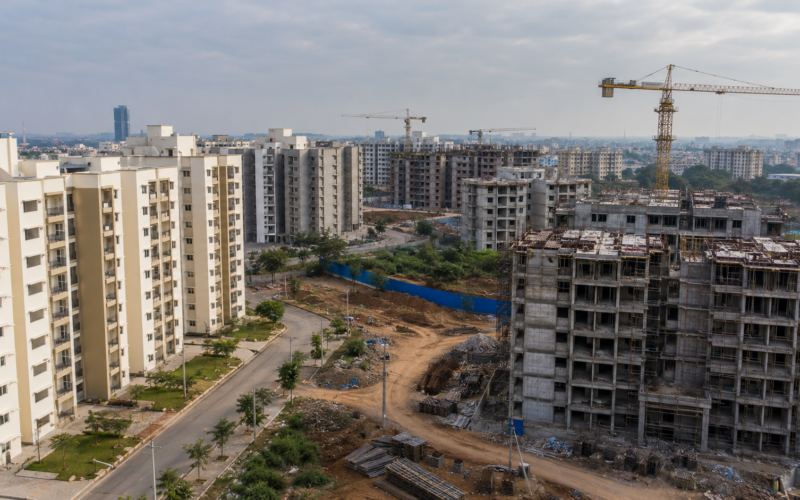
The government plans to construct apartment towers of up to ten floors on Housing Board and other departmental land. Locating the developments within the urban region, rather than exclusively on Hyderabad’s distant periphery, could help beneficiaries remain closer to employment, transport, schools and existing community networks.
This approach addresses a recurring weakness in affordable housing programmes, where low-cost homes are sometimes separated from livelihoods and essential services. However, the value of an urban location depends on more than the land parcel. Water supply, sewerage, road access, public transport, power, fire safety and long-term building maintenance must be available when residents take possession.
What do the ₹11 lakh unit cost, ₹5 lakh subsidy and ₹6 lakh beneficiary share mean?
Each first-phase LIG flat is estimated to cost ₹11 lakh, excluding the land value absorbed by the government. Telangana will provide ₹5 lakh as financial assistance, leaving the selected beneficiary responsible for ₹6 lakh.
For the 7,680-flat phase, the disclosed unit economics imply approximately ₹844.8 crore of construction value. The state subsidy component would amount to about ₹384 crore, while beneficiaries would collectively contribute approximately ₹460.8 crore. These calculations exclude the economic value of government land, off-site infrastructure, financing costs and any additional charges that may arise during implementation.
The land component is strategically important because it can be one of the largest costs in urban Hyderabad. The Housing Minister has said beneficiaries will receive an undivided share of land without paying the underlying land cost. The government has indicated that this share could carry substantial market value at some locations, although the actual value will vary by site and should not be treated as a uniform independent valuation.
If the original 70,000-unit LIG framework is retained and the current ₹11 lakh construction cost is broadly applicable, the LIG portion alone could represent around ₹7,700 crore of construction activity and ₹3,500 crore of subsidy support. These are directional calculations rather than an announced project budget because future phases, unit designs, locations and costs may differ.
The funding structure reduces the state’s upfront burden by combining public land, subsidies, Housing Board resources and beneficiary payments. It also transfers part of the execution risk to household affordability. Construction can remain on schedule only if the government releases assistance promptly, contractors receive predictable payments and selected families can meet their instalments.

Which Hyderabad constituencies and government sites are included in the first phase?
The first phase covers Rajendranagar at Mailardevpally, Maheshwaram at Jalpally, Serilingampally at Rayadurgam, Ibrahimpatnam at Bandlaguda, Malkajgiri at Kowkur, Nampally at Red Hills, Khairatabad at Hakeempet Dargha and Jubilee Hills MLA Colony, Karwan at Kulsumpura, Bahadurpura at Nandi Musaliguda and Amberpet at City Police Lines.
The remaining locations are Kukatpally at KPHB Colony, Medchal at Pocharam, Quthbullapur at Gajularamaram, Sanath Nagar at Patigadda, Secunderabad Cantonment at Maredpally and Malakpet at Gaddiannaram R&B Quarters.
The geographical spread gives the programme exposure to established urban areas as well as expanding residential corridors. It also makes execution more complex because every site will have different title, access, utility, density and construction conditions.
Government instructions require land to be checked for clear title, encumbrances, litigation, permitted land use, road connectivity and infrastructure feasibility. Completing these checks before construction contracts are awarded will be essential. A disputed or infrastructure-constrained site could delay an entire constituency’s allocation even if work progresses elsewhere.
The distributed model may support more inclusive housing by avoiding a single large resettlement colony. However, managing 16 sites simultaneously requires standardised designs, central procurement discipline and local coordination across the Housing Board, municipal bodies, utility agencies and district administrations.
Who is eligible for Indiramma LIG flats in Hyderabad’s CURE area under the 2026 rules?
Applicants must have lived in Hyderabad’s CURE area for at least ten years and must be residents of the Assembly constituency under which they apply. Annual household income cannot exceed ₹6 lakh.
Neither the applicant nor another member of the family may own a house, flat or residential plot within the Outer Ring Road or CURE limits. Applicants who have already received a home or comparable assistance under another government housing programme are not eligible. Only one application is permitted per family.
The scheme provides reservations of 14% for Scheduled Castes, 5% for Scheduled Tribes, 16% for Backward Classes and 5% for persons with disabilities. Another 10% is reserved for eligible government outsourcing employees, Class IV employees and sanitation workers. A 30% reservation for women applies within the relevant categories.
The flat is expected to be registered in the name of an eligible woman in the selected family. Beneficiaries will not be permitted to sell, transfer or lease the property for ten years after allotment. The flat may, however, be mortgaged to an authorised lender for a housing loan, subject to the applicable conditions.
Applicants should understand that satisfying the basic income and ownership criteria does not guarantee a flat. Eligibility will be verified, and a computerised lottery will be conducted if the number of qualified applications exceeds the available units.
How can eligible residents apply for Telangana’s Indiramma housing scheme before August 10?
Applications are being accepted from July 21 to August 10, 2026. Eligible residents can apply through the official Telangana MeeSeva portal, an authorised MeeSeva centre or the official MeeSeva WhatsApp service by sending “Hi” to 8096958096 and selecting the Indiramma Indlu service.
Each applicant must pay a non-refundable application fee of ₹100 and an earnest money deposit of ₹10,000. The deposit will be adjusted against the beneficiary’s contribution if a flat is allotted. Applicants who are not selected are expected to receive a refund of the deposit.
Applicants should keep their Aadhaar card, an Aadhaar-linked mobile number, proof of residence and household income information ready. Clear images of the front and back of the Aadhaar card are required for the online process. Residence, income, caste, disability or employment-category documents may be requested during scrutiny and field verification.
Before submitting the form, applicants should confirm that their name, Aadhaar number, constituency, family details, address and bank or payment information are correct. Duplicate applications, suppressed property ownership or false declarations can result in rejection or cancellation.
Applicants should retain the application acknowledgement, reference number and payment receipt. These documents will be important for tracking the application, checking lottery results, obtaining an EMD refund or responding to verification queries.
The selection process includes document scrutiny, income and family verification, checks for duplicate applications and a computerised lottery where eligible demand exceeds supply. A provisional allotment will be followed by field verification and stage-linked payments before registration and handover.
Why could beneficiary financing become the decisive affordability test for the scheme?
The ₹5 lakh subsidy and free land materially reduce the price of a home in urban Hyderabad. Nevertheless, a ₹6 lakh beneficiary contribution remains substantial for a household earning no more than ₹6 lakh annually.
Successful applicants must initially pay ₹1 lakh after provisional allotment, followed by ₹2 lakh after completion of the reinforced cement concrete structure and another ₹2 lakh during the finishing stage. The balance, after adjusting the ₹10,000 EMD, will be payable around handover, together with any applicable charges.
The staged structure prevents the entire contribution from becoming due immediately. It also links household payments to visible construction progress. However, lower-income families may still require housing loans, savings or support from relatives to meet the instalments.
The permission to mortgage allotted flats should improve access to formal housing finance. Actual credit availability will depend on lenders’ assessment of income stability, repayment capacity, property documentation and the timing of registration. Informal workers with irregular earnings may find it harder to secure loans despite meeting the scheme’s income criteria.
If a meaningful share of selected beneficiaries cannot arrange the contribution, the Housing Board could face delayed payments, cancelled allotments and repeated lotteries. Transparent rules for defaults, substitutions and EMD refunds will therefore be as important as the initial application process.
Affordability also continues after possession. Residents of multi-storey buildings must fund lifts, water pumps, common-area electricity, security, waste management and structural maintenance. A home that is inexpensive to acquire but costly to maintain could create financial stress for low-income households.
What execution milestones will determine whether Telangana can deliver the flats within a year?
The government has indicated that it wants the initial homes completed before the next Bonalu season. Delivering 7,680 flats across 16 locations within roughly a year would require land preparation, design approval, tendering and construction to progress in parallel.
The first evidence of implementation will be the publication of project-specific tenders and the appointment of contractors. Subsequent milestones include site possession, foundation work, completion of the structural frame, utility connections, finishing, occupancy approvals and beneficiary handover.
Speed cannot come at the expense of construction quality or regulatory compliance. High-density residential towers require adequate fire access, structural assurance, sewage capacity, reliable water supply and safe electrical systems. Defects discovered after occupation would increase maintenance costs and weaken confidence in later phases.
The difference between the earlier 12,000-flat pilot approval and the current 7,680-flat application phase suggests that the programme is still being calibrated around identified land and implementation readiness. That is not inherently negative, but it reinforces the need to judge progress through completed sites rather than the one-lakh target alone.
A credible scale-up would require the first phase to demonstrate predictable costs, timely subsidy releases, acceptable construction quality and strong occupancy. Delays in land transfer, contracting or beneficiary finance would make the larger expansion more difficult and expensive.
How could the CURE housing programme affect Hyderabad’s construction and urban-services economy?
The first phase could create demand for civil contractors, cement, steel, prefabricated building components, electrical equipment, plumbing systems, elevators, fire-safety installations and project-management services. It could also support smaller suppliers and workers located around the individual sites.
No major construction contracts have yet been publicly identified for the full programme. Revenue opportunities for listed or private contractors should therefore not be assumed until the Telangana Housing Board issues tenders and awards packages.
The broader economic value depends on whether the homes improve access to employment and reduce housing insecurity. Ownership within the urban region could help families avoid long commutes, strengthen labour retention for city employers and create a formal household asset.
Higher density will simultaneously increase demand for municipal services. Water, sewerage, roads, public transport, schools, healthcare and solid-waste systems must expand alongside housing. Building apartment towers without this supporting infrastructure would transfer the cost from construction budgets to residents and municipal agencies.
The programme has moved beyond a broad policy announcement by opening applications, defining the initial sites and setting beneficiary economics. What remains unresolved is whether the financing, land and construction system can deliver the first 7,680 homes on schedule. Timely tender awards, visible site mobilisation, predictable EMD refunds and completion of the first structural milestones will provide the clearest evidence that Telangana can scale the model towards one lakh urban homes.
What are the key takeaways from Telangana’s Indiramma CURE housing rollout?
- Telangana has opened applications for 7,680 Indiramma LIG ownership flats across 16 Hyderabad CURE constituencies.
- The initial phase represents 7.68% of the broader one-lakh affordable-housing objective.
- Each one-bedroom flat will offer approximately 528 sq ft of built-up area and 400 sq ft of carpet area.
- The estimated unit cost is ₹11 lakh, comprising a ₹5 lakh government subsidy and ₹6 lakh beneficiary contribution.
- The first-phase unit economics imply about ₹844.8 crore of construction activity, excluding land and supporting infrastructure.
- Applicants must meet income, residence and property-ownership conditions, with only one application allowed per family.
- Applications remain open through August 10 via MeeSeva centres, the MeeSeva portal and the official MeeSeva WhatsApp service.
- A ₹100 application fee and ₹10,000 EMD are payable, with allotment subject to verification and a lottery if demand exceeds supply.
- Beneficiary financing, construction quality and urban infrastructure will determine whether the homes remain affordable after possession.
- Tender awards, site mobilisation and structural completion will be the next measurable tests of the one-lakh housing plan.
Discover more from Business-News-Today.com
Subscribe to get the latest posts sent to your email.