

Amkor Technology, Inc. (Nasdaq: AMKR) has entered a $1.5 billion multi-year advanced packaging and development agreement with NVIDIA Corporation to support next-generation artificial intelligence and accelerated computing infrastructure. NVIDIA will provide Amkor Technology with a prepayment that will help finance additional advanced semiconductor packaging and test capacity in the United States, while the companies align their technology roadmaps around high-density interconnects and heterogeneous integration. The agreement strengthens the commercial foundations of Amkor Technology’s capital-intensive Arizona expansion and places the company more firmly inside NVIDIA’s manufacturing ecosystem. The central question is whether stronger customer commitments can help Amkor Technology convert a costly capacity buildout into sustained revenue growth, higher utilisation and structurally better margins.
How does NVIDIA’s $1.5 billion Amkor agreement change the economics of United States AI packaging capacity?
The immediate significance of the NVIDIA agreement is not simply its headline value. It is the combination of a long-term capacity relationship, technology co-development and customer prepayment at a time when Amkor Technology is committing billions of dollars to new manufacturing infrastructure.
Semiconductor packaging facilities require significant spending on specialised buildings, cleanrooms, automation, interconnect equipment and testing systems before meaningful revenue is generated. Those investments can become economically painful when customer demand arrives later than expected or when equipment built for a particular package architecture cannot be efficiently redeployed.
NVIDIA’s commitment should give Amkor Technology greater visibility when deciding what capacity to install, which technologies to prioritise and how quickly to expand. It also moves part of the commercial risk closer to the customer, rather than leaving Amkor Technology to invest entirely against forecast demand.
The announcement does not establish that Amkor Technology will immediately receive the entire $1.5 billion as cash. The companies described the arrangement as a multi-year advanced packaging and development agreement and confirmed that NVIDIA would make a prepayment, but they did not disclose the prepayment amount, payment schedule, revenue-recognition treatment or minimum annual purchasing volumes.
That distinction matters. The agreement improves demand visibility and funding support, but its effect on reported revenue, operating cash flow and margins will depend on the timing of capacity deployment and NVIDIA programme ramps.
Why is advanced packaging becoming as strategically important as leading-edge wafer fabrication?
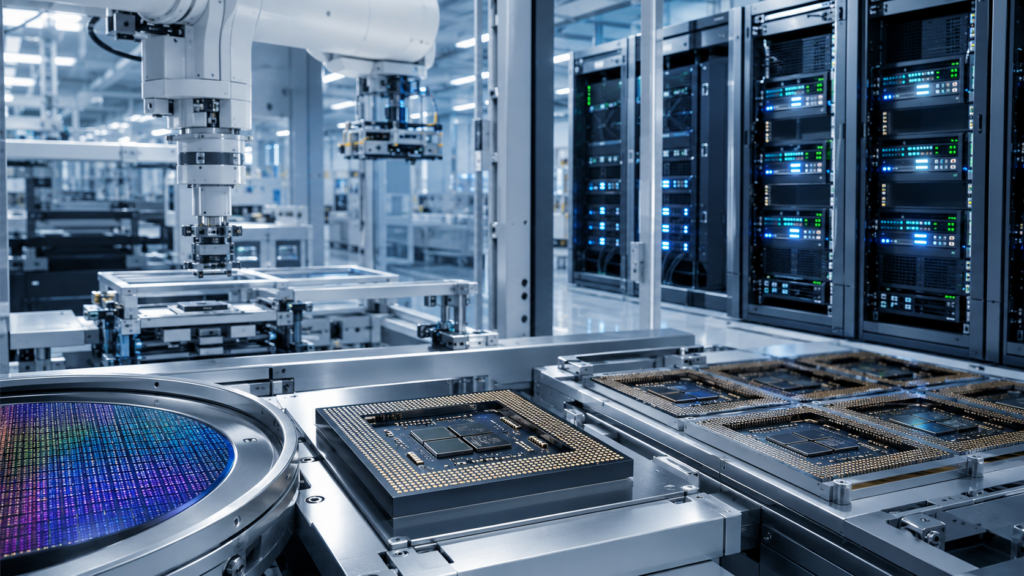
Artificial intelligence processors are no longer defined solely by the performance of an individual piece of silicon. Modern accelerated computing platforms increasingly combine graphics processing units, central processing units, high-bandwidth memory, networking components and specialised accelerators inside complex packages.
The package must provide dense electrical connections, manage power delivery, control heat, preserve signal integrity and support reliable high-volume production. A delay or yield problem at the packaging stage can therefore restrict shipment volumes even when sufficient wafers are available.
Amkor Technology and NVIDIA plan to develop technologies involving high-density interconnects and next-generation heterogeneous integration. These capabilities allow different semiconductor dies, potentially manufactured using different process technologies, to operate as a coordinated system.
Amkor Technology’s existing advanced packaging roadmap includes 2.5D integration and high-density fan-out platforms. These technologies are increasingly relevant as chip designers use chiplet architectures to improve performance and avoid the cost and manufacturing limitations associated with building every function on one extremely large die.
Testing is also becoming more important as package values rise. Detecting a defect after several expensive components have been integrated can create a substantially larger loss than identifying the same problem earlier. Amkor Technology’s ability to provide wafer-level processing, assembly, burn-in, final test and system-level test gives it an opportunity to capture more value across the manufacturing chain.
For NVIDIA, the partnership supports access to another scaled packaging and test platform. For Amkor Technology, it creates an opportunity to move deeper into high-performance computing, where package complexity, content and service value are generally higher than in more mature semiconductor applications.
How does the NVIDIA agreement connect Amkor Technology and Taiwan Semiconductor Manufacturing Company in Arizona?
The NVIDIA partnership becomes more strategically meaningful when viewed alongside Amkor Technology’s June 2026 agreement with Taiwan Semiconductor Manufacturing Company.
Taiwan Semiconductor Manufacturing Company and Amkor Technology entered a 10-year partnership under which the foundry can procure advanced packaging and test services from Amkor Technology in Arizona. The relationship is intended to connect front-end semiconductor fabrication with back-end assembly and testing inside the United States.
NVIDIA now adds a major source of demand and technology alignment to that emerging ecosystem. Taiwan Semiconductor Manufacturing Company can produce advanced wafers, Amkor Technology can package and test the resulting chips, and NVIDIA can coordinate product roadmaps and capacity requirements across both stages.
This alignment addresses a longstanding weakness in semiconductor localisation strategies. Building leading-edge wafer fabrication without sufficient domestic packaging and test capacity leaves a critical part of the supply chain dependent on overseas facilities.
Amkor Technology began constructing its Arizona campus in September 2025 and expects building completion during 2027, followed by tool installation, line verification, customer qualification and production in 2028. The company initially secured a 104-acre site in Peoria and added an adjacent 67-acre parcel in May 2026, creating room for future expansion.
The campus is expected to contain approximately 750,000 square feet of cleanroom space across two phases. Amkor Technology has described the first phase as anchored by customer commitments and included it in the company’s long-term financial targets. The second phase has not yet been included in those targets, with its timing expected to depend on additional customer demand.
NVIDIA’s capacity agreement provides stronger support for that demand-led model. It does not eliminate construction or qualification risk, but it gives Amkor Technology a clearer commercial reason to install capacity than a purely speculative forecast of artificial intelligence growth.
What does the NVIDIA partnership mean for Amkor Technology’s $7 billion capital programme?
Amkor Technology has estimated total investment of approximately $7 billion across the two phases of its Arizona campus. That makes the project central not only to the company’s growth strategy but also to its balance-sheet management and future free cash flow.
The company entered 2026 with improving operating performance. First-quarter revenue rose 27.5% from the previous year to $1.685 billion, while gross margin increased from 11.9% to 14.2%. Operating income reached $100 million, net income was $83 million and operating cash flow improved to $145.1 million.
Capital expenditure, however, climbed to $224.6 million during the quarter from $79.9 million a year earlier. Amkor Technology expects total 2026 capital spending of approximately $2.5 billion to $3 billion, primarily because of the Arizona construction programme.
At March 31, the company held approximately $1.85 billion in cash and short-term investments and reported $1.41 billion of debt. Amkor Technology subsequently issued approximately $1.2 billion of convertible senior notes, providing additional funding for capital expenditure and general corporate purposes.
The notes do not bear regular interest and initially convert at approximately $106.37 per share, substantially above the share price at which they were issued. Amkor Technology also entered capped-call transactions designed to reduce potential dilution below an initial cap of $139.50 per share. The financing increased liquidity, but it also raised the company’s pro forma leverage and created a larger future repayment or conversion obligation.
Customer prepayments and capacity commitments can partially offset this pressure. They can reduce the amount of corporate capital that must be committed before demand becomes visible and provide evidence that the infrastructure is being developed around identified commercial programmes.
However, the NVIDIA agreement does not remove the need for disciplined project execution. Amkor Technology must still manage construction costs, equipment lead times, customer qualification, workforce development and the potentially expensive period between opening a facility and reaching efficient utilisation.
Can NVIDIA demand help Amkor Technology convert advanced packaging growth into higher margins?
Amkor Technology is already generating most of its revenue from advanced products. Advanced product sales reached $1.372 billion in the first quarter of 2026, representing more than 81% of total revenue. Computing, which includes data centres and infrastructure, accounted for 21% of revenue and expanded by 19% from the previous year.
The NVIDIA agreement could accelerate the shift towards more complex packages, but higher technical content does not automatically produce higher margins. Advanced packages often include more expensive materials, and profitability depends heavily on utilisation, yield, process stability and the amount of value captured through testing and turnkey services.
Amkor Technology’s first-quarter gross margin of 14.2% remained relatively modest compared with the margins generated by many semiconductor designers. Its economic opportunity lies in raising utilisation and increasing the proportion of revenue from differentiated packaging and testing programmes rather than simply adding manufacturing volume.
Management has targeted approximately $9 billion of revenue and a 17.5% gross margin by 2028, followed by more than $11 billion of revenue and a gross margin above 22% by 2030. It also expects earnings per share to rise from $1.50 in 2025 to approximately $5 or more by 2030.
The Arizona facility is central to those ambitions. Amkor Technology has projected that the first phase could generate approximately $1 billion of annual revenue at full scale and achieve a gross margin above 30%. Management expects the facility to reach break-even around 2029 and full utilisation around 2030.
These remain company targets rather than assured outcomes. The NVIDIA relationship makes the demand assumptions more credible, particularly because it combines capacity support with technology roadmap alignment. The measurable proof will come when programmes enter production, yields stabilise and utilisation supports the margin expansion embedded in Amkor Technology’s 2030 model.
Why did AMKR shares jump after hours despite losing ground over the previous month?
Amkor Technology shares closed the regular session on July 23 at approximately $65.33, down about 2.5% for the day. The NVIDIA agreement was announced after the market closed, and the stock subsequently rose 12.2% to $73.30 in extended trading.
The reaction suggests that investors viewed the agreement as more than a routine supplier announcement. A named commitment from NVIDIA gives Amkor Technology stronger strategic validation in artificial intelligence infrastructure and provides financial support for capacity that had previously been viewed as a major execution challenge.
The move should nevertheless be placed in context. Before the announcement, Amkor Technology shares were down almost 25% over one month, despite gaining approximately 4% across the preceding five trading sessions. The regular-session price remained well below the 52-week high of $96.68, although it was more than three times the 52-week low of $20.87.
At the regular close, Amkor Technology’s market capitalisation was approximately $16.2 billion. The after-hours move implied a valuation closer to $18.2 billion, subject to the lower liquidity and greater volatility commonly associated with extended trading.
The partnership improves the strategic narrative, but a sustained rerating will require evidence that NVIDIA-supported capacity translates into revenue visibility, improved returns on invested capital and progress towards Amkor Technology’s long-term margin targets.
What could prevent the NVIDIA and Amkor Technology agreement from reaching its full value?
The first challenge is timing. Amkor Technology’s Arizona facility is not expected to begin production until 2028. Construction must be completed, equipment must be installed and customers must qualify individual manufacturing processes before commercial volumes can ramp.
The second challenge is technological change. Artificial intelligence architectures are evolving rapidly, and packaging requirements can shift as customers change memory configurations, interconnect designs, cooling systems and chiplet strategies. Amkor Technology must ensure that installed equipment remains relevant across successive NVIDIA product generations.
The third challenge is utilisation. Packaging facilities carry substantial fixed costs, and profitability can weaken rapidly when production volumes fall below plan. The NVIDIA agreement improves visibility, but the disclosed terms do not establish guaranteed utilisation rates or explain how capacity risks are divided between the companies.
Customer concentration is another consideration. Deeper relationships with major semiconductor customers can improve planning and capital efficiency, but they can also increase exposure to changes in a small number of product roadmaps. Amkor Technology will need to balance anchor commitments with a sufficiently diverse customer base.
Finally, the project remains exposed to construction costs, equipment availability, workforce recruitment and the conditions attached to government incentives. Amkor Technology has been awarded up to $407 million in direct United States CHIPS Act funding, but access depends on achieving specified construction and production milestones.
What should investors expect from Amkor Technology’s July 27 earnings report?
Amkor Technology is scheduled to release second-quarter 2026 results after the Nasdaq market closes on July 27. The report will provide the first near-term financial checkpoint following the NVIDIA announcement.
The most important measures will include computing revenue growth, gross margin, capital expenditure and operating cash flow. Investors will also look for any revision to the company’s $2.5 billion to $3 billion 2026 capital expenditure forecast.
Management may provide additional information about customer prepayments, the pace of Arizona construction and whether the NVIDIA agreement changes the timing of equipment orders. Disclosure about the accounting treatment of the agreement would also help investors understand when it may begin affecting the income statement and balance sheet.
The partnership has strengthened Amkor Technology’s strategic positioning by connecting a major artificial intelligence customer with its emerging United States manufacturing capacity. What remains unresolved is whether the company can control the cost of the investment period and achieve the utilisation required to deliver its margin targets.
The next proof point is therefore not another partnership announcement. It is evidence that capital expenditure, customer commitments and operational milestones are progressing together without weakening near-term financial discipline.
What are the key takeaways from the NVIDIA and Amkor Technology advanced packaging partnership?
- Amkor Technology and NVIDIA have entered a $1.5 billion multi-year advanced packaging and development agreement for artificial intelligence infrastructure.
- NVIDIA will make a prepayment to support Amkor Technology’s United States capacity expansion, although detailed payment and purchasing terms were not disclosed.
- The companies will align technology roadmaps around high-density interconnects and heterogeneous integration.
- The agreement strengthens the customer foundations of Amkor Technology’s $7 billion, two-phase Arizona packaging and test campus.
- Amkor Technology’s separate 10-year partnership with Taiwan Semiconductor Manufacturing Company connects wafer fabrication with domestic packaging and testing.
- First-quarter revenue increased 27.5% to $1.685 billion, but planned 2026 capital expenditure of $2.5 billion to $3 billion highlights the scale of the investment burden.
- Advanced products already generate more than 81% of Amkor Technology’s revenue, while computing accounted for 21% of first-quarter sales.
- Amkor Technology expects Arizona production to begin in 2028, reach break-even around 2029 and approach full utilisation in 2030.
- AMKR shares rose 12.2% in extended trading after the announcement, but remained below their 52-week high.
- The July 27 earnings release will test whether improving customer visibility is being matched by disciplined capital deployment and margin progress.
Discover more from Business-News-Today.com
Subscribe to get the latest posts sent to your email.