




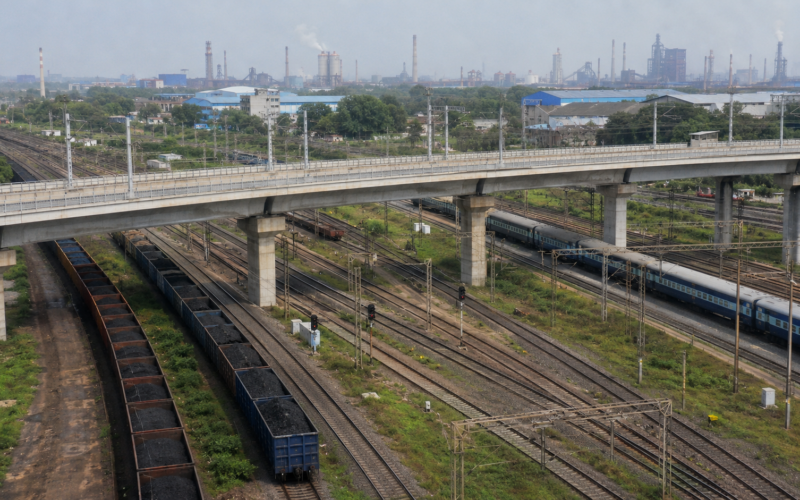
Indian Railways has approved a ₹135 crore rail flyover intended to decongest the strategically important Rourkela-Bondamunda section of South Eastern Railway. The 4.59 km structure will run from Bondamunda A Cabin to Bondamunda Link B Cabin and is intended to separate heavy freight movements from passenger operations. The project is expected to add capacity for eight million tonnes of freight annually while reducing crossing conflicts at Bondamunda Yard. Its strategic relevance comes from rising mineral and steel traffic linked to the Barsua-Taldih-Kalta mining complex and Rourkela Steel Plant. Steel Authority of India Limited, listed as NSE: SAIL and BSE: 500113, stands to benefit from more reliable rail evacuation, although the project alone is unlikely to materially change near-term earnings expectations.
Why has Indian Railways prioritised the Bondamunda rail flyover at this stage of corridor expansion?
The approval reflects a shift from simply adding tracks to addressing the specific junction conflicts that prevent existing infrastructure from operating at its full capacity. Bondamunda is not an ordinary intermediate station. It functions as a major freight and marshalling location serving an industrial region where iron ore, coal, steel and other bulk commodities must move alongside scheduled passenger services.
When freight trains and passenger services need to cross one another at the same level, additional tracks do not automatically eliminate congestion. A train occupying a crossover can block several possible movements through the yard, causing delays that spread beyond the immediate location. The planned flyover is intended to remove one of those operating conflicts by allowing freight traffic to pass above or independently of competing passenger routes.
The timing is also connected to expected industrial growth rather than merely existing congestion. Indian Railways is preparing for increased traffic from expanded mining activity at the Barsua-Taldih-Kalta complex, higher production at Rourkela Steel Plant and the wider development of the High-Density Network around Rourkela. Waiting until all that capacity is operational would risk creating a logistics bottleneck precisely when industrial output needs dependable evacuation.
At ₹135 crore, the Bondamunda project is comparatively modest beside major railway doubling or greenfield corridor programmes. Its potential return, however, will depend less on its physical length and more on how many conflicting train movements it eliminates. In railway economics, a short grade-separated connection at the correct location can sometimes deliver more usable capacity than a much longer stretch of additional track elsewhere.
How will separating freight and passenger movements change operations at Bondamunda Yard?
The most immediate operational benefit should be a reduction in train detention. Freight trains are longer, heavier and slower to accelerate than passenger services, making each conflicting movement particularly disruptive inside a busy yard. Allowing those trains to move through a segregated alignment should shorten the periods during which passenger paths, points and signals remain occupied.
Improved segregation could also make train scheduling more predictable. Railway timetables depend not only on average journey times but also on the variation between the best and worst operating outcomes. A yard that frequently experiences crossing conflicts forces planners to build additional recovery time into schedules, reducing the number of train paths that can be confidently offered.
Passenger services may therefore benefit even though the project is largely justified by freight growth. Fewer conflicts should reduce the risk of passenger trains being held outside or within the Bondamunda-Rourkela section while slower freight formations clear the junction. Reliability gains could become increasingly important as Indian Railways introduces faster passenger services that require cleaner and more predictable operating windows.
The flyover may also improve locomotive and wagon productivity. Every hour spent waiting at a congested junction reduces the number of trips that rolling stock can complete and raises the cost of moving each tonne of freight. Faster yard transit can therefore create capacity without requiring a proportionate increase in wagons, locomotives or crews.
These benefits will not arise from the civil structure alone. Signalling integration, yard remodelling, operating procedures and coordination with adjacent lines will determine whether trains can use the new infrastructure efficiently. A flyover that merely transfers congestion to another junction would deliver a far weaker return than one commissioned as part of a coordinated corridor plan.

Why is eight million tonnes of additional annual freight capacity strategically important?
The projected eight million tonnes of additional freight movement is small compared with Indian Railways’ nationwide annual cargo volume, which reached approximately 1.67 billion tonnes in the 2025-26 financial year. At the local corridor level, however, eight million tonnes represents a substantial logistics increment that could support additional mineral extraction and steel production without forcing an equivalent volume onto roads.
Bulk commodities are particularly dependent on rail because their weight, distance and relatively low value per tonne make road transportation expensive at scale. A constrained railway corridor can therefore become a direct limitation on industrial output. Mines may have reserves and steel plants may have production capacity, but neither creates full economic value if raw materials and finished products cannot be moved reliably.
Additional railway capacity could strengthen the connection between mines, processing facilities, steel plants, consumption centres and ports. That has implications beyond Steel Authority of India Limited because private steel producers, mineral suppliers, contractors and downstream manufacturers depend on the same regional logistics ecosystem.
The capacity estimate should nevertheless be viewed as an enabling figure rather than a guaranteed traffic outcome. Achieving the full eight million tonnes will require the anticipated mining and steel expansions to proceed, freight demand to remain commercially attractive and adjoining railway sections to possess sufficient capacity. The flyover can remove a constraint, but it cannot independently create industrial demand.
The wider economic benefit lies in reducing the friction attached to each tonne moved. Improved transit reliability can lower inventory buffers, demurrage exposure, wagon detention and uncertainty over delivery schedules. Those savings are rarely as visible as the headline project cost, but they are central to whether industrial companies can operate larger facilities efficiently.
How does the new flyover fit with the fourth and fifth railway lines around Rourkela?
The Bondamunda flyover should be viewed as one component of a broader capacity augmentation programme rather than a standalone intervention. Indian Railways has already commissioned a 9.3 km fourth line between Bondamunda and Rourkela, while a separate 9.6 km fifth line between Rourkela and Bondamunda A Cabin is under construction.
South Eastern Railway reported that the fifth-line project, carrying a sanctioned cost of approximately ₹244.99 crore, had reached around 45% physical progress by April 2026. The railway had targeted October 2026 for completion, although the project faced an unresolved dependency involving the removal of encroachments near Road Over Bridge 133A.
The fourth line increases the number of tracks available, the fifth line is intended to add further corridor capacity, and the new flyover is designed to remove conflicts at a crucial yard connection. Together, these works represent a layered approach to railway expansion. More tracks provide theoretical capacity, while grade separation converts a greater share of that theoretical capacity into usable train paths.
Coordination between the projects will be essential. The fifth line reaching completion before the flyover may increase the number of trains approaching Bondamunda without immediately eliminating the yard conflict. Conversely, commissioning the flyover while adjoining works remain incomplete could limit the number of trains able to use it.
The existing encroachment issue on the fifth-line project also provides a warning for the new flyover. Even projects located substantially within railway land can encounter utilities, access constraints, structures and local clearances. The Ministry of Railways has not yet disclosed the new flyover’s tender schedule, construction period, contractor, land requirement or expected commissioning date.
What execution risks could delay the Bondamunda project or weaken its expected benefits?
Construction inside or beside an operating railway yard is inherently complex. Bondamunda must continue handling freight and passenger traffic while foundations, piers, track connections, signalling equipment and overhead electrification are modified. This increases the need for carefully planned traffic blocks and can slow work compared with construction on an entirely new alignment.
Safety requirements are another significant factor. The flyover must accommodate heavy axle loads associated with mineral and steel traffic while connecting seamlessly with existing track geometry. Structural work above or near live railway lines also requires strict sequencing, particularly where cranes, launching equipment or temporary supports could affect operating tracks.
Cost escalation is a further risk because the ₹135 crore figure represents the approved project cost at the present stage. Delays in tendering, changes to the alignment, utility relocation, additional bridge requirements or prolonged traffic management could increase expenditure. Indian Railways will need to maintain discipline around scope changes if the project is to preserve its intended economic return.
The absence of a public completion schedule makes it difficult to judge whether the flyover will be ready before the anticipated increase in industrial traffic. If mining and steel output expands first, congestion could intensify during the construction period. If industrial expansion is delayed, the railway may initially operate below the projected eight million tonnes of incremental capacity.
There is also a network risk. Freight capacity is determined by the weakest segment across an entire route, not simply by the most recently upgraded section. Congestion near Jharsuguda, Chakradharpur, ports, loading terminals or destination yards could reduce the full corridor benefit even after Bondamunda is decongested.
What does the flyover mean for Steel Authority of India Limited and investor sentiment?
Steel Authority of India Limited is an important beneficiary because the project is partly justified by anticipated growth at its Barsua-Taldih-Kalta mining complex and Rourkela Steel Plant. More reliable movement of iron ore and other inputs could support higher plant utilisation, while improved evacuation capacity could reduce delays in dispatching finished steel.
The financial benefit would most likely appear through improved operating efficiency rather than a direct one-time earnings contribution. Lower wagon detention, reduced demurrage, more predictable raw-material arrivals and tighter inventory management can collectively support margins and working-capital discipline. The magnitude will depend on actual production growth and the proportion of traffic using the improved alignment.
Steel Authority of India Limited shares traded around ₹171.30 on July 3, 2026. The stock was down approximately 0.54% over five trading days and had declined around 17.38% over one month, while remaining within a 52-week range of ₹118.10 to ₹209.70.
That price pattern suggests investors are currently placing greater weight on steel prices, input costs, capital expenditure, production performance and the broader commodity cycle than on one regional rail approval. The Bondamunda flyover is strategically supportive, but it is not large enough by itself to reverse market sentiment or materially alter near-term valuation assumptions.
Its relevance becomes stronger when viewed alongside Steel Authority of India Limited’s broader expansion plans. New steelmaking or mining capacity cannot generate attractive returns if outbound and inbound logistics remain constrained. The railway project therefore reduces one infrastructure risk attached to future growth, but investors will still need evidence that industrial expansions, railway works and market demand are progressing in alignment.
Could Bondamunda become a model for removing freight conflicts across Indian industrial corridors?
Indian Railways has classified the project under its Energy, Mineral and Cement Corridor programme, which indicates that the approval is part of a broader freight strategy. India’s ambition to increase rail freight volumes will require not only long dedicated corridors but also targeted interventions at junctions, yards and industrial connections.
Projects such as Bondamunda can be attractive because they address measurable operating conflicts. Their performance can be assessed through reduced detention, higher average speeds, additional train paths and increased tonnage. That makes them potentially easier to prioritise than infrastructure justified only by broad regional expectations.
The model is particularly relevant for established industrial regions where acquiring land for entirely new corridors is difficult. Grade separation allows railways to extract more capacity from existing rights of way, although construction complexity and traffic disruption can remain substantial.
The strategic test will be whether Indian Railways commissions these smaller bottleneck-removal projects in coordination with mine expansions, industrial plants, loading terminals and adjoining line works. Infrastructure completed too early can remain underused, while infrastructure delivered too late becomes an expensive response to congestion that has already damaged industrial efficiency.
Bondamunda therefore represents more than a ₹135 crore bridge. It is a test of whether corridor planning can connect industrial forecasts with railway engineering, procurement and commissioning before traffic growth overwhelms the network.
Key takeaways on Indian Railways’ ₹135 crore Bondamunda flyover and Odisha freight capacity
- The 4.59 km rail flyover is intended to remove a significant freight and passenger crossing conflict at Bondamunda Yard.
- Indian Railways expects the project to enable eight million tonnes of additional freight movement annually.
- The primary industrial drivers are anticipated mining expansion and higher production at Rourkela Steel Plant.
- Passenger reliability could improve because freight trains would no longer occupy certain conflicting routes through the yard.
- The flyover complements the commissioned fourth line and the separate 9.6 km fifth-line project under construction.
- Coordination between the flyover, fifth line, signalling systems and adjoining sections will determine the usable capacity created.
- The lack of a disclosed tender schedule, contractor and commissioning date remains an important execution uncertainty.
- Steel Authority of India Limited could benefit from better raw-material and finished-steel logistics, but the project is not a near-term valuation catalyst by itself.
- Construction inside a live railway yard introduces safety, traffic-block and cost-escalation risks.
- The project could provide a template for targeted grade-separation investments across India’s congested mineral and industrial corridors.
Discover more from Business-News-Today.com
Subscribe to get the latest posts sent to your email.

