


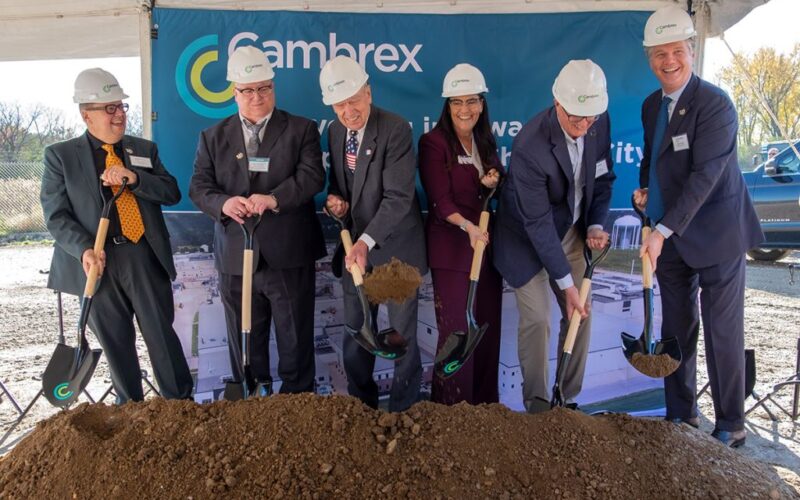
Cambrex Corporation has begun construction on a $120 million expansion of its active pharmaceutical ingredient manufacturing facility in Charles City, Iowa, advancing an investment intended to increase US production capacity for complex small molecule drugs and synthetic peptides. Announced on October 30, 2026, following a groundbreaking ceremony the previous day, the project will add 160,000 litres of manufacturing capacity and increase the site’s stated total capacity by approximately 25% to nearly one million litres. The privately held contract development and manufacturing organisation expects the expansion to be completed during the fourth quarter of 2028, extending a manufacturing investment first announced in October 2025. The development strengthens Cambrex’s ability to support pharmaceutical customers moving from clinical development towards commercial production while expanding domestic drug substance manufacturing infrastructure. Its financial contribution will depend on securing sufficient customer demand, qualifying additional production capabilities and achieving efficient utilisation after the facility becomes operational.
The expansion forms part of a broader investment programme across Cambrex’s North American and European manufacturing network. Its Charles City facility already produces active pharmaceutical ingredients, pharmaceutical intermediates and highly potent compounds, with capabilities supporting both clinical development and commercial supply. The new capacity is intended to extend these activities into additional large-scale manufacturing, including synthetic peptide production.
The project also carries a regional economic development dimension that was not detailed in the October newswire announcement. Iowa government records identify approved investment-related tax incentives and an employment commitment associated with the expansion, providing additional context for the project’s capital requirements and potential local benefits.
Cambrex moves its previously announced Iowa manufacturing investment into construction
The October groundbreaking marks a new implementation milestone rather than an additional $120 million investment commitment. Cambrex originally announced the Charles City expansion on October 22, 2025, citing increased customer demand for domestic active pharmaceutical ingredient manufacturing and specialised peptide production.
In March 2026, the company reported completing initial engineering studies for the proposed manufacturing plant. At that stage, Cambrex described plans for a new facility with 140,000 litres of capacity, alongside improvements to existing production suites and additional specialised manufacturing equipment.
The October announcement now identifies 160,000 litres of added manufacturing capacity, with completion targeted for the fourth quarter of 2028. The updated figure indicates a larger stated addition than the 140,000 litres outlined during the earlier engineering stage, although Cambrex has not provided a detailed reconciliation of the revised scope.
The company’s published expansion descriptions have also used different percentage measures. Its October 2025 announcement referred to a 40% increase in large-scale manufacturing capacity, the March 2026 update described a 20% increase for the relevant expansion phase, and the latest release refers to approximately 25% growth in total site capacity.
These figures should not be treated as directly interchangeable because the disclosures refer to capacity using different descriptions and potentially different measurement bases. The latest stated project scope is an additional 160,000 litres, with total site capacity approaching one million litres, while individual production categories may have different available volumes.
The movement from engineering studies into construction is operationally meaningful because it indicates that the investment has advanced beyond preliminary design. However, the groundbreaking does not establish that all equipment has been procured, production lines have been installed or the expansion is ready to manufacture commercial drug substances.
Why does the Charles City expansion matter for small molecule drugs and synthetic peptide manufacturing?
Cambrex’s investment targets two important pharmaceutical manufacturing activities that can involve substantially different production requirements.
Small molecule active pharmaceutical ingredients are used across a wide range of therapeutic areas, including cardiovascular disease, oncology, infectious diseases and other established pharmaceutical markets. Manufacturing these compounds at commercial scale requires reliable chemical synthesis, purification, analytical testing and production processes capable of meeting product-specific quality specifications.
Synthetic peptide manufacturing introduces additional complexity because production economics depend on molecular structure, synthesis methods, purification requirements and manufacturing scale. Peptides are used in several therapeutic categories, and demand for specialised synthesis capabilities has increased as pharmaceutical developers pursue new peptide-based medicines.
Cambrex intends to use the Charles City expansion to support complex chemistry, including highly potent active pharmaceutical ingredients, controlled substances and commercial-scale liquid-phase peptide manufacturing. The company’s earlier engineering update identified large-scale and mid-scale reactors and advanced Hastelloy agitated filter dryers among the planned equipment capabilities.
These investments are relevant because producing a compound in a laboratory or early clinical manufacturing environment does not automatically establish an efficient process for commercial supply. Larger production volumes may require different equipment configurations, improved reaction control, more efficient purification methods and additional measures to ensure consistent product quality.
The ability to support customers across multiple development stages can strengthen a contract manufacturer’s commercial relationships. Pharmaceutical sponsors may prefer to retain an established manufacturing partner when a drug candidate advances from process development into late-stage clinical trials and commercial production, provided the partner can offer competitive economics and sufficient capacity.
Cambrex’s strategy is to expand that continuity. Its manufacturing network already provides services covering drug substance development, process optimisation, analytical testing and commercial production. Adding capacity at Charles City could reduce the need for some customers to transfer established processes to an unrelated manufacturer when their production requirements increase.
However, the planned facility has not been tied publicly to a specific newly approved medicine or a disclosed long-term supply contract. The company has not identified customer allocations, production volumes or expected revenue associated with the additional capacity.
Iowa approves $10.1 million in state incentives alongside the pharmaceutical manufacturing project
Public economic development records provide additional financial detail beyond Cambrex’s October announcement.
In May 2026, the Iowa Economic Development Authority approved an incentive application for Cambrex Charles City, Inc. under the Business Incentives for Growth programme. The approval included a $7.6 million investment tax credit and a $2.5 million sales and use tax refund, representing approximately $10.1 million in approved state tax incentives.
The state documentation described the project as involving a qualifying investment of $135.1 million and the construction of a 7,700-square-foot production facility. It also identified 104 anticipated jobs associated with the expansion, with a qualifying wage of $24.76 per hour.
These government figures provide a more detailed view of the project’s economic development commitments than the company’s latest announcement. They do not mean that the full $10.1 million has already been received in cash, because tax credits and refunds depend on the applicable programme rules and qualifying expenditures.
The project’s reported investment amounts also require careful interpretation. Cambrex continues to describe the expansion publicly as a $120 million investment, while the state records identify $135.1 million in qualifying investment. Separately, a May 2026 Charles City council document recorded an estimated capital investment of approximately $149.8 million.
The records do not provide a complete reconciliation of the different amounts or establish that they represent identical cost definitions. They should therefore not be added together or treated as evidence of a confirmed construction cost overrun.
The local government documentation also outlined proposed support through incremental property tax payments totalling approximately $400,941 over nine years. That arrangement was described as subject to further development agreements and required approval processes, rather than an unconditional completed disbursement.
For Cambrex, public incentives may reduce selected project costs and support the investment case, but they do not independently establish financial returns. The larger economic question is whether the additional manufacturing capacity can generate sufficient operating contribution to justify the capital committed.
How could 104 new jobs and a larger manufacturing footprint affect Charles City’s pharmaceutical economy?
The expansion could provide a measurable employment benefit for Charles City and the surrounding Iowa region.
Cambrex’s existing Charles City operation employs more than 400 people, according to the facility’s published profile. The site occupies approximately 45 acres and includes commercial-scale production plants, mid-scale manufacturing facilities, pilot operations and research laboratories.
The 104 jobs identified in state economic development records would represent a potential workforce increase of roughly one-quarter relative to a base of 400 employees. Actual percentage growth would depend on the workforce at the time the new positions are filled, and the jobs remain associated with the project’s implementation rather than employment already created.
Large-scale pharmaceutical manufacturing involves specialised positions in process engineering, production operations, quality control, analytical chemistry, maintenance and related technical functions. Expanding the workforce can therefore create demand for employees with manufacturing and scientific skills that differ from those required in more conventional industrial facilities.
The economic contribution could extend into local services, maintenance, construction and manufacturing support. However, the proportion of project expenditure that will flow to regional suppliers remains undisclosed, and some specialised pharmaceutical equipment may be sourced outside Iowa.
The Charles City facility has operated for approximately a century, reaching its 100th anniversary in 2026. This established industrial footprint gives Cambrex a site with existing infrastructure, operating knowledge and regulatory experience rather than requiring the company to develop an entirely new manufacturing location.
Expanding an existing facility can offer logistical and operational advantages, including access to established utilities, quality systems and experienced personnel. Those advantages may help limit selected implementation costs, although they do not remove the need to qualify new equipment and production processes.
The project’s local impact will become clearer through construction activity, hiring progress and the eventual operation of the additional manufacturing capacity.
Can Cambrex convert growing demand for US pharmaceutical manufacturing into long-term contracts?
The commercial rationale for the investment reflects pharmaceutical customers’ growing interest in supply-chain resilience and geographically diversified manufacturing.
Cambrex has previously identified demand from drug developers seeking US-based production of active pharmaceutical ingredients. Such decisions can be influenced by manufacturing reliability, regulatory requirements, product complexity and the desire to reduce dependence on a limited number of international suppliers.
For a contract development and manufacturing organisation, domestic manufacturing capacity can become commercially valuable when it aligns with customers’ specific drug development and supply requirements. However, geographic location alone does not determine supplier selection, particularly when pharmaceutical companies can source technically comparable manufacturing services from several countries.
Customers also evaluate process development expertise, production reliability, quality performance and the ability to maintain competitive costs over a medicine’s commercial lifecycle.
The Charles City investment may strengthen Cambrex’s position in projects requiring complex synthesis or an established US manufacturing partner. The company already has capabilities involving highly potent compounds, controlled substances and specialised production processes, making additional reactor capacity potentially useful for a broader range of pharmaceutical programmes.
Synthetic peptides could provide another source of opportunity. The expansion is designed to support commercial-scale peptide production, but Cambrex has not disclosed how much of the additional capacity will be reserved for peptide programmes or whether particular therapeutic categories account for the expected demand.
The economics of peptide manufacturing can differ significantly between products. Some molecules require complex multi-stage synthesis and purification, while others may be produced more efficiently through established large-scale processes. The relationship between reactor volume and saleable output therefore depends on the products manufactured, rather than on capacity measured in litres alone.
Cambrex has not published an expected capacity utilisation rate, average contract value, incremental annual revenue or projected return on investment for the Iowa expansion. These missing figures limit the ability to estimate the commercial payoff from the company’s capital expenditure.
The strongest evidence of future demand would come from confirmed multi-year manufacturing agreements, particularly those associated with medicines approaching or entering commercial production. Such arrangements could improve utilisation visibility before the facility reaches completion.
How does the Iowa expansion fit into Cambrex’s wider US and European investment strategy?
The Charles City project is part of a series of manufacturing and technology investments across Cambrex’s international network.
In August 2025, its Snapdragon Chemistry business expanded peptide manufacturing capabilities in Waltham, Massachusetts. The facility added a good manufacturing practice suite supporting peptide projects through solid-phase, liquid-phase and hybrid synthesis approaches, alongside analytical and purification capabilities.
That investment addresses development and smaller-scale manufacturing requirements that can precede the need for substantially larger commercial production. The Iowa expansion could complement such activities by providing additional capacity for programmes requiring larger production volumes, although no specific transfer arrangement between the facilities has been announced.
Cambrex has also invested in High Point, North Carolina, where it expanded commercial manufacturing capabilities for active pharmaceutical ingredients and products serving specialised therapeutic markets. In August 2026, the company reported completing pre-approval inspections by the US Food and Drug Administration, Japan’s Pharmaceuticals and Medical Devices Agency and Australia’s Therapeutic Goods Administration at the High Point facility.
Those inspections relate specifically to High Point and should not be interpreted as regulatory clearance for the new Charles City expansion.
In Europe, Cambrex began construction in August 2026 on a $30 million research and development facility at its Milan site in Italy. The project will expand analytical development and process research capabilities while supporting upgrades across existing production facilities.
Completion of the Milan investment is expected during the second half of 2027, ahead of the planned fourth-quarter 2028 completion of the Iowa project.
Together, the investments indicate a strategy combining specialist process development with commercial manufacturing capacity. Research and development facilities can support process optimisation and early-stage scientific work, while larger production sites provide the infrastructure needed to manufacture approved drugs at commercial volumes.
However, the financial results of these investments are not publicly disclosed on a project-by-project basis. Their combined commercial value will depend on customer acquisition, successful technology transfer and sustained demand for specialised manufacturing services.
Why does Claudio Russolo’s leadership transition matter as Cambrex enters a new investment phase?
Cambrex is entering the construction phase of the Iowa project during a planned chief executive transition.
On October 1, 2026, the company announced that Claudio Russolo would succeed Thomas Loewald as president and chief executive officer, effective November 6. Russolo currently serves as chief operating officer and has held several senior positions across Cambrex’s commercial and operational businesses.
His appointment follows a leadership succession process planned by the board. Cambrex has presented the transition as a continuity measure intended to support the next phase of growth, rather than as a restructuring or change in strategic direction.
Russolo will inherit a manufacturing expansion programme spanning several facilities, including the Iowa project and investments in Europe. His operating background is relevant because the execution of pharmaceutical manufacturing investments requires coordination between engineering, quality systems, regulatory requirements and commercial operations.
The company’s ownership structure also shapes the financial context. Cambrex is held in the portfolio of private equity investor Permira, which acquired the business in 2019. Cambrex is not independently publicly traded, so there is no current Cambrex share price through which investors can directly assess the October announcement.
As a privately held business, Cambrex does not provide the same routine public financial disclosure expected from an exchange-listed pharmaceutical manufacturer. The announcement therefore does not include consolidated revenue, profitability, debt or available cash figures that would allow a detailed assessment of the project’s financing burden.
The available evidence supports an analysis of the investment’s industrial and commercial logic, but not a calculation of its effect on enterprise valuation or shareholder returns.
Why will pharmaceutical manufacturing qualification be as important as completing construction in 2028?
The fourth-quarter 2028 completion target represents a construction and development milestone, not a guarantee that all additional capacity will immediately generate commercial revenue.
Pharmaceutical drug substance production is subject to current good manufacturing practice requirements and applicable regulatory expectations. New equipment and manufacturing processes must be appropriately qualified, while product-specific processes require validation and documentation consistent with the relevant requirements.
The US Food and Drug Administration’s ICH Q7 guidance addresses quality management and good manufacturing practice for active pharmaceutical ingredients. Its framework includes equipment qualification, process controls, analytical testing and procedures intended to establish consistent manufacturing quality.
Cambrex’s existing Charles City operation has experience manufacturing highly potent substances and controlled pharmaceutical materials. The facility also holds relevant Drug Enforcement Administration registrations for controlled-substance activities.
These existing capabilities provide an operational foundation, but they do not automatically qualify every additional production suite or new product-specific manufacturing process.
The expansion’s financial returns will depend on the transition from completed construction to productive manufacturing. During that period, equipment qualification, process validation, technology transfer and customer scheduling can influence the timing of commercial output.
A new production plant may also experience lower initial utilisation while customers complete qualification activities or move programmes into larger-scale manufacturing. Costs associated with staffing, utilities, maintenance and equipment can arise before the additional facility reaches its intended operating rate.
The announced capacity should therefore be treated as planned manufacturing infrastructure until the relevant operational milestones are achieved.
What will establish whether Cambrex’s $120 million investment creates lasting commercial value?
Cambrex has moved its previously announced Iowa investment into construction, supported by a defined capacity target and an expected completion date. The project also has an identifiable economic development framework involving approved state incentives and employment commitments.
The central uncertainties are commercial rather than conceptual. Cambrex has established experience in pharmaceutical manufacturing, but the additional capacity must be matched to customer programmes that can support reliable production volumes and acceptable economic returns.
The company’s future disclosures could provide more clarity through construction milestones, equipment installation, workforce expansion and the commencement of qualification activities. Customer contract announcements, if disclosed, would offer additional evidence that the manufacturing investment is supported by demand extending beyond the construction period.
The Iowa project also illustrates the difference between strengthening domestic drug manufacturing infrastructure and demonstrating a measurable improvement in pharmaceutical supply security. Additional manufacturing capacity creates options for drug developers, but resilience depends on the medicines produced, their supply arrangements and the continuity of commercial operations.
For Cambrex, completion of the expanded Charles City facility in the fourth quarter of 2028 would represent an important step in its manufacturing strategy. The more consequential test will follow commissioning, when the company must convert new reactor capacity into qualified, consistently utilised production supporting both established small molecule medicines and synthetic peptide programmes.
Key takeaways from Cambrex’s $120 million Iowa API manufacturing expansion
- Cambrex announced on October 30, 2026, that it had broken ground on its Charles City pharmaceutical manufacturing expansion following an October 29 ceremony.
- The $120 million project was originally announced in October 2025, making the latest development a construction milestone rather than a separate investment commitment.
- The expansion is expected to add 160,000 litres of manufacturing capacity, bringing the site’s stated total capacity to nearly one million litres.
- Cambrex expects construction to be completed in the fourth quarter of 2028, with commercial manufacturing subject to subsequent operational requirements.
- The expanded facility will support small molecule active pharmaceutical ingredients, synthetic peptides and other specialised pharmaceutical manufacturing activities.
- Iowa approved approximately $10.1 million in state tax incentives for the project, subject to the relevant programme requirements.
- State economic development records identify 104 anticipated jobs and a qualifying investment of $135.1 million, while separate city records contain a higher project investment estimate.
- Cambrex’s existing facilities in Massachusetts, North Carolina and Italy provide complementary drug development and manufacturing capabilities.
- Claudio Russolo will assume the chief executive role on November 6, 2026, as Cambrex advances its international investment programme.
- Future commercial performance will depend on construction progress, manufacturing qualification, customer commitments and the utilisation of the new capacity.
Discover more from Business-News-Today.com
Subscribe to get the latest posts sent to your email.