



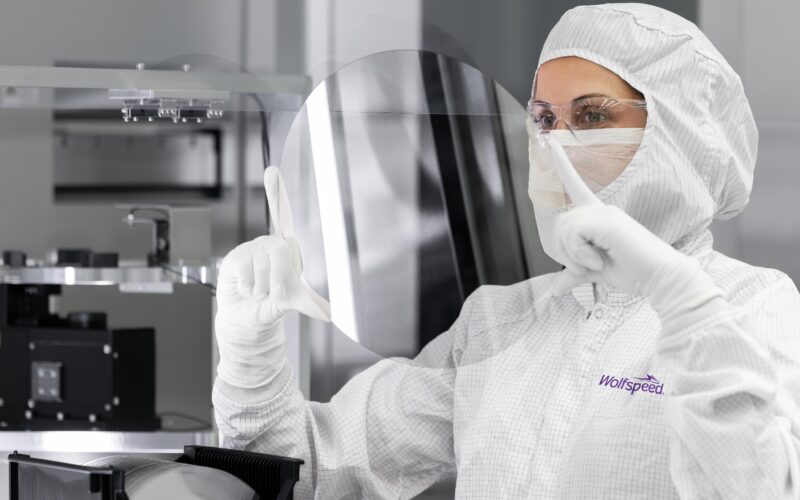
Wolfspeed, Inc. (NYSE: WOLF) has commercially introduced its proprietary transparent silicon carbide technology, opening a new market opportunity in augmented reality, quantum computing and advanced optical applications. Announced on October 29, 2026, the launch extends the semiconductor manufacturer’s materials portfolio beyond conventional power electronics by making optical-grade transparent silicon carbide substrates available for commercial evaluation and use.
The technology, known as TSiC, draws on Wolfspeed’s experience manufacturing high-purity semi-insulating silicon carbide wafers. The company says its optical-grade substrates combine low optical absorption and high wafer flatness with the refractive index, thermal conductivity and mechanical characteristics of silicon carbide. These properties make the material a potential candidate for compact augmented reality waveguides and certain quantum photonic applications.
However, the commercial introduction should be distinguished from confirmed mass-market adoption. Wolfspeed has not disclosed customer purchase commitments, contracted revenue, shipment volumes or the financial contribution expected from TSiC. The announcement establishes commercial availability, while the larger opportunity will depend on customer qualification, manufacturing economics and the ability of device developers to demonstrate performance advantages.
Why is Wolfspeed expanding transparent silicon carbide into augmented reality and quantum computing applications?
Wolfspeed has historically concentrated on silicon carbide materials and power semiconductor devices used in applications such as electric vehicles, industrial equipment and electrical infrastructure. Its manufacturing expertise is built around producing high-quality semiconductor crystals and wafers with tightly controlled characteristics. The introduction of TSiC represents an effort to apply that capability to markets where optical rather than primarily electrical performance determines the material’s value.
Transparent silicon carbide has properties that distinguish it from more conventional optical substrates. The material combines a relatively high refractive index with mechanical hardness and high thermal conductivity, while suitable crystal quality can support low optical absorption. These characteristics create opportunities in applications requiring light manipulation within small, durable structures.
For augmented reality, the immediate attraction is the potential to improve waveguides that direct digital images into the user’s field of vision. For quantum technologies, silicon carbide provides a host material in which selected crystal defects can exhibit useful quantum and optical properties. The same material platform therefore has potential applications across two technologically distinct industries.
Wolfspeed’s commercial approach is based on supplying an enabling material rather than introducing a finished augmented reality headset or quantum computer. This distinction is important because the company would occupy an upstream position in the value chain, supplying substrates that customers must incorporate into more complex systems. The commercial opportunity depends on how successfully device manufacturers can convert those materials into qualified products.
How could Wolfspeed’s TSiC technology improve the optical performance of augmented reality glasses?
Augmented reality glasses rely on optical systems that deliver digitally generated images while allowing users to see the surrounding environment. Waveguides are an important component of many designs because they transport and redirect light through thin optical structures. Their performance influences field of view, image quality, efficiency and the physical size of the wearable device.
One limitation of conventional waveguide materials is the relationship between refractive index and the range of light angles that can be supported. Materials with higher refractive indices can potentially enable wider fields of view or reduce the need for multiple optical layers. This creates an opportunity for silicon carbide, which offers a high refractive index while retaining useful mechanical and thermal characteristics.
Wolfspeed says its TSiC substrates could help support wider fields of view, improved visual performance and more compact augmented reality devices. Barry Silverstein, an optical systems specialist affiliated with the University of Rochester and formerly involved in optics development at Meta Reality Labs, has identified silicon carbide’s high refractive index as a potential route towards simplifying waveguide architectures. His assessment supports the technical rationale, although it does not represent a commercial product qualification.
The potential advantage is particularly relevant to lightweight glasses intended for prolonged use. Optical layers contribute to product thickness and weight, creating design trade-offs between visual performance and comfort. A higher-index material could potentially help manufacturers reduce some of these compromises.
However, optical system performance depends on more than the substrate’s refractive index. Light coupling, diffraction efficiency, colour uniformity, surface processing and display architecture also influence the quality of the final image. Wolfspeed has not released device-level measurements establishing how its TSiC substrates perform in a commercially validated pair of augmented reality glasses.
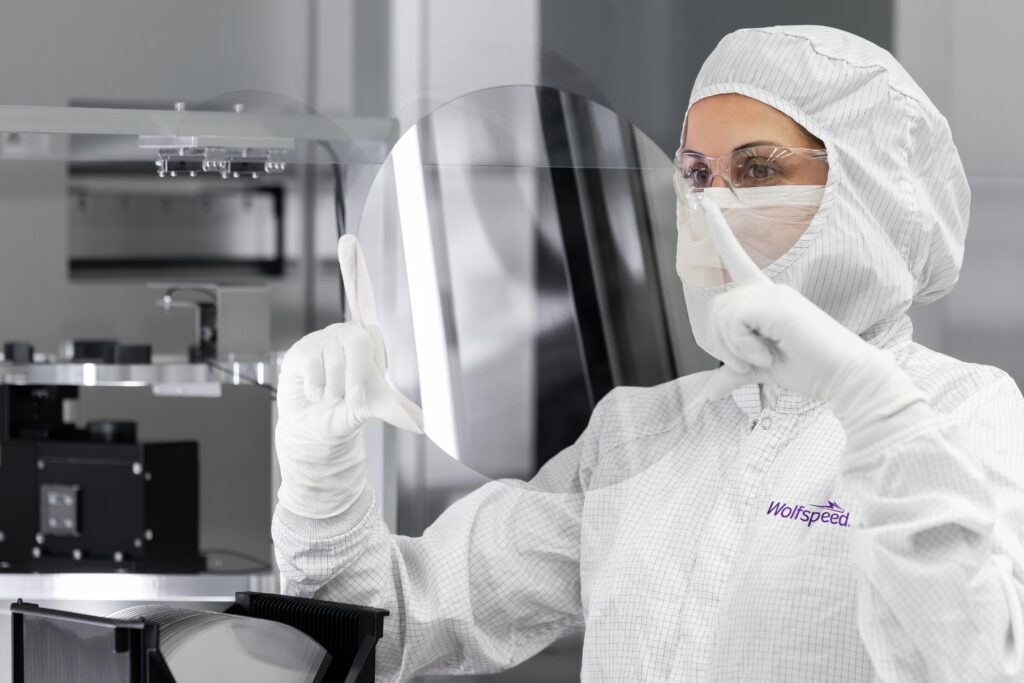
Why do wafer flatness and optical absorption matter for commercial silicon carbide waveguides?
Optical-grade substrates must satisfy requirements that differ from those applied to many conventional power semiconductor wafers. A wafer suitable for electrical devices is not automatically suitable for transmitting and manipulating visible light. Optical applications can require exceptionally low absorption, uniform material properties and highly controlled surface geometry.
Wolfspeed says TSiC is engineered for low optical absorption and superior wafer flatness. Low absorption is important because unwanted attenuation can reduce optical efficiency and increase the power required to generate a visible image. In a battery-powered wearable device, efficiency can influence both operating time and thermal management.
Wafer flatness is also important because waveguide fabrication depends on precise optical geometry. Variations in surface shape or thickness can affect the consistency of light propagation and subsequent manufacturing processes. Such tolerances may become increasingly demanding when customers attempt to fabricate many optical components across a single substrate.
Silicon carbide’s hardness introduces a potential trade-off. The same property that can support mechanical durability also makes processing and polishing technically demanding. Manufacturers must therefore balance the material’s optical advantages against the complexity and cost of producing finished components.
The commercial test will involve whether Wolfspeed can supply optical-grade substrates with consistent characteristics at economically viable yields. Substrate availability is a prerequisite, but customers will still need to demonstrate that their own fabrication processes can convert wafers into acceptable optical components. The cost of the finished waveguide, rather than the isolated performance of the raw material, will influence adoption.
What role could transparent silicon carbide play in quantum computing and quantum photonic systems?
The quantum computing opportunity rests on a different characteristic of silicon carbide. Selected defects within its crystal structure can exhibit electronic states that may be manipulated for quantum information applications. Certain defect centres can also interact with light, making them relevant to quantum sensing, photonics and research into quantum communication.
This creates interest in materials that can support quantum states and optical interfaces within a common platform. Silicon carbide is attractive because its semiconductor processing characteristics are relatively well understood and selected defects can be investigated using established fabrication techniques. Its compatibility with photonic structures could potentially support integrated devices combining electronic and optical functions.
Wolfspeed has highlighted the possibility of using silicon carbide to host qubits, preserve their quantum states and transmit quantum information through light. This describes a potential capability of the material platform rather than the demonstrated functionality of a commercially available Wolfspeed quantum computing system. The company has not announced a processor architecture, qubit count or validated quantum computing performance benchmark associated with TSiC.
A substantial development gap remains between material availability and a scalable quantum computer. Researchers must address the creation and control of suitable defects, coherence, optical readout, device integration and reproducibility. A material with favourable physical properties does not eliminate the challenges of error correction or building complex quantum systems.
The near-term opportunity may therefore involve supplying research institutions and technology developers investigating quantum photonic components. Commercial demand from large-scale quantum computing systems remains difficult to quantify. Wolfspeed’s prospects will depend on whether specific customers qualify TSiC for applications that progress beyond laboratory demonstrations.
How does Wolfspeed’s 200 mm substrate capability support its next-generation optical materials strategy?
Wolfspeed has identified the development of 200 mm optical-grade substrates as an important part of its TSiC roadmap. Larger wafers can potentially support more components per substrate and improve manufacturing economics when yields and processing costs are appropriately controlled. The company is also developing 300 mm TSiC technology to address possible future requirements.
These developments build on Wolfspeed’s broader investment in silicon carbide crystal growth and wafer manufacturing. The company has substantial experience with 200 mm substrates for semiconductor applications, giving it a manufacturing base that may support new material specifications. Nevertheless, optical-grade production introduces requirements that cannot be assumed to be identical to those of power electronics.
The distinction between development and commercial readiness is particularly important for 300 mm TSiC. Wolfspeed has confirmed that work on the larger diameter is underway, but has not disclosed that commercial-scale 300 mm optical-grade manufacturing has begun. The future roadmap should therefore be viewed as a planned capability rather than an existing supply commitment.
Increasing wafer diameter can introduce technical challenges involving crystal quality, flatness and defects across a larger surface. Manufacturing improvements must also deliver acceptable yields to generate a cost advantage. A larger wafer that produces more unusable components may fail to achieve the expected economic benefit.
For customers, consistency of supply may prove as important as technical specifications. Augmented reality manufacturers developing high-volume products require qualified materials that can be sourced reliably over time. Wolfspeed’s ability to support that requirement will depend on production capacity, process stability and the successful qualification of its optical-grade substrates.
What does the transparent silicon carbide launch mean for Wolfspeed’s wider semiconductor business?
The TSiC launch follows a period in which Wolfspeed has been seeking to strengthen its financial position and diversify growth opportunities. The company completed a financial restructuring in September 2025, emerging from Chapter 11 protection after reducing total debt by approximately 70% and extending maturities. Its subsequent strategy has emphasised making better use of existing manufacturing assets and expanding commercially relevant applications for silicon carbide.
The latest optical materials initiative sits alongside continued activity in power semiconductor devices, artificial intelligence data centres and industrial electrification. Wolfspeed has introduced new power semiconductor technologies and strengthened supply relationships during 2026. These markets remain more established commercial activities than quantum computing or next-generation augmented reality optics.
The company’s fiscal fourth-quarter 2026 results demonstrate why financial discipline remains important. Wolfspeed reported approximately $150 million in quarterly revenue, a generally accepted accounting principles gross margin of negative 25% and a net loss of approximately $145 million. Cash, cash equivalents and short-term investments totalled approximately $1.1 billion at June 28, 2026.
Those results indicate that the business still faces substantial profitability challenges despite its restructuring progress. New product categories may contribute to future growth, but their financial significance depends on customer demand and the economics of manufacturing. The TSiC announcement does not provide enough information to estimate its contribution to revenue or margins.
The strategic attraction is that transparent silicon carbide could extend the usefulness of existing materials expertise across additional markets. If customer demand develops, Wolfspeed may be able to generate value from technology and manufacturing capabilities originally established for other applications. However, the degree of overlap between optical-grade production and existing capacity remains a question for future commercial disclosures.
How did Wolfspeed shares perform before the TSiC announcement, and what are investors likely to evaluate?
Wolfspeed shares closed at $24.95 on October 29, 2026, declining 6.34% from the previous closing price of $26.64. The shares had gained 5.67% on October 28 and 7.83% on October 27, illustrating substantial volatility over the three trading sessions. The TSiC announcement was released after the regular US market close on October 29, so the closing decline should not be attributed to that launch.
The share performance reflects a business operating through an important financial and strategic transition. Wolfspeed’s ability to grow revenue, improve manufacturing utilisation and reduce losses remains relevant to its investment outlook. Expansion into optical materials introduces another potential growth category but does not immediately resolve these operating challenges.
Investors will also be evaluating the company’s near-term financial outlook. Wolfspeed has scheduled its fiscal first-quarter 2027 earnings announcement for November 4, 2026, creating a more immediate opportunity to assess revenue, profitability and management guidance. The TSiC launch may provide useful strategic context, but management’s financial disclosures will offer stronger evidence about near-term business performance.
The longer-term investment question concerns how successfully Wolfspeed can convert materials expertise into commercially differentiated products. Applications in augmented reality and quantum computing could create additional demand for high-quality silicon carbide substrates, but the timing and size of those opportunities remain uncertain. Customer qualification, manufacturing yields and eventual shipment volumes will be more meaningful indicators than the number of potential applications alone.
What must happen before Wolfspeed’s transparent silicon carbide technology generates meaningful commercial revenue?
The first requirement is broader customer evaluation and qualification. Augmented reality developers must determine whether TSiC provides measurable optical benefits within their product designs, while quantum technology developers need to establish whether the substrates meet their particular research and device requirements. These are separate markets with different technical specifications and commercial timelines.
Manufacturing performance will be another important consideration. Wolfspeed must demonstrate that it can consistently produce optical-grade wafers at the required quality and scale. Improvements in substrate diameter and process efficiency could support future adoption, but their economic benefits will depend on production yields and customer demand.
Commercial agreements would provide clearer evidence of market traction. The October announcement establishes product availability but does not identify customers, confirmed volumes or long-term purchasing commitments. Future disclosures involving supply contracts or qualified production programmes would make the financial opportunity easier to assess.
The company must also demonstrate that its technology creates an advantage customers are willing to pay for. Optical performance, manufacturing complexity and the cost of competing materials will influence purchasing decisions. In quantum computing, the path from material qualification to high-volume revenue is likely to be especially dependent on the progress of the underlying technology.
Wolfspeed has expanded its silicon carbide strategy into applications that extend beyond conventional semiconductor power devices. The technical characteristics of TSiC provide a credible basis for further commercial investigation, particularly in compact optical systems. Its lasting significance will depend on whether customers translate those material properties into qualified products and sustained demand.
Discover more from Business-News-Today.com
Subscribe to get the latest posts sent to your email.