

Broadcom Inc. (Nasdaq: AVGO) is a Palo Alto, California-headquartered technology company that designs, develops and supplies semiconductor and infrastructure software products used across artificial intelligence data centers, networking, wireless communications, storage, private cloud, cybersecurity and enterprise computing. The company operates through Semiconductor Solutions and Infrastructure Software, combining businesses with very different economic characteristics under one corporate structure. President and Chief Executive Officer Hock E. Tan has overseen a long acquisition-led expansion that transformed Broadcom Inc. from a semiconductor-focused supplier into a much broader infrastructure technology company. The latest phase of that transformation is being driven by custom AI accelerators, high-speed networking and VMware Cloud Foundation.
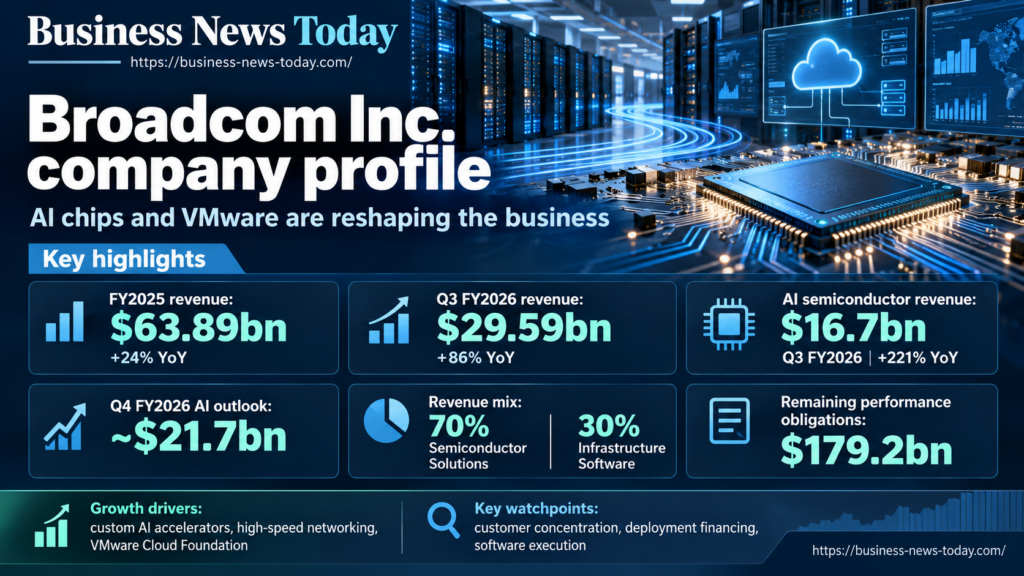
Broadcom Inc. generated $63.89 billion of revenue in fiscal 2025, up 24% from $51.57 billion a year earlier, with Semiconductor Solutions contributing $36.86 billion and Infrastructure Software generating $27.03 billion. Momentum accelerated during fiscal 2026, with third-quarter revenue reaching $29.59 billion, up 86% year over year, as semiconductor revenue more than doubled and infrastructure software continued expanding. AI semiconductor revenue alone reached $16.7 billion in the quarter, increasing 221% from the prior-year period and 54% sequentially.
Management expected AI semiconductor revenue to rise further to approximately $21.7 billion in the fourth quarter of fiscal 2026. That growth is rapidly changing Broadcom Inc.’s revenue mix and strategic profile, but it is also concentrating more of the company’s future performance around a relatively small group of hyperscale and frontier AI customers undertaking exceptionally large infrastructure programmes.
What does Broadcom Inc. do and how does its business model operate?
Broadcom Inc. generates revenue from semiconductors, semiconductor-based systems, intellectual-property licensing and infrastructure software used by some of the world’s largest technology and enterprise customers. Semiconductor Solutions includes artificial intelligence accelerators, networking products, wireless components, broadband technology, storage connectivity, industrial semiconductors and other specialised devices, while Infrastructure Software includes VMware private cloud, mainframe software, enterprise cybersecurity and storage-area networking.
The semiconductor business spans both broadly sold products and highly customised components developed in close cooperation with major customers. Custom AI accelerators, which Broadcom Inc. refers to as XPUs, have become particularly important because large cloud and frontier AI customers increasingly want processors optimised around their own workloads rather than depending entirely on standard merchant accelerators.
Broadcom Inc. can participate in several layers of the same artificial intelligence deployment. The company can provide custom compute silicon while also supplying Ethernet switching, networking chips, optical connectivity technology and other components required to connect enormous accelerator clusters. That creates a broader revenue opportunity than supplying a single processor category.
Infrastructure Software follows a different model because products such as VMware Cloud Foundation, mainframe software and enterprise security can generate large multi-year customer commitments. Combining semiconductor growth with substantial software revenue gives Broadcom Inc. a more diversified earnings model than a conventional semiconductor manufacturer, although the rapid expansion of AI hardware is once again making semiconductors the larger share of the business.
How did Broadcom Inc. develop into its current semiconductor and software structure?
Broadcom Inc.’s present structure is the result of decades of semiconductor consolidation followed by a deliberate expansion into enterprise software. The company’s technology heritage includes operations that originated within Hewlett-Packard, AT&T, Bell Labs and Lucent, while predecessor Avago Technologies completed the acquisition of Broadcom Corporation in 2016 and subsequently adopted the Broadcom name.
Software became a much larger strategic priority after Broadcom Inc. acquired CA Technologies in 2018. The transaction added mainframe and enterprise infrastructure software, providing a recurring software business alongside the company’s semiconductor operations.
Broadcom Inc. expanded further in 2019 through the acquisition of Symantec Corporation’s Enterprise Security business for $10.7 billion in cash. That transaction added endpoint, network and information-security products and reinforced the company’s strategy of acquiring mature enterprise technology franchises with significant installed customer bases.
The largest transformation came with the acquisition of VMware in November 2023. VMware brought virtualisation, private cloud and hybrid infrastructure into the portfolio and pushed software to a much larger share of group revenue. Infrastructure Software generated $27.03 billion in fiscal 2025, compared with $7.64 billion in fiscal 2023 before VMware had been included for a full financial year.
Artificial intelligence is now shifting the mix again. Semiconductor Solutions represented approximately 70% of third-quarter fiscal 2026 revenue while Infrastructure Software accounted for around 30%, compared with approximately 57% and 43% respectively a year earlier. The change reflected extraordinary semiconductor growth rather than a contraction in software, which also continued expanding.
Why are custom AI accelerators becoming such an important growth engine for Broadcom Inc.?
Broadcom Inc.’s artificial intelligence strategy is built around customers that want greater control over their computing architecture. Instead of purchasing only standard processors developed for a broad customer base, hyperscale and frontier AI companies can design accelerators around their own models and workloads while relying on Broadcom Inc. for semiconductor implementation, networking and system-level expertise.
The strategy is increasingly visible through Broadcom Inc.’s collaboration with OpenAI. The companies are developing a multi-generation compute platform combining OpenAI-designed accelerators with Broadcom Inc. silicon implementation, networking and connectivity technologies. Their first processor, Jalapeño, was unveiled in June 2026 after progressing from initial design to manufacturing tape-out in nine months, with initial deployment targeted around the end of 2026.
The broader OpenAI programme contemplates deployment of as much as 10 gigawatts of custom AI accelerator infrastructure through 2029. Broadcom Inc. is also working with other major artificial intelligence customers, meaning the company’s opportunity increasingly extends beyond individual semiconductor orders into multi-year infrastructure programmes.
Custom silicon does not eliminate competition. Nvidia Corporation remains deeply embedded across AI accelerators, systems and networking, while Marvell Technology competes in custom silicon and advanced connectivity. Large technology companies are also building greater internal semiconductor expertise, making Broadcom Inc.’s ability to execute complex designs quickly and reliably central to maintaining its role.
Why is high-speed networking as important as AI accelerators for Broadcom Inc.?
Artificial intelligence clusters cannot operate efficiently if thousands of accelerators are unable to exchange data quickly enough, making networking one of the most important constraints on large-scale AI computing. Broadcom Inc. already has a substantial position in Ethernet switching silicon and connectivity, giving the company an opportunity to benefit as accelerator deployments require progressively faster networks.
Large AI clusters increasingly demand specialised Ethernet switches, network interface technology and optical connectivity capable of handling extremely high bandwidth while minimising congestion and latency. Broadcom Inc. can therefore participate in both the processors performing computation and the network infrastructure connecting those processors.
This creates a strategic advantage if customers continue adopting Ethernet-based architectures for large AI clusters. Broadcom Inc. does not need custom accelerators to displace every merchant processor to benefit from artificial intelligence investment because network expansion can create a separate source of semiconductor demand.
The challenge is maintaining technological relevance as network requirements evolve rapidly. Accelerator suppliers, switch vendors and hyperscale operators are all developing competing architectures, while customers want better performance without becoming excessively dependent on a single technology provider.
What does Broadcom Inc.’s $179.2 billion of remaining performance obligations indicate?
Broadcom Inc. reported approximately $179.2 billion of remaining performance obligations at August 2, 2026, compared with $33.3 billion at the end of fiscal 2025. The increase reflects firmly committed amounts across certain multi-year semiconductor and infrastructure software agreements, including a significant long-term custom AI accelerator contract entered into during fiscal 2026.
Approximately one-quarter of those obligations were expected to be recognised as revenue over the following 12 months. The remaining amount extends further into future periods, creating unusually high contractual visibility relative to Broadcom Inc.’s historical business.
Remaining performance obligations should not be interpreted as a simple guaranteed revenue backlog. Recognition depends on contractual terms, product delivery and satisfaction of performance obligations, while not every Broadcom Inc. customer agreement is captured within the metric.
The scale nevertheless illustrates how dramatically the company’s AI business is changing. Multi-year accelerator programmes can produce commitments far larger than conventional semiconductor purchase orders, giving Broadcom Inc. additional visibility while increasing dependence on a smaller number of enormous customer relationships.
How concentrated has Broadcom Inc.’s customer base become?
Customer concentration has increased materially as artificial intelligence deployments have grown. Broadcom Inc. estimated that its five largest end customers represented approximately 55% of third-quarter fiscal 2026 revenue, up from roughly 40% in the comparable prior-year period.
Broadcom Inc. also reported that direct sales to one semiconductor customer that operates as a distributor represented approximately 50% of quarterly company revenue. That distributor concentration is different from end-customer concentration because products sold through the distributor may ultimately reach multiple underlying customers, but it still creates operational and credit exposure to a small number of commercial relationships.
Large customers can produce extraordinary scale because a single AI infrastructure programme can involve billions of dollars of processors and networking equipment. They can also create considerable volatility because deployment schedules, financing availability or changes in internal architecture can shift revenue between reporting periods.
The concentration therefore creates one of the central tensions in the Broadcom Inc. company profile. The customers capable of driving exceptional growth are also large enough for a delay or strategy change at one organisation to materially affect company-wide performance.
How is VMware Cloud Foundation changing Broadcom Inc.’s software business?
VMware Cloud Foundation has become the centre of Broadcom Inc.’s infrastructure software strategy by combining virtualised compute, networking, storage, automation and management within a private-cloud platform. Broadcom Inc. is positioning the product for enterprises that want cloud-like operating models while retaining significant infrastructure within private or hybrid environments.
Infrastructure Software generated approximately $8.75 billion of revenue in the third quarter of fiscal 2026, up 29% year over year. Broadcom Inc. attributed much of that expansion to continued growth in VMware Cloud Foundation as the company consolidated VMware products and customers around the broader platform.
Contract structures have also changed following the acquisition. Broadcom Inc. has increasingly moved software customers toward longer contractual commitments, while substantial upfront licence recognition means reported software revenue should not be analysed exactly like a conventional software-as-a-service company where most subscription revenue is recognised evenly over the contract term.
Broadcom Inc. recognised approximately $3.47 billion of upfront licence revenue during the third quarter and $7.18 billion during the first nine months of fiscal 2026. That accounting structure makes customer retention, renewal behaviour and actual platform adoption particularly important measures of VMware’s longer-term performance.
Competition remains substantial. VMware Cloud Foundation competes not only with other private-cloud products but with public-cloud and hybrid-cloud architectures, while customers continue adjusting to the licensing, packaging and commercial changes introduced following Broadcom Inc.’s acquisition.
What do Broadcom Inc.’s latest results reveal about profitability and cash generation?
Broadcom Inc.’s third-quarter fiscal 2026 results combined exceptional growth with substantial operating profitability. Revenue increased 86% to $29.59 billion, while GAAP operating income reached approximately $15.96 billion and GAAP net income increased to approximately $13.09 billion.
Non-GAAP operating income was approximately $20.10 billion, materially above the statutory figure because Broadcom Inc. excludes items including acquisition-related amortisation and stock-based compensation from its adjusted results. The difference makes it important to distinguish reported and adjusted profitability rather than treating the two measures as interchangeable.
Cash generation was also substantial. Broadcom Inc. produced approximately $14.20 billion of operating cash flow during the quarter and spent around $532 million on capital expenditure, resulting in company-reported free cash flow of approximately $13.67 billion, equivalent to roughly 46% of quarterly revenue.
For the fourth quarter of fiscal 2026, management guided to approximately $34.8 billion of revenue, which would represent anticipated year-over-year growth of 93%. Non-GAAP operating income was expected to equal approximately 66% of projected revenue, while AI semiconductor revenue was forecast at around $21.7 billion.
The immediate operating test is therefore execution against an increasingly demanding set of customer deployment schedules. Broadcom Inc. needs to convert large custom accelerator commitments into recognised revenue without allowing rapid hardware growth to weaken margins or cash generation materially.
How strong is Broadcom Inc.’s balance sheet after VMware and the AI expansion?
Broadcom Inc. continues to carry substantial debt following its acquisition strategy, but extraordinary cash generation is allowing the company to reduce borrowings while continuing shareholder distributions. At August 2, 2026, principal debt outstanding was approximately $61.08 billion, down from roughly $67.12 billion at the end of fiscal 2025, while cash and cash equivalents stood at approximately $23.98 billion.
During the first three quarters of fiscal 2026, Broadcom Inc. generated approximately $32.95 billion of operating cash flow. Over the same period, the company paid approximately $9.28 billion of dividends, spent about $8.45 billion repurchasing shares and made roughly $6.05 billion of net debt payments.
Those figures show that the current business can support several capital-allocation priorities simultaneously, but artificial intelligence infrastructure is creating a new category of financial exposure. Broadcom Inc. is increasingly helping customers finance very large AI deployments rather than simply delivering semiconductors against conventional purchase orders.
That change makes the quality and structure of AI infrastructure financing an increasingly important part of Broadcom Inc.’s balance-sheet analysis.
How does the AI XPV financing platform change Broadcom Inc.’s risk profile?
Broadcom Inc. established an AI XPV financing platform with Apollo Global Management and Blackstone’s Credit & Insurance business to support more than 20 gigawatts of artificial intelligence compute capacity through 2028. The platform launched with an initial $35 billion financing tranche intended to facilitate more than one gigawatt of infrastructure for Anthropic, with Broadcom Inc. supplying custom accelerators and networking technology.
The structure allows financial partners to fund substantial infrastructure deployments while Broadcom Inc. supplies the underlying technology. That can help frontier AI laboratories acquire computing capacity at a scale that might otherwise place enormous immediate demands on their own balance sheets.
Broadcom Inc. has nevertheless provided a backstop associated with customer lease obligations. At August 2, the maximum potential undiscounted liability if all covered AI racks were deployed was approximately $29 billion, although the fair value of the backstop was not material and no payments had been made.
The $29 billion figure should therefore not be interpreted as an expected loss or conventional debt obligation. It is a maximum contingent exposure whose eventual economic impact depends on customer lease performance, the residual value of underlying equipment and the remedies available if a customer defaults.
The financing platform demonstrates how the economics of artificial intelligence are expanding Broadcom Inc.’s role beyond semiconductor design. It also means that the company’s future risk profile will increasingly depend on customer creditworthiness, asset values and infrastructure financing structures alongside conventional technology execution.
How important is Apple Inc. to Broadcom Inc. outside artificial intelligence?
Broadcom Inc. remains diversified across important semiconductor markets outside artificial intelligence, including wireless connectivity, broadband, storage and industrial applications. Apple Inc. is one of the clearest examples of how these established businesses continue to generate substantial long-term opportunities.
In July 2026, Apple Inc. announced a new multiyear commitment with Broadcom Inc. expected to exceed $30 billion. The agreement covers custom silicon components and advanced wireless connectivity technologies and is expected to support production of more than 15 billion U.S.-made chips.
The programme also includes approximately $1.5 billion of planned expansion and modernisation at Broadcom Inc.’s Fort Collins, Colorado operations, where the company produces advanced radio-frequency components including FBAR filters.
The relationship provides useful diversification from AI demand, although it also illustrates another form of customer concentration. Large consumer-electronics customers possess considerable purchasing power and technical expertise, making continuing design wins dependent on performance, cost, manufacturing execution and Broadcom Inc.’s ability to remain technologically relevant across successive product generations.
What are the biggest risks facing Broadcom Inc.?
Customer concentration is one of the most important risks because a growing proportion of Broadcom Inc.’s revenue and future obligations are associated with a limited number of hyperscale and frontier AI companies. Delayed data-center construction, tighter financing conditions or changes in accelerator architecture at one major customer could materially change deployment timing.
Artificial intelligence financing creates another risk. The AI XPV model could help accelerate demand, but residual-value guarantees and lease backstops expose Broadcom Inc. to factors beyond semiconductor manufacturing, including customer credit quality, equipment values and the economics of long-lived computing infrastructure.
Competition remains intense across both operating segments. Nvidia Corporation, Marvell Technology and internal semiconductor teams at hyperscale customers compete for artificial intelligence opportunities, while VMware Cloud Foundation competes against private-cloud, hybrid-cloud and public-cloud alternatives.
Supply chains and trade controls also remain material. Broadcom Inc. depends on a global semiconductor ecosystem for manufacturing, packaging and assembly, while export restrictions can affect which products are supplied into particular countries. The company reported that 17% of fiscal 2025 revenue was associated with shipments or deliveries to China including Hong Kong, although shipment geography does not necessarily represent the ultimate end-customer location.
What will determine Broadcom Inc.’s outlook over the next 12 to 24 months?
Broadcom Inc.’s most important measurable test will be whether its custom AI accelerator pipeline converts into deployment at the scale already implied by customer commitments. AI semiconductor revenue reached $16.7 billion in Q3 FY2026 and management expected approximately $21.7 billion in Q4, but the comparison base is becoming considerably larger. Future evidence will therefore need to come from sustained deployment, additional accelerator generations and broader customer adoption rather than percentage growth alone.
The OpenAI programme will provide one important indicator. Initial deployment of the Jalapeño platform is targeted around the end of 2026, while the broader partnership contemplates custom accelerator infrastructure reaching as much as 10 gigawatts through 2029. Successful progression from initial silicon into repeatable multi-generation deployments would strengthen Broadcom Inc.’s position as an implementation partner for customers designing proprietary AI compute.
The AI XPV platform provides another measurable test because it links technology demand with infrastructure financing. Successful deployment of the initial Anthropic capacity without material backstop losses would demonstrate that Broadcom Inc. can help expand the addressable market while keeping contingent financial exposure under control.
VMware Cloud Foundation remains the other major pillar. Infrastructure Software continues generating substantial revenue and profit, but customer retention, renewal quality and wider private-cloud adoption will become increasingly important as post-acquisition contract changes move into the comparison base.
Financial discipline will tie those developments together. Broadcom Inc. currently generates enough cash to fund dividends, repurchase shares and reduce debt while simultaneously expanding into enormous AI infrastructure programmes. If custom accelerator deployments continue scaling, software retention remains strong and financing exposures remain manageable, Broadcom Inc. will increasingly resemble an integrated infrastructure technology company spanning compute, networking and enterprise software. If customer concentration rises further or AI financing commitments expand faster than cash generation, the same forces accelerating growth could become the most important constraints on the company’s outlook.
Discover more from Business-News-Today.com
Subscribe to get the latest posts sent to your email.