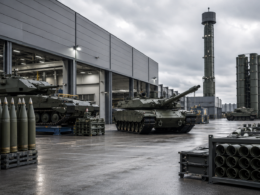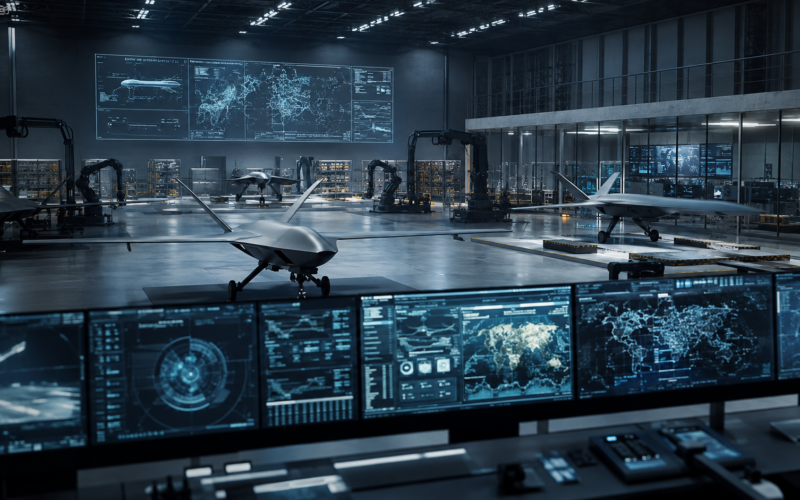
Anduril Industries, Inc. is a privately held American defence technology company attempting to challenge the traditional military procurement model through artificial intelligence, autonomous systems, reusable software and manufacturing designed for higher production volumes. The Costa Mesa, California-based company reported $2.2 billion in 2025 revenue and completed a $5 billion Series H financing at a $61 billion valuation in May 2026. Its portfolio includes the Lattice command-and-control platform, the FQ-44 collaborative combat aircraft, Barracuda autonomous air vehicles and precision-strike variants, Roadrunner counter-drone interceptors, Ghost reconnaissance aircraft and Ghost Shark extra-large autonomous undersea vehicles.
Reuters subsequently reported in July 2026 that Anduril was discussing another financing that could value the company at around $100 billion. The proposed structure, amount being raised and final valuation remained fluid, and no completed transaction had been announced as of August 1. The $61 billion Series H valuation therefore remains the latest confirmed benchmark for the Anduril Industries company profile.
Anduril has already demonstrated that a venture-backed defence company can progress beyond prototypes and win major procurement programmes. The company holds a ten-year United States Army enterprise contract with a maximum estimated value of $20 billion, a ten-year United States Marine Corps installation counter-drone contract with a ceiling of $642.21 million, an Air Force engineering, manufacturing development and production award for the FQ-44, and an Australian programme of record valued at A$1.7 billion for Ghost Shark vehicles. None of these headline figures should be treated as immediately guaranteed revenue because orders, options, appropriations and performance milestones determine what is ultimately recognised.
The central investor question is no longer whether Anduril can attract government customers. Its contract portfolio and reported revenue show that it can. The harder test is whether the company can manufacture aircraft, autonomous weapons, rocket systems and undersea vehicles at the scale promised while maintaining safety, reliability, programme discipline and attractive financial returns.
What are the key takeaways from the Anduril Industries company profile?
Anduril’s competitive case rests on the combination of its Lattice software platform, privately funded product development, autonomous hardware and the Arsenal manufacturing strategy. Its reported $2.2 billion of 2025 revenue provides evidence of substantial commercial activity, but the company does not publish the audited balance sheets, segment margins, cash-flow statements, debt disclosures or customer-concentration data expected from a publicly traded defence contractor.
The completed $61 billion private valuation was equivalent to approximately 27.7 times reported 2025 revenue. That calculation is only an illustrative valuation-to-revenue comparison rather than a conventional public-market price-to-sales or enterprise-value-to-sales multiple because Anduril does not disclose net debt, preferred-share rights or a complete capital structure. A possible $100 billion valuation would be equivalent to more than 45 times 2025 revenue before considering any growth achieved during 2026.
What does Anduril Industries do and how does its business model operate?
Anduril develops software and autonomous systems for defence, border security and national-security missions across air, land, sea and space. The company’s products are designed to collect information from sensors, combine and interpret that information through software, support operational decisions and coordinate autonomous or crewed systems under human supervision.
The company’s business model differs from the traditional approach in which a government agency defines a detailed requirement and funds a contractor’s development work. Anduril says it frequently identifies operational problems, uses private capital to develop products and then sells completed or configurable systems to government customers. This can reduce development time and allow Anduril to retain greater control over intellectual property, but it also exposes the company and its investors to the risk that self-funded products may not secure large procurement orders.
Anduril can generate revenue from hardware deliveries, software licences, systems integration, engineering, installation, sustainment, data infrastructure and technical support. Its United States Army enterprise agreement illustrates the breadth of that model because the procurement vehicle can cover commercial software, integrated hardware, data and computing infrastructure, and ancillary services.
The Army contract has a five-year base period and a five-year optional ordering period, with a maximum estimated value of up to $20 billion. The Army explicitly stated that the amount represents a ceiling rather than an obligated sum, meaning Anduril’s actual revenue will depend on funded orders issued under the contract.
Who founded Anduril and how did the company emerge from Silicon Valley?
Anduril was founded in 2017 by Palmer Luckey, Brian Schimpf, Trae Stephens, Matt Grimm and Joe Chen. Luckey had previously founded virtual-reality company Oculus, while Schimpf became Anduril’s chief executive officer and Stephens became executive chairman. The founding team combined consumer technology, software, venture-capital and government experience rather than relying on a conventional defence-prime background.
The company initially gained attention through autonomous surveillance and counter-intrusion systems. Sentry towers combined sensors with the Lattice software platform to detect, classify and track activity around borders, military installations and critical infrastructure. Anduril subsequently expanded into autonomous aircraft, counter-drone systems, maritime platforms, missiles, tactical communications and space technology.
Acquisitions accelerated that expansion. Anduril acquired Area-I in 2021, adding the ALTIUS family of air-launched and tube-launched autonomous aircraft, and acquired Dive Technologies in 2022 to enter the autonomous undersea market.
The company also signed a definitive agreement in May 2025 to acquire tactical computing and communications specialist Klas. Anduril said at the time that completion remained subject to regulatory approval and customary closing conditions. A later official announcement confirming closure was not identified during the factual audit, so Klas should not be described as a completed acquisition without further confirmation.
How does the Lattice software platform connect Anduril’s defence products?
Lattice is the software platform that connects much of Anduril’s hardware portfolio. It is designed to integrate sensors, autonomous platforms, communications networks and effectors into a common command-and-control environment, including equipment produced by third parties and government-owned systems.
Lattice for Command and Control combines information from distributed systems and is designed to allow operators to supervise large numbers of sensors and autonomous assets. Lattice for Mission Autonomy can translate operator intent into tasks, manage onboard resources, coordinate multiple vehicles and adjust plans as mission conditions change.
The software platform may become more strategically durable than any single Anduril vehicle. Military customers typically operate equipment from several manufacturers, making interoperability more practical than replacing every legacy system. Software capable of linking existing equipment with new autonomous systems could therefore generate integration, licence and support opportunities across many programmes.
The open-architecture positioning is also commercially important. Anduril argues that Lattice can connect platforms, sensors and payloads from different suppliers rather than requiring customers to purchase a closed collection of Anduril products. The value of that claim will ultimately depend on real-world interoperability, cybersecurity, reliability and procurement adoption.
Which autonomous aircraft and counter-drone systems define Anduril’s portfolio?
The FQ-44 is Anduril’s aircraft for the United States Air Force Collaborative Combat Aircraft programme. These semi-autonomous aircraft are intended to operate alongside crewed fighters, extending sensing, electronic-warfare and combat capacity while reducing the number of missions that require a human pilot to enter highly contested airspace.
The Air Force awarded Anduril an engineering, manufacturing development and production contract for the FQ-44 in June 2026. The service said the aircraft had met mission requirements and was ready for full-scale manufacturing. The Air Force plans to procure more than 150 combat-capable Collaborative Combat Aircraft by the end of the decade across the programme, not 150 Anduril aircraft annually.
The Air Force also selected Anduril as one of six companies eligible to compete for mission-autonomy software work and awarded initial production options to Anduril, RTX Collins Aerospace and Shield AI. The competitive structure means Anduril’s aircraft and software positions are significant, but not exclusive across the entire programme.
Roadrunner is a reusable vertical-take-off autonomous aircraft, while Roadrunner-M is configured to intercept aerial threats. Its recoverable design allows the aircraft to return when it does not engage a target, potentially improving the economics of responding to uncertain or changing threats.
Anvil is a smaller kinetic interceptor designed for Group 1 and Group 2 drone threats. The company’s United States Marine Corps installation counter-drone contract is a ten-year indefinite-delivery, indefinite-quantity agreement worth up to $642.21 million, covering the delivery, installation and sustainment of counter-small-unmanned-aircraft systems. Marine Corps Systems Command is the contracting activity.
The $642.21 million figure is the maximum contract value rather than guaranteed revenue. The agreement includes a base period and nine additional ordering periods, and actual revenue depends on orders issued for equipment, surveys, engineering, training and sustainment.
Ghost and ALTIUS provide additional reconnaissance, surveillance, electronic-warfare and strike capabilities. The breadth of this portfolio allows Anduril to compete across tactical drones, collaborative combat aircraft and layered counter-drone defence rather than relying on one platform family.
How important are Barracuda and rocket-motor systems to Anduril’s strategy?
Barracuda is a family of autonomous air vehicles that includes precision-strike and cruise-missile variants. The programme is intended to address military demand for weapons that can be produced in larger quantities and with less specialised manufacturing than many conventional long-range systems.
In May 2026, Anduril announced an agreement covering production of at least 3,000 surface-launched Barracuda-500M systems. A subsequent company announcement described a delivery rate of 1,000 surface-launched systems annually for three years.
The company later announced a framework for air-launched Barracuda-500 systems, extending the family across different launch methods. Framework and production announcements establish programme direction, but actual revenue will depend on final orders, delivery schedules and the commercial terms attached to each configuration.
Anduril expanded into solid rocket motors through its acquisition of Adranos. This capability could generate revenue both through Anduril’s own weapons and through component supply to other manufacturers, although the company does not disclose separate revenue or profitability for the rocket-motor business.
Rocket propulsion is strategically attractive because the United States defence industrial base has faced limited production capacity for motors used in missiles and space systems. It is also a technically demanding business in which safety, qualification and production consistency can create material execution risks.
What role do Ghost Shark and autonomous maritime systems play in Anduril’s growth?
Anduril entered the autonomous undersea market through its acquisition of Dive Technologies. The acquired technology included large autonomous undersea vehicles designed for missions such as intelligence preparation, surveillance, mine warfare, seabed mapping and infrastructure inspection.
Ghost Shark is an extra-large autonomous undersea vehicle developed through cooperation involving Anduril Australia, the Royal Australian Navy and Australia’s Defence Science and Technology Group. It should not be described simply as an unmanned submarine because the official terminology is an extra-large autonomous undersea vehicle.
The programme progressed from a co-development effort into an A$1.7 billion Royal Australian Navy programme of record. Anduril opened a dedicated Sydney manufacturing facility in October 2025 and said the first vehicle produced there was ready for undersea acceptance testing.
The Australian award is strategically important because it demonstrates that Anduril can move an international programme from prototype development toward fleet production. It also broadens the company beyond United States procurement and gives it exposure to rising Indo-Pacific demand for autonomous maritime systems.
Why is Arsenal-1 central to the Anduril investment case?
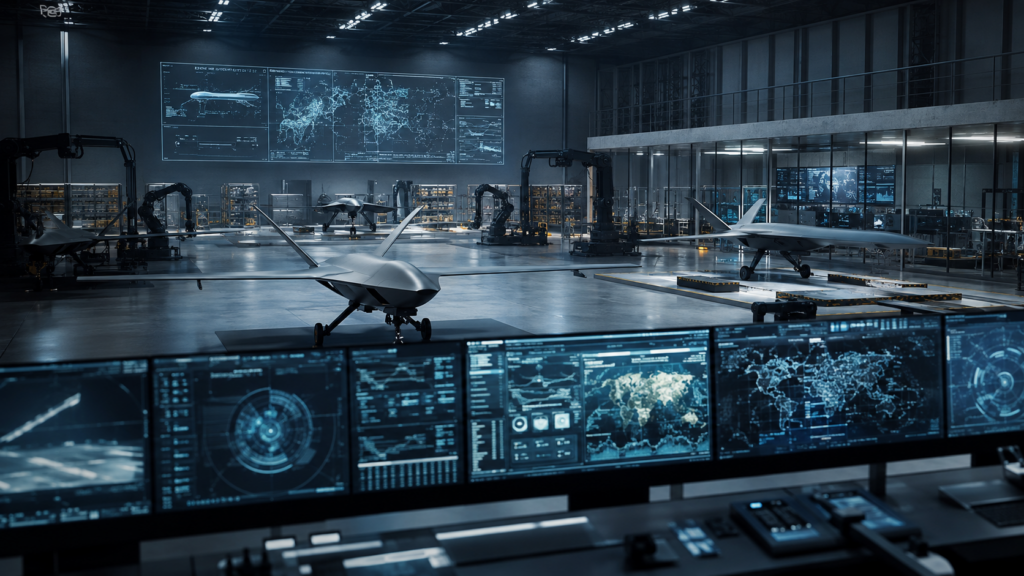
Arsenal-1 is Anduril’s manufacturing facility in Ohio and the physical centre of its effort to apply higher-volume production methods to defence equipment. The company has said the completed campus is expected to exceed five million square feet and create more than 4,000 direct jobs.
Anduril describes Arsenal as a software-defined manufacturing platform rather than only a factory. The model combines product design, bill-of-material management, testing, supply-chain planning and production data within a common digital system intended to support several product families.
The company says nearly 90% of its products can be manufactured using commercially available components and materials. That strategy may reduce lead times and supplier concentration, although military requirements, export controls and specialised components will continue to constrain parts of the portfolio.
Arsenal-1 creates a potential advantage because workers, machinery and supply-chain resources can be moved between product lines as demand changes. It also creates substantial fixed-cost and execution exposure. Producing aircraft, missiles, counter-drone interceptors and other systems at scale requires stable product designs, qualified suppliers, repeatable testing and rigorous quality control.
The FQ-44 production award provides an important first test of the model. The Air Force’s decision confirms that Anduril has progressed beyond competitive prototyping, but sustained production, unit economics and delivery reliability remain to be demonstrated over a longer period.
What do Anduril’s revenue and funding history reveal about its valuation?
Anduril reported that 2025 revenue reached $2.2 billion, more than double the prior year, while its workforce nearly doubled. California officials reported in January 2026 that the company employed approximately 7,000 people across 35 locations, with roughly half based in Southern California.
The company raised $1.5 billion at a $14 billion valuation in August 2024 to support its Arsenal manufacturing strategy. It later raised capital at a $30.5 billion valuation in 2025 before completing the $5 billion Series H at $61 billion in May 2026.
The speed of that valuation expansion reflects investor expectations that Anduril can capture a meaningful share of growing military spending on drones, autonomy, missile systems, artificial intelligence and distributed manufacturing. It also raises the amount of future performance required to generate attractive returns for later-stage investors.
Because Anduril remains private, reported revenue does not reveal whether the company is profitable. Public disclosures do not provide comprehensive data on gross margin, operating income, free cash flow, capital expenditure, debt or customer concentration. Revenue growth should therefore not be interpreted as proof that the business is producing positive or durable cash returns.
Can investors buy Anduril stock and has the company confirmed an IPO?
Anduril remains privately held and does not have a publicly traded stock ticker. Ordinary retail investors cannot purchase Anduril shares through the New York Stock Exchange, Nasdaq or another conventional public exchange.
The company has not publicly disclosed a confirmed IPO timetable. Discussions of a possible future listing are understandable given its scale and repeated private financing rounds, but an IPO should not be presented as scheduled unless the company files publicly or formally announces a transaction.
Anduril’s investor-relations page warns about unauthorised offers and funds claiming to provide access to pre-IPO securities. Private-market exposure can involve indirect ownership, high fees, transfer restrictions, limited liquidity and uncertainty over whether the underlying transaction has company approval.
A public listing could eventually provide liquidity to employees and early investors while giving Anduril another source of capital. It would also require significantly greater disclosure of profitability, cash flow, contract concentration, related-party transactions and governance.
How do OpenAI, Meta and Microsoft fit into Anduril’s technology ecosystem?
Anduril partnered with OpenAI in December 2024 to improve artificial intelligence capabilities used in counter-unmanned-aircraft systems. The collaboration is intended to combine OpenAI models with Anduril’s defence systems and operational data, but the companies did not disclose a contract value or guaranteed revenue commitment.
Meta Platforms and Anduril announced a partnership in May 2025 to develop extended-reality products for military users. The systems are intended to improve perception and allow users to interact more intuitively with autonomous platforms. The partnership reconnects Palmer Luckey with the virtual-reality technology field he helped commercialise through Oculus.
Anduril also worked with Microsoft on the United States Army’s Integrated Visual Augmentation System programme. The companies announced that Anduril would assume greater oversight of production and future development subject to government approval, while Anduril later received a $159 million initial prototyping contract for the Soldier Borne Mission Command programme.
These relationships show that Anduril is not attempting to build every software model, cloud service and interface independently. Instead, it is combining its defence integration and autonomy capabilities with technologies developed by larger commercial companies.
How does Anduril compare with Lockheed Martin, Palantir and other defence companies?
Anduril competes with traditional defence contractors including Lockheed Martin Corporation, Northrop Grumman Corporation, RTX Corporation and General Dynamics Corporation. These companies have much larger revenue bases, established supply chains, extensive government relationships and decades of experience delivering complex military programmes.
Anduril’s advantage is its willingness to invest private capital, develop products before full procurement and design hardware around software and autonomous operation. Its disadvantage is that its manufacturing, sustainment and programme-management systems have not yet been tested across as many programmes or decades as those of the traditional primes.
Palantir Technologies Inc. is an important comparison because it helped establish a commercial software model within government and defence. Palantir focuses principally on data integration, analytics and decision software, while Anduril combines software with aircraft, interceptors, sensors, precision-strike vehicles and undersea systems.
General Atomics is a direct competitor in the Collaborative Combat Aircraft programme, where the Air Force awarded production contracts for both General Atomics’ FQ-42 and Anduril’s FQ-44. Shield AI, AeroVironment, Inc., Kratos Defense & Security Solutions, Inc. and European companies including Helsing also compete across autonomous systems, drones and military software.
The competitive landscape is not purely adversarial. Anduril can integrate third-party systems through Lattice and form partnerships with larger contractors where its autonomy or software capabilities complement established platforms.
Who owns and leads Anduril Industries?
Brian Schimpf is Anduril’s co-founder and chief executive officer, while Trae Stephens is co-founder and executive chairman. Palmer Luckey remains a founder and the company’s most prominent public advocate. Matt Grimm and Joe Chen are also members of the founding team.
Anduril has raised funding from investors including Founders Fund, Andreessen Horowitz, Thrive Capital, Sands Capital and other major private-market institutions. The company does not publicly disclose a complete current ownership table or the percentage held by individual founders and investors.
Private ownership allows management to invest in long-duration programmes without publishing quarterly results or responding immediately to public-market volatility. It also gives potential investors less transparency into voting rights, board control, executive compensation, preferred-share terms and insider transactions.
What are the biggest risks facing Anduril Industries?
Manufacturing execution is the most immediate risk. Anduril is simultaneously expanding aircraft, counter-drone systems, autonomous air vehicles, rocket motors, undersea vehicles, sensors, communications equipment and software. Each product category carries different regulatory, testing, supply-chain and safety requirements.
Contract ceilings can create exaggerated perceptions of near-term revenue. The $20 billion Army agreement and $642.21 million Marine Corps contract establish maximum procurement capacity, but revenue will depend on funded orders and successful delivery.
Technical reliability is especially important because Anduril’s products operate in safety-critical and potentially lethal environments. Autonomous systems must behave predictably, command software must resist cyberattack, sensors must distinguish threats from false detections and weapons must remain subject to authorised human control.
The company’s rapid workforce and facility expansion creates organisational risk. Managing approximately 7,000 employees across 35 locations, integrating acquired businesses and developing several factories requires management systems that may be less visible to investors than product demonstrations and contract announcements.
Ethical and regulatory scrutiny will remain significant. Governments, military customers and the public continue to debate the appropriate role of artificial intelligence in surveillance, target identification and lethal force. The existence of a human operator does not remove questions about automation bias, accountability and the reliability of machine-generated recommendations.
International expansion brings export controls, local-production obligations, cybersecurity rules and geopolitical exposure. Defence relationships with one government can restrict commercial opportunities in another market or lead to sanctions and political retaliation.
Valuation is an additional financial risk. The completed $61 billion valuation already assumes continued revenue growth, successful production and conversion of contract opportunities. A future round near $100 billion would raise those expectations without giving investors the detailed financial disclosures available from listed defence companies.
What is Anduril Industries’ growth outlook through 2027?
Anduril enters the next stage of its development with greater commercial evidence than most venture-backed defence companies. It has reported multibillion-dollar revenue scale, secured major procurement vehicles and advanced several products from development into production.
The most important operating test will be Arsenal-1. The company must show that software-defined manufacturing can produce complex defence equipment repeatedly, safely and at predictable cost rather than merely supporting successful prototypes.
The FQ-44 could become transformational if Anduril secures substantial production volumes and meets Air Force requirements. The June 2026 award confirms that the programme has entered full-scale manufacturing, but the ultimate quantity, pricing and profitability attributable specifically to Anduril have not been publicly disclosed.
Barracuda provides another large-volume opportunity. The stated minimum of 3,000 surface-launched systems gives the company a clearer production objective than many prototype contracts, although the economics will depend on manufacturing cost, delivery performance and follow-on orders.
Ghost Shark demonstrates the potential for international programme expansion, while Lattice may become the most durable element of the portfolio by connecting products made by Anduril, government agencies and other contractors.
Anduril’s $2.2 billion revenue base and $5 billion Series H show that it has moved beyond the experimental start-up stage. It is now attempting to become a new-generation defence prime capable of combining software leadership with industrial-scale production.
The valuation question remains demanding. At $61 billion, private investors are assuming that Anduril can translate contract ceilings and programme selections into funded orders, reliable deliveries and sustainable financial returns. Talks around a possible $100 billion valuation would increase the burden of proof further.
Through 2027, Anduril is likely to be judged less by how many products it unveils and more by aircraft output, Barracuda deliveries, Ghost Shark testing, contract conversion and manufacturing discipline. Successful execution could establish the company as one of the most important new defence manufacturers created in decades. Delays, safety problems, cost inflation or weak order conversion would expose how far its private valuation has moved ahead of the financial information available to outsiders.
Discover more from Business-News-Today.com
Subscribe to get the latest posts sent to your email.