


Broadcom is not the AI chip story most retail investors think they know. While the debate rages on Wall Street about Nvidia versus the rest, Broadcom has quietly locked in long-term supply agreements with two of the fastest-growing AI companies on the planet, secured a revenue backlog that would have seemed implausible three years ago, and guided toward AI chip sales that could exceed $100 billion in a single year. If you have seen AVGO trending on Twitter or cropping up in r/stocks threads, here is everything worth understanding before you decide whether this ticker belongs on your watchlist. The next near-term catalyst is the Q2 fiscal 2026 earnings call, scheduled for 4 June 2026, where management will update the market on whether the $10.7 billion AI revenue guidance for the quarter held.
What does Broadcom actually make, and why does it matter for AI infrastructure?
Broadcom Inc. is a Palo Alto-based designer and supplier of semiconductors and infrastructure software. Its chips show up inside data centres, enterprise networks, and inside virtually every iPhone Apple ships. The company operates two main revenue segments: semiconductor solutions, which generated a record $12.5 billion in Q1 fiscal 2026, and infrastructure software, which includes VMware and produced $6.8 billion in the same period.
The AI story lives entirely in the semiconductor segment, and more specifically in what Broadcom calls XPUs — custom accelerators designed for specific AI workloads rather than general-purpose computing. Unlike Nvidia’s GPUs, which are sold off the shelf to anyone who will pay, Broadcom’s XPUs are co-designed with individual hyperscale customers and baked into long-term supply relationships. The customer designs the architecture; Broadcom handles silicon engineering and supply.
Broadcom occupies the role of an implementation layer in the AI stack. It ensures the optical interconnects and networking fabric can handle the data throughput required for AI model clusters running at the scale of trillions of parameters. That positioning is less visible than Nvidia’s brand, but it is arguably more defensible. Custom silicon cannot be swapped for a commodity replacement without years of redesign work.
Broadcom’s trailing revenue reached $68.3 billion over the twelve months to April 2026, with a gross margin of 67.9%. For a company at this scale, those are exceptional numbers and they reflect the pricing power that comes from being deeply embedded in customers’ infrastructure roadmaps.
Why are the Google and Anthropic deals changing the revenue outlook so dramatically for AVGO shareholders?
The event that sent AVGO up more than 6% in a single session in early April 2026 was a pair of announcements that reshaped the medium-term revenue picture for the company. Broadcom revealed it had entered an extended partnership with Google, committing to design and deliver upcoming generations of specialised AI processors and associated technologies through 2031. That is an unusually long forward commitment by any standard in the semiconductor industry, where customer relationships typically operate on much shorter cycles.
The Anthropic dimension is where the numbers start to look remarkable. On the March earnings call, CEO Hock Tan confirmed that Broadcom was already delivering 1 gigawatt of compute to Anthropic through Google’s TPUs, and that for 2027, this demand was expected to surge in excess of 3 gigawatts. The expanded deal announced in April confirmed Anthropic will access 3.5 gigawatts of Google TPU capacity starting in 2027, tripling the compute from an October 2025 predecessor agreement.
Analyst Stacy Rasgon at Bernstein has estimated that Broadcom generates approximately $20 billion in revenue per gigawatt of custom compute delivered. Applied to the Anthropic commitment alone, that arithmetic produces numbers that now dominate analyst revenue models. Analysts at Mizuho, led by Vijay Rakesh, estimated that Broadcom would collect $21 billion in AI revenue from Anthropic in 2026, rising to $42 billion in 2027.
These are analyst projections, not contracted dollar amounts. The filings do not state a specific dollar value. But the direction of travel is clear and the structural logic is sound: Anthropic’s computing demand is growing faster than its own direct infrastructure buildout can accommodate, and Broadcom sits at the junction between that demand and Google’s TPU manufacturing pipeline.
How does Q1 fiscal 2026 performance set up the case for Q2 and beyond?
Broadcom’s Q1 fiscal 2026 AI semiconductor revenue reached $8.4 billion, up 106% year on year, beating the company’s own forecast and driven by robust demand for custom AI accelerators and AI networking products. That number matters because it was the first public confirmation that the AI revenue acceleration the company had described in late 2025 was materialising as expected rather than as aspiration.
Q2 fiscal 2026 guidance projects AI semiconductor revenue of $10.7 billion, representing 140% year-on-year growth, driving anticipated total semiconductor revenue of $14.8 billion. Infrastructure software revenue for Q2 is forecast at approximately $7.2 billion, up 9% year on year, with VMware revenue growing 13% year on year.
Total Q2 fiscal 2026 revenue guidance stands at approximately $22 billion, representing year-on-year growth of approximately 47%. If the company delivers anywhere near that number on 4 June, it will represent an extraordinary acceleration for a business that already operates at megacap scale. The June earnings call is now the single most important near-term event for AVGO watchers.
Broadcom already holds a $73 billion AI backlog across XPUs, switches, digital signal processors, and optical components, scheduled for delivery over the next 18 months. However, CEO Hock Tan himself cautioned investors not to treat that figure as confirmed shipping revenue, describing it as a moving target. That caveat is important context for any retail investor building a thesis around backlog numbers.
What is the milestone timeline between now and the next major revenue inflection point?
The sequence that matters for AVGO shareholders runs roughly as follows. The immediate near-term marker is the Q2 fiscal 2026 earnings report on 4 June, where the $10.7 billion AI revenue guidance will either be confirmed or revised. A beat would represent a third consecutive quarter of guidance delivery at scale and would likely reset analyst price targets higher. A miss, or any softening in hyperscaler CapEx guidance, would trigger the same valuation anxiety that knocked the stock 11% after a headline earnings beat earlier in 2026.
Beyond Q2, the structural transition into 2027 is where the largest numbers reside. Anthropic’s TPU computing demand is projected to surge from 1 gigawatt in 2026 to over 3 gigawatts in 2027, and securing 3.5 gigawatts in advance reflects Anthropic’s intent to lock in the resources required to remain competitive in model training and inference. That capacity ramp directly translates into Broadcom order flow.
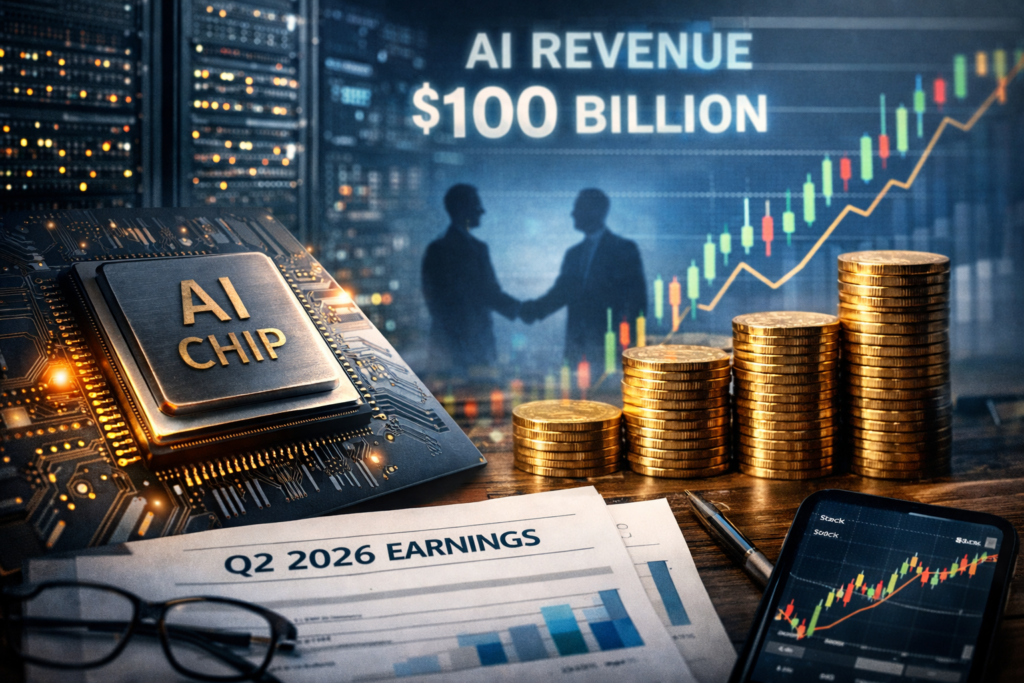
Management stated on the Q1 call that it has line of sight to achieve AI revenue from chips alone in excess of $100 billion in 2027. That projection is contingent on the hyperscaler CapEx cycle continuing, on Anthropic’s commercial ramp sustaining its trajectory, and on no material change in the competitive or geopolitical environment. None of those conditions are guaranteed.
How does the macro environment and AI spending cycle affect the AVGO thesis?
Broadcom’s AI revenue is structurally linked to the capital expenditure budgets of a handful of the largest technology companies in the world. Google’s 2026 capital expenditure plan of $175 billion to $185 billion provides a direct demand pipeline into Broadcom’s order book. When hyperscaler CapEx rises, Broadcom’s order flow accelerates. When it contracts, the reverse follows quickly.
The macro picture in April 2026 adds layers of complexity. Geopolitical volatility stemming from the US-Iran conflict elevated energy costs and introduced fresh supply chain uncertainty for the semiconductor sector. Semiconductor names including Broadcom saw net retail outflows in March 2026 as traders shifted away from high-beta chip stocks toward broader indices amid the disruption. That rotation partly explains why AVGO spent time trading well below its 52-week peak of $414.61 despite the fundamental picture strengthening.
The Iran conflict has a secondary effect specific to semiconductors. Any sustained disruption to energy supply chains introduces uncertainty about data centre buildout timelines, since AI infrastructure is extraordinarily power-intensive. Hock Tan has argued that the complexity of AI workloads has outpaced the capabilities of general-purpose silicon, and that custom-tailored accelerators are the only path to the power efficiency required for next-generation AI clusters. If that argument holds, energy cost pressure actually strengthens the XPU case rather than weakening it.
How is AVGO currently priced relative to its AI revenue growth rate, and what do analysts think?
AVGO’s current price is approximately $371, against a 52-week range of $161.61 to $414.61, with a market capitalisation of approximately $1.76 trillion and a trailing price-to-earnings ratio of around 69. On a forward basis, the valuation compresses significantly as earnings projections rise; the forward P/E sits closer to 27, reflecting the market’s expectation of substantial profit growth over the next twelve months.
Morningstar’s fair value estimate for AVGO stands at $247, implying a significant premium at current prices, though the firm acknowledges Broadcom’s best-in-class position in custom AI accelerators and notes the company is actively adding customers including Anthropic and OpenAI. At the other end of the spectrum, Benchmark carries a $500 price target with a buy rating, pointing to Broadcom’s positioning across AI semiconductor and infrastructure software markets.
Analyst consensus from multiple aggregators converges near $435 to $437, with buy or moderate buy ratings dominant across the coverage group. Seaport Global Securities moved to neutral in early April, citing the view that near-term gains had already been priced in following the Google and Anthropic announcements.
The gap between Morningstar’s intrinsic value and the Street consensus is wide enough to be telling in itself. Broadcom is not a stock where valuation is the reason people are buying. The thesis is trajectory: a company that generated $8.4 billion in AI revenue in a single quarter is being priced for where it might stand in 2027, not where it stood in 2024.
What are the execution risks retail investors should understand before taking a position in AVGO?
The concentration risk in Broadcom’s AI business is the most discussed concern among analysts who approach the stock with caution. Google is the dominant customer, and the entire Anthropic revenue stream runs through Google’s TPU infrastructure. If Google were to reduce its TPU buildout, bring more chip design in-house at scale, or shift compute relationships, the effect on Broadcom’s AI segment would be material and rapid.
CEO Hock Tan himself flagged the backlog caveat on the Q4 2025 earnings call, noting it is a moving target and explicitly cautioning investors not to treat it as confirmed revenue. Insider selling added to the noise; Tan disclosed a sale of 130,000 shares in December 2025, though large sales from executives who have seen a stock multiply many times over are not necessarily bearish signals.
EU regulatory scrutiny over VMware licensing practices represents a separate, slower-moving risk. The VMware integration generates meaningful software revenue and carries strong recurring characteristics, but enterprise customers who pushed back against pricing changes following the Broadcom acquisition remain a source of churn risk that management has so far managed without a headline deterioration.
Trade tariffs and semiconductor export controls introduce a further variable. While Broadcom’s primary revenue base is with US hyperscalers and its manufacturing runs through TSMC rather than its own fabs, policy changes around chip exports to specific jurisdictions or restrictions on TSMC’s ability to manufacture advanced nodes for particular customers would create uncertainty the market would price quickly and harshly.
Why are retail investors on Reddit and Twitter watching AVGO, and what is the community saying?
AVGO is not a retail-driven meme stock. Its $1.76 trillion market cap places it firmly in the category of institutional-dominated megacaps. But the AI infrastructure narrative, the Google deal, and the Anthropic revenue numbers have generated genuine retail enthusiasm that sits alongside institutional positioning rather than in conflict with it.
On r/wallstreetbets, a post about the Google and Anthropic supply agreements reached 280 upvotes and 55 comments in a single morning, reflecting genuine retail interest in the long-term deal implications rather than short-term momentum trading. The dominant retail debate centres on whether the post-announcement rally has already captured the upside or whether the 2027 revenue inflection creates further room.
A separate r/stocks discussion noted that despite beating on revenue and earnings, the stock dropped 11% after its Q4 2025 results on concerns about valuation and guidance interpretation. That episode underlines the key tension for retail holders: operationally excellent companies trading at high multiples punish any ambiguity in forward guidance with outsized corrections, even when the underlying business is delivering.
Cathie Wood’s ARK Invest purchasing $10.7 million in AVGO shares after that correction, alongside Ray Dalio’s Bridgewater Associates adding to its position, generated secondary coverage that brought fresh retail eyes to the ticker. AVGO’s community following is fundamentals-oriented by semiconductor standards. The forums are running discounted cash flow arguments and debating gigawatt figures rather than short squeezes.
Key takeaways: What retail investors need to know about Broadcom (AVGO) heading into Q2 2026
- Broadcom’s AI semiconductor revenue reached $8.4 billion in Q1 fiscal 2026, up 106% year on year, and management has guided for $10.7 billion in Q2. The 4 June earnings call is the next major binary event for the stock.
- The Google and Anthropic agreements announced in April 2026 extend Broadcom’s core custom chip supply relationship with Google to 2031 and commit Anthropic to 3.5 gigawatts of TPU-based compute from 2027, representing a structurally significant forward revenue pipeline.
- Mizuho analysts project $21 billion in AI revenue attributable to Anthropic alone in 2026, rising to $42 billion in 2027. These are analyst estimates, not contracted dollar amounts, and should be read as directional rather than definitive.
- Management has stated it has line of sight to AI chip revenue exceeding $100 billion in 2027. The credibility of that number depends entirely on hyperscaler CapEx holding at current levels and Anthropic’s commercial trajectory continuing.
- The primary risks are customer concentration with Google, valuation sensitivity to any guidance miss or CapEx reduction, VMware enterprise churn, and geopolitical disruption affecting semiconductor supply chains or AI infrastructure timelines.
- At approximately $371, AVGO sits roughly 10% below its 52-week high of $414.61. Analyst consensus targets cluster near $435 to $437. Morningstar’s fair value of $247 reflects a structurally more conservative view of sustainable earnings power.
- This is not a stock where the debate is about operational quality. The debate is about whether the AI infrastructure buildout sustains the growth trajectory long enough to justify a $1.76 trillion market cap at 69 times trailing earnings.
Discover more from Business-News-Today.com
Subscribe to get the latest posts sent to your email.