The Boeing Company (NYSE: BA) is heading into another critical round of labour negotiations after approximately 17,000 engineers, scientists and technical employees rejected proposed four-year contracts and authorized a potential strike, placing fresh pressure on an aerospace manufacturer that is still trying to stabilize production, complete delayed aircraft certifications and rebuild customer confidence. Boeing and the Society of Professional Engineering Employees in Aerospace, or SPEEA, are scheduled to meet on August 31 to review employee demands and establish a timetable for renewed formal bargaining ahead of the current contracts’ October 6 expiration.
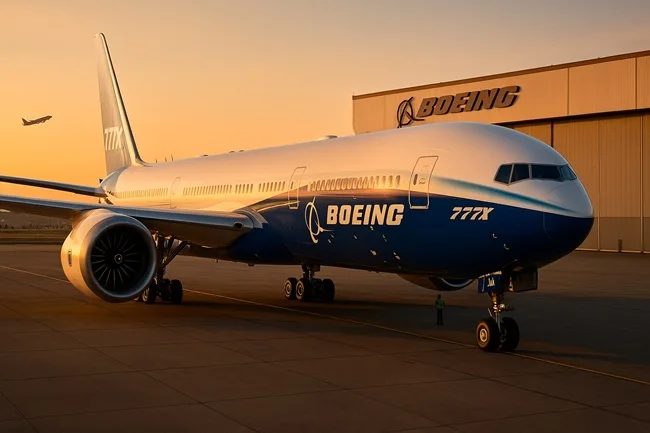
The dispute has already moved beyond routine collective bargaining. Boeing has started implementing contingency plans and has advertised contractor positions covering engineering and technical work, while SPEEA says its members are preparing for the possibility of a work stoppage if a substantially improved agreement cannot be reached. Reuters reported that a strike could further delay certification of the Boeing 737 MAX 10 and Boeing 777-9, both of which are already years behind their original schedules and depend heavily on the engineers and technical specialists represented by SPEEA.
The August 31 meeting is therefore more consequential than another negotiating session over compensation. Boeing entered the dispute after reporting $24.6 billion of second-quarter revenue, record company backlog of $715 billion and its first positive quarterly free cash flow in an extended period, suggesting that the broader recovery under Chief Executive Officer Kelly Ortberg is gaining traction. A prolonged strike among the technical workforce responsible for certification, production support and engineering could interrupt that momentum at precisely the point investors are looking for evidence that Boeing can move from stabilization toward consistent execution.
Why did Boeing’s 17,000 engineers and technical workers reject the contract offers?
The rejection was striking because SPEEA’s own negotiating team had initially endorsed Boeing’s proposals unanimously. The four-year offers emerged after weeks of negotiations and represented the first full bargaining process between Boeing and the two major SPEEA units in 14 years, with both company and union negotiators initially presenting the agreements as meaningful progress on pay, benefits, work-life balance and other employee priorities.
Rank-and-file employees saw the package differently. Members of SPEEA’s Professional Unit, which represents engineers and scientists, rejected the offer by a 64.25% vote, while 71.9% of the Technical Unit, which includes analysts, designers, technicians and other specialists, voted against its proposal. Both groups also authorized the union negotiating team to call a strike if necessary after the current agreements expire.
A follow-up survey involving roughly 12,800 members showed that immediate and larger guaranteed wage increases have become the dominant issue. Approximately 39% of Professional Unit respondents and 56.5% of Technical Unit respondents ranked immediate across-the-board increases as their top priority, followed by larger pools for annual performance-based raises and stronger cost-of-living adjustments.
Those priorities reveal why an offer that looked substantial on paper still failed. Boeing proposed a total annual compensation review fund of 7% for 2027 followed by 5.5% in each of 2028, 2029 and 2030, with guaranteed individual increases tied partly to inflation and the remaining money distributed according to performance. The company said the package represented total wage funds increasing by 28.5% over four years and created an opportunity for compounded wage growth of as much as 31.9%, but many employees appear to prefer more of that value guaranteed immediately rather than dependent on performance allocations or future inflation calculations.
Why is Boeing already preparing for a strike before the October 6 deadline?
Boeing says contingency planning is necessary to protect customers and maintain business continuity if employees walk out after the current contracts expire. The company has said thousands of people could support those preparations and that it intends to draw on a broad range of qualified resources while maintaining its stated emphasis on safety and quality.
The company has also posted temporary or contract openings for engineering and technical positions, a step Reuters described as an escalation of the labour dispute. SPEEA has interpreted the contractor recruitment as evidence that both sides are preparing seriously for a potential strike, while Boeing has maintained that its goal remains reaching an agreement before the October deadline.
Boeing’s contingency preparations accelerated after members rejected the original proposals. The company had previously linked certain early-ratification benefits to an August 21 approval, including retroactive pay and a higher 2026 incentive target, arguing that money otherwise needed for strike preparations could instead be directed toward employees. Once the offers were rejected, Boeing said those incentives were no longer available and resources would be redirected to contingency planning.
That decision adds another layer to the bargaining equation because both sides now have costs attached to prolonging the dispute. Boeing must spend money preparing replacement capacity, while employees have already lost access to some early-ratification incentives and would face the financial consequences of a strike if negotiations ultimately fail.
Why would a SPEEA strike be particularly dangerous for the 737 MAX 10 and 777-9?
SPEEA members occupy roles that are difficult to replace quickly because they include engineers, scientists, technical analysts, designers and specialists involved directly in Boeing’s aircraft development, certification and production systems. Reuters reported that these employees perform critical work supporting certification of the 737 MAX 10 and 777-9, two aircraft programs that remain central to Boeing’s commercial strategy but have already suffered years of delays.
The 737 MAX 10 is intended to give Boeing a larger single-aisle aircraft capable of competing more directly with the Airbus A321neo family, while the 777-9 is designed to become the largest aircraft within Boeing’s next-generation widebody portfolio. Airlines have placed significant orders for both programs, making timely certification important not only for Boeing’s revenue but also for customers whose fleet plans depend on receiving the aircraft.
A work stoppage involving mechanics can disrupt assembly lines visibly and immediately, but an engineering strike can create a different type of bottleneck. Certification documentation, design reviews, technical investigations, regulatory coordination and production engineering cannot necessarily be replaced by adding temporary labour at the same speed that certain manual production tasks might be reassigned.
That risk is amplified by Boeing’s recent history. The company has spent the past two years trying to strengthen quality controls and manufacturing discipline after the January 2024 Alaska Airlines 737 MAX 9 door-plug accident triggered renewed regulatory scrutiny. Introducing large numbers of contractors or losing experienced engineering personnel during another major labour dispute could create additional execution risk just as management says operations and certification programs are becoming more stable.
How does the Boeing labour dispute compare with its recent major strikes?
Boeing has fresh experience with the cost of prolonged labour disputes. Roughly 33,000 International Association of Machinists and Aerospace Workers employees in its commercial airplane business staged a seven-week strike in 2024, while approximately 3,200 IAM workers in the defence business conducted a 101-day strike in 2025.
Those disruptions matter because management is trying to establish a period of operational stability after years of production, regulatory and financial problems. Another large strike in 2026, this time involving highly specialized engineering and technical personnel, would reinforce concerns that labour instability remains a recurring operational risk across different parts of Boeing.
The SPEEA dispute also differs from the previous machinists’ strike because the affected workforce is smaller but occupies a particularly specialized position. Approximately 13,000 employees are in the Professional Unit, comprising engineers and scientists, while roughly 4,000 are in the Technical Unit, including technicians, planners, designers and analysts. Most work in Washington state, with additional employees in Oregon, California and Utah.
That concentration around Boeing’s Pacific Northwest commercial aircraft operations means a strike could reach directly into engineering support for some of the company’s most valuable programs.
Is Boeing financially stronger entering this labour dispute than it was during earlier strikes?
Yes, although the recovery remains incomplete. Boeing reported second-quarter 2026 revenue of $24.56 billion, up 8% from $22.75 billion a year earlier, helped by 171 commercial aircraft deliveries. First-half revenue increased 11% to $46.78 billion, showing that higher production and deliveries are beginning to translate into stronger reported sales.
The company also generated $1.36 billion of operating cash flow during the quarter and approximately $600 million of free cash flow. That was a significant improvement from the weak cash-generation periods that accompanied Boeing’s production restrictions and recovery efforts, although the company still recorded a GAAP net loss of $428 million for the quarter and $435 million for the first half.
Boeing’s backlog reached a record $715 billion at quarter-end, including more than 6,200 commercial airplanes. That backlog gives the company enormous long-term revenue visibility, but it also means customers are waiting for thousands of aircraft that Boeing must manufacture and deliver efficiently if the backlog is to translate into cash and earnings.
Chief Executive Officer Kelly Ortberg said when reporting the results that operations had become more stable and key certification programs remained on plan, while emphasizing continued work on safety, quality and on-time performance. A major engineering strike would challenge each part of that narrative, particularly if it slows certifications or destabilizes programs management currently describes as progressing according to schedule.
Why might Boeing have underestimated employee dissatisfaction with its wage proposal?
One of the more unusual aspects of the dispute is that SPEEA’s negotiating team originally recommended approval, suggesting the formal negotiators believed the offer had achieved meaningful improvements. Rank-and-file members nevertheless rejected it decisively, demonstrating a gap between bargaining-table expectations and the priorities of the broader workforce.
Inflation appears central to that disconnect. Boeing says SPEEA-represented employees would receive a guaranteed minimum annual salary increase linked to inflation, capped at 3%, before managers allocate the remainder of each annual wage fund based on individual performance. In 2027, for example, the total wage fund would equal 7%, followed by 5.5% in each of the final three contract years.
Employees appear to want a greater portion guaranteed to everyone rather than distributed through a performance process. The survey results indicate that immediate across-the-board increases outranked larger merit pools and stronger cost-of-living adjustments, suggesting workers are seeking more certainty after years in which inflation reduced the purchasing power of salaries.
That distinction will probably shape the next proposal. Boeing can increase the total value of compensation, but if the structure does not move sufficiently toward guaranteed raises, management risks improving a package financially without resolving the specific issue that drove the rejection.
What does Boeing’s stock performance say about investor concern?
Boeing shares closed at $209.82 on August 28, slipping only 0.03% during the session as news emerged that negotiations would resume. The muted daily move suggests investors did not treat the announcement of renewed discussions itself as a major new negative development, although Boeing shares have weakened noticeably during August.
The stock closed at $214.20 on August 21, meaning it fell roughly 2% over the following week. Compared with the $221.56 close on July 28, Boeing shares were down approximately 5.3% over one month, while the stock was about 17.5% below its 52-week high of $254.35.
The 52-week low stands at approximately $176.77, meaning the August 28 close remained roughly 19% above the annual trough. Boeing shares were down around 3.8% for 2026 through August 28, reflecting a market that has acknowledged operational improvement without fully pricing in an uncomplicated recovery.
The labour dispute is only one of several variables affecting sentiment, so short-term price movements should not be attributed entirely to SPEEA negotiations. Nevertheless, the dispute directly touches the certification and delivery schedules that determine Boeing’s future cash generation, making escalation toward an actual strike potentially more significant to investors than the negotiating headlines seen so far.
What happens when Boeing and SPEEA meet on August 31?
The immediate purpose of the meeting is to review SPEEA’s member survey and determine the next steps and schedule for formal negotiations. Both sides are entering the discussion with substantially more information about what employees will require to approve a new agreement, particularly the demand for larger immediate guaranteed wage increases.
The bargaining window is still meaningful. The existing contracts do not expire until October 6, and a strike cannot begin before the contracts expire, giving Boeing and SPEEA more than a month to negotiate a revised arrangement. Boeing says it remains committed to reaching an agreement before that deadline.
However, contingency preparations mean the risk is no longer theoretical. Boeing is planning for business continuity, contractors are being recruited and union members have authorized a strike, creating a situation where both sides need to demonstrate progress before October.
The most important signal will be whether Boeing materially changes the structure of guaranteed wage increases rather than simply adjusting the headline value of the package. The survey suggests that employees have already communicated clearly that predictable immediate compensation carries more weight than larger pools whose distribution depends partly on future performance decisions.
Can Boeing avoid another strike without slowing its financial recovery?
The company has a strong incentive to do so. Boeing’s commercial aircraft output is improving, cash generation has turned positive for the quarter and its $715 billion backlog provides extraordinary demand visibility, but the recovery remains highly dependent on consistent execution.
A labour agreement would remove one potential source of disruption just as the company tries to increase deliveries and complete major certification programs. A strike, by contrast, could delay aircraft entering service, complicate regulatory work and add another period of operational uncertainty following the machinists’ strikes of 2024 and 2025.
The challenge for Boeing is that avoiding disruption has a financial cost of its own. Larger guaranteed raises increase the recurring compensation base for thousands of highly skilled employees, while management is simultaneously trying to improve margins and cash generation. Yet engineering talent is central to the safety, quality and certification improvements on which the recovery depends, making aggressive labour cost restraint potentially expensive if it produces turnover or a prolonged strike.
That is why the dispute goes well beyond another argument over salaries. Boeing is effectively deciding how much it is willing to pay for stability among the engineers and technical specialists needed to execute its recovery.
For SPEEA members, the question is whether a company whose revenue, deliveries and cash generation are improving will provide enough guaranteed compensation to offset years of inflation and reward the workforce supporting that recovery. For investors and airline customers, the more urgent question is whether those two positions can converge before October 6.
Boeing has spent years trying to get the 737 MAX 10 and 777-9 closer to airline service. Allowing a contract dispute with approximately 17,000 of the people helping complete that work to become another lengthy strike would introduce exactly the kind of execution risk Kelly Ortberg has been trying to remove.
Discover more from Business-News-Today.com
Subscribe to get the latest posts sent to your email.