




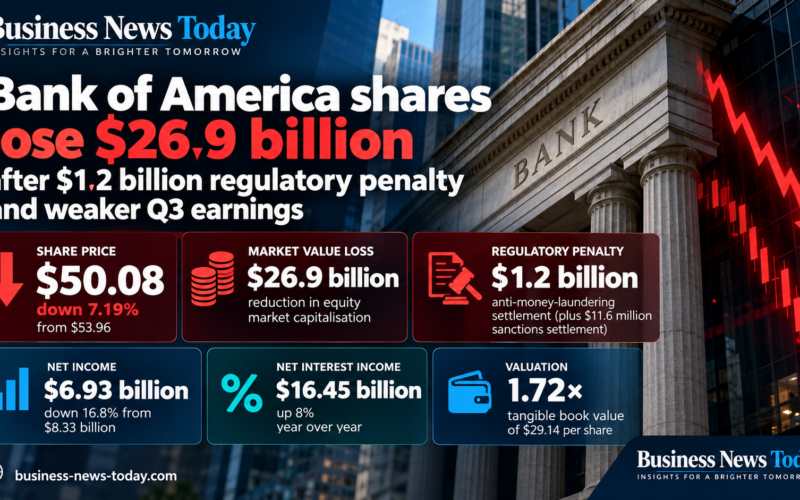
Bank of America Corporation (NYSE: BAC), the Charlotte, North Carolina-based banking and financial services group, suffered a sharp share-price decline on October 14, 2026, after reporting weaker third-quarter earnings and recognising a $1.2 billion regulatory settlement associated with serious anti-money-laundering compliance failures. The shares were trading at approximately $50.08 at 11:24 a.m. Eastern Time, down 7.19% from the previous close of $53.96, reducing the bank’s indicative equity market capitalisation by approximately $26.9 billion. The decline followed an October 13 enforcement announcement from the United States Treasury Department and financial results showing net income falling to $6.93 billion from $8.33 billion a year earlier, despite continued growth in net interest income.
The market reaction presents an important valuation question because the reduction in Bank of America’s equity market value is more than 22 times the $1.2 billion settlement charge recognised in its latest earnings. The comparison does not establish that investors overreacted, since weaker trading revenue, disappointing investment banking fees, governance concerns and broader market conditions also influenced sentiment. However, the scale of the repricing suggests investors are assessing more than the immediate financial penalty, particularly the possibility of continued compliance expenditure and weaker sustainable returns. At approximately $50 per share, Bank of America trades at about 1.72 times its September 30 tangible book value of $29.14 per share, leaving a substantial valuation premium that depends on the bank maintaining attractive profitability.
The underlying financial results are more resilient than the headline earnings decline might initially suggest. Net interest income increased 8% year over year to $16.45 billion, average loans expanded 6%, and average deposits exceeded $2 trillion, while the bank maintained a Common Equity Tier 1 capital ratio of 10.9%. Excluding the regulatory settlement, adjusted diluted earnings reached $1.08 per share, compared with reported earnings of $0.91. Nevertheless, adjusted return on average tangible common shareholders’ equity declined to 14.9% from approximately 15.3% a year earlier, raising questions about how much premium investors should assign to the bank’s capital and earnings.
Why did Bank of America shares lose nearly $27 billion after the regulatory penalty?
The October 13 enforcement action exposed substantial deficiencies in Bank of America’s compliance systems, particularly its ability to identify, investigate and report suspicious financial transactions. The Financial Crimes Enforcement Network assessed a $1.2 billion penalty after identifying failures involving more than $5 billion in suspicious activity, including transactions associated with priority national security and illicit finance risks. The Office of the Comptroller of the Currency separately announced a record $750 million civil money assessment involving deficiencies in Bank Secrecy Act and anti-money-laundering compliance. Importantly, the $750 million assessment is credited against the $1.2 billion Financial Crimes Enforcement Network penalty, meaning the two amounts must not be added together as separate cumulative charges.
The Treasury Department also announced an approximately $11.6 million settlement through the Office of Foreign Assets Control concerning apparent violations of US sanctions programmes. This is a distinct enforcement component from the principal $1.2 billion anti-money-laundering penalty, bringing the overall announced enforcement amounts above $1.21 billion. Bank of America recognised a $1.2 billion non-tax-deductible settlement charge in its September-quarter results, reducing diluted earnings by approximately $0.17 per share. The additional sanctions settlement should therefore be distinguished from both the credited regulatory assessments and the principal earnings adjustment.
The seriousness of the action extends beyond its financial size. The Office of the Comptroller of the Currency stated that Bank of America’s transaction monitoring systems had failed to identify or escalate potentially suspicious activity adequately, resulting in delayed reporting and persistent weaknesses in internal controls. Regulators also identified shortcomings in staff expertise, training and audit procedures, including failures that continued after a December 2024 cease-and-desist order requiring improvements. The Financial Crimes Enforcement Network reported that the bank admitted to willful Bank Secrecy Act violations as part of its resolution, making the matter more consequential than an isolated administrative deficiency.
The bank’s response and the durability of its remediation efforts are now central to the valuation argument. Management has indicated that significant investments in compliance technology, personnel and controls are already reflected in its operating expense structure, but the enforcement findings indicate that earlier corrective measures had not fully resolved regulators’ concerns. Independent reviews, enhanced monitoring and additional reporting requirements could continue to absorb management attention and financial resources. The uncertainty is not simply whether Bank of America can pay the settlement, but whether it can restore confidence in its control environment without materially weakening its long-term efficiency and profitability.
How did Bank of America’s third-quarter earnings perform without the $1.2 billion charge?
Bank of America reported third-quarter revenue of $29.96 billion, an increase of approximately 3.2% from $29.04 billion in the corresponding period last year. Reported net income declined 16.8% to $6.93 billion, while diluted earnings per share fell from $1.04 to $0.91. Excluding the regulatory settlement charge, adjusted net income was approximately $8.1 billion and adjusted diluted earnings were $1.08 per share. That adjusted earnings figure was below the approximately $1.10 per share expected by analysts surveyed by Reuters, indicating that the disappointing result was not attributable solely to the regulatory penalty.
The earnings composition reveals a business with contrasting operating trends. Net interest income increased from $15.23 billion to $16.45 billion, supported by stronger lending, deposit growth and repricing of fixed-rate assets. However, sales and trading revenue declined 5% to approximately $5.1 billion, while investment banking fees fell 11% to $1.8 billion. These developments reduced the contribution from capital markets operations during a quarter in which several competing financial institutions reported stronger performance.
Fixed-income, currencies and commodities trading represented a particularly significant weakness. Revenue from those activities declined 17% to approximately $2.6 billion, reflecting less favourable trading conditions and weaker performance across selected businesses. Equities trading performed better, with revenue increasing 11% to approximately $2.5 billion, but the improvement was insufficient to offset the broader decline. The result illustrates why Bank of America’s diversified business model does not eliminate exposure to volatility in investment banking and institutional markets.
Another important distinction concerns adjusted earnings per share and total profitability. Although adjusted diluted earnings of $1.08 exceeded the $1.04 reported in the corresponding quarter last year, adjusted net income was slightly below the previous year’s $8.33 billion. Part of the improvement in per-share earnings reflects a smaller share count following substantial repurchases rather than stronger aggregate profitability. That matters when evaluating the company’s valuation because earnings growth supported by a declining share count may prove less durable than growth generated through higher operating income.
Is Bank of America stock expensive at 1.72 times tangible book value?
Bank of America’s September-quarter results showed tangible book value of $29.14 per common share, compared with $28.16 a year earlier. At the October 14 intraday reference price of $50.08, the shares traded at approximately 1.72 times tangible book value, representing a premium of about 72% to the bank’s reported tangible common equity per share. The company’s broader accounting book value was $39.26 per share, producing a conventional price-to-book ratio of approximately 1.28 times. Both figures are relevant, but tangible book value provides a more focused comparison by excluding goodwill and certain intangible assets.
Using approximately 6.923 billion common shares outstanding at September 30, the $50.08 share price implies an equity market capitalisation of roughly $346.7 billion. Bank of America reported tangible common shareholders’ equity of approximately $201.8 billion, meaning investors were assigning a market premium of nearly $145 billion above that accounting measure. The premium reflects expectations that the bank can earn attractive returns on its capital, grow its earnings and distribute cash to shareholders over time. It is not an independently calculated value for the bank’s franchise or evidence that its assets could be sold for the market valuation.
The recent selloff has nevertheless changed the valuation arithmetic. At the previous closing price of $53.96, Bank of America traded at approximately 1.85 times September tangible book value, compared with around 1.72 times following the decline. This represents a meaningful contraction in the premium attached to the company’s earnings power, even though its reported tangible book value increased year over year. The question is whether the reduced multiple sufficiently compensates investors for weaker capital markets performance, compliance uncertainty and the possibility of a sustained decline in returns on equity.
For a bank, a price-to-tangible-book multiple is most meaningful when considered alongside sustainable return on tangible common equity and the cost of that equity. A bank consistently earning returns comfortably above its shareholders’ required return can justify a premium to tangible book value, while a business generating returns below that threshold may struggle to sustain one. Bank of America’s adjusted third-quarter return on average tangible common equity was 14.9%, compared with approximately 15.3% a year earlier. The premium therefore depends on investors believing that profitability near current adjusted levels is sufficiently durable and that future compliance expenditure will not materially erode those returns.
What return on tangible equity would justify Bank of America’s current valuation?
The relationship between tangible equity and earnings provides a useful way to examine the valuation without assigning an arbitrary share-price target. Using September tangible book value of $29.14 per share as a fixed reference, a hypothetical sustainable annual return on tangible equity of 12% would correspond to approximately $3.50 in earnings per share. A 15% return would imply around $4.37, while a 17% return would imply approximately $4.95. These calculations are deliberately simplified sensitivities using period-end tangible equity rather than forecasts based on average equity, future share counts or changes in capital.
At the October 14 reference price of $50.08, those hypothetical earnings levels would correspond to price-to-earnings multiples of approximately 14.3, 11.5 and 10.1 times, respectively. The comparison demonstrates why Bank of America’s sustainable profitability matters more than the settlement charge in isolation. A business capable of maintaining returns around 15% or higher could support a materially different valuation argument from one whose returns deteriorate toward 12%. However, actual shareholder value also depends on the cost of equity, future growth, capital retention and distributions, so these simplified multiples should not be interpreted as fair-value estimates.
The latest results suggest that Bank of America remains capable of generating attractive returns before exceptional regulatory costs, but its performance is not uniformly improving. Adjusted return on tangible common equity declined modestly year over year, while the adjusted efficiency ratio increased to 62% from approximately 60%. The deterioration indicates that costs are consuming a greater proportion of revenue even after excluding the settlement charge. Sustained expense pressure could limit the earnings benefit from stronger lending and deposit growth, making the current valuation premium more difficult to defend.
Can rising net interest income offset weaker investment banking and trading revenue?
Net interest income remains one of the strongest elements of Bank of America’s operating performance. The bank generated $16.45 billion in net interest income during the September quarter, up approximately 8% from a year earlier, while its fully taxable-equivalent net interest yield increased by 15 basis points to 2.16%. Average loans and leases reached approximately $1.23 trillion, representing growth of 6%, and average deposit balances increased 2% to approximately $2.02 trillion. These figures indicate that commercial and consumer banking activity continues to support the group’s recurring revenue base.
Loan growth was particularly visible in corporate and commercial banking. Bank of America reported that average loans increased across every major client segment, while its Global Banking business recorded 8% growth in average loans and leases. Consumer Banking generated approximately $3.52 billion in quarterly net income, compared with $3.44 billion a year earlier, supported by higher revenue and relatively stable credit costs. Global Wealth and Investment Management also performed well, with revenue increasing 13% to approximately $7.1 billion as asset management fees and client balances expanded.
The interest-rate outlook introduces an additional uncertainty. Higher interest rates can support income from certain assets while increasing deposit funding costs and potentially weakening borrowers’ repayment capacity. Falling rates may reduce asset yields but could also lower deposit costs, depending on the timing of repricing and the composition of the balance sheet. Consequently, the impact of changing Federal Reserve policy cannot be reduced to a simple assumption that higher or lower rates will automatically benefit Bank of America.
The bank’s ability to sustain net interest income growth will depend on loan demand, deposit pricing, balance-sheet composition and the broader economic environment. An acceleration in commercial lending could strengthen earnings, particularly if credit quality remains stable. Conversely, weaker borrower demand or higher deposit costs could reduce the contribution from the business that currently provides the strongest support to profitability. The durability of this revenue stream is therefore an important condition for justifying the shares’ premium to tangible book value.
Does Bank of America’s balance sheet provide protection against future regulatory and credit risks?
Bank of America reported approximately $3.43 trillion in total assets and $2.04 trillion in deposits at September 30, 2026, illustrating the scale of its banking operations. Its Common Equity Tier 1 capital ratio was 10.9% under the standardised regulatory approach, supported by approximately $198 billion in Common Equity Tier 1 capital. Management reported that its regulatory capital position remained above applicable minimum requirements, while average global liquidity sources totalled approximately $914 billion. These figures indicate substantial financial resources, although capital and liquidity measures serve different regulatory purposes and should not be treated as interchangeable.
The capital position is relevant because the settlement charge is financially manageable relative to the bank’s scale. A $1.2 billion penalty represents approximately 0.6% of its reported tangible common shareholders’ equity, although the charge is already reflected in the September financial statements. The greater concern is whether future compliance obligations require higher recurring expenditure or constrain management’s flexibility in allocating capital. Regulatory remediation can affect operating efficiency over multiple reporting periods even when the immediate financial penalty has been recognised.
Credit quality offers a comparatively reassuring picture. Net charge-offs declined slightly to approximately $1.35 billion during the quarter, compared with $1.37 billion a year earlier, while the annualised net charge-off ratio improved to 0.44% from 0.47%. The provision for credit losses was approximately $1.27 billion, compared with $1.30 billion in the corresponding period last year. These figures do not indicate a broad deterioration in the loan portfolio, although they cannot rule out future losses if economic conditions weaken.
The bank reported approximately $14.18 billion in allowances for credit losses and $5.65 billion in nonperforming loans, leases and foreclosed properties at September 30. These measures should be monitored alongside unemployment, commercial real estate conditions, consumer credit performance and corporate borrowing activity. A simultaneous increase in credit losses and compliance expenditure would create a more difficult earnings environment than either challenge in isolation. For now, the latest reported credit figures provide some support for the view that the regulatory setback has not coincided with an immediate deterioration in underlying asset quality.
Could further compliance spending reduce shareholder returns and capital distributions?
Bank of America returned approximately $8.3 billion to shareholders during the September quarter through common dividends and share repurchases. This included approximately $6 billion in common stock repurchases and $2.2 billion in common dividends, with the difference from the reported total reflecting rounded figures. The bank’s common share count declined to approximately 6.923 billion at September 30 from 7.329 billion a year earlier, a reduction of roughly 5.5%. That decline has supported earnings per share, although future repurchase activity will depend on capital requirements, profitability and management decisions.
The bank paid a quarterly common dividend of $0.32 per share, equivalent to an annualised rate of $1.28 if maintained. At the October 14 reference price, that would represent an indicative dividend yield of approximately 2.6%, although future distributions are not guaranteed. The combination of dividends and repurchases has historically formed an important component of Bank of America’s shareholder-return proposition. However, a sustained increase in compliance expenditure could reduce the earnings available to support capital distributions, particularly if profitability in other divisions remains subdued.
Management has indicated that the bank has already made substantial investments in financial crime prevention and compliance personnel. Chief Executive Officer Brian Moynihan sought to reassure investors during the October earnings discussion that ongoing remediation expenses were broadly incorporated into the bank’s operating cost expectations. Nevertheless, analysts questioned how such a large settlement could emerge when management had previously discussed progress in addressing regulatory deficiencies. The uncertainty centres on whether existing expenditure will prove sufficient and whether regulators will require further operational improvements.
The bank’s efficiency ratio will provide an important measure of the financial consequences. Reported noninterest expense increased to approximately $19.72 billion from $17.34 billion a year earlier, although the latest figure includes the $1.2 billion settlement. Excluding that charge, adjusted noninterest expense was approximately $18.5 billion, still higher than the prior-year level. Further increases in personnel, monitoring technology, external review and remediation expenses could constrain profitability unless revenue growth or efficiencies elsewhere compensate for them.
What could justify a recovery or further decline in Bank of America shares?
A constructive scenario would involve Bank of America demonstrating that the major financial penalties have been substantially absorbed and that remediation can proceed without a prolonged acceleration in operating expenses. Continued growth in net interest income, stronger investment banking activity and resilient credit quality could help sustain adjusted returns on tangible equity near or above the latest 14.9% level. Further growth in tangible book value and disciplined capital distributions would strengthen the argument for maintaining a premium valuation. Under those circumstances, some of the uncertainty reflected in the October selloff could diminish as investors gain confidence in earnings quality and regulatory progress.
A more moderate scenario would involve continued growth in lending and deposits alongside elevated compliance costs and inconsistent trading performance. Bank of America could remain highly profitable while adjusted returns on tangible equity stay below earlier levels, limiting the justification for a higher price-to-tangible-book multiple. Capital distributions might continue, but the bank would need to balance repurchases against operating investment and regulatory expectations. In that environment, a valuation around 1.7 times tangible book could remain sensitive to relatively small changes in profitability assumptions.
A more adverse scenario would involve additional remediation requirements, weaker capital markets revenue and rising credit losses. The combination could reduce sustainable returns on tangible common equity toward the lower end of the illustrative range, particularly if expense growth continues exceeding revenue growth. Under such conditions, the market could assign a lower premium to tangible book even without another major regulatory penalty. The risk is therefore not limited to a repeat of the October enforcement action, but extends to the possibility that investors have overestimated the bank’s sustainable earnings power.
The market-value comparison provides useful context without resolving which scenario will materialise. The approximately $26.9 billion decline between the October 13 close and the October 14 intraday reference is far greater than the $1.2 billion earnings charge, but the difference reflects changes in expectations rather than an identifiable additional financial liability. A regulatory enforcement action can affect confidence in management, the perceived reliability of internal controls and the valuation multiple assigned to future earnings. The scale of the repricing consequently becomes more understandable when viewed through those longer-term uncertainties, although it does not establish that all of them will lead to material financial losses.
What must Bank of America prove to justify its $50 share price?
Bank of America’s October 2026 selloff has created a more demanding test of the premium investors are willing to pay for its banking franchise. The company retains substantial financial strengths, including more than $2 trillion in deposits, growing net interest income, significant regulatory capital and stable recent credit performance. Its adjusted return on tangible common equity of 14.9% indicates that the underlying business remains profitable despite the earnings charge and weaker capital markets activity. However, the latest enforcement findings raise material questions about operational controls, governance and the future expense structure.
The next several quarters should establish whether the bank can improve compliance without sacrificing the operating efficiency that supports its valuation. Investors will need evidence that adjusted expenses stabilise, returns on tangible equity remain attractive and stronger commercial lending translates into sustainable earnings growth. Updates on remediation progress will be particularly important because financial penalties are easier to quantify than the recurring consequences of deficient internal controls. Continued capital distributions would provide additional evidence of balance-sheet flexibility, although those distributions must be supported by operating performance rather than treated as an independent valuation justification.
At approximately $50 per share, Bank of America trades at a substantially lower valuation than before the enforcement announcement, but it still commands a premium of more than 70% to tangible book value. That premium is more defensible if the bank maintains returns around 15% and restores confidence in its regulatory compliance framework than if ongoing expenses and weaker business performance push sustainable profitability materially lower. The October decline has reduced the valuation without resolving those uncertainties, leaving the investment argument dependent on measurable improvements rather than the assumption that a large one-time penalty automatically creates an undervalued stock. The central conclusion is that Bank of America’s earnings capacity remains substantial, but the credibility and durability of those earnings have become more important to its valuation than the immediate cost of the settlement.
Disclaimer: This article is for informational and journalistic purposes only and does not constitute investment advice, a recommendation, an offer or a solicitation to buy or sell any security. Investors should conduct their own research and consider their financial circumstances, objectives and risk tolerance before making investment decisions.
Discover more from Business-News-Today.com
Subscribe to get the latest posts sent to your email.

