


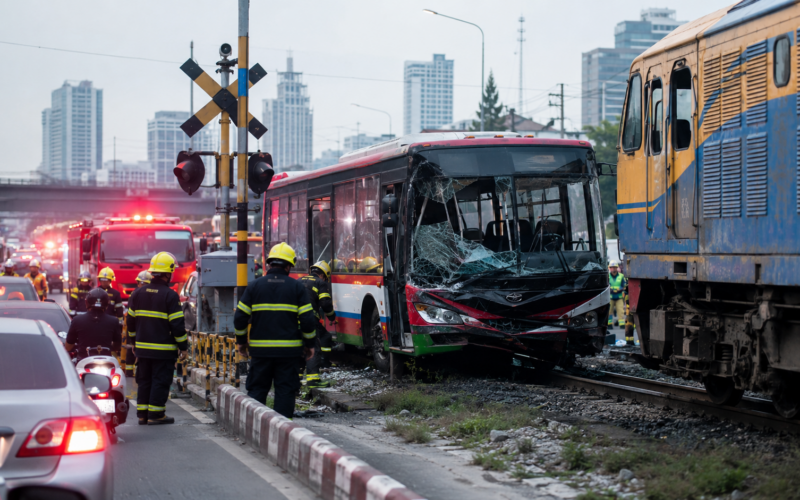
A collision between a freight train and a public bus in Bangkok killed at least eight people and injured dozens more on Saturday, May 16, 2026, after the crash triggered a major fire near the Makkasan railway crossing in the Thai capital.
The collision occurred near the Airport Rail Link’s Makkasan station, a busy transport area in central Bangkok. Emergency crews, firefighters and rescue workers were deployed after the freight train struck the public bus at a rail crossing, with the impact dragging the bus and nearby vehicles along the tracks. The bus caught fire shortly after the collision, while nearby cars and motorcycles were also damaged.
Thai emergency and police figures placed the death toll at eight. Injury counts varied during the emergency response, with officials reporting more than 30 injured people and medical authorities warning that the number of injured could rise as victims were distributed across hospitals in Bangkok and surrounding areas.
All eight people who died were found on the bus. Rescue teams entered the charred vehicle after firefighters brought the blaze under control. Hospitals in Bangkok were placed on emergency standby to receive the injured, including critically injured patients, burn victims and passengers from the bus as well as people from nearby vehicles.

What happened in the Bangkok train-bus collision near Makkasan railway crossing?
The crash took place at a railway crossing near Makkasan, an area connected to Bangkok’s Airport Rail Link and heavily used by commuters and motorists. A freight train transporting containers struck the public bus at the crossing, causing the bus to burst into flames.
Initial accounts indicated that several vehicles had stopped near the crossing when the train approached. Officials said early reports suggested the bus may have been halted on the tracks at a red light, which may have affected the operation of crossing barriers. Authorities have not issued a final cause and the incident remains under investigation.
Footage from the scene showed the train hitting the bus and dragging vehicles along the railway line. Witness accounts indicated that the crash was followed almost immediately by fire, creating a complex rescue operation involving passengers, motorists, motorcyclists and bystanders.
The crash site was cordoned off as firefighters worked to extinguish the flames. Rescue workers then searched the burned bus and removed victims. Investigators were seen examining the wreckage as police and transport officials began assessing the sequence of events.
Why are Thai authorities investigating the Makkasan rail crossing barriers and traffic signals?
Thai authorities are examining whether the bus was stopped on the tracks, whether traffic conditions trapped vehicles at the crossing, and whether the crossing barriers functioned properly before the train arrived. The investigation is expected to focus on traffic flow, warning systems, barrier timing and driver decision-making.
A key question is whether the public bus entered the rail crossing before traffic ahead had cleared. If the bus was unable to move because of a red light or blocked traffic, the crossing would have become especially dangerous once the freight train approached.
The operation of the crossing barriers is also under scrutiny. Some witness accounts suggested that the barriers may not have lowered before the train reached the crossing. Officials have not confirmed whether the barriers malfunctioned, whether they were obstructed, or whether traffic conditions prevented a normal safety response.
The investigation is significant because level crossings in dense urban areas depend on several systems working together. Railway signals, road traffic lights, barrier arms, driver compliance and traffic clearance all need to align. A failure in any part of that chain can quickly turn a congested crossing into a mass-casualty event.
How did Bangkok hospitals respond after the deadly Thailand train-bus collision?
Bangkok’s emergency medical network activated a hospital response after the crash. The Bangkok Erawan Centre managed the on-site emergency response and helped distribute injured people to hospitals.
The Department of Medical Services under Thailand’s Public Health Ministry placed major state hospitals on alert. Rajavithi Hospital, Lerdsin Hospital and Nopparat Rajathanee Hospital were among the hospitals told to prepare emergency rooms, medical staff, operating theatres, inpatient wards and burn treatment capacity.
Rajavithi Hospital prepared its burn unit, operating theatres and blood reserves. Other hospitals received patients in red, yellow and green categories, reflecting the severity of injuries. Red-category patients were treated as critically injured and potentially at risk of death or in need of ventilator support.
The hospital response reflected the scale and complexity of the crash. The incident involved fire, blunt-force trauma, vehicle damage and possible crush injuries. Injured people included bus passengers as well as motorists and motorcyclists near the crossing when the collision occurred.
Why does the Bangkok train-bus crash raise wider road and rail safety questions in Thailand?
The Makkasan train-bus collision is likely to intensify scrutiny of road and rail safety in Thailand, particularly at level crossings where heavy urban traffic intersects with railway operations.
Thailand has long faced high road-safety risks, with road fatalities remaining a serious public-policy concern. Rail crossings add another layer of danger when buses, motorcycles, cars and freight trains operate in close proximity in congested city areas.
The crash also highlights the risks created by mixed transport corridors in fast-moving urban environments. Bangkok depends on buses, motorcycles, private cars, rail services and airport-linked transit routes. In such areas, a blocked crossing can quickly involve multiple types of vehicles and a large number of people.
For public agencies, the key issue is not only what caused this specific crash but whether similar crossings require stronger traffic coordination, clearer warning systems, better enforcement, upgraded barriers or redesigned road layouts. The investigation will therefore matter beyond the immediate casualty count.
What are the key takeaways from the deadly Thailand train-bus collision near Makkasan?
- At least eight people were killed after a freight train struck a public bus at a railway crossing near Makkasan station in Bangkok.
- More than 30 people were injured, with victims taken to several hospitals across Bangkok after the crash.
- The public bus caught fire after the collision, and nearby cars and motorcycles were also damaged.
- Thai authorities are investigating whether the bus was stopped on the tracks and whether crossing barriers functioned properly.
- Bangkok hospitals prepared emergency rooms, burn units, operating theatres, blood reserves and inpatient wards to treat injured victims.
Discover more from Business-News-Today.com
Subscribe to get the latest posts sent to your email.