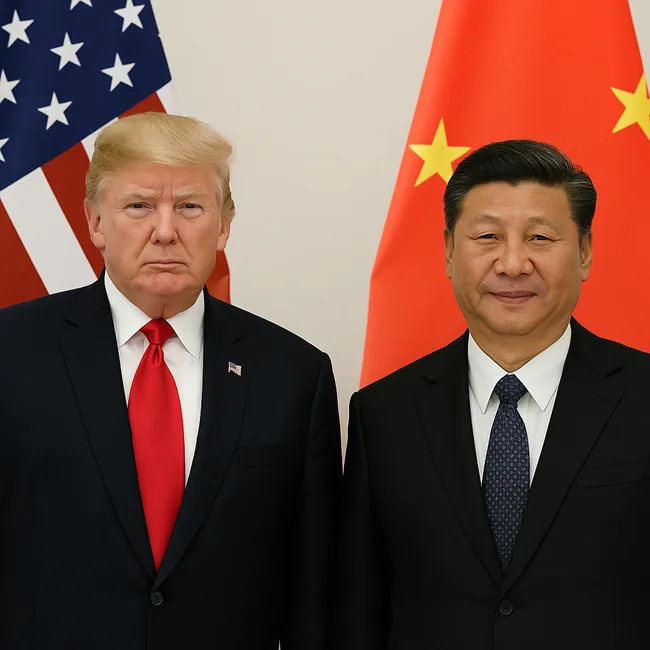


Chinese President Xi Jinping has arrived in the United States for a state visit culminating in talks with President Donald Trump at the White House on September 24, placing trade, artificial intelligence, critical minerals, Taiwan and the Iran conflict at the centre of the world’s most consequential bilateral relationship. China’s Foreign Ministry confirmed that Xi left Beijing on September 23 accompanied by senior officials including Foreign Minister Wang Yi, while the White House scheduled a full state-arrival ceremony, bilateral engagements and a state dinner.
The meeting comes at a delicate moment. Washington and Beijing have avoided a return to the extreme tariff escalation that characterised earlier phases of their trade confrontation, but major disputes remain unresolved over Chinese access to advanced semiconductors, US access to rare-earth supplies, agricultural purchases, artificial intelligence and Taiwan. Both governments have publicly emphasised the need to manage differences, with Beijing describing its goal as a relationship of “constructive strategic stability” rather than the elimination of strategic competition.
Why is the September 24 Trump-Xi summit economically more important than its ceremonial state-visit setting?
The ceremonial programme is unusually elaborate, including a White House military review involving hundreds of personnel, a B-2 Spirit bomber and F-22 fighters, followed by a state dinner. Yet the commercial importance lies in whether the two governments can extend or deepen arrangements that have prevented their trade confrontation from returning to tariffs above 100% on major categories of bilateral commerce.
The current tariff truce is due to expire in November, giving Trump and Xi a relatively near-term negotiating deadline. Reuters has reported that Washington is seeking additional Chinese purchases of American agricultural and industrial products while Beijing wants greater predictability around US technology restrictions. Rare-earth exports are another crucial bargaining point because China dominates global processing and permanent-magnet supply chains used in automobiles, renewable energy, electronics and defence systems.
Previous commitments have also remained incomplete. Associated Press reported that Chinese purchases of US agricultural products have lagged agreed targets and that a proposed purchase of 200 Boeing aircraft had not yet been completed, while investment mechanisms envisioned in earlier negotiations have progressed slowly. The summit therefore provides an opportunity to convert broad political understandings into transactions that businesses can actually measure.
Why has artificial intelligence become one of the hardest issues in US-China relations?
Artificial intelligence sits at the intersection of commercial competition and national security. Both countries want leadership in frontier models, computing infrastructure, robotics and AI-enabled industrial systems, while Washington continues to restrict China’s access to some high-end semiconductor technologies and Beijing objects to what it describes as attempts to constrain its technological development.
At the same time, both sides recognise that powerful artificial-intelligence systems can create shared risks. Officials have discussed possible mechanisms for communicating about major AI incidents, cyber threats and dangerous unintended behaviour, although strategic mistrust limits how much technical information either side may be willing to exchange.
That makes AI different from a conventional trade dispute. The United States and China simultaneously want to outperform one another and prevent catastrophic misuse or instability, meaning they have incentives to compete and cooperate at the same time. A narrow communication channel covering major AI incidents could therefore be meaningful even without broader agreement on semiconductor restrictions.
How could rare-earth minerals become leverage in the Trump-Xi negotiations?
China controls an outsized portion of global rare-earth separation and magnet manufacturing, giving Beijing influence over materials essential to electric vehicles, defence systems, industrial automation and high-performance electronics. The United States has accelerated domestic mining and processing programmes but cannot replicate the entire Chinese supply chain immediately.
Washington is consequently seeking greater predictability around Chinese export availability. Beijing, meanwhile, wants the United States to reconsider restrictions affecting advanced chips and Chinese technology companies. That creates an unusually direct negotiating trade-off between critical physical materials and sophisticated digital technologies.
The commercial consequences extend well beyond the United States and China. European, Japanese, South Korean and Indian manufacturers also depend on predictable rare-earth and semiconductor markets, meaning a breakdown between Washington and Beijing can quickly propagate across global supply chains.
Why is Taiwan still the summit’s most sensitive security issue?
China regards Taiwan as part of its territory and has not renounced the use of force to achieve unification, while the United States maintains unofficial relations with Taipei and supplies defensive equipment under its longstanding Taiwan policy. Beijing is expected to use the summit to press Washington for restraint on weapons sales and other actions it regards as supporting Taiwanese independence.
US allies in Asia have expressed concern that Taiwan policy could become entangled with economic bargaining. Reuters has reported anxiety among some officials in the region about whether Washington might alter its language or military support in exchange for commercial concessions, although there is no evidence that Trump has agreed to such a trade-off.
The distinction is important because speculation about possible concessions should not be confused with announced policy. Any actual shift would need to be established through statements, weapons decisions or formal diplomatic language following the summit.
How does the Iran war complicate Trump’s discussions with Xi Jinping?
China is a major buyer of Iranian energy and has maintained economic links with Tehran despite US sanctions pressure. Washington wants Beijing to use its relationship with Iran to encourage de-escalation, while China has an economic interest in restoring stable shipping through the Strait of Hormuz because elevated oil prices increase costs for the world’s largest crude importer.
Iran therefore creates an area where American and Chinese economic interests partly overlap despite their broader geopolitical rivalry. Both want stable energy flows, but they differ sharply over US sanctions, military operations and the appropriate means of influencing Tehran.
The summit could consequently address Iran without producing a formal bilateral initiative. Even limited Chinese pressure favouring continued diplomatic talks would matter if it contributes to lower risks around Hormuz and global oil markets.
What are the key takeaways from Xi Jinping’s September 24 White House summit with Donald Trump?
The meeting is unlikely to eliminate structural rivalry between the United States and China because disagreements over technology, Taiwan, industrial policy and global influence run much deeper than one summit. Both governments are instead signalling that they want competition to remain manageable enough to protect trade and prevent political disputes from turning into uncontrolled escalation.
The immediate commercial tests will be easier to measure. An extension of the tariff truce, additional agricultural or aircraft purchases, improved rare-earth access or a new AI-risk communication mechanism would provide businesses with tangible evidence that summit diplomacy is producing practical outcomes.
The absence of such agreements would not automatically mean the meeting failed, because maintaining regular presidential dialogue itself reduces uncertainty. However, companies making investment and supply-chain decisions will ultimately care less about ceremonial symbolism than whether US-China economic rules become more predictable.
Discover more from Business-News-Today.com
Subscribe to get the latest posts sent to your email.