


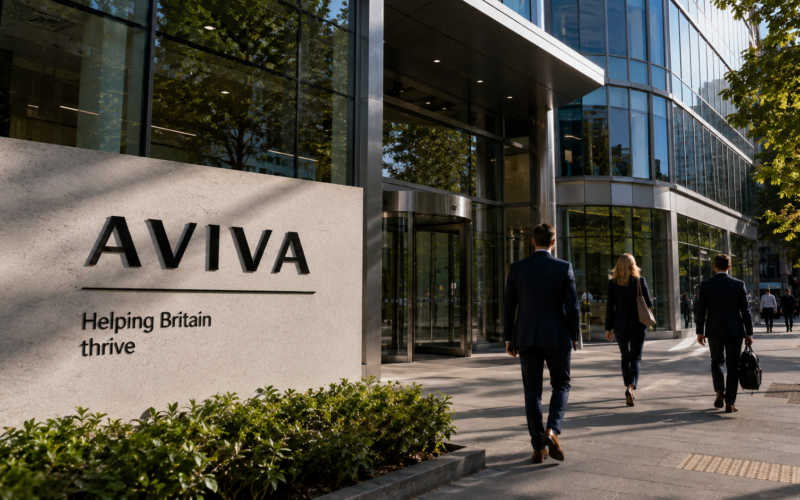
Aviva plc (LSE: AV.) reported a 24% increase in first-half operating profit to £1.33 billion on August 14, beating the £1.26 billion analyst consensus as the Direct Line acquisition and strong Wealth inflows lifted the enlarged insurance group. General Insurance gross written premiums increased 29% to £8.1 billion, while Wealth net inflows climbed 32% to £7.6 billion and the interim dividend increased 7% to 14 pence per share. The shares responded by rising 1.82% to a new 52-week high of £7.27, even as the FTSE 100 declined, extending a rerating that has accompanied Chief Executive Officer Amanda Blanc’s transformation of Aviva into a larger UK-focused insurance and savings group. The central question has consequently shifted from whether the £3.7 billion Direct Line acquisition can be integrated to whether Aviva can use the additional scale to deliver its targeted 11% annual operating EPS growth without allowing softer insurance pricing, higher claims or weakening capital efficiency to dilute the benefits.
Direct Line is now included for a full six-month reporting period for the first time. Aviva completed the acquisition on July 1, 2025, issuing approximately 378 million new shares alongside the cash component of the consideration, and the deal transformed its position in UK personal lines insurance. A year later, management says the integration of more than 8,000 Direct Line employees has progressed smoothly, around £100 million of the targeted £225 million annual cost synergies has already been captured and approximately £150 million of capital synergies has been delivered. That puts Aviva far beyond the stage where investors can evaluate the transaction primarily on promised synergies, because the acquisition must increasingly demonstrate measurable effects on underwriting margins, earnings per share and cash generation.
Why does Aviva’s £1.33 billion first-half operating profit matter beyond the Direct Line boost?
Operating profit increased from £1.07 billion in the first half of 2025 to £1.33 billion in the latest period, adding approximately £262 million of profit year on year. The comparison needs care because Direct Line was acquired immediately after the June 30, 2025 reporting period and therefore contributed nothing to Aviva’s first-half 2025 numbers, whereas the 2026 period includes the enlarged group. Even so, beating consensus by roughly £70 million indicates that performance has been stronger than the market expected even after analysts had already incorporated the acquisition.
Aviva had already entered 2026 from a stronger earnings base. Full-year 2025 operating profit increased 25% to £2.20 billion and operating earnings per share rose 17% to 56 pence, allowing the company to achieve its previous 2026 profit and capital-generation targets one year early. Excluding the £174 million contribution from Direct Line during the second half of 2025, Aviva said underlying group operating profit still increased 15%, showing that the pre-acquisition businesses were already growing before the full financial effect of Direct Line arrived.
This distinction matters because acquisition-led growth has a lower quality if the original business is deteriorating underneath the consolidation. Aviva’s broader franchise has instead been expanding across General Insurance and Wealth, while management is attempting to increase the proportion of earnings generated from capital-light activities. The investment case is therefore becoming a combination of organic growth, acquisition synergies and share-count management rather than dependence on a single financial lever.

Has Aviva already captured enough of the £225 million Direct Line cost synergy target?
Around £100 million of the £225 million annual Direct Line cost-synergy target has now been achieved, equivalent to approximately 44% of the expected run-rate benefit. That is meaningful progress only a little more than a year after completion, although the full £225 million annual run-rate is not expected until 2028. Management had already increased the cost-synergy target from the earlier acquisition assumptions and estimated approximately £350 million of costs would be required to achieve those savings.
The economics therefore cannot be judged from gross savings alone. Spending hundreds of millions on restructuring, technology integration and organisational change can depress near-term statutory earnings even when the eventual run-rate outcome is attractive. What matters is whether the resulting cost base allows the enlarged personal-lines business to maintain competitive prices while producing a structurally better expense ratio.
Capital synergies are equally important because insurance growth consumes regulatory capital. Aviva had delivered around £150 million of Direct Line capital benefits by the end of 2025 and said in May that it expected more than another £350 million by the end of 2026, taking the total above the £500 million target outlined after the transaction. The additional 2026 benefit alone was expected to add more than seven percentage points to the Solvency II shareholder cover ratio.
That provides a useful benchmark for the August result. Aviva’s first-half Solvency II shareholder cover ratio stood at 176%, compared with 180% at the end of 2025, leaving it inside management’s 160% to 180% target range. Continued delivery of Direct Line capital synergies could therefore give Aviva additional capacity for dividends, reinvestment or future capital returns without requiring a significant improvement in market conditions.
Why could softer motor and home insurance pricing become the next test for Aviva?
Direct Line has increased Aviva’s scale precisely as the UK general insurance market is moving into a more competitive pricing phase. Reuters noted that Aviva is navigating softening insurance pricing, meaning growth in written premiums cannot automatically be treated as evidence of equivalent improvement in profitability. A large insurer can always defend market share by reducing prices, but doing so becomes economically unattractive if claims inflation does not decline at the same pace.
Aviva’s first-quarter numbers demonstrated why underwriting discipline matters. Group General Insurance premiums increased 19% to £3.4 billion and the undiscounted combined operating ratio improved to 94.1% from 96.6%, meaning underwriting was profitable before investment income. UK and Ireland personal-lines premiums increased 59%, reflecting both Direct Line and organic growth, while management maintained its objective for a UK and Ireland combined ratio below 94% for 2026.
The acquisition creates opportunities to improve those economics through scale. Aviva can spread technology, claims management, fraud detection, advertising and central costs across a substantially larger premium base while combining brands and distribution channels that reach consumers directly and through price-comparison websites. Direct Line policies sold through comparison sites had nearly doubled by the first-quarter update, suggesting management is already changing how the acquired business competes for customers.
However, insurance scale creates value only when pricing remains rational. A larger market position can provide better data and operating efficiency, but it does not eliminate weather events, bodily-injury inflation, repair costs or competitive pressure. Investors should therefore watch the combined operating ratio much more closely than premium growth as the Direct Line integration matures.
Can Wealth become large enough to reduce Aviva’s dependence on underwriting cycles?
Wealth may be the most important counterbalance to the cyclical nature of general insurance. First-half net inflows increased 32% to £7.6 billion, while Wealth assets under management rose approximately 12% to £261 billion. Aviva Investors separately recorded £1.5 billion of external net inflows after £1.2 billion of outflows in the comparable period, with its assets under management reaching £273 billion.
The attraction is the recurring fee base. Workplace pensions receive contributions month after month, while investment platforms and adviser relationships can retain customer assets for many years. Aviva said earlier in 2026 that its Workplace business was receiving approximately £1 billion of regular member contributions each month, providing an unusually visible source of gross inflows compared with businesses dependent on one-off insurance policy sales.
This scale can create operating leverage because administering additional assets does not require costs to increase proportionately. Aviva is targeting £280 million of Wealth operating profit by 2027, and management’s broader strategy is to push the group toward more than 75% capital-light earnings by the end of 2028. That mix should theoretically support higher returns on equity because fee-based assets require less regulatory capital than underwriting or long-duration annuity liabilities.
Aviva also has an unusually broad customer base through which to cross-sell. The company has more than 25 million customers across its core markets, creating opportunities to move insurance customers into pensions, savings and investment products or sell insurance to existing Wealth customers. The challenge is converting that theoretical customer advantage into measurable increases in multi-product penetration rather than simply maintaining a collection of large but separate businesses.
Why did Aviva cut its 2026 Health profit expectation despite otherwise strong results?
The principal negative revision in the August results came from Health. Aviva reduced its expected 2026 Health operating profit to around £90 million from the previous £100 million ambition, citing slower market growth in consumer and small and medium-sized enterprise channels. The company nevertheless continues to describe Health as a strategically attractive long-term market and intends to keep investing rather than attempting to protect short-term profit by materially reducing growth expenditure.
The downgrade follows warning signs visible earlier in the year. First-quarter Health sales fell 31% to £25 million even though in-force premiums increased 9%, indicating that the existing book continued expanding while the pace of new customer acquisition weakened. Management was still targeting £100 million of operating profit at that stage, so the August reduction confirms that softer demand has persisted long enough to affect the full-year expectation.
In isolation, a £10 million change is small relative to £1.33 billion of first-half group operating profit. Strategically, however, it matters because Health is one of the capital-light businesses Aviva expects to help raise returns over time. If Health growth remains subdued, more of the burden for achieving the 2028 capital-light target shifts toward Wealth and General Insurance.
The downgrade is also a useful reminder that diversification does not mean every division grows simultaneously. One of Aviva’s advantages is that weakness in Health can be offset by insurance underwriting, Wealth inflows or other businesses, but investors should still distinguish portfolio resilience from universally strong organic growth.
Can Aviva really compound operating earnings per share by 11% through 2028?
Aviva’s central medium-term target is an 11% compound annual increase in operating earnings per share from the 2025 base through 2028. Management is also targeting IFRS return on equity above 20% by 2028 and more than £7 billion of cumulative cash remittances between 2026 and 2028. The first-half earnings beat strengthens confidence in those targets, but maintaining double-digit per-share compounding for three years will require several drivers to work together.
Direct Line synergies should contribute through lower costs and released capital, while Wealth can add fee income and the enlarged General Insurance operation can generate additional underwriting profit if pricing remains disciplined. Aviva also completed a £350 million share buyback in July, repurchasing approximately 56.7 million shares at an average price of 617.05 pence. The buyback reduced the share count and should therefore provide a modest mechanical tailwind to future earnings per share.
The mathematical hurdle remains meaningful. Compounding 56 pence of 2025 operating EPS at 11% annually would imply approximately 76.5 pence by 2028. That requires an increase of roughly 20.5 pence per share, or about 37%, over three years. The target therefore cannot be achieved merely by delivering the remaining Direct Line cost savings, particularly because additional shares were issued to finance part of the acquisition.
A more durable path would combine organic profit growth, synergy delivery, capital efficiency and selective buybacks. If one of those elements weakens materially, such as general insurance margins deteriorating as pricing softens, the other businesses will need to compensate for the group to sustain the 11% trajectory.
Does Aviva’s 176% solvency ratio leave enough room for another large capital return?
Aviva’s Solvency II shareholder cover ratio stood at 176% at the half year, down from 180% at the end of 2025 but higher than the 171% estimated after the first quarter. The ratio therefore sits comfortably within management’s 160% to 180% target range despite the payment of the final dividend, the £350 million buyback and other capital movements earlier in the year.
The remaining Direct Line capital synergies could push the ratio higher if other variables remain broadly stable. Management said in May that achieving more than £350 million of additional synergies during 2026 would add more than seven percentage points and could move solvency above the target range by year-end. That creates an obvious capital-allocation question because Aviva has historically returned excess capital to shareholders when it could not deploy it at sufficiently attractive returns.
Since Amanda Blanc became chief executive in 2020, Aviva has refocused on the UK, Ireland and Canada and returned more than £10 billion to shareholders while simultaneously acquiring businesses including Direct Line. That track record means investors may reasonably expect excess capital to remain under consideration for distribution, although the Board has not committed to another buyback beyond completed programmes.
The better outcome is not necessarily the largest possible buyback. If Aviva can deploy capital into Wealth, technology or smaller acquisitions at returns above the economic benefit of repurchasing its own shares, retaining some excess capital could create more long-term value. The company’s capital framework therefore matters as much as the absolute solvency percentage.
What does Aviva’s record £7.27 share price imply after the August 14 earnings beat?
Aviva shares closed August 14 at £7.27, up 1.82% for the day and establishing a new 52-week high while the FTSE 100 declined 0.21%. Trading volume reached 9.5 million shares compared with a 50-day average of around seven million, suggesting the earnings response attracted unusually strong participation rather than reflecting a thin-market move.
The stock was trading at 661.8 pence on July 14, meaning the August 14 close represents an increase of approximately 9.9% in one month. Even the five-day picture is positive despite normal volatility, with the shares having traded around £6.97 on August 11 before advancing through £7.14 on August 13 and reaching £7.27 after the results.
The rerating reflects several years of strategic repair rather than one strong earnings report. Aviva has simplified its geographic portfolio, increased operating profit, restored large capital returns, acquired Direct Line and established measurable growth targets extending through 2028. The market is now assigning a higher value to the possibility that the company can combine insurance scale with fee-based Wealth growth rather than remaining primarily a mature life insurer.
A record share price also raises the standard for future results. Expectations now incorporate meaningful Direct Line synergies and continued earnings growth, so simply reporting higher premiums may not be enough if margins weaken or capital-generation targets slip. The next phase of the valuation will depend increasingly on per-share earnings and return on equity rather than restructuring announcements.
Key takeaways from Aviva’s 2026 half-year results and Direct Line integration
- Aviva reported first-half operating profit of £1.33 billion, up 24% and ahead of the £1.26 billion analyst consensus.
- General Insurance gross written premiums increased 29% to approximately £8.1 billion, ahead of consensus expectations of £7.8 billion.
- Wealth net inflows increased 32% to £7.6 billion, while Wealth assets under management reached approximately £261 billion.
- Aviva has captured around £100 million of its £225 million Direct Line cost-synergy target, equivalent to approximately 44% of the expected annual run-rate savings.
- Around £150 million of Direct Line capital synergies had already been delivered, with the total target exceeding £500 million.
- The Solvency II shareholder cover ratio stood at 176%, compared with 180% at the end of 2025 and 171% after the first quarter.
- Aviva lowered its 2026 Health operating profit expectation to £90 million from £100 million because of slower consumer and SME market growth.
- The interim dividend increased 7% to 14 pence per share, while Aviva completed a separate £350 million share buyback in July.
- Aviva continues to target an 11% operating EPS CAGR through 2028, IFRS return on equity above 20% and more than £7 billion of cumulative cash remittances from 2026 to 2028.
- Aviva shares closed at a new 52-week high of £7.27 on August 14, roughly 10% above their July 14 level.
Can Aviva turn the Direct Line deal from an acquisition success into durable per-share growth?
Aviva’s August 14 results strengthen the argument that the Direct Line acquisition is producing operational benefits more quickly than investors might have expected when the £3.7 billion transaction was completed. Around 44% of the targeted cost synergies have already been captured, capital benefits are emerging and General Insurance scale has expanded dramatically, while the group simultaneously recorded much stronger Wealth inflows. The earnings beat therefore reflects a business with several growth engines rather than a company depending entirely on acquisition accounting.
The harder phase now begins because the market is no longer pricing Aviva as an unresolved turnaround. Shares have reached a fresh 52-week high, Direct Line integration expectations are embedded in forecasts and management has publicly committed to 11% annual EPS growth through 2028. Delivering that target requires the group to preserve underwriting profitability as UK insurance pricing softens, extract the remaining acquisition synergies and continue expanding capital-light fee income without allowing Health weakness or competitive pressure in other markets to offset the gains.
Wealth could become increasingly important in determining whether that growth is sustainable. Net inflows of £7.6 billion provide new fee-earning assets without the same regulatory-capital requirements as many traditional insurance products, while workplace pensions create recurring contributions and opportunities to deepen customer relationships. If Aviva can combine this growth with a more efficient Direct Line operation, its target of more than 20% IFRS return on equity becomes considerably more credible.
The downside case is also becoming clearer. Softer motor pricing, higher-than-expected claims inflation or slower synergy delivery could pressure General Insurance margins, while the Health downgrade demonstrates that not every capital-light market is currently expanding as management anticipated. Aviva has largely won the argument that it can simplify the group, deploy capital and integrate Direct Line. The next rerating depends on proving that the enlarged company can compound earnings per share at double-digit rates after the easy gains from restructuring begin to run out.
Discover more from Business-News-Today.com
Subscribe to get the latest posts sent to your email.