

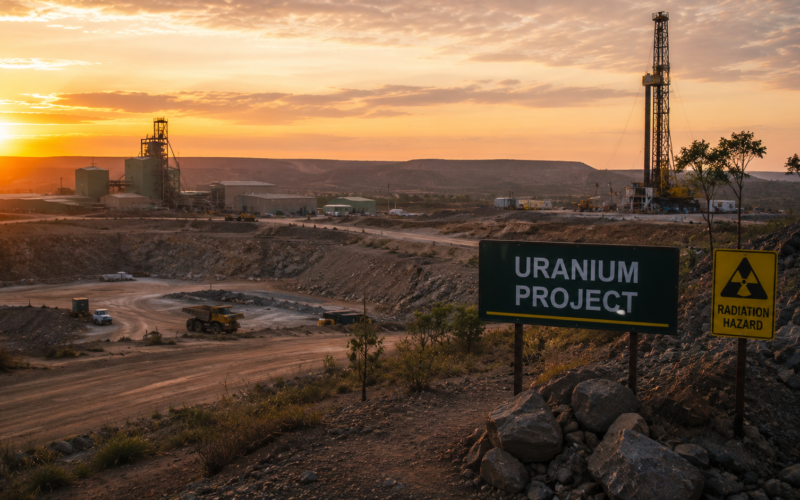
Australian uranium stocks climbed on 10 July 2026 after Australia and India finalised administrative arrangements to enable Australian uranium exports to India for peaceful nuclear energy use. Deep Yellow Limited (ASX: DYL), Boss Energy Limited (ASX: BOE), Bannerman Energy Limited (ASX: BMN), Alligator Energy Limited (ASX: AGE) and Paladin Energy Limited (ASX: PDN) traded higher as investors responded to a policy catalyst tied to India’s long-term nuclear energy buildout. The move matters because India is targeting a major expansion of nuclear generation capacity by 2047, while Australia holds a globally significant uranium resource base but has historically faced political and non-proliferation constraints in exporting to India. The immediate market reaction does not guarantee near-term contracts for every ASX uranium company, but it strengthens the long-duration demand narrative that has kept uranium equities firmly on retail and institutional watchlists.
Why did ASX uranium stocks rally after Australia and India finalised the uranium export pathway?
ASX uranium stocks rallied because the Australia-India uranium arrangement gave investors a fresh policy signal in a sector where demand visibility is often more important than short-term production volumes. Uranium equities do not usually move only on today’s spot price. They move on confidence that utilities, governments and fuel buyers will need reliable contracted supply over many years. India’s nuclear ambitions therefore matter to ASX uranium investors because they add another strategic buyer to a market already being reshaped by energy security, decarbonisation and geopolitical supply-chain concerns.
The immediate stock moves were broad. Deep Yellow Limited rose strongly, Boss Energy Limited also gained, Bannerman Energy Limited advanced, Alligator Energy Limited moved higher and Paladin Energy Limited joined the rally. That breadth matters because the announcement was not tied to one mine or one company contract. It was a sector-level signal that Australian uranium may become more relevant to India’s civil nuclear fuel strategy. Investors bought the theme first and will worry about the exact winners later, which is very on-brand for uranium trading.
The key distinction is that this is not the same as a signed offtake agreement for a specific ASX producer. The arrangement clears an administrative and diplomatic pathway, but commercial contracts, pricing, delivery schedules, safeguards compliance and utility procurement decisions still have to follow. That makes the rally understandable but not risk-free. The market is pricing a stronger long-term addressable market, not immediate earnings upgrades across the entire ASX uranium board.

How does India’s nuclear energy ambition change the demand story for Australian uranium companies?
India’s nuclear energy target changes the uranium demand story because it introduces a large, long-duration growth market that is seeking fuel diversity. India’s power system is under pressure from rising industrial demand, urbanisation, electrification and energy security needs. Nuclear energy remains a small share of India’s electricity mix, but New Delhi’s ambition to expand nuclear capacity toward 100GW by 2047 would require a much larger and more reliable fuel supply chain.
For Australian uranium companies, that creates a strategic tailwind. Australia is politically aligned with India through a broader Indo-Pacific framework, has uranium resources, and is actively trying to deepen trade ties beyond traditional commodity flows into China. Uranium supply therefore sits at the intersection of energy policy, strategic diplomacy and resource monetisation. This is exactly the kind of overlap markets tend to like, because it turns a commodity story into a government-backed security-of-supply story.
However, India’s demand ambition will not automatically translate into immediate revenue for ASX uranium producers. Nuclear plant construction is slow, fuel procurement is highly regulated, and buyers typically contract through long-term arrangements rather than chasing spot-market supply in a hurry. The demand signal is powerful because it improves the long-term contracting backdrop, but investors still need to separate policy direction from bankable sales. In uranium, the distance between a handshake and a delivery drum can be longer than traders prefer.
Why did Deep Yellow, Boss Energy, Bannerman Energy and Paladin Energy attract market attention?
Deep Yellow Limited attracted attention because it is one of the more visible ASX uranium developers and had one of the stronger moves in the sector during the session. The stock traded around A$1.47 during the rally, while recent market data placed its 52-week range near A$1.30 to A$2.97. That means Deep Yellow Limited is still well below its yearly high, giving traders room to argue that any strengthening in long-term uranium contracting sentiment could matter if project development milestones also improve.
Boss Energy Limited gained because it remains a closely watched Australian uranium name with exposure to the Honeymoon uranium project in South Australia. The stock traded around A$1.37 during the sector move, with a 52-week range near A$1.00 to A$3.92. The share-price context is important because Boss Energy Limited is still trying to rebuild investor confidence after earlier operational and planning concerns weighed heavily on sentiment. A policy-driven uranium rally helps the sector mood, but Boss Energy Limited still has to prove the operating case.
Paladin Energy Limited is a different kind of uranium exposure because it has a larger market profile and production-linked relevance through Langer Heinrich in Namibia. Paladin Energy Limited traded around A$10.17 during the move, with a 52-week range near A$6.03 to A$15.10. For investors, Paladin Energy Limited offers more direct leverage to global uranium market conditions than many earlier-stage developers, but the stock also tends to be judged more closely on production performance, costs, contracting and balance-sheet discipline. Bannerman Energy Limited and Alligator Energy Limited also gained as investors looked for broader ASX uranium exposure, including development-stage and exploration-linked options.
What does the Australia-India uranium agreement mean for Australia’s critical minerals diplomacy?
The Australia-India uranium arrangement matters because it extends the strategic minerals relationship beyond lithium, rare earths and critical minerals into nuclear fuel. Australia and India have been building a broader economic and security relationship, and uranium supply fits naturally into that framework because it combines energy security, emissions goals and Indo-Pacific strategic alignment. For Australia, the deal diversifies a resource export story that has often been heavily exposed to China. For India, it adds a trusted democratic supplier to a sensitive fuel chain.
The political symbolism is not small. India is not a signatory to the Nuclear Non-Proliferation Treaty, and that historically complicated Australian uranium exports. The new administrative arrangements therefore show that the two countries have found a framework they are comfortable presenting as compatible with peaceful-use safeguards. That is strategically important because nuclear fuel trade requires more than commodity economics. It requires government confidence, compliance architecture and diplomatic trust.
The risk is that symbolism can outrun commercial substance. Australian uranium companies will still need to compete against global suppliers, including established producers with existing customer networks and operating scale. India’s procurement decisions will likely be driven by reliability, price, safeguards, contract flexibility and long-term political comfort. ASX uranium names gained because the door is more open, but walking through that door will require contracts, not hashtags.
How should investors read the stock moves in Deep Yellow, Boss Energy and Paladin Energy?
Investors should read the stock moves as a sentiment upgrade for the uranium sector rather than a company-specific earnings reset. Deep Yellow Limited, Boss Energy Limited and Paladin Energy Limited each have different risk profiles, and the same policy catalyst does not affect them equally. Deep Yellow Limited is still valued around development-stage execution, Boss Energy Limited has operating credibility to rebuild, and Paladin Energy Limited is more exposed to production delivery and global contracting dynamics.
The 52-week context is useful. Deep Yellow Limited remains far below its 52-week high, Boss Energy Limited remains dramatically below its own 52-week high, and Paladin Energy Limited is also below its 52-week peak despite recovering from lower levels. That tells investors the uranium trade still carries scars from volatility, project risk and changing expectations. A single diplomatic catalyst can produce a sharp rally, but sustained rerating needs stronger evidence that uranium prices, contract volumes and project execution are moving in the same direction.
The expert assessment is that the market reaction is rational but incomplete. It makes sense for ASX uranium stocks to respond to a major potential demand source becoming more accessible. It does not make sense to assume every uranium company will benefit equally or immediately. The better investor question is which companies are closest to delivering reliable supply into a tightening long-term contract market. That is where the hype ends and the spreadsheet starts, which is less fun but usually more profitable.
What risks could limit the commercial benefit for ASX uranium companies?
The first risk is timing. Nuclear capacity expansion takes years, and fuel procurement follows strict regulatory and operational cycles. India’s 2047 target is strategically meaningful, but it does not imply a near-term surge in Australian uranium shipments. Utilities may phase purchases gradually, and contracts may favour suppliers with established operating records. That could make the immediate share-price reaction more powerful than the near-term revenue effect.
The second risk is company-level execution. Development-stage uranium companies still need permits, financing, technical validation, construction execution and reliable production plans. Even companies with existing or near-existing production exposure must manage costs, recoveries, grades and ramp-up performance. Uranium investors have seen enough false dawns to know that a strong policy backdrop cannot rescue weak project delivery. The market may cheer the macro story today, but it will punish operational disappointment tomorrow with surprising enthusiasm.
The third risk is political and safeguards complexity. Uranium is not iron ore. It is a controlled nuclear fuel material tied to international safeguards, bilateral agreements and end-use monitoring. Any delay in administrative implementation, regulatory approvals or buyer qualification could slow commercial outcomes. Australia’s uranium export opportunity to India is now clearer, but it remains inside one of the most regulated commodity supply chains in the world.
Why does the uranium deal fit into the broader ASX energy transition trade?
The uranium deal fits the broader ASX energy transition trade because nuclear energy is increasingly being treated as part of the clean firm-power toolkit. Renewable energy growth remains central to decarbonisation, but grids with high renewable penetration still need reliable low-emissions generation, storage, transmission and flexible backup. Nuclear power is controversial in Australia’s domestic politics, but uranium exports allow Australia to participate in global nuclear energy growth without building domestic reactors.
For ASX investors, uranium sits alongside copper, rare earths, lithium and grid infrastructure as a thematic exposure to electrification and energy security. The difference is that uranium demand is more policy-sensitive, more concentrated and more contract-driven. That makes the sector volatile, but also attractive during periods when governments appear to be leaning more heavily into nuclear power. The Australia-India arrangement gives uranium bulls another argument that demand is broadening beyond traditional Western and East Asian markets.
The forward-looking issue is whether the market now starts differentiating more aggressively between credible uranium producers and speculative uranium stories. If Indian demand becomes a real contracting theme, buyers will care about delivery reliability. That would favour companies with advanced projects, credible technical teams, financing pathways and clear regulatory status. In other words, the next phase of the uranium trade may become less about owning anything yellow and more about owning what can actually ship.
What are the key takeaways from the ASX uranium rally after the Australia-India deal?
- The Australia-India uranium arrangement gives ASX uranium investors a fresh policy catalyst tied to India’s long-term nuclear power expansion.
- Deep Yellow Limited, Boss Energy Limited, Bannerman Energy Limited, Alligator Energy Limited and Paladin Energy Limited rallied as traders priced in a stronger demand narrative.
- The deal supports the long-term uranium contracting backdrop, but it does not yet represent company-specific sales agreements.
- India’s target of scaling nuclear energy capacity toward 100GW by 2047 could create a major future fuel requirement.
- Australia’s uranium export pathway to India strengthens the strategic resources relationship between the two countries.
- Deep Yellow Limited and Boss Energy Limited remain well below their 52-week highs, showing that investor confidence is still recovering.
- Paladin Energy Limited offers larger, production-linked uranium exposure, but remains sensitive to operating delivery and global uranium pricing.
- The main risks are timing, safeguards complexity, project execution and the gap between diplomatic announcements and commercial contracts.
- The uranium sector’s next rerating phase will likely favour companies with credible supply pathways rather than purely thematic exposure.
- The broader ASX energy transition trade now has a stronger nuclear fuel angle, especially for investors tracking India’s energy security buildout.
Discover more from Business-News-Today.com
Subscribe to get the latest posts sent to your email.