
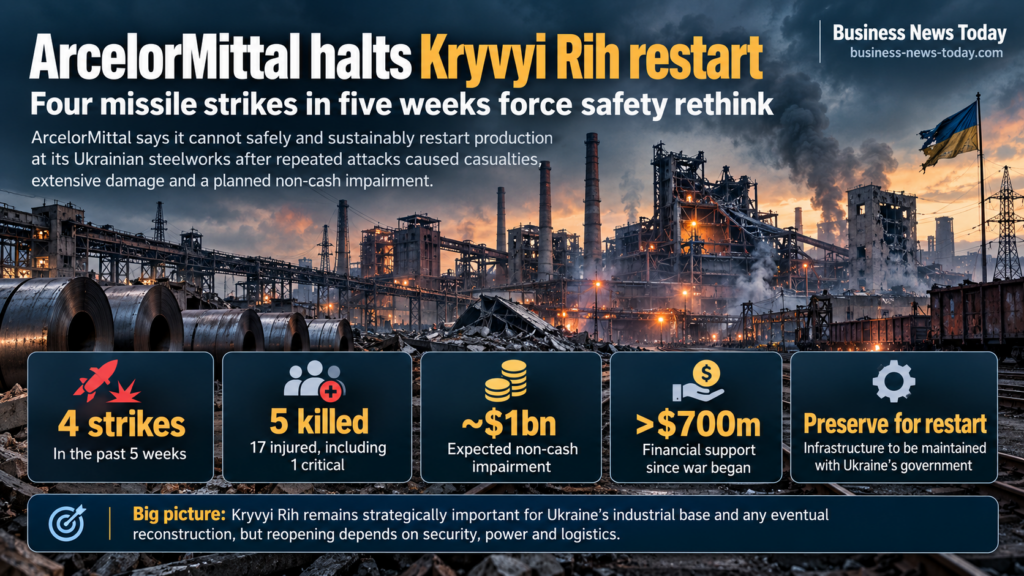
ArcelorMittal (Euronext Amsterdam: MT; NYSE: MT) has told the Ukrainian government it cannot safely and sustainably restart production at ArcelorMittal Kryvyi Rih after four missile strikes over five weeks caused extensive damage and killed five people. Another 17 employees were injured, including one who remained in critical condition when the company issued its September 25 statement. ArcelorMittal expects to record a non-cash impairment charge of approximately $1 billion, principally reflecting damage to property, plant and equipment.
The company is not abandoning the site outright. ArcelorMittal says it will work with Ukraine’s government to preserve infrastructure so that restarting the operation remains possible when security conditions permit. The group has already provided more than $700 million of financial support to its Ukrainian subsidiary since the war began, demonstrating both the strategic importance of the operation and the mounting economic burden associated with keeping it viable.
Why can ArcelorMittal no longer safely restart the Kryvyi Rih steelworks?
ArcelorMittal said the Ukrainian operation was struck four times during the previous five weeks, with the latest attack occurring on September 21. Those incidents caused casualties and extensive physical damage, leaving management unable to conclude that normal operations could resume safely and sustainably.
The plant had already experienced repeated disruptions since Russia’s full-scale invasion of Ukraine in February 2022, including power shortages, logistics problems and earlier strikes. Steelmaking facilities are particularly difficult to operate intermittently because blast furnaces, coke ovens, rolling mills and supporting utilities are designed around continuous industrial processes.
Damage to electricity, ironmaking or transport infrastructure can therefore affect much more than the equipment directly struck. A plant may require multiple interconnected systems to function before even one production line can operate reliably.
The human risk now appears to have overtaken the economics. Four attacks within five weeks create conditions in which repairing one section of the complex does not guarantee employees can return safely if further strikes remain possible.
What does the $1 billion ArcelorMittal impairment mean for investors?
An impairment reduces the accounting value of assets because management no longer expects them to generate the economic benefits previously assumed. ArcelorMittal says the approximately $1 billion charge will principally reflect reduced carrying value for property, plant and equipment at Kryvyi Rih.
Because the charge is non-cash, it does not represent a $1 billion payment leaving ArcelorMittal immediately. JPMorgan analysts cited by Reuters said they did not expect the impairment itself to affect group EBITDA, although operational losses from Ukrainian production could have some effect during the third and fourth quarters.
The economic cost is nevertheless real. Assets that once carried substantial productive value are now considered less recoverable under current conditions, while the company must continue spending money to preserve infrastructure and support employees without generating normal production revenue.
ArcelorMittal shares were still trading higher in Amsterdam during September 25 despite the announcement, according to market data, suggesting investors viewed the impairment as manageable relative to the scale of the global group and possibly already reflected some Ukraine risk in the valuation.
How important was Kryvyi Rih to Ukraine’s industrial economy before the shutdown?
ArcelorMittal Kryvyi Rih is Ukraine’s largest integrated steel operation and one of the country’s most important industrial employers. The site includes iron-ore extraction, coke production, steelmaking and rolling assets, giving it strategic importance well beyond the revenues of one corporate subsidiary.
Steel exports historically provided Ukraine with significant foreign-currency earnings while supporting construction, engineering, rail and manufacturing supply chains. War has sharply reduced that industrial capacity by damaging plants, disrupting ports and destroying energy infrastructure.
Kryvyi Rih’s difficulties therefore illustrate a broader problem for Ukraine’s economy. Heavy industry requires predictable energy, transportation and employee safety, all of which become exceptionally difficult to guarantee under repeated missile attacks.
Keeping the site intact for an eventual restart could matter greatly during reconstruction. Ukraine would need enormous quantities of steel for bridges, buildings, energy infrastructure and transport networks if security conditions eventually allow large-scale rebuilding.
Could the Kryvyi Rih shutdown tighten European hot-rolled coil supply?
JPMorgan analysts cited by Reuters said disruption to Ukrainian steel facilities could tighten European hot-rolled coil availability and potentially support prices.
Hot-rolled coil is used across automotive manufacturing, construction, machinery and other industrial applications. Europe has already experienced significant restructuring across its steel sector because of high energy costs, decarbonization expenditure and import competition.
Removing Ukrainian supply can therefore matter even if Kryvyi Rih represents a modest portion of total European consumption. Commodity markets price marginal supply, meaning reductions from several constrained producers can produce a larger effect than the size of any one facility might suggest.
Higher steel prices would potentially benefit competing producers while raising input costs for manufacturers. The actual impact will depend on inventories, imports and production levels across European mills.
Why has ArcelorMittal spent more than $700 million supporting the Ukraine operation?
The company appears to be preserving long-term option value despite severe near-term conditions. Kryvyi Rih contains infrastructure, mineral resources, employees and industrial capabilities that would be extremely expensive to recreate from nothing.
Leaving the site entirely could destroy that option. Equipment deteriorates without maintenance, skilled employees leave and infrastructure becomes harder to restore the longer a facility remains abandoned.
ArcelorMittal says its immediate strategy will therefore focus on preservation while it discusses the plant’s future with Ukraine’s government.
That approach recognizes that war economics and post-war economics can be radically different. An asset generating little value under continuing attacks could become strategically important when reconstruction begins.
The uncertainty is how long ArcelorMittal must carry preservation costs before that opportunity returns.
What would have to happen before ArcelorMittal Kryvyi Rih could reopen?
Security is the fundamental condition. The company must be able to operate without exposing employees to repeated strikes, and damaged facilities would then require engineering assessments and repairs before steel production could resume.
Energy reliability will also matter because integrated steelmaking consumes enormous quantities of electricity and fuel. Ukraine’s energy network has repeatedly been targeted, making stable industrial power another constraint even where production equipment remains intact.
Logistics provide a third requirement. Raw materials must reach the plant and finished steel must move toward customers through railways, roads and ports.
ArcelorMittal’s decision therefore leaves the plant suspended between closure and future recovery. The approximately $1 billion impairment recognizes today’s damaged economics, while preserving infrastructure keeps open the possibility that one of Ukraine’s most important industrial assets can operate again under fundamentally different security conditions.
Discover more from Business-News-Today.com
Subscribe to get the latest posts sent to your email.