Apollo Global Management Inc. is exploring strategic options for Energos Infrastructure, the 13-vessel floating liquefied natural gas platform it controls, in discussions that could value the company at more than $3 billion, according to Reuters, which cited people familiar with the private deliberations. The alternatives reportedly include a complete sale or a partial transaction, while XRG, the international investment arm of Abu Dhabi National Oil Company (ADNOC), has emerged among prospective buyers.
Reuters reported that a potential XRG proposal could involve acquiring as much as 50% of Energos. Apollo and XRG declined to comment, while Energos did not respond to Reuters’ request. The sources also cautioned that Apollo could ultimately retain the business, meaning the discussions do not represent an announced transaction or agreed valuation.
What does Energos Infrastructure actually own?
Energos is a Stamford, Connecticut-based owner and operator of floating LNG infrastructure.
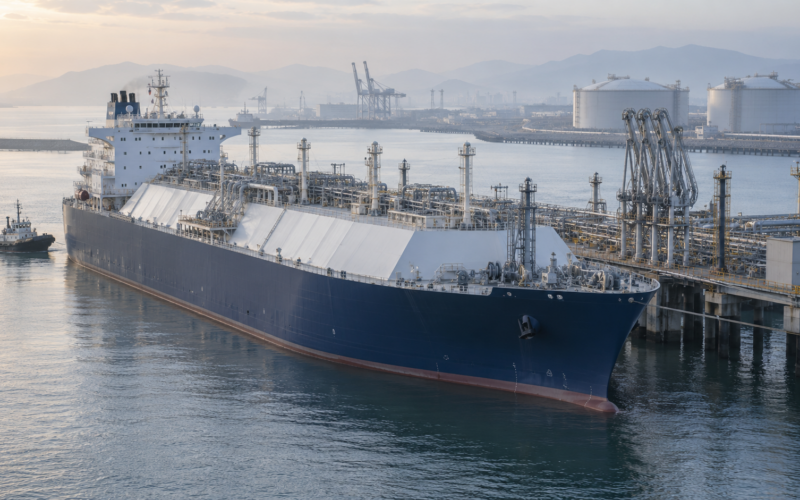
Its fleet consists of 13 vessels, including nine floating storage and regasification units, two floating storage units and two LNG carriers. The assets operate under long-term commercial arrangements across countries including Brazil, Egypt, Indonesia, Mexico and the Netherlands.
Floating storage and regasification units receive LNG from tankers, store the fuel and convert it from its supercooled liquid state back into natural gas before feeding it into pipelines. They can provide countries with LNG-import capacity much faster than conventional onshore terminals that may take several years and billions of dollars to construct.
That flexibility became particularly valuable after Russia’s invasion of Ukraine forced European countries to find alternatives to Russian pipeline gas. Floating terminals could be deployed more rapidly than permanent infrastructure, turning FSRUs into strategically important energy-security assets.
How did Apollo build Energos?
Apollo formed Energos with New Fortress Energy in 2022. New Fortress contributed LNG infrastructure assets while Apollo supplied institutional capital as the partners built a dedicated floating infrastructure business.
Apollo subsequently acquired New Fortress Energy’s remaining 20% interest in January 2024, giving the investment manager full control.
The current strategic review therefore comes after several years of ownership during which LNG infrastructure valuations benefited from rising demand for flexible import capacity. Apollo now has several possible routes to monetise that investment, ranging from selling the entire platform to bringing in a strategic minority partner while retaining exposure.
A valuation above $3 billion would also provide another reference point for increasingly scarce floating regasification assets.
Why is XRG interested in Energos?
XRG is Abu Dhabi National Oil Company’s international investment vehicle and has been instructed to build a much larger global natural gas, LNG and chemicals portfolio.
Reuters reported that XRG aims to create an integrated gas and LNG business with capacity of as much as 25 million tonnes annually by 2035. Energos would not itself provide liquefaction capacity, but its floating terminals would add an important downstream infrastructure layer capable of delivering LNG into importing markets.
XRG has already expanded aggressively during 2026. It acquired an additional 7.6% interest in two liquefaction trains at the Rio Grande LNG project in Texas and joined Eni in acquiring minority stakes in three Argentine upstream blocks connected with a proposed LNG development.
Energos would therefore fit an emerging pattern. XRG is assembling exposure across the LNG value chain rather than relying only on production inside the United Arab Emirates.
Why have floating LNG terminals become strategically valuable?
Energy security is the biggest reason.
Countries that lack pipeline gas need import terminals before they can receive LNG. Traditional land-based terminals provide significant capacity but require lengthy permitting, construction and major fixed investment.
FSRUs can often be deployed more quickly and can sometimes be relocated when demand changes. That creates optionality that fixed infrastructure cannot easily match.
Energos’ current deployments illustrate the global nature of that demand. One of its vessels, Energos Eskimo, operates at Ain Sukhna in Egypt and provides up to 750 million standard cubic feet per day of regasification capacity, helping strengthen gas supply to the Egyptian market.
Europe’s energy crisis demonstrated another use case when Germany and other countries rapidly deployed floating terminals after Russian pipeline supplies collapsed. Similar assets can support fast-growing emerging markets whose electricity systems require gas but cannot wait years for permanent terminals.
What could a sale mean for Apollo shareholders?
Apollo has increasingly expanded beyond conventional private equity into infrastructure, insurance-linked investing, private credit and long-duration assets. Energos fits that broader model because its vessels operate under contracted arrangements capable of producing relatively predictable cash flows.
Selling the business could crystallise value for Apollo-managed funds and recycle capital into new investments. A partial sale could achieve some monetisation while allowing Apollo to retain exposure to future LNG infrastructure demand.
The significance to Apollo Global Management shareholders will ultimately depend on which Apollo funds own the asset, the original invested capital and the final transaction valuation. Those economics have not been disclosed in Reuters’ report, preventing a reliable calculation of potential investment returns at this stage.
Could Apollo decide not to sell Energos?
The answer remains entirely dependent on the strategic process because Reuters’ sources explicitly said no transaction is one possible outcome. Apollo could conclude that bids fail to reflect the platform’s value, choose to sell only a minority position or retain Energos while LNG infrastructure demand continues growing.
Any future transaction would therefore require confirmation of a buyer, ownership percentage, valuation and financing structure.
What is already clear is why the asset attracts interest. Energos owns a scarce portfolio of floating infrastructure positioned between global LNG suppliers and countries that need gas quickly without committing immediately to permanent import terminals.
That combination of contracted cash flow, movable infrastructure and energy-security importance explains why a 13-vessel fleet can command discussion of a valuation above $3 billion.
Discover more from Business-News-Today.com
Subscribe to get the latest posts sent to your email.