



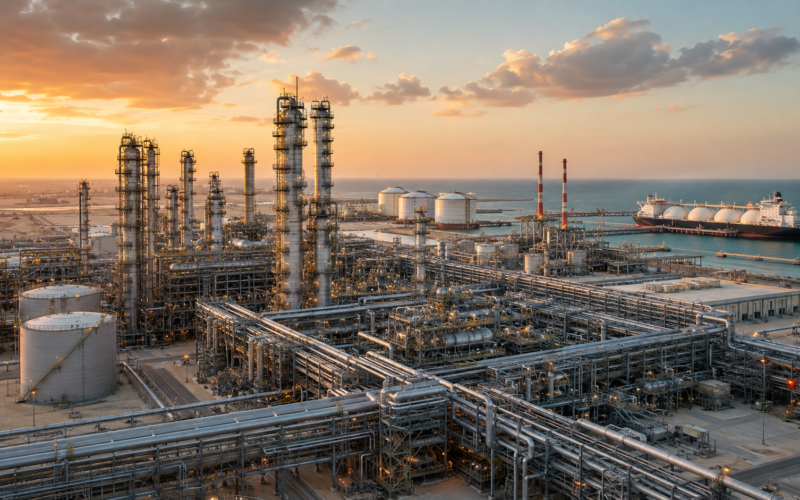
ADNOC Gas plc (ADX: ADNOCGAS) has taken final investment decisions on Phases 2 and 3 of its Rich Gas Development project and awarded $8.2 billion of engineering, procurement and construction contracts, increasing total committed investment across the three-phase programme to $13.2 billion. Wison Engineering will receive $3.9 billion to build a new natural gas processing train at Habshan, while Tecnimont has secured $4.3 billion for a new natural gas liquids fractionation train at Ruwais. ADNOC Gas has simultaneously raised its target for EBITDA growth to approximately 60% by 2030 compared with 2023, materially above its previous objective of more than 40% growth through 2029. The decision comes immediately after second-quarter net income fell 52% year on year to $665 million as disruption in the Strait of Hormuz constrained exports of LNG, LPG and naphtha. The strategic tension is therefore unusually clear: ADNOC Gas is committing billions of dollars to process and monetise substantially more gas just as geopolitical disruption has demonstrated that producing higher-value export volumes does not guarantee they can always reach international customers.
How does the $13.2 billion Rich Gas Development programme change ADNOC Gas’ growth profile?
Rich Gas Development has become the largest capital investment undertaken by ADNOC Gas and is no longer simply a debottlenecking programme around existing facilities. Phase 1, approved in June 2025 with approximately $5 billion of contracts, covers upgrades and expansion work across Habshan, Asab, Buhasa and Das Island. Phases 2 and 3 move the programme further by adding entirely new processing and fractionation trains at two strategically important sites.
The progression changes what investors are being asked to underwrite. Phase 1 largely focuses on extracting more throughput and efficiency from infrastructure already in place, while the later phases add new physical capacity capable of processing higher upstream gas volumes and recovering more valuable liquids. ADNOC Gas expects those additional feedstock volumes to emerge as parent company ADNOC expands associated and non-associated gas production across developments including Bab Gas Cap and Umm Shaif Gas Cap.
The $8.2 billion awarded for Phases 2 and 3 alone is equivalent to roughly 29% of ADNOC Gas’ planned $28 billion investment envelope for 2026 through 2030. That comparison does not mean the contracts will translate into $8.2 billion of cash spending immediately, but it demonstrates how central Rich Gas Development has become to the company’s next growth cycle. Management is effectively concentrating a substantial part of its capital programme around the assumption that higher ADNOC feedstock volumes can be converted into domestic gas, petrochemical feedstock and exportable liquids at attractive margins.

Why is the new Habshan processing train central to ADNOC Gas’ 2030 EBITDA target?
Phase 2 will add a new natural gas processing train at Habshan under a $3.9 billion EPC contract awarded to Wison Engineering. Habshan is already one of the core processing centres in ADNOC Gas’ system, and the additional train is intended to increase processing capacity, improve operating flexibility and support rising downstream and petrochemical demand in the United Arab Emirates.
The economic logic begins upstream. ADNOC is pursuing higher crude-production capacity and developing additional gas resources, which produces more associated and non-associated gas requiring processing before it can enter pipelines, petrochemical facilities or export chains. Additional processing capacity allows ADNOC Gas to capture value from volumes that could otherwise become constrained by existing plant limits.
Habshan also illustrates why infrastructure resilience has become as important as nameplate capacity. Security-related incidents at the complex on April 3 and April 8 disrupted operations, although ADNOC Gas said gas supply had already recovered to 85% by August, surpassing the year-end recovery target announced earlier. The rapid restoration is encouraging, but the incidents show that concentrating significant processing infrastructure at strategically important sites creates operational exposure alongside scale advantages.
The new train therefore needs to create more than incremental throughput. It must increase redundancy and operational flexibility sufficiently to make the wider network better able to accommodate maintenance, disruptions and rising feedstock volumes. If it achieves that objective, Phase 2 could strengthen both earnings capacity and reliability rather than simply increasing the amount of gas the system can theoretically process.
Why could the $4.3 billion Ruwais NGL project generate higher-value growth than gas volumes alone?
Phase 3 shifts the focus from processing raw gas to extracting greater value from the hydrocarbons contained within it. Tecnimont will build a new natural gas liquids fractionation train at Ruwais under a $4.3 billion EPC contract, allowing ADNOC Gas to recover larger volumes of higher-value liquids from rich gas streams.
Natural gas liquids can include products that feed petrochemical and industrial markets or are sold internationally. Increasing their recovery can improve the economic value generated from each unit of rich gas processed because ADNOC Gas is not limited to selling the methane component as domestic sales gas. The Ruwais investment therefore supports a broader product mix and strengthens the connection between upstream gas production, petrochemical development and export markets.
That higher-value exposure also explains why the Strait of Hormuz disruption matters so much. ADNOC Gas’ second-quarter weakness was not driven primarily by an inability to produce gas for the domestic market. Export liftings of LPG, naphtha and LNG were constrained by maritime disruption, preventing the company from fully monetising international products even as energy prices were elevated.
Phase 3 can therefore expand margins only if logistics infrastructure and export routes remain sufficiently reliable. Producing more NGLs at Ruwais raises potential earnings, but geopolitical disruption can turn valuable inventory into temporarily stranded working capital. This makes export resilience an increasingly important part of the investment case for a company expanding precisely the products most exposed to international shipping.
Why did ADNOC Gas profit fall 52% when energy prices were unusually strong?
ADNOC Gas reported second-quarter net income of $665 million, down from approximately $1.39 billion a year earlier. The decline occurred despite an average Brent crude price of about $104 per barrel during the quarter, illustrating that high commodity prices cannot compensate when physical sales are constrained.
The closure and disruption of maritime routes through the Strait of Hormuz restricted liftings of LNG, LPG and naphtha throughout the period. These products normally provide ADNOC Gas with international exposure and can benefit from stronger commodity-price realisations, but the company could not fully capture those conditions because export movements were disrupted.
The $665 million result nevertheless exceeded management’s earlier guidance range of $400 million to $600 million. That outperformance was supported by the domestic gas business, which continued supplying industrial, utility and other customers within the United Arab Emirates. Reuters reported that around $1 billion of ADNOC Gas’ approximately $1.7 billion first-half net income came from domestic customers, highlighting the stabilising role of the home market during the export disruption.
This is one of the most important conclusions from the quarter. ADNOC Gas has often been viewed partly through the lens of international LNG and liquids growth, but the domestic gas franchise acted as the earnings anchor when shipping conditions deteriorated. Rich Gas Development may therefore create a more resilient financial outcome if incremental volumes can be balanced between domestic consumption, petrochemical feedstock and international exports rather than depending excessively on one destination.
Can domestic UAE gas demand provide a stable earnings floor while export markets remain disrupted?
ADNOC Gas supplies approximately 60% of the United Arab Emirates’ sales gas requirements, giving it a large internal market that is structurally different from the international LNG and liquids business. Domestic demand is tied to electricity generation, industrial development and petrochemical activity, which means gas can be monetised without every molecule passing through an international shipping route.
That distinction became financially visible during the second quarter. The company’s domestic franchise continued generating resilient margins while export liftings were constrained, allowing net income to remain above guidance despite one of the most difficult maritime environments the business has faced since listing.
Longer term, industrial expansion could strengthen the domestic side further. The Rich Gas Development programme is explicitly designed to support the country’s expanding downstream and petrochemical sectors, while projects such as MERAM and Estidama are intended to increase gas monetisation and transmission capability elsewhere in the value chain. ADNOC Gas is therefore building infrastructure against both international demand and a growing captive domestic economy.
Domestic demand cannot completely insulate shareholders from export disruption because LNG, LPG and NGL sales remain economically important. It does, however, make ADNOC Gas fundamentally different from an export-only LNG developer whose earnings can be severely impaired if marine access disappears. The second quarter effectively stress-tested that diversification and showed that the domestic franchise can absorb part, but not all, of the shock.
What does the new 60% EBITDA growth target imply about ADNOC Gas’ capital allocation?
ADNOC Gas previously targeted more than 40% EBITDA growth between 2023 and 2029. Following the final investment decisions on Rich Gas Development Phases 2 and 3, it now targets approximately 60% growth by 2030 versus the 2023 base year. Management expects to invest about $28 billion between 2026 and 2030 to deliver that ambition.
The target is a management forecast rather than guaranteed earnings. Achieving it requires multiple large projects to move from engineering and construction into reliable operation, sufficient upstream gas to reach the processing system, domestic and international customers to absorb additional products, and realised margins that support the projected uplift. Delays in any one megaproject may not derail the full plan, but simultaneous schedule or cost pressure across several projects would materially increase the execution burden.
ADNOC Gas is also attempting to preserve shareholder distributions while funding this programme. The board approved a $940 million quarterly dividend payable in September and reaffirmed a policy targeting 5% annual dividend growth through 2030. That creates a capital-allocation framework in which rising investment must coexist with progressively higher distributions rather than temporarily replacing them.
The combination can work if project cash flows arrive on schedule and operating earnings normalise after the current disruption. It becomes more difficult if geopolitical constraints persist, because the company would then be funding a larger construction programme while export earnings remain below their potential. The quality of the 60% growth target will therefore be judged not only by eventual EBITDA but by the amount of incremental capital required to reach it.
How do Ruwais LNG, MERAM and Estidama reduce dependence on one growth project?
Rich Gas Development is only one of four megaprojects underpinning ADNOC Gas’ expansion plan. Management also identifies Ruwais LNG, Maximizing Ethane Recovery and Monetization, known as MERAM, and the Estidama pipeline programme as major growth platforms. Together, the four programmes are expected by the company to generate approximately $13.4 billion of In-Country Value for the United Arab Emirates.
MERAM is expected to be delivered in 2027 and is intended to increase recovery and monetisation of ethane. Estidama expands gas-transmission infrastructure, while Ruwais LNG introduces additional liquefaction capacity and a new export platform. These assets occupy different positions in the gas value chain, reducing the risk that ADNOC Gas’ entire growth strategy depends on one processing plant or one product.
The portfolio also creates internal dependencies. New upstream volumes need processing capacity, processed gas requires transmission infrastructure, NGLs require fractionation and export capability, and LNG capacity requires reliable feed gas. Delays in one part of the chain can therefore affect utilisation elsewhere even when individual projects remain technically successful.
That interconnected structure is why execution quality matters more than simply adding up headline project values. ADNOC Gas can create substantial operating leverage if the assets enter service in the right sequence. Poor sequencing could leave expensive infrastructure waiting for feedstock or downstream capacity, reducing early returns on invested capital.
What does ADNOC Gas’ latest share price say about investor reaction to the profit fall and growth plan?
ADNOC Gas’ own market display showed a last price of approximately AED 3.40 for August 10, while Reuters reported a delayed quote around AED 3.43 earlier in the trading session. Using the company-displayed AED 3.40 reference provides a market capitalisation of roughly AED 262 billion based on available market data.
At AED 3.40, the shares were approximately 0.6% below the July 10 close of AED 3.42 and about 9.6% below the 52-week high of AED 3.76. They remained approximately 9% above the 52-week low of AED 3.12. The relatively contained price reaction is notable given that quarterly net income fell by more than half, suggesting investors were weighing the profit decline against the above-guidance result, faster Habshan recovery and upgraded long-term growth target.
The stock is also supported by its dividend profile. ADNOC Gas remains the largest dividend payer on the Abu Dhabi Securities Exchange and has committed to annual dividend growth through 2030, giving shareholders a current-return component while they wait for the capital programme to mature.
The valuation question will become more demanding as capital spending rises. A stable share price during disruption indicates confidence in the underlying franchise, but a sustained rerating will likely require evidence that $28 billion of investment is producing measurable earnings growth rather than simply expanding the asset base.
Why does the Strait of Hormuz remain the biggest external challenge to the 2030 growth thesis?
ADNOC Gas expects third-quarter net income of between $600 million and $800 million under an assumption that maritime routes through the Strait of Hormuz remain disrupted. For the full year, the company expects net income of $3.5 billion to $4 billion if maritime operations are fully restored during the fourth quarter and pricing realisations normalise. Those forecasts remain explicitly conditional on geopolitical and logistical developments outside management’s direct control.
The vulnerability is particularly relevant because Phase 3 of Rich Gas Development is designed to increase recovery of liquids for export. Higher upstream production and more sophisticated fractionation therefore increase the commercial value potentially exposed to shipping disruption unless alternative logistics routes or customer structures reduce dependence on the Strait.
Chief Executive Officer Fatema Al Nuaimi said the company was examining alternatives in response to the continuing situation, although she did not disclose specific measures. That makes export resilience a potentially significant future investment theme alongside the processing expansion itself.
The core strategic issue is not whether geopolitical disruption will last permanently. It is whether ADNOC Gas can design a growth portfolio capable of continuing to generate acceptable returns when periodic interruptions occur. The second quarter showed that domestic gas provides meaningful protection, but it also showed that export-heavy growth carries risks that cannot be solved by higher processing capacity alone.
What are the key takeaways from ADNOC Gas’ $13.2 billion Rich Gas Development programme?
- ADNOC Gas has taken final investment decisions on Phases 2 and 3 of Rich Gas Development and awarded $8.2 billion of new EPC contracts.
- Total investment across all three Rich Gas Development phases has reached $13.2 billion, making it ADNOC Gas’ largest capital programme.
- Wison Engineering will deliver a $3.9 billion natural gas processing train at Habshan, while Tecnimont will build a $4.3 billion NGL fractionation train at Ruwais.
- ADNOC Gas has raised its targeted EBITDA growth to approximately 60% by 2030 versus 2023, compared with its previous target of more than 40% through 2029.
- The company expects to invest approximately $28 billion between 2026 and 2030 across its wider growth programme.
- Second-quarter net income fell 52% to $665 million because Strait of Hormuz disruption constrained LNG, LPG and naphtha exports.
- The $665 million result still exceeded management’s previous $400 million to $600 million guidance range.
- Gas supply from the Habshan complex has recovered to 85%, ahead of the year-end recovery target previously communicated by management.
- Around $1 billion of ADNOC Gas’ approximately $1.7 billion first-half net income came from domestic customers, demonstrating the stabilising value of the UAE gas business.
- Project execution, export-route normalisation and the conversion of new processing capacity into higher earnings are the main tests of the 2030 growth thesis.
Can ADNOC Gas turn $28 billion of investment into 60% EBITDA growth without export risk consuming the upside?
ADNOC Gas has strengthened the industrial logic behind its long-term expansion. Rich Gas Development now has all three phases committed, upstream ADNOC projects are preparing additional feedstock, the domestic market continues to absorb large gas volumes and complementary investments across LNG, ethane recovery and pipelines provide several routes for monetising higher production. The 85% Habshan recovery also shows that the operating system is recovering faster than management initially expected after the April incidents.
What remains unresolved is whether the commercial system can become as resilient as the processing system. The second quarter demonstrated that ADNOC Gas can continue generating substantial profit when exports are constrained, but it also showed how much earnings potential can disappear when LNG and liquids cannot move normally through the Strait of Hormuz. The $13.2 billion Rich Gas Development programme increases the amount of gas and higher-value liquids the company should eventually be able to process, making export flexibility more important rather than less important.
The next measurable evidence will come from three areas: continued Habshan restoration, progress toward normal maritime liftings and visible construction milestones across the newly sanctioned processing and fractionation trains. If these arrive while dividends continue growing and the wider project portfolio remains on schedule, ADNOC Gas can begin translating its 60% EBITDA target from management ambition into an increasingly visible earnings pathway. Persistent maritime disruption, further project cost inflation or delays in converting ADNOC’s upstream growth into usable feedstock would make the same capital programme substantially harder to justify.
Discover more from Business-News-Today.com
Subscribe to get the latest posts sent to your email.

