


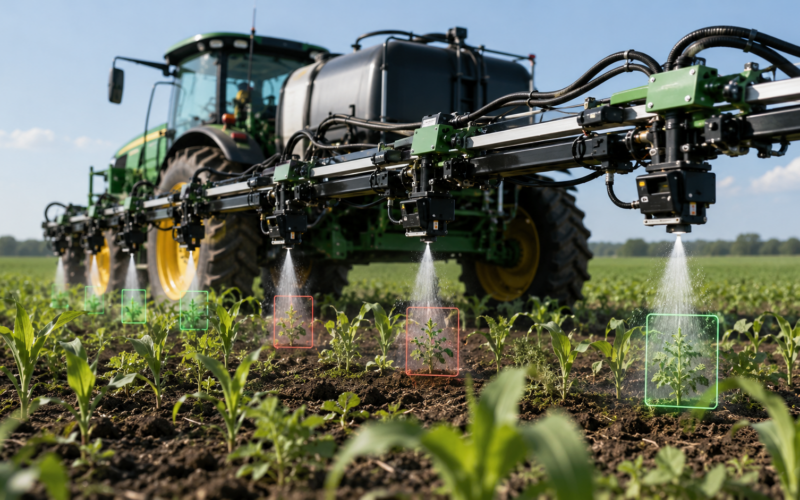
A traditional broadcast herbicide pass treats the selected swath of a field whether every part of that ground contains weeds or not. AI-powered precision spraying changes the decision from whether an entire field needs treatment to whether a particular patch, weed or even individual plant should receive chemical.
That distinction is already moving beyond demonstration plots. Deere & Company (trading as John Deere) says its See & Spray technology was used across more than five million acres during the 2025 growing season. Across that commercial usage, Deere reported that customers reduced non-residual herbicide use by nearly 50% on average and avoided applying close to 31 million gallons of herbicide mixture. Those are Deere-reported operating figures rather than independently audited industry averages, but the acreage demonstrates that machine-vision spraying has already reached meaningful commercial scale.
At the other end of the precision spectrum, Swiss agricultural technology company Ecorobotix said in March 2026 that 1,000 of its ARA ultra-high-precision sprayers had been deployed worldwide. ARA treats areas measuring approximately 6 centimetres by 6 centimetres, allowing applications to be aimed at individual plants. Ecorobotix says its systems are operating in more than 30 countries and can reduce herbicide use by as much as 95% in suitable applications. Those maximum savings remain manufacturer claims and vary with crop, weed pressure and treatment strategy.
CNH Industrial is commercialising another architecture through Case IH and New Holland. SenseApply technology uses real-time cameras and artificial intelligence for selective spraying and variable-rate applications, while New Holland’s IntelliSense Sprayer Automation uses a forward-looking multispectral camera mounted above the cab. The result is not one universal precision-spraying design but an emerging industry in which machinery manufacturers are deciding how much vision, computing and nozzle-level control farmers actually need.
How do AI precision sprayers identify weeds while moving through a field?
The basic system combines cameras, onboard processors, machine-learning models and electronically controlled spray nozzles.
As the sprayer moves, cameras continuously capture images of the field. Software identifies vegetation and determines whether the plant or patch matches what the system has been trained to treat. The controller then activates only the appropriate nozzle or spray zone instead of continuously spraying the full boom width.
The technical difficulty increases sharply once crops emerge. Green-on-brown systems mainly need to identify vegetation against soil or residue and are already well suited to fallow spraying. Green-on-green systems have to distinguish a weed from a crop when both may be similar colours, partly overlapping and moving in wind.
Deere’s latest See & Spray material says its boom-mounted camera and processing system can scan more than 2,500 square feet per second while operating at speeds of up to 15 miles per hour. Current See & Spray Gen 2 can differentiate in-season crops from weeds and also use detected biomass variation for real-time variable-rate prescriptions.
Ecorobotix uses a different operating model. Its Plant-by-Plant AI analyses images and triggers treatment within about 250 milliseconds, while the ARA platform concentrates application into a 6 × 6 centimetre footprint. That makes the architecture particularly relevant to vegetables and other high-value crops where plants are closely spaced and manual weed removal can be expensive.
The sprayer is consequently becoming less like a passive liquid-distribution machine and more like a computer-vision platform whose physical output happens to be agricultural chemistry.

How much herbicide can AI precision spraying actually save?
There is no single credible percentage for the entire industry because savings depend heavily on weed density and the application being replaced.
Deere’s See & Spray Select, designed primarily for targeted treatment in fallow ground, currently advertises average herbicide savings of 77%. Deere separately says its broader 2025 customer usage produced nearly 50% average savings in non-residual herbicide across more than five million acres. The commercial acreage figure is arguably the more useful benchmark because it captures a much wider variety of real operating conditions.
Ecorobotix reports potential herbicide reductions of up to 95%, reflecting ARA’s much smaller treatment footprint. The figure is plausible as a best-case targeted-spraying outcome but should not be read as meaning every ARA customer routinely uses 95% less herbicide.
Independent agricultural research reinforces why results vary. University researchers studying targeted spraying have found that economics change substantially with weed pressure, chemistry choices and whether residual as well as post-emergence herbicides are selectively applied. Arkansas Agricultural Experiment Station research found the highest return in its evaluated See & Spray programmes when both residual and post-emergence chemistries were targeted rather than assuming one universal spraying strategy.
The commercial arithmetic can nevertheless become substantial. If a grower spends $25 per acre on a non-residual herbicide application across 5,000 acres, a 50% reduction in treated area represents $62,500 of avoided chemical expenditure before technology charges, depreciation and other operating costs.
The value of the camera is therefore ultimately measured in what does not leave the spray tank.
Can precision spraying reduce farm labour costs as well as chemical use?
In specialty crops, labour may be an even larger opportunity than herbicide savings.
Ecorobotix reported a 2026 demonstration near Los Banos, California, involving cotton fields with heavy populations of glyphosate-resistant weeds. Its comparison conventional programme included a $30.15-per-acre broadcast chemical treatment plus two manual chopping passes costing $260 per acre each, producing total weed-management expenditure of $550.15 per acre.
The ARA programme used two targeted chemical applications and was reported at $184.07 per acre. Ecorobotix therefore calculated approximately $366 per acre, or 67%, lower weed-management cost, with reported weed control of 90% to 99% and estimated herbicide-use reductions of 60% to 90%.
Those numbers require an important qualification. This was an Ecorobotix field demonstration, not an independent randomized economic study, and most of the apparent saving came from replacing expensive hand-chopping labour rather than herbicide reduction alone.
That qualification also explains why precision spraying could have very different adoption economics across agriculture. A broadacre grain farmer may justify the technology mainly through chemical savings and spraying capacity. A high-value vegetable or cotton grower facing expensive manual weed control may value labour substitution just as highly.
How are Deere, CNH Industrial and Ecorobotix approaching precision spraying differently?
Deere is designing around enormous broadacre machines capable of treating thousands of acres during narrow seasonal windows. Its systems integrate computer vision with existing sprayers, nozzle-control technology and the John Deere Operations Center, while eligible older machines can also receive See & Spray Premium through a precision upgrade rather than requiring replacement of the entire sprayer. Deere currently offers the upgrade for selected model-year 2018 and newer machines with 120-foot booms.
CNH Industrial is pursuing a different sensing architecture. New Holland’s IntelliSense Sprayer Automation uses a single cab-mounted multispectral camera that looks as far as 50 feet ahead across the boom width. Green-on-brown selective spraying can operate at speeds up to 19 mph, while variable-rate functions based on crop biomass can operate at up to 25 mph. Those variable-rate modes can adjust nitrogen, fungicide, plant-growth regulator, harvest-aid and other applications rather than limiting the system to weed control.
Case IH SenseApply is commercially available as factory-fit technology and as a retrofit kit. CNH describes it as its first factory-fit automated crop-sensing system and has integrated the technology with its FieldOps digital platform.
Ecorobotix is focused more heavily on ultra-high precision. Its ARA platform is tractor-mounted rather than a giant self-propelled broadacre machine, and the 6 × 6 centimetre spray footprint makes individual-plant treatment its central proposition. The company passed 1,000 deployed ARA units in March 2026 and is investing $50 million over three years in U.S. expansion, including assembly in Lyons, Kansas, through manufacturing partner KMW.
These different architectures suggest that precision spraying will not converge around one machine. Broadacre grains, fallow land and high-value vegetables require different combinations of speed, treatment resolution, boom width and capital intensity.
Could AI precision spraying change how farmers choose herbicides?
The impact on crop-protection suppliers could be more complicated than simply selling fewer litres.
When chemicals are broadcast across an entire field, expensive active ingredients face a strong economic disadvantage. If a system sprays only the patches containing target weeds, the cost of chemistry per treated acre matters differently because the treated area may shrink substantially.
Deere explicitly presents that choice to customers: growers can retain the savings generated by targeted spraying or reinvest part of those savings in more sophisticated tank mixes.
That creates a potential shift in crop-protection economics. Precision spraying could reduce volume demand for some broad-use non-residual herbicides while making premium chemistries, alternative modes of action or potentially biological products more affordable when they are applied to only a fraction of the field.
The technology does not solve herbicide resistance by itself. Poorly designed programmes can still select for resistant weeds, and missed weeds remain an agronomic risk. The important change is that the farmer gains more flexibility over where expensive chemistry is economically practical.
If that model scales, crop-protection companies may eventually compete not only on price per litre but on value per accurately treated plant.
Is farm machinery becoming a recurring software business?
Precision spraying is also changing how agricultural machinery can be monetised.
Deere offers See & Spray Premium through a usage-based structure tied to acres where the technology avoids spraying. The manufacturer therefore participates economically when the machine identifies field area that does not require chemical rather than earning revenue solely when the farmer purchases the sprayer.
This is a meaningful departure from the traditional agricultural-equipment model. Historically, most value was captured through sale of the tractor, sprayer, parts and maintenance. Vision systems, algorithms and connected farm platforms create the possibility of recurring technology revenue throughout the machine’s operating life.
Retrofits strengthen that model further. A farmer with an eligible existing sprayer does not necessarily need to buy an entirely new machine to adopt computer vision. CNH Industrial likewise offers SenseApply as both factory-fit and retrofit technology.
The commercial battle could therefore extend beyond who sells the best sprayer. Manufacturers increasingly need to prove that their algorithms identify enough untreated area, operate across enough crops and generate enough recurring savings to keep farmers inside their digital ecosystem.
What are the biggest technical limitations of AI weed sprayers?
Agricultural fields are difficult environments for computer vision.
Weeds appear at different growth stages and under different lighting conditions. Crop leaves overlap. Dust can cover cameras. Residue can obscure plants. Drought changes appearance, shadows move and unfamiliar weeds may not be represented sufficiently in training data.
Ecorobotix’s dependence on crop-specific algorithms illustrates the challenge. Its current platform supports more than 30 crop algorithms, while company material says its technology can recognise more than 40 weed species. The company is working with universities and local partners as it expands in the United States because algorithms have to reflect regional cropping systems and weed populations.
Detection is only the first problem. The sprayer also has to place the chemical accurately after recognising the weed. Boom movement, machine speed, wind and plant motion can all affect the relationship between what the camera sees and where the droplet ultimately lands.
False negatives are particularly important. Missing a healthy area means saving herbicide; missing a weed means leaving a competing plant capable of growing, reproducing or developing resistance problems.
That makes machine-learning accuracy an agronomic variable rather than merely a software benchmark.
Will AI precision sprayers eventually replace broadcast spraying?
Probably not, because many agricultural inputs are intentionally applied across most or all of a crop.
Residual herbicides may need broader soil coverage before weeds emerge. Fungicides can be applied to protect crop tissue. Nutrients and plant-growth regulators may be managed according to crop biomass rather than whether one isolated weed is present.
Modern spraying systems are therefore becoming multi-mode rather than purely selective. CNH’s architecture combines spot spraying with Base + Boost and variable-rate functions. Deere systems can combine targeted applications with broader treatments and, depending on machine configuration, use separate tanks during the same field pass.
The disruption is not the elimination of broadcast application.
It is the elimination of the assumption that every chemical application needs to treat every square metre equally.
Could plant-by-plant spraying change the economics of farming?
The technology has already crossed the point where it can be dismissed as a laboratory demonstration.
Deere reports more than five million acres of See & Spray use in one growing season. Ecorobotix has deployed 1,000 ARA machines globally. CNH Industrial has moved SenseApply into commercially available Case IH equipment and model-year 2026 New Holland sprayers.
The deeper change is the resolution at which agricultural decisions are being made.
For generations, farmers managed chemistry largely at the field level. GPS and variable-rate technology divided fields into zones. Computer vision can now push treatment decisions toward individual weeds and plants.
That changes several economic relationships simultaneously. Farmers can purchase less non-residual herbicide when weed pressure is sparse. A tank can cover more ground before refilling. Specialty-crop growers may reduce manual weed-control labour. More expensive chemistries can become practical when only a fraction of the field receives them, while machinery manufacturers gain recurring revenue opportunities from software and algorithms.
The barriers remain substantial. Equipment is expensive, recognition systems need crop-specific training, field conditions are unpredictable and broad application remains necessary for many treatments. Maximum supplier-reported chemical savings should not be mistaken for universal farm outcomes.
Yet the direction is increasingly clear.
The next generation of spraying equipment will not simply control how much chemical moves through a boom.
It will decide, hundreds or thousands of times during every pass, whether anything beneath that boom needs to be sprayed at all.
Discover more from Business-News-Today.com
Subscribe to get the latest posts sent to your email.