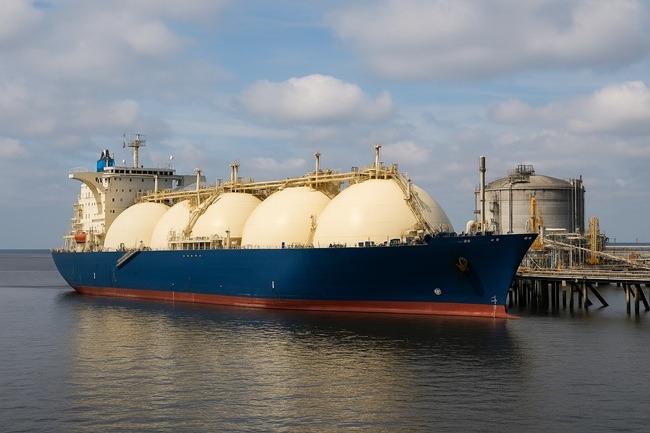
ADNOC Logistics & Services plc (ADX: ADNOCLS) has ordered four 175,000-cubic-meter LNG carriers from Jiangnan Shipyard for approximately $900 million, equivalent to AED3.3 billion. The vessels will be constructed in Shanghai and delivered in 2029. The order expands the company’s LNG newbuild program to 18 ships and lifts its fleet commitments since 2022 to more than $5 billion across 32 vessels. ADNOC Logistics & Services expects the four carriers to receive long-term charters, although no counterparty, charter duration or contracted return has been disclosed. The strategic case depends on matching new shipping capacity with ADNOC’s expanding LNG marketing platform while protecting returns against a large global vessel orderbook.
What does ADNOC Logistics & Services gain from ordering four more LNG carriers?
The immediate gain is additional control over the transport capacity needed to connect future LNG supply with customers in Asia, Europe and other growth markets. Each carrier can transport 175,000 cubic meters, placing the ships within the standard large-vessel category used across major liquefaction and receiving terminals. At an average order value of approximately $225 million per vessel, the commitment is significant enough to require long-term utilization rather than occasional exposure to the spot market.
ADNOC Logistics & Services is also building repeatable operating scale. The company has already received six LNG carriers of the same stated capacity from Jiangnan Shipyard under a previous $1.2 billion program. Five entered ADNOC Gas charters from May 2026, with four contracted for 15 years and one for seven years. Repeating a vessel series with an existing shipyard can reduce design-interface risk, improve crew familiarity and simplify maintenance, spare-parts management and technical supervision across the fleet.
The order nevertheless increases the capital tied to one shipping segment. The previous six Jiangnan vessels averaged about $200 million each, compared with approximately $225 million for the new quartet, although differences in specification, equipment, delivery timing and inflation prevent a direct price comparison. ADNOC Logistics & Services must therefore demonstrate that operating efficiency and charter quality compensate for the higher headline investment per ship.
Why does the 2029 delivery window align with ADNOC’s global LNG expansion strategy?
Delivery in 2029 places the four ships behind the company’s current wave of contracted capacity. Eight additional LNG carriers are already under construction at Samsung Heavy Industries and Hanwha Ocean for delivery from 2028. Those vessels carry a combined investment value of about $2.5 billion and have 20-year time charters with ADNOC Gas. The four Jiangnan vessels would arrive as that initial expansion is being absorbed into operations, reducing the risk of introducing the entire program at once.
The timing also supports ADNOC’s recently launched global LNG marketing and trading platform, which targets 47 million tonnes per annum of combined marketable LNG by 2035. Shipping capacity is essential to that model because a larger marketing portfolio requires control over cargo scheduling, destination flexibility and voyage economics. Vessel ownership can protect access during tight freight markets and allow the wider ADNOC group to capture part of the transport margin instead of transferring it entirely to third-party shipowners.
The broader fleet program extends beyond LNG. Including its 50% interest in AW Shipping, the joint venture with Wanhua Chemical Group, ADNOC Logistics & Services has committed more than $5 billion to 32 vessels since 2022. Nine have been delivered and 23 are due through 2029. The July announcement also coincided with delivery of Meera, the first of four 93,000-cubic-meter very large ammonia carriers ordered through AW Shipping, showing that the company is building exposure across LNG, ethane and ammonia rather than relying on a single gas-shipping market.
How does the absence of disclosed charters change the risk profile of the $900 million order?
The four vessels are expected to operate under long-term charters, but expected employment is not equivalent to contracted revenue. ADNOC Logistics & Services has not identified the charterer, start date, duration, rate structure or minimum return. This makes the order more exposed to execution risk than the eight Korean-built LNG carriers already secured under 20-year agreements with ADNOC Gas.
The company’s existing capital framework targets high single-digit unlevered returns for long-term contracted investments and low double-digit returns for other investments. It has also indicated that asset-backed financing can be introduced when LNG contracts commence, with a targeted loan-to-value ratio of about 65%. Whether the four new vessels meet those parameters will depend on charter negotiations, financing costs and the freight environment closer to delivery.
A 2029 delivery slot provides time to secure employment, but it also postpones certainty. If LNG shipping supply grows faster than liquefaction capacity, charterers could gain bargaining power and press for lower rates. ADNOC Logistics & Services could retain spot exposure if long-term terms are unattractive, but that would produce more volatile cash flow and weaken the infrastructure-like earnings profile associated with its existing gas-carrier contracts. The commercial objective should be a charter that protects downside without surrendering all upside if freight markets tighten.
Can ADNOC Logistics & Services fund its $5 billion fleet expansion without stretching leverage?
The balance sheet currently provides substantial capacity. ADNOC Logistics & Services ended the first quarter of 2026 with $695 million of cash, net debt of $420 million and net debt equal to only 0.28 times EBITDA. Total equity stood at $7.3 billion. The company also has access to a $2.6 billion revolving credit facility priced at 80 basis points above the Secured Overnight Financing Rate.
Management’s medium-term leverage framework allows net debt to rise to between 2.0 and 2.5 times EBITDA, leaving room to fund vessel payments as construction milestones are reached. However, the company had approximately $3.3 billion of remaining committed capital expenditure before this latest order. The $900 million commitment adds another material layer, while the precise payment schedule and any associated ship financing have not been published.
Capital allocation must also support shareholder distributions. ADNOC Logistics & Services is targeting a 2026 annual dividend of $341 million through quarterly payments, in addition to potential distributions connected with project cost savings. Fleet expansion can increase future distributable cash flow, but excessive reliance on debt would raise interest expense and reduce flexibility for the remaining 20% acquisition of Navig8 or other growth opportunities. The strongest funding outcome would combine construction-stage liquidity, asset-backed debt after charter commencement and retained operating cash flow without moving leverage rapidly toward the upper limit.
What do the latest ADNOC Logistics & Services results say about shipping profitability?
First-quarter revenue was $1.083 billion, down 10% because scheduled offshore project revenue ended after completion of a major engineering and construction program. EBITDA nevertheless increased 7% to $368 million, lifting the group margin by five percentage points to 34%. Net profit rose 20% to $222 million, while operating free cash flow increased 45% to $394 million. The figures show that lower revenue did not translate into weaker group profitability because the earnings mix shifted toward higher-margin shipping.
Shipping revenue increased 4% to $512 million, while shipping EBITDA rose 37% to $197 million and its margin expanded to 38%. Shipping net profit more than doubled to $125 million. Strong tanker rates provided much of the uplift, but new LNG and ethane carriers also contributed, demonstrating how vessel deliveries can raise earnings even before the full contracted gas-carrier program reaches scale.
The latest guidance update on June 29 strengthened that picture. ADNOC Logistics & Services now expects low single-digit revenue growth in 2026, high-20% EBITDA growth and high-60% net-profit growth. The upgrade reflects stronger Shipping performance and improving material-handling volumes in Offshore Contracting. The four LNG carriers will not contribute until 2029, so they do not explain the current upgrade, but they are intended to extend the shift toward contracted, high-margin shipping earnings after present tanker conditions normalize.
How does Jiangnan Shipyard strengthen China’s position in the LNG carrier market?
The repeat award gives Jiangnan Shipyard a larger role in a segment historically dominated by South Korean yards. ADNOC Logistics & Services has already accepted six LNG carriers from Jiangnan, providing operational evidence that the yard can execute a large-vessel series for an international energy shipowner. That delivery history lowers the perceived risk attached to returning for four more vessels.
ADNOC Logistics & Services is not concentrating all newbuild exposure in China. Its eight other LNG carriers are split between Samsung Heavy Industries and Hanwha Ocean in South Korea, creating some diversification across yards, production systems and delivery schedules. Even so, the program remains dependent on Asian shipbuilding capacity and on complex supply chains for containment systems, engines, propulsion equipment and specialized components.
Execution will be judged on delivery timing, fuel efficiency, boil-off performance, reliability and lifecycle maintenance cost rather than the initial contract value alone. A delayed vessel can miss the start of a charter and trigger lost revenue, while an inefficient ship can become commercially disadvantaged as charterers place more weight on emissions and fuel consumption. The existing Jiangnan relationship gives ADNOC Logistics & Services a useful base of experience, but technical supervision remains essential throughout construction.
Why do Hormuz risk and a large LNG vessel orderbook create opposing market signals?
Regional conflict has demonstrated the value of fleet access while also exposing the limits of vessel ownership. Disruption around the Strait of Hormuz has reduced traffic, increased insurance costs and complicated crew and voyage planning. Additional carriers provide scheduling flexibility, but they cannot eliminate dependence on a maritime chokepoint for cargoes loaded at facilities inside the Gulf.
At the same time, the global LNG carrier orderbook is historically large. More than 100 ships were scheduled for delivery during 2026 after 76 deliveries in 2025, creating a near-term risk that fleet growth outpaces new liquefaction supply. Freight markets can therefore move sharply between oversupply and scarcity when project delays, weather, canal restrictions or geopolitical events alter voyage distances and vessel availability.
The 2029 delivery date is a calculated bet that additional LNG production and longer trading routes will absorb the new ships by the time they enter service. Long-term charters would reduce exposure to spot-rate weakness, but charter quality will matter more than fleet size. The strategic benefit comes from pairing vessels with reliable cargo flows and creditworthy counterparties, not from accumulating ships for its own sake.
How did ADNOCLS shares respond to the $900 million LNG carrier investment announcement?
ADNOCLS closed at AED6.07 on July 10, up 0.83% for the session in which the order was announced. This was the latest available close as of July 13. The shares gained approximately 2.5% over the five trading sessions from July 6 and were about 1.3% lower over one month. The 52-week trading range stood at AED4.54 to AED6.42, placing the stock approximately 5.5% below its annual high.
Trading volume reached about 35 million shares on July 10, substantially above the recent average of roughly 9 million. The combination of a positive close and elevated volume indicates that investors did not view the capital commitment as an immediate balance-sheet concern. However, the reaction also followed the June guidance upgrade and stronger shipping-rate environment, so it should not be assigned exclusively to the vessel order.
The market will need more information before assigning full value to the four ships. Charter counterparties, contract duration, targeted returns, financing structure and payment milestones will determine whether the program creates incremental equity value or simply adds asset intensity. Until those details emerge, the order supports the long-term growth narrative while leaving the most important return assumptions untested.
What are the key takeaways from the ADNOC Logistics & Services LNG carrier investment?
- The $900 million order adds four 175,000-cubic-meter ships and expands the ADNOC Logistics & Services LNG newbuild program to 18 vessels.
- Delivery in 2029 aligns new shipping capacity with ADNOC’s target of 47 million tonnes per annum of marketable LNG by 2035.
- The average commitment of approximately $225 million per vessel requires high utilization and disciplined charter economics.
- No charter counterparty or contract duration has been disclosed, making employment risk higher than for the eight vessels already contracted to ADNOC Gas for 20 years.
- Low leverage, $695 million of cash and a $2.6 billion revolving facility provide substantial funding headroom.
- The order adds to an already large capital program, making payment timing, debt structure and asset-backed financing important for shareholder returns.
- First-quarter Shipping EBITDA growth of 37% shows why ADNOC Logistics & Services is directing more capital toward maritime assets.
- Jiangnan Shipyard’s successful delivery of six earlier LNG carriers reduces repeat-order execution risk while strengthening China’s competitive position in LNG shipbuilding.
- A large global vessel orderbook could pressure charter rates, while geopolitical disruption around Hormuz creates opposing support for freight and fleet access.
- ADNOCLS shares reacted positively with unusually high volume, but sustained rerating will require evidence that the new vessels secure attractive long-term contracts.
Discover more from Business-News-Today.com
Subscribe to get the latest posts sent to your email.