


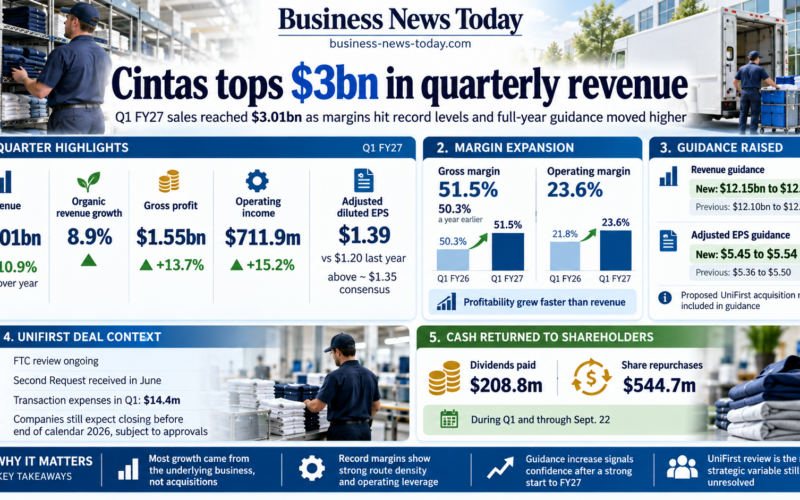
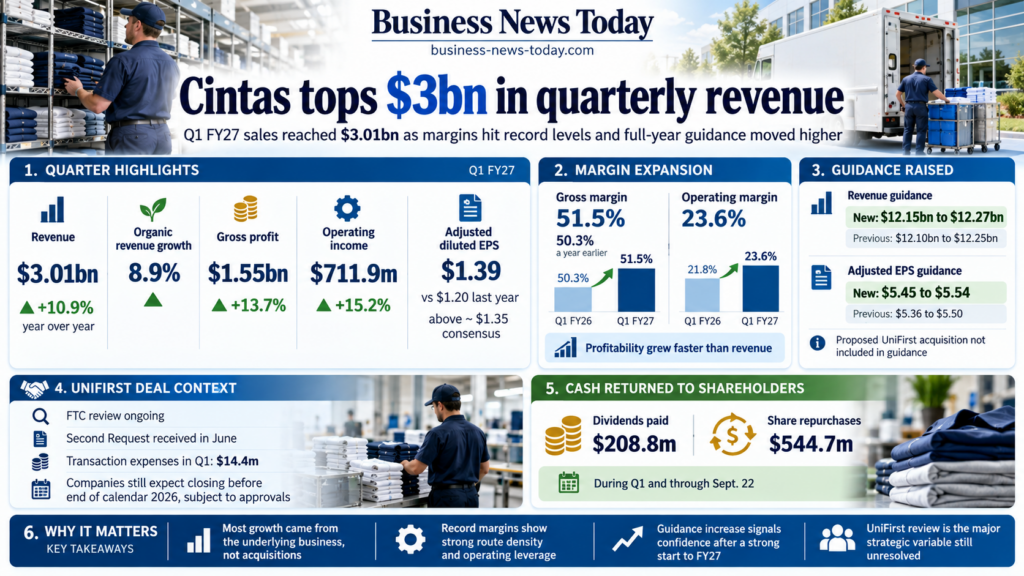
Cintas Corporation (Nasdaq: CTAS), the Cincinnati-based uniform rental, workplace services and facility-products company, has crossed $3bn of quarterly revenue for the first time after fiscal first-quarter 2027 sales increased 10.9% to $3.01bn. Organic revenue growth reached 8.9%, demonstrating that most of the expansion came from the underlying business rather than acquisitions, currency changes or differences in the number of working days.
Profitability grew even faster. Gross profit increased 13.7% to $1.55bn, lifting gross margin to a record 51.5% from 50.3%, while operating income rose 15.2% to $711.9m. The operating margin reached 23.6%, showing that Cintas converted its sales growth into disproportionately higher operating profit rather than allowing additional revenue to disappear into servicing costs.
Adjusted diluted earnings per share reached $1.39 compared with $1.20 a year earlier and exceeded the widely followed consensus estimate of around $1.35. Cintas subsequently increased its full-year fiscal 2027 revenue and adjusted earnings guidance, even though its proposed acquisition of UniFirst Corporation remains outside those forecasts.
Why is Cintas’s 51.5% gross margin as important as the $3bn revenue milestone?
Cintas operates a service model with significant route density, processing facilities, garment inventory, sales infrastructure and recurring customer relationships. Revenue growth is valuable, but incremental customers create the most shareholder value when existing routes, plants and service infrastructure can accommodate them without costs rising equally fast.
The 120-basis-point year-on-year expansion in gross margin indicates that operating efficiency improved while revenue grew. Operating income rising 15.2% against revenue growth of 10.9% provides a second measure of that leverage.
This is particularly important because Cintas serves businesses across categories such as uniforms, entrance mats, restroom supplies, first-aid products and fire-protection services. Many of those services involve recurring visits and replenishment. Adding customers near existing routes can therefore improve utilisation of labour, vehicles and processing capacity.
Technology investment also matters. Management has linked its margin performance to continued investment in technology, capacity and workforce capabilities. For a route-based service company, better scheduling, customer data, inventory visibility and automated processing can influence both employee productivity and the amount of capital required to support growth.
The quarter consequently suggests that Cintas is not simply gaining revenue through price or expansion. Its profitability metrics show the existing operating system is extracting more earnings from each dollar of sales.
How much did Cintas raise its fiscal 2027 guidance?
Cintas increased its annual revenue forecast to between $12.15bn and $12.27bn from its previous range of $12.10bn to $12.25bn. It also raised adjusted diluted earnings-per-share guidance to $5.45 to $5.54 from $5.36 to $5.50.
The revisions are not enormous, but their direction matters after only the first quarter. Management is effectively saying that the stronger opening period provides enough confidence to move both the top and bottom ends of the earnings range higher.
There is an important exclusion. The guidance does not incorporate the expected effects of the proposed UniFirst acquisition, and the adjusted EPS forecast excludes non-recurring transaction expenses associated with that transaction. Investors therefore should not use the new guidance as a forecast for the combined company.
Cintas recorded approximately $14.4m of transaction expenses related to the proposed UniFirst deal during the first quarter. Those costs illustrate that the acquisition is already affecting reported financials even though it has not yet closed and its future revenue is excluded from management’s outlook.
What is happening with Cintas’s proposed acquisition of UniFirst?
The Federal Trade Commission continues to review the transaction. Cintas and UniFirst received a request for additional information, commonly called a Second Request, in June, extending the US antitrust review. The companies have said they are cooperating with the regulator and continue to expect closing before the end of calendar 2026, subject to the required approvals and closing conditions.
That scrutiny is understandable because the combination would unite two significant uniform-rental and workplace-service providers. Regulators can examine whether customers in particular markets would face fewer credible suppliers or less pricing competition after consolidation.
For Cintas, the strategic rationale extends beyond adding UniFirst’s reported revenue. Route businesses can generate substantial synergies when overlapping depots, processing facilities, service territories and administrative functions are integrated. Yet exactly those overlaps can also draw antitrust attention if regulators believe local customers would lose meaningful choice.
Until the FTC process is complete, shareholders should treat UniFirst as a potential future contributor rather than an operating part of Cintas. The cleanest measure of Cintas’s current performance remains the 8.9% organic growth and record margins generated by the standalone business.
How much cash is Cintas already returning to shareholders?
Cintas paid approximately $208.8m of dividends on September 15. During the first quarter and through September 22, it also purchased approximately $544.7m of its own shares under existing repurchase programmes.
Those distributions sit alongside spending on operating capacity and transaction costs, demonstrating the cash-generative nature of the business. A company pursuing a substantial acquisition while continuing to repurchase shares and pay dividends needs sufficient balance-sheet flexibility to do all three without compromising investment in the core operation.
The buyback also matters to per-share earnings over time because reducing the share count allows future profit to be distributed across fewer shares. It should still be evaluated against valuation: repurchasing an expensive stock can create less economic value than investing internally or reducing debt.
Cintas’s capital-allocation equation could change if the UniFirst acquisition closes. Integration costs, transaction financing and working-capital requirements may compete temporarily with repurchases for cash.
Why did Cintas shares fall after strong results and then rebound?
Cintas shares fell 3.44% to $191.97 on September 23, the day the company reported its first-quarter results, despite beating widely followed earnings and revenue expectations. The stock then recovered 2.97% on September 24 and another 1.13% on September 25, ending the week at $199.91, slightly above its $198.80 closing level immediately before the results.
That pattern illustrates how a highly valued, consistently growing company can produce good results without generating an immediate positive share-price reaction. When expectations are already elevated, investors can use earnings days to take profits even when fundamental performance remains strong.
By Friday, much of the initial decline had reversed. That leaves the operating picture largely intact: Cintas has passed $3bn in quarterly revenue, expanded already-high margins, increased guidance and continued returning cash to shareholders.
The largest unresolved variable is no longer the quarter just reported. It is whether the UniFirst acquisition clears regulatory review and, if it does, whether Cintas can apply the same margin discipline to a significantly larger combined network.
Discover more from Business-News-Today.com
Subscribe to get the latest posts sent to your email.