




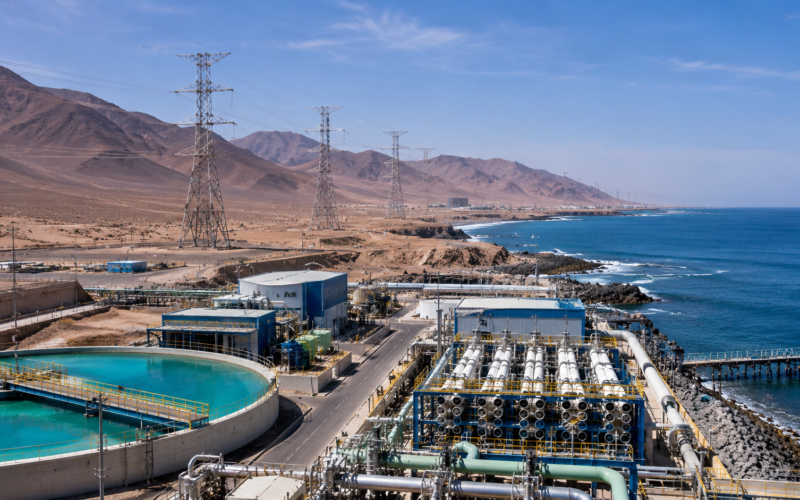
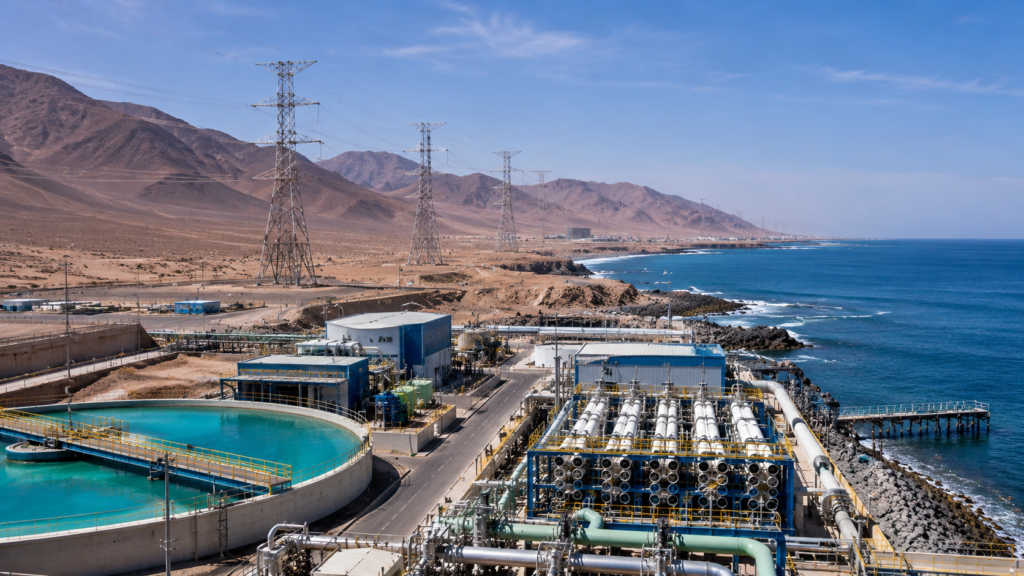
BHP Group Limited (ASX: BHP, NYSE: BHP, LSE: BHP, JSE: BHG) is exploring the sale of the Puerto Coloso desalination plant in Chile alongside its electricity transmission lines serving the Escondida, Spence, and Cerro Colorado copper operations, in a combined transaction that could raise between 1.5 billion and 2 billion United States dollars, according to Bloomberg reporting published on July 10, 2026 citing people familiar with the matter. The electricity transmission lines, comprising approximately 1,000 kilometres of infrastructure that feeds the three copper operations in northern Chile, are expected to raise about 1 billion to 1.3 billion United States dollars, while the Puerto Coloso desalination plant that serves the Escondida operation is expected to raise roughly 500 million to 700 million United States dollars. The process remains at an early stage and no final decision has been made, and the valuation, timing and structure of any transaction continue to be under discussion. BHP Group Limited declined to comment on the Bloomberg report.
The Chilean infrastructure divestment sits within a broader capital reallocation programme that BHP Group Limited has publicly framed around unlocking as much as 10 billion United States dollars from infrastructure, by-products, and other non-core assets to fund its expanding copper business, and it follows the sale of a 49 percent stake in Western Australian iron ore transmission assets to Global Infrastructure Partners for approximately 2 billion United States dollars alongside a 4.3 billion United States dollar silver streaming arrangement tied to the Antamina copper operation in Peru. BHP Group Limited shares closed the previous trading session at approximately 57.51 Australian dollars on the Australian Securities Exchange, having slid 2.31 percent to a six-week low as investors weighed a critical Escondida environmental permit that unlocks up to 14.7 billion United States dollars in Chilean copper expansion capital against the specific execution risks associated with a decade-long capital deployment profile that does not deliver first meaningful production from the Los Colorados replacement concentrator until the early 2030s.
What does BHP’s $1.5 to $2 billion Chilean infrastructure sale exploration actually change for the copper capex funding architecture
The Chilean infrastructure divestment represents a specific capital allocation mechanism that BHP Group Limited has been progressively refining through the past three years, and its execution at the Puerto Coloso and transmission line scale changes the source-of-funds architecture that supports the substantial copper capital expenditure programme through the second half of the current decade. BHP Group Limited has committed to invest between 10.7 billion and 14.7 billion United States dollars across its Chilean operations in coming years, with the Escondida programme anchored by a new concentrator that carries a capital cost of 4.4 to 5.9 billion United States dollars, and the Vicuña joint venture with Lundin Mining Corporation carrying a Stage I capital estimate of approximately 7 to 8 billion United States dollars on a 100 percent basis. The Chilean asset sale proceeds directly offset a meaningful portion of this capital commitment.
The mechanical logic of the divestment is the separation of physical infrastructure ownership from operational access. Under a typical structured infrastructure sale, BHP Group Limited would divest the physical desalination plant and transmission lines to institutional infrastructure investors while retaining guaranteed access to the water and power those assets deliver through long-term take-or-pay contracts. That structure preserves operational continuity for the copper operations while releasing the capital tied up in the infrastructure assets, which can then be redeployed into higher-return copper mining capital expenditure with substantially different risk-return characteristics. The BHP Group Limited internal cost of capital applied to copper mining operations is materially higher than the infrastructure market cost of capital, and the arbitrage between those two discount rates is the specific value creation mechanism the transaction crystallises.
The strategic signal to the market is that BHP Group Limited is progressively evolving from a traditional integrated mining operating model toward what its Chief Executive Mike Henry has described as an asset-light approach for non-core support infrastructure. The precedent set by the 2 billion United States dollar Western Australia iron ore transmission sale to Global Infrastructure Partners established both the commercial feasibility of the model and the institutional buyer appetite for mining-linked infrastructure. Extending the model to Chilean copper support infrastructure demonstrates that the framework is scalable across geographies, commodity segments, and asset types, which supports the argument that further BHP Group Limited infrastructure divestitures may be forthcoming across the balance of the 10 billion United States dollar unlock plan.
Why is the Puerto Coloso desalination plant sale strategically distinct from a straightforward transmission line divestiture
The Puerto Coloso desalination plant is structurally different from the transmission lines being sold alongside it in ways that materially affect the buyer universe, the transaction economics, and the residual operational risk for BHP Group Limited. The plant was originally sanctioned as a 3.4 billion United States dollar investment in 2013 to deliver sustainable water supply to Escondida over the long term, replacing progressively unsustainable extraction from freshwater aquifers in the Atacama Desert. Water is not fungible in the way that electricity is fungible, and the desalination plant carries specific operational, environmental, and community engagement responsibilities that transmission assets do not carry.
The commercial architecture of a desalination plant sale therefore requires a different buyer profile than the transmission line divestiture. Institutional infrastructure funds and pension investors that have historically acquired mining-linked transmission assets typically operate through regulated tariff frameworks that provide predictable cash flow visibility, and Chile’s transmission tariff architecture is well established and transparent. Desalination assets in industrial water supply require operational specialisation across membrane technology, corrosion management, environmental compliance for brine discharge, and community engagement around water rights that most infrastructure funds do not maintain in-house. That specialisation typically favours strategic acquirers including desalination-focused water infrastructure operators such as Acciona Agua, Almar Water Solutions, Veolia Environnement, or Suez Environnement Company alongside sovereign wealth funds with existing water infrastructure exposure.
The residual operational risk for BHP Group Limited after a desalination plant sale is meaningfully greater than after a transmission line sale for structural reasons. Water supply security is directly linked to the licence to operate at Escondida, and any interruption to desalinated water availability would immediately affect copper production. That risk profile means any transaction structure requires materially stronger performance guarantees, service level commitments, and dispute resolution mechanisms than a standard transmission line sale, and it may include contingent capacity expansion obligations that support the growth trajectory implicit in the Escondida expansion programme. Structuring these arrangements will take time and will influence the timing and specific terms of any transaction.
How does the $10 billion infrastructure unlock plan connect the Chilean sale to Australia and Antamina deals
The 10 billion United States dollar infrastructure unlock target that BHP Group Limited has publicly communicated is architecturally supported by a small number of distinct large transactions rather than a broader continuous divestment programme. The Global Infrastructure Partners acquisition of a 49 percent stake in Western Australian iron ore transmission assets for approximately 2 billion United States dollars established the first anchor transaction. The 4.3 billion United States dollar silver streaming deal tied to the Antamina copper operation in Peru established the second anchor transaction and demonstrated the willingness of specialist by-product streaming counterparties to underwrite substantial upfront capital in exchange for future silver production. The current Chilean infrastructure exploration would deliver the third anchor transaction and take cumulative proceeds toward roughly 8 billion United States dollars if it completes at the upper end of the current 1.5 to 2 billion United States dollar valuation range.
The specific composition of the residual unlock target is analytically important for how investors should read the trajectory of the programme. If BHP Group Limited targets the full 10 billion United States dollar aggregate unlock, the residual approximately 2 billion United States dollars implies that additional transactions may be forthcoming across the second half of the decade, potentially targeting further by-product streaming arrangements at other operations, transmission or water infrastructure at Copper South Australia including the Olympic Dam and Carrapateena assets acquired through the OZ Minerals transaction in fiscal 2023, or specific coal or by-product asset sales that further sharpen the portfolio focus. The specific composition of any residual transactions will be shaped by the copper capital expenditure requirement, the pace of Vicuña joint venture funding calls, and the specific market conditions in institutional infrastructure fund pricing.
The read-through to competing diversified miners including Rio Tinto Group, Anglo American plc, Glencore plc, and Freeport-McMoRan Inc. is that mining-linked infrastructure divestment is emerging as a specific capital allocation lever that provides materially different risk and return characteristics than either traditional equity raises or bank debt facilities. Rio Tinto Group has begun exploring similar transactions in Australian iron ore infrastructure, and other majors are likely to consider similar arrangements as they navigate the substantial capital requirements associated with the current copper capital cycle. The specific timing of BHP Group Limited’s current Chilean sale exploration may set precedent terms that other miners can reference in structuring their own arrangements.
What role does the $14.7 billion Escondida expansion play in the timing of the current divestiture wave
Escondida is the largest single copper mine in the world by production volume and the anchor asset in BHP Group Limited’s copper portfolio, and the current expansion programme covers multiple interconnected capital projects that together require substantial funding through the balance of the decade. The Escondida new concentrator at 4.4 to 5.9 billion United States dollars is designed to replace the ageing Los Colorados concentrator and enable a step-up in production capacity, with potential first production timing in calendar year 2031 to 2032. The programme also includes sulphide leaching technology deployment at Spence with a capital cost of 0.6 to 0.9 billion United States dollars, potential Cerro Colorado restart at 2.3 to 3.2 billion United States dollars using leaching technology, and various infrastructure and permitting activities that support the overall capital deployment envelope.
The timing coordination between the divestiture proceeds and the capital deployment requirements is analytically material. The Antofagasta Environmental Assessment Commission granted initial approval for early works at Escondida on July 8, 2026 covering sulphide leaching and electricity infrastructure improvements valued at approximately 1.3 billion United States dollars, which unlocks the initial capital deployment phase of the broader expansion. The Chilean infrastructure divestment proceeds arriving over the coming quarters would specifically fund the initial capital deployment during the early works phase, and the timing alignment is one of the specific reasons the current divestment exploration is proceeding on the current schedule rather than being delayed to later in the decade.
The commercial and strategic risk in the timing coordination is that infrastructure divestment proceeds arrive in specific transactional windows that are subject to buyer diligence, regulatory review, and specific market pricing conditions, while capital expenditure requirements typically flow on schedules driven by construction and permitting milestones. Any friction in the divestment timeline could create funding pressure on the capital expenditure programme, which BHP Group Limited would need to address through alternative funding sources including additional debt issuance, retained earnings reallocation from other segments, or specific project financing arrangements. The specific mix of these alternative sources depends on the earnings trajectory of the iron ore business through the Chinese economic cycle and the copper price environment through the deployment period.
How does the Vicuña joint venture with Lundin Mining reshape BHP’s capital commitment through the mid-2030s
The Vicuña joint venture with Lundin Mining Corporation, formed as a 50/50 partnership through the completion of Vicuña Corp in January 2025, combines the Filo del Sol and Josemaria copper deposits in Argentina into a single integrated project that carries substantial capital and production potential through the mid-2030s. Filo del Sol has been characterised as the largest greenfield copper deposit discovered in the past 30 years, with combined resources at Filo del Sol and Josemaria of approximately 11 billion tonnes on a total resource basis, and the Vicuña build-out targets an estimated 300 kilotonnes per year of copper equivalent production at Stage I with total production potential of approximately 800 kilotonnes per year of copper equivalent across all three stages.
The financial architecture of the Vicuña partnership commits BHP Group Limited to approximately half of the total capital deployment across the multiple stages, which on the current estimates would mean a BHP Group Limited share of approximately 3.5 to 4 billion United States dollars for Stage I and approximately 9 billion United States dollars for all three stages combined. The Régimen de Incentivo para Grandes Inversiones approval that Argentina extended to Vicuña provides regulatory and fiscal stability for the substantial capital commitment, and Argentine domestic economic policy under the current administration has been broadly supportive of foreign direct investment in major mining projects. However, Argentine political and macroeconomic risk remains materially higher than the Chilean or Australian operating jurisdictions, and BHP Group Limited will need to manage the Vicuña exposure carefully as it scales up.
The read-through to the overall BHP Group Limited copper capital deployment envelope is that the Chilean and Argentine capital commitments together account for the substantial majority of the copper growth capital through the balance of the decade. Copper South Australia adds further capital commitment through the Phase 1 and Phase 2 growth programmes at Olympic Dam and Carrapateena, with combined capital estimates of approximately 8.5 to 10.9 billion United States dollars across the two phases. The aggregate BHP Group Limited copper capital deployment across Chile, Argentina, and Australia through the mid-2030s therefore approaches 25 to 30 billion United States dollars, which is a materially different scale of capital deployment than the company has previously coordinated and which drives the specific urgency behind the current infrastructure unlock plan.
Why do regulated Chilean transmission assets attract institutional infrastructure fund and pension investor interest
Chilean electricity transmission operates under one of Latin America’s most developed and transparent regulatory frameworks, with tariffs set through a structured process by the Comisión Nacional de Energía and long-term transmission contracts providing multi-decade cash flow visibility that is precisely aligned with institutional infrastructure investor return requirements. Regulated transmission tariff frameworks typically deliver low single-digit percentage annual returns on regulated asset base above a defined weighted average cost of capital, with capital indexation and pass-through mechanisms that reduce inflation and commodity price risk. These characteristics make Chilean regulated transmission assets attractive to pension funds, sovereign wealth funds, and specialist infrastructure funds seeking predictable long-duration cash flows.
The specific commercial appeal of the BHP Group Limited transmission asset package is enhanced by the specific customer profile. The lines serve the Escondida, Spence, and Cerro Colorado copper operations that together account for a meaningful share of Chile’s copper output, and Chile itself accounts for approximately 25 to 27 percent of global mined copper supply. The commercial commitment of the copper operations to the power supply is effectively locked in by the specific mining infrastructure geography, and BHP Group Limited would sign long-term commercial arrangements ensuring continued use of the transmission capacity following any sale. That structural commitment reduces the demand risk that would apply to non-mining-linked transmission assets and supports premium valuation multiples.
The buyer universe for the transmission asset package includes regulated transmission specialists such as Transelec S.A., Interchile S.A., Colbún S.A., Engie Chile, and Enel Américas Chile, alongside international infrastructure fund investors including Global Infrastructure Partners, Brookfield Infrastructure Partners L.P., Macquarie Asset Management, IFM Investors, and specialist Latin American infrastructure operators. Chinese state-linked infrastructure investors have also been active in Latin American electricity infrastructure, though political sensitivity around Chinese ownership of strategic infrastructure has been building across multiple jurisdictions including Chile. The specific mix of prospective buyers will shape both the ultimate transaction price and the regulatory approval timeline.
What are the execution, water security, and community risks that could complicate the Puerto Coloso transaction
The primary execution risk relates to the specific transaction structuring for the Puerto Coloso desalination plant, which as noted requires materially more complex arrangements than a straightforward transmission line sale. Buyer identification, technical diligence on the plant’s operational condition and remaining useful life, environmental compliance verification including brine discharge management, and negotiation of the long-term water supply agreement between the new owner and BHP Group Limited all represent multi-quarter workstream requirements. Any friction in these workstreams could delay the transaction close and affect the timing of proceeds delivery to fund the Escondida expansion capital deployment.
The water security risk is a specific concern that both BHP Group Limited and prospective buyers will need to manage carefully. Water availability in the Atacama Desert region is a structural constraint on copper industry operations across Chile, and Puerto Coloso represents a critical component of BHP Group Limited’s water supply security architecture at Escondida. Any change of ownership that introduces uncertainty around water availability during operational disruptions, capacity expansion decisions, or force majeure events would materially affect the value of the Escondida operation and the achievability of the expansion capital deployment programme. Transaction structuring must therefore embed specific commitments around service continuity and expansion optionality that support BHP Group Limited’s long-term Escondida operating requirements.
The community and regulatory risk architecture around Chilean mining is evolving under the current administration. Evolving royalty and taxation frameworks, water access legislation, and community relations challenges at Escondida and other Chilean operations can materially affect operating costs and volumes. Any transaction involving critical infrastructure assets attracts additional regulatory and community engagement scrutiny beyond the standard commercial approval process, and BHP Group Limited will need to engage with Chilean authorities, indigenous community stakeholders, and local government entities across the Antofagasta Region to secure the necessary approvals for the transaction. The specific timing and terms of these engagements are difficult to predict and represent a specific source of execution uncertainty in the transaction.
Key takeaways on what the BHP Chilean infrastructure divestment signals for mining capital allocation
- BHP Group Limited is exploring the sale of the Puerto Coloso desalination plant in Chile alongside its electricity transmission lines serving Escondida, Spence, and Cerro Colorado, in a combined transaction valued at 1.5 billion to 2 billion United States dollars according to Bloomberg reporting on July 10, 2026.
- The transmission lines covering approximately 1,000 kilometres are expected to raise 1 billion to 1.3 billion United States dollars, while the Puerto Coloso desalination plant serving Escondida is expected to raise 500 million to 700 million United States dollars.
- The Chilean divestment is the third major transaction in BHP Group Limited’s publicly framed 10 billion United States dollar infrastructure unlock plan, following the 2 billion United States dollar sale of a 49 percent stake in Western Australian iron ore transmission assets to Global Infrastructure Partners and the 4.3 billion United States dollar silver streaming arrangement tied to the Antamina copper operation in Peru.
- Proceeds are being coordinated with the substantial Chilean copper capital expenditure programme that BHP Group Limited has committed to at between 10.7 billion and 14.7 billion United States dollars in coming years, anchored by the Escondida new concentrator carrying a capital cost of 4.4 to 5.9 billion United States dollars.
- BHP Group Limited received Antofagasta Environmental Assessment Commission approval on July 8, 2026 for early works at Escondida covering sulphide leaching and electricity infrastructure improvements valued at approximately 1.3 billion United States dollars, unlocking the initial capital deployment phase of the broader expansion.
- The Vicuña joint venture with Lundin Mining Corporation, formed in January 2025 as a 50/50 partnership through Vicuña Corp, targets approximately 300 kilotonnes per year of copper equivalent production at Stage I and 800 kilotonnes per year across all three stages, with BHP Group Limited’s share of Stage I capital estimated at 3.5 to 4 billion United States dollars.
- BHP Group Limited’s aggregate copper capital deployment across Chile, Argentina, and Australia through the mid-2030s approaches 25 to 30 billion United States dollars, materially larger than any prior copper capital cycle the company has coordinated.
- The Puerto Coloso desalination plant sale is structurally distinct from the transmission line divestment and requires more complex transaction arrangements around water security, environmental compliance, and long-term operational commitments, likely attracting strategic acquirers including Acciona Agua, Almar Water Solutions, Veolia Environnement, and Suez Environnement Company alongside sovereign wealth funds.
- The transmission asset package is expected to attract institutional infrastructure fund and pension investor interest including Global Infrastructure Partners, Brookfield Infrastructure Partners L.P., Macquarie Asset Management, IFM Investors, and Latin American infrastructure specialists such as Transelec S.A. and Interchile S.A.
- BHP Group Limited shares closed the previous session at 57.51 Australian dollars, having slid 2.31 percent to a six-week low as investors weighed the Escondida environmental permit unlocking up to 14.7 billion United States dollars in expansion capital against the specific execution risks associated with a decade-long capital deployment profile that does not deliver first meaningful production from the Los Colorados replacement concentrator until the early 2030s.
Share this:
Discover more from Business-News-Today.com
Subscribe to get the latest posts sent to your email.