

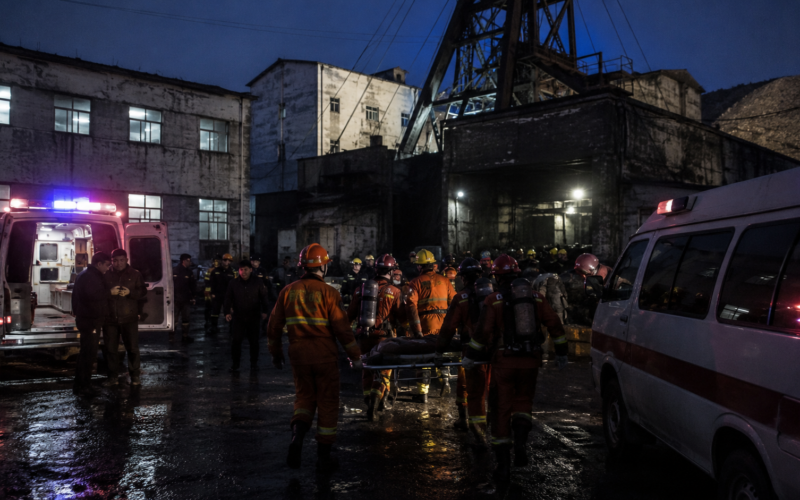
A gas explosion at the Liushenyu coal mine in Qinyuan County, Changzhi City, in China’s northern Shanxi Province has killed at least 90 people, making it one of the country’s deadliest mining disasters in more than a decade and intensifying national scrutiny of industrial safety enforcement in China’s coal sector.
Nine workers remained missing after the explosion, while more than 120 people were sent to hospital for treatment. The accident occurred at 7:29 p.m. local time on Friday at the Liushenyu coal mine, where 247 workers were underground when the blast struck.
The disaster has triggered a major emergency response involving rescue teams, medical personnel and local authorities. Many of those injured were affected by toxic gas exposure after carbon monoxide levels in the mine exceeded safe limits. The cause of the explosion remains under investigation.
Chinese President Xi Jinping ordered full rescue efforts for the missing workers, medical treatment for the injured and a thorough investigation into the cause of the disaster. Chinese Premier Li Qiang also called for rescue and investigation work to be carried out with urgency. Individuals in charge of the company connected to the mine have been taken into custody by law enforcement.
The Liushenyu coal mine explosion has placed renewed focus on Shanxi Province, one of China’s most important coal-producing regions, and on the continuing risks facing underground mining operations even after years of national safety reforms.
Why has the Liushenyu coal mine explosion become one of China’s deadliest recent mining disasters?
The Liushenyu coal mine explosion has become a major national disaster because of the scale of casualties, the number of workers underground at the time and the continuing search for missing miners. With at least 90 people dead and nine still missing, the accident stands among China’s worst coal mine disasters since the 2009 Heilongjiang mine explosion, which killed 108 people.
The incident began on Friday evening when a gas explosion occurred underground at the Liushenyu coal mine in Qinyuan County. The mine is located in Changzhi City, a coal-producing area of Shanxi Province. Of the 247 workers underground at the time, 201 were brought to the surface in the early phase of rescue work, but many were injured or exposed to toxic conditions.
The early death toll rose sharply as emergency teams continued operations through Saturday. Initial reports pointed to elevated carbon monoxide levels inside the mine. Carbon monoxide is particularly dangerous in underground mining because it is colorless, odorless and can rapidly incapacitate workers before they are able to evacuate.
The disaster is significant not only because of the number of deaths but also because it occurred in a province central to China’s coal industry. Shanxi Province has long been associated with large-scale coal production, energy security and industrial employment. A major accident in such a region carries consequences beyond the immediate rescue operation because it tests the credibility of safety oversight in a sector that remains critical to China’s economy.

How are Chinese authorities responding to the Shanxi coal mine blast and missing workers?
Chinese authorities have moved the Liushenyu coal mine explosion into a high-level national response framework. President Xi Jinping called for every effort to rescue the missing, treat the injured and manage the aftermath of the accident. President Xi Jinping also ordered a full investigation into the cause of the explosion and called for accountability under the law.
Premier Li Qiang issued instructions on the rescue and investigation work, reinforcing the central government’s emphasis on emergency response and administrative responsibility. The rescue headquarters said individuals in charge of the company involved had been taken into custody by law enforcement, indicating that the investigation is already extending beyond technical questions into possible corporate and management accountability.
The immediate rescue work has focused on locating the nine missing workers and managing hazardous underground conditions. Toxic gas exposure has been a major concern, with many of the hospitalized workers reportedly injured by gas after the explosion. Rescue teams have also had to work in difficult underground conditions, where mine layout, ventilation, access routes and gas levels can determine whether missing workers can be reached safely.
The broader government response also reflects a familiar pattern after major industrial disasters in China. Central leaders typically demand rescue operations first, followed by investigation, accountability and wider safety reviews. In this case, the scale of the Liushenyu coal mine disaster makes it likely to become a reference point for renewed inspection of high-risk coal mines, especially in gas-prone mining regions.
What does the Shanxi coal mine disaster reveal about China’s coal safety risks?
The Shanxi coal mine disaster shows that China’s coal industry still faces serious operational safety risks despite major improvements over the past two decades. China has reduced mining deaths from the extremely high levels seen in the early 2000s, but large-scale underground accidents continue to occur when gas control, ventilation, emergency access and regulatory enforcement fail to contain risk.
The Liushenyu coal mine explosion appears to involve hazardous gas conditions, with carbon monoxide levels reported to have exceeded limits. In underground coal mining, gas management is central to safety because methane, carbon monoxide and poor ventilation can turn a technical failure into a mass casualty event within minutes. The presence of 247 workers underground at the time of the explosion increased the scale of the disaster.
Shanxi Province is especially important to this discussion because it is one of China’s main coal-producing provinces. Coal remains deeply tied to electricity generation, heavy industry and regional employment. That makes coal safety not just a workplace issue but also a public policy issue involving energy security, industrial regulation and local government oversight.
The accident also highlights the persistent tension in China’s coal sector. The country needs steady coal supply to support power generation and industrial demand, but high production pressure can increase exposure to safety lapses if inspections, maintenance and emergency systems do not keep pace. The Liushenyu coal mine explosion will therefore be read as both a human tragedy and a governance test for mining regulators.
Why is Shanxi Province central to understanding China’s coal mining safety challenge?
Shanxi Province is central to China’s coal mining safety challenge because the province sits at the heart of the country’s coal economy. Large coal reserves, long-established mining operations and deep industrial dependence have made Shanxi Province a strategic energy region for China.
That strategic importance creates a difficult policy balance. Coal mines in Shanxi Province support energy supply and local employment, but underground mining remains one of the most hazardous forms of industrial activity. Mines with high gas content require strict ventilation systems, monitoring, emergency preparedness and transparent reporting. A breakdown in any of those systems can have severe consequences.
The Liushenyu coal mine explosion occurred in Qinyuan County, Changzhi City, placing the disaster within a region where coal activity is not peripheral but structurally important. This matters because investigations after major mine accidents often focus not only on the specific operator but also on whether local regulators, inspectors and emergency systems properly identified risks before the disaster.
For China’s central government, Shanxi Province is also symbolically important. A major fatal accident in a leading coal province raises questions about whether past safety campaigns have achieved durable enforcement or whether risk management still depends too heavily on post-accident crackdowns. The Liushenyu coal mine disaster may therefore influence future inspection priorities in Shanxi Province and other coal-producing areas.
How does the Liushenyu coal mine explosion compare with earlier major China mining accidents?
The Liushenyu coal mine explosion is being compared with earlier major China mining disasters because of its high death toll and its timing after years of official efforts to improve mine safety. The 2009 Heilongjiang mine explosion killed 108 people and became one of the defining disasters of that period. The latest Shanxi accident is now being described as China’s deadliest coal mine disaster since that event.
China has experienced repeated coal mine disasters over several decades, including gas explosions, floods, collapses and fires. Many of the deadliest incidents have involved underground mines where trapped workers faced toxic gases, blocked exits or delayed rescue access. The recurring pattern has made coal mine safety a central part of China’s industrial regulation agenda.
The comparison with past disasters matters because China has spent years consolidating unsafe mines, closing illegal operations and tightening workplace safety rules. Those measures have reduced the frequency of some accidents, but the Liushenyu coal mine explosion shows that catastrophic risk has not disappeared.
The accident also comes at a time when China’s energy system remains under pressure to balance coal supply, renewable energy expansion and industrial reliability. Coal is still a major part of that system, which means safety failures in coal-producing regions can quickly become national policy concerns. The Liushenyu disaster is therefore not only an accident investigation but also a reminder that energy security and workplace safety cannot be separated in China’s coal sector.
What questions will investigators face after the Liushenyu coal mine explosion in Shanxi?
Investigators will face several core questions after the Liushenyu coal mine explosion. The first is what caused the gas explosion and why carbon monoxide levels exceeded limits before or after the blast. Investigators will need to examine ventilation systems, gas monitoring equipment, emergency procedures and whether any warnings were missed or inadequately handled.
The second question concerns operational responsibility. Law enforcement has taken individuals in charge of the company into custody, which suggests that investigators are examining whether management failures contributed to the disaster. That inquiry may include staffing levels, production schedules, safety records, inspection compliance and emergency training.
The third question concerns regulatory oversight. A disaster of this scale raises questions about whether local authorities and mine safety regulators had previously identified risk at the Liushenyu coal mine, and whether corrective measures were required or enforced. In China’s industrial accident investigations, accountability can extend from company officials to local regulators if negligence is found.
The fourth question concerns rescue logistics. With nine workers still missing after the explosion, investigators and emergency teams will need to assess whether mine access routes, ventilation pathways and rescue infrastructure functioned as required. Underground rescue operations are often complicated by unstable structures, toxic gases and limited visibility.
The outcome of the investigation will matter beyond Shanxi Province. If investigators identify systemic failures, the disaster could lead to wider safety inspections across coal-producing regions, tighter enforcement against high-risk mines and renewed political pressure on local authorities to prevent major industrial accidents.
What are the key takeaways from the Liushenyu coal mine explosion in Shanxi Province?
- At least 90 people have died after a gas explosion at the Liushenyu coal mine in Qinyuan County, Changzhi City.
Nine workers remained missing after the disaster, while more than 120 people were taken to hospital for treatment. - The explosion occurred at 7:29 p.m. local time on Friday while 247 workers were underground.
Early reports indicated that carbon monoxide levels inside the mine had exceeded safe limits. - President Xi Jinping ordered full rescue efforts, medical treatment for the injured and a complete investigation into the cause.
Premier Li Qiang also issued instructions on rescue operations and the official inquiry. - Individuals in charge of the company connected to the Liushenyu coal mine have been taken into custody by law enforcement.
The move indicates that the investigation is already examining possible management and accountability failures. - Shanxi Province remains one of China’s most important coal-producing regions and a key area for mining safety oversight.
The disaster has renewed attention on underground gas risks, emergency readiness and regulatory enforcement. - The Liushenyu coal mine explosion is China’s deadliest coal mine disaster since the 2009 Heilongjiang mine explosion.
The scale of the casualties could make the accident a major reference point for future mine safety inspections.
Discover more from Business-News-Today.com
Subscribe to get the latest posts sent to your email.