





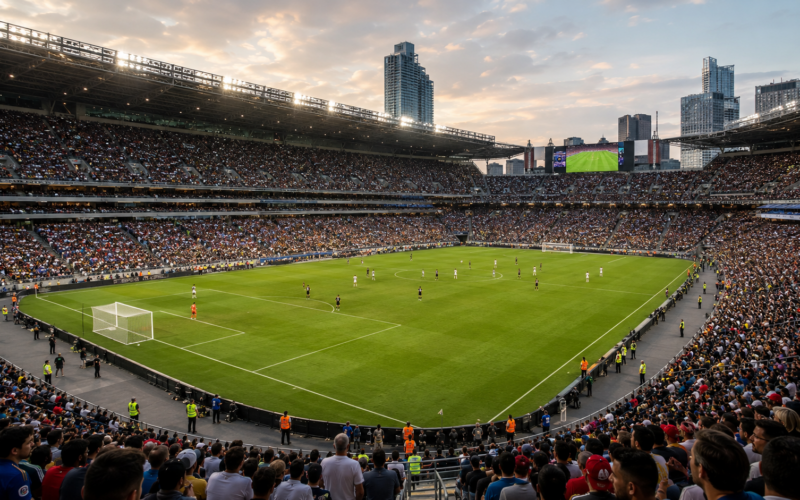
Ruben Vargas scored the decisive penalty as Switzerland defeated Colombia 4-3 in a shootout after a 0-0 draw in their FIFA World Cup 2026 Round of 16 match at BC Place in Vancouver on Tuesday, July 7, 2026. The result sent Switzerland into their first World Cup quarter-final since 1954.
Colombia produced the better chances across 120 minutes, with Gustavo Puerta forcing Gregor Kobel into a major first-half save and Jhon Lucumí heading against the crossbar in extra time. Jaminton Campaz then missed the clearest opening of the match in the 116th minute after Switzerland lost possession near their own penalty area.
The penalty shootout swung repeatedly before Switzerland held their nerve. Juan Fernando Quintero, Jaminton Campaz and Luis Díaz scored for Colombia, but Davinson Sánchez hit the crossbar and Cucho Hernández was denied by Kobel.
Switzerland converted through Granit Xhaka, Zeki Amdouni, Cedric Itten and Vargas, with only Manuel Akanji missing for Murat Yakin’s side. Switzerland advanced to face Argentina at Kansas City Stadium on Saturday, July 11, while Colombia were eliminated after failing to turn territorial pressure and 15 attempts into a goal.
FIFA World Cup 2026 Switzerland 0-0 Colombia full match scorecard and key incidents
FIFA World Cup 2026 Switzerland vs Colombia penalty shootout
How did Colombia create the better chances without breaking Switzerland’s defensive structure?
Colombia entered the match with greater attacking ambition and immediately tried to stretch Switzerland through Luis Díaz and Daniel Muñoz. James Rodríguez dropped into midfield to receive and switch play, while Gustavo Puerta advanced from deeper positions to support the first wave of attacks.
The early pattern suited Colombia because Switzerland were missing Johan Manzambi, whose movement had helped them connect midfield and attack earlier in the tournament. Ardon Jashari replaced him, but Switzerland’s build-up became more cautious and less vertical.
Colombia’s first real warning arrived in the second minute when Jhon Arias worked into shooting position. The better chance came in the 21st minute, when Puerta curled a strong right-footed effort towards the far corner and forced Kobel into a diving save.
That chance captured the match’s central tension. Colombia were entering more dangerous areas and finishing with greater frequency, but Switzerland’s defensive spacing and Kobel’s positioning ensured those attacks remained survivable.
Why did Gregor Kobel become Switzerland’s most important player long before the shootout?
Kobel’s penalty save from Cucho Hernández will be remembered as the match’s decisive intervention, but his importance began much earlier. The save from Puerta in the 21st minute stopped Colombia from gaining the lead their pressure threatened to produce.
The Switzerland goalkeeper also managed crosses and second balls calmly in a match where Colombia won multiple corners and kept testing the back line. His handling helped prevent the kind of chaotic penalty-area sequence that often decides a 0-0 knockout match.
The contrast with Camilo Vargas was subtle but important. Vargas made two saves and remained secure, but Kobel had to handle the higher-value moments because Colombia created both big chances.
By the time the match reached penalties, Kobel had already carried Switzerland through the most dangerous stretches. His save from Hernández therefore felt like a continuation of the performance rather than a sudden isolated moment.
How did Switzerland’s midfield compensate for the absence of Johan Manzambi?
Manzambi’s absence removed Switzerland’s most productive attacking midfielder from the tournament run. He had supplied goals and assists before suffering a knee contusion in training, forcing Yakin to adjust the balance of the team.
Jashari came into the side and offered work rate and positional discipline, but Switzerland lost some final-third sharpness. Xhaka and Freuler therefore had to control the tempo while also preventing Colombia’s midfield runners from receiving in central space.
The result was a more conservative Switzerland than the side that beat Algeria. They kept the ball for long phases and finished with 53% possession, but much of that possession was held in safer zones rather than around Colombia’s box.
Yakin’s side accepted that trade-off. Without Manzambi, the immediate priority was to remain compact and prevent Díaz, Arias and Suárez from creating repeated one-on-one situations.
Why could Fabian Rieder not convert Switzerland’s best first-half openings?
Rieder became Switzerland’s most active attacking player during normal time. His first-half strike from a tight angle forced Camilo Vargas into a low save, and his movement offered Switzerland a route into the final third when Embolo was being closely monitored.
The problem was shot quality. Rieder’s best chance came from an angle that favoured the goalkeeper, while his later free kick curled around the wall but flashed into the side-netting rather than seriously testing Vargas.
Colombia’s defenders also prevented him from combining consistently with Ndoye and Embolo. Whenever Rieder received centrally, Lerma and Puerta closed quickly enough to stop him turning into space.
Rieder gave Switzerland their clearest attacking rhythm, but he did not produce the type of chance Colombia later created through Lucumí and Campaz. That difference explains why Switzerland’s expected-goals total remained only 0.35 across 120 minutes.
How did Colombia’s first-half control still leave them exposed to Swiss patience?
Colombia’s structure was more expansive than Switzerland’s, especially when Mojica and Muñoz advanced together. That allowed Lorenzo’s side to create passing triangles around the wings and keep Switzerland defending towards its own area.
The risk was that every attack required several players to move ahead of the ball. Switzerland rarely countered with speed, but Embolo and Ndoye remained positioned to occupy Colombia’s centre-backs whenever a turnover occurred.
Switzerland’s best transitions were not frequent enough to dominate the match, but they were enough to stop Colombia from committing recklessly. Sánchez and Lucumí had to protect space behind them rather than fully joining attacks.
The opening half therefore ended without the breakthrough Colombia wanted. They had been the more ambitious team, yet Switzerland had absorbed the pressure without allowing the match to become unstable.
Why did the second half become more tactical, physical and cautious?
The second half began with Djibril Sow replacing Jashari, a change designed to add more midfield running and defensive coverage. Colombia still carried the larger attacking threat, but both sides became increasingly aware that one error could decide the match.
Xhaka and Zakaria were booked within the first 15 minutes after the restart. The yellow cards showed how Switzerland were using fouls to interrupt Colombia’s attempts to accelerate through midfield.
Luis Suárez was then booked on the hour, increasing the disciplinary pressure on Colombia’s central striker. Lorenzo later removed both Suárez and Arias, partly because fatigue and suspension risk had become factors.
The match never became truly open during normal time. Each team looked capable of creating one moment, but neither manager wanted to expose the defensive balance needed to survive a knockout tie.
Why did Colombia’s attacking substitutions improve control but not finishing?
Lorenzo introduced Quintero and Campaz in the 66th minute, replacing James Rodríguez and Jhon Arias. The substitutions changed Colombia’s attacking profile by adding one passer with set-piece quality and one winger capable of sharper direct movement.
Quintero immediately became important because he could deliver from dead-ball situations and receive between Switzerland’s defensive lines. Campaz, meanwhile, gave Colombia fresh legs against a Swiss defence beginning to defend deeper.
The changes helped Colombia create the best extra-time moments. Quintero’s corner led to Lucumí hitting the crossbar, while Campaz later found himself in front of goal after Switzerland lost possession.
The problem was execution. Colombia had enough creativity to produce the decisive chance but not enough composure to finish it. That gap ultimately sent the match to penalties, where Switzerland were better equipped emotionally.
How close did Dan Ndoye come to ending the match before extra time?
Switzerland’s strongest late normal-time moment came through Ndoye. He made a clever diagonal run behind the Colombia defence and received in enough space to shoot before the defenders could fully recover.
The finish did not match the movement. Ndoye dragged the low effort across goal and wide of the far post in stoppage time, leaving Vargas untested.
The chance mattered because Switzerland had produced so little in the second half. A goal then would have felt harsh on Colombia, but it also would have reflected the danger of leaving a disciplined opponent alive.
Ndoye’s miss also set up one of Yakin’s biggest decisions. He was replaced by Vargas in stoppage time, and the substitute later became the player who decided the shootout.
Why was Jhon Lucumí’s 99th-minute header Colombia’s clearest route to victory?
The match finally opened during extra time, and Colombia’s best moment arrived from Quintero’s corner. Lucumí attacked the delivery from close range and rose above the Swiss defenders.
His header beat Kobel but struck the crossbar. For Colombia, it was the type of high-value chance that should have changed the match.
The timing increased the impact. Switzerland had spent much of normal time avoiding clear concessions, only for Colombia to find a genuine opening early in extra time.
Lucumí’s miss did not end Colombia’s pressure, but it changed the emotional rhythm. The players had seen the ball beat the goalkeeper and still stay out, a moment that often carries psychological weight in a knockout match.
Why was Jaminton Campaz’s 116th-minute miss even more costly than the crossbar?
Campaz’s chance was arguably more painful because it came from open play and with less defensive pressure. Switzerland lost the ball near their own area, and Colombia suddenly had the opportunity to punish the mistake.
The ball bounced towards Campaz inside the penalty area, giving him a clear view of goal. He attempted to lift the finish but sent it over the bar.
The miss became the final major chance of the match. Colombia had already hit the woodwork, and this was the moment when their superiority in expected goals should have become the winning goal.
Instead, Switzerland survived. Four minutes later, the outcome shifted from chance creation to penalty execution, a format where Colombia’s missed opportunities could no longer be repaired through open play.
How did Switzerland survive while creating only 0.35 expected goals?
Switzerland’s performance was not built on attacking dominance. It was built on defensive survival, patience and the ability to keep the match from slipping into chaos.
Akanji and Elvedi defended the penalty area with restraint, while Xhaka and Freuler helped slow Colombia’s attacks before they reached the box. Even when Colombia produced 15 attempts, only three reached the target.
Switzerland also avoided panic when they were second-best for chance quality. Their possession figure showed they could still manage the ball, but they rarely used it to attack aggressively.
The plan was not attractive, but it was effective. In knockout football, a team can be outshot and still advance if it protects the most dangerous central spaces, avoids major mistakes and has a goalkeeper capable of deciding the shootout.
Why did Murat Yakin’s late substitutions become decisive in the penalty shootout?
Yakin’s changes looked conservative during the final minutes, but they became decisive once the match reached penalties. Itten, Amdouni and Vargas were all on the pitch for the shootout and all converted.
Vargas was introduced in stoppage time at the end of normal time despite pre-match fitness doubts. Rather than needing him to change open play, Yakin ensured he was available for a pressure kick.
Amdouni entered in extra time and immediately gave Switzerland another composed option from the spot. Itten, introduced earlier for Embolo, struck his penalty down the middle with confidence.
The substitutions reflected tournament management rather than just match management. Switzerland did not win because the bench transformed the attack, but because the right penalty takers were on the field when the match demanded them.
Why did the shootout momentum keep swinging before Vargas settled it?
Colombia began perfectly when Quintero scored, and Xhaka then survived Camilo Vargas getting a hand to his kick. Sánchez’s strike against the crossbar gave Switzerland the first advantage.
Amdouni converted to put Switzerland ahead, only for Campaz to score and Akanji to miss over the bar. At that point, Colombia had been given a reprieve and the shootout was level again.
The decisive turn came when Hernández went low to Kobel’s right. The Switzerland goalkeeper read the direction and saved, restoring the advantage to Yakin’s side.
Itten scored, Díaz replied and Vargas then stepped forward with the match on his right foot. His low finish sent Camilo Vargas the wrong way and ended Colombia’s tournament.
The shootout was not a simple case of Swiss perfection. It was a sequence of pressure, reprieves and recoveries, but Switzerland handled the final decisive kick better.
Why did Colombia’s elimination feel especially harsh after 120 minutes?
Colombia produced more attempts, more expected goals, both big chances and the most dangerous extra-time moments. Their supporters also turned BC Place into a largely Colombian atmosphere, making Vancouver feel closer to a home venue than a neutral knockout site.
The emotional pain came from how the chances were missed. Lucumí’s header hit the bar with Kobel beaten, and Campaz’s late opening was the type of chance Colombia would have expected to convert.
Lorenzo’s side also had to watch Sánchez strike the crossbar in the shootout before Hernández was denied by Kobel. The pattern repeated itself: Colombia came close but could not push the ball across the decisive line.
The defeat does not erase their tournament. Colombia topped Group K, beat Ghana in the Round of 32 and conceded only one goal across the tournament before penalties ended the run.
The next step is clear. Colombia have structure, midfield control and wide threat, but they need a more ruthless penalty-area finisher to convert promising tournament football into deeper knockout progress.
What does Switzerland’s first quarter-final since 1954 mean for Murat Yakin’s team?
Switzerland had repeatedly reached major-tournament knockout rounds without breaking into the final eight at the World Cup. They had exited the last 16 in 2006, 2014, 2018 and 2022, making this victory historically important.
The win also repaired some of the emotional damage from Switzerland’s Euro 2024 penalty defeat to England. This time, they survived the shootout rather than being defined by it.
Yakin’s team did not produce a flowing attacking performance, but that may not matter in the context of Swiss football history. The achievement lies in finding a way through a difficult match while missing key players and facing a crowd heavily tilted towards Colombia.
Switzerland’s identity is now clear. They are disciplined, difficult to break, emotionally resilient and comfortable taking a match into long tactical phases.
That approach may not please every neutral, but it has carried them to the country’s first World Cup quarter-final in 72 years.
What must Switzerland improve before facing Argentina in Kansas City?
Argentina will pose a very different challenge. Colombia had wide pace and midfield creativity, but Argentina bring Lionel Messi, Lautaro Martínez, Julián Álvarez and Enzo Fernández into a system capable of turning late pressure into goals.
Switzerland cannot rely on creating only 0.35 expected goals again. Against Argentina, one or two counters may not be enough if Messi begins controlling the final third.
Manzambi’s fitness will therefore be a major concern. If he remains unavailable, Yakin must find another way to connect Xhaka and Freuler with the forwards.
Switzerland also need more from Embolo and Ndoye in open play. Their defensive work helped the team survive, but the quarter-final will require a greater attacking outlet to relieve pressure.
The positive is that Switzerland have already shown they can stay patient under stress. If they can combine that discipline with sharper transitions, Argentina may face another difficult knockout test after close escapes against Cape Verde and Egypt.
How does Switzerland’s victory complete the FIFA World Cup 2026 quarter-final bracket?
Switzerland’s shootout victory completed the Round of 16 and confirmed the final FIFA World Cup 2026 quarter-final. They will face Argentina at Kansas City Stadium on Saturday, July 11.
Argentina reached the quarter-finals by coming from 2-0 down to defeat Egypt 3-2 in Atlanta. That result, combined with Switzerland’s win, sets up a meeting between the defending champions and a Swiss side seeking their first World Cup semi-final.
The winner will advance to the semi-final at Atlanta Stadium. The opponent will come from the Norway vs England quarter-final in Miami.
Colombia’s exit ends one of the tournament’s most consistent defensive campaigns. Switzerland’s survival, meanwhile, gives the quarter-finals a team whose strength lies less in star power and more in organisation, patience and penalty nerve.
Key takeaways from Switzerland vs Colombia at FIFA World Cup 2026
- Switzerland defeated Colombia 4-3 on penalties after a 0-0 draw across 120 minutes.
- The victory sent Switzerland into their first FIFA World Cup quarter-final since 1954.
- Colombia created the better chances, leading 1.03 to 0.35 in expected goals.
- Gustavo Puerta forced Gregor Kobel into a major first-half save in the 21st minute.
- Switzerland’s last shot on target came in the first half, highlighting their limited open-play threat.
- Jhon Lucumí headed against the crossbar from a Juan Fernando Quintero corner in extra time.
- Jaminton Campaz missed Colombia’s clearest open-play chance in the 116th minute.
- Davinson Sánchez hit the crossbar with Colombia’s second penalty.
- Gregor Kobel saved Cucho Hernández’s shootout attempt before Ruben Vargas scored the decisive kick.
- Switzerland will face Argentina at Kansas City Stadium on July 11.
Share this:
Discover more from Business-News-Today.com
Subscribe to get the latest posts sent to your email.