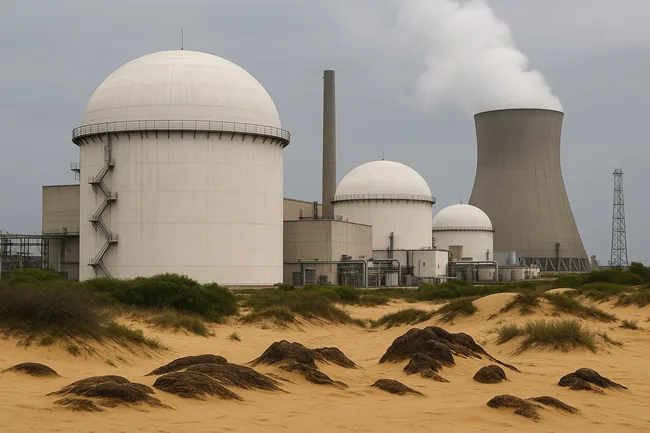





The Tata Power Company Limited (NSE: TATAPOWER; BSE: 500400) has set a 2030 target of ₹1 lakh crore in revenue, ₹10,000 crore in profit after tax and 30 GW of generation capacity. The roadmap includes 20 GW of renewable capacity, a proposed 10 GW ingot-and-wafer manufacturing project in Odisha, expanded electricity distribution operations and possible entry into nuclear power through small modular reactor opportunities. The company ended FY26 with ₹63,681 crore in revenue, ₹5,212 crore in net profit and approximately 16.3 GW of installed capacity, meaning it must lift revenue by about 12% annually, profit by nearly 18% and capacity by roughly 16.5% through 2030. The growth plan is supported by a previously outlined ₹1.46 lakh crore capital expenditure programme for FY25 to FY30, but several major projects remain subject to land, transmission, financing, regulatory and technology milestones. Tata Power shares closed at ₹377.20 on July 7, leaving the stock almost unchanged over five sessions but around 6.7% lower over one month and nearly 19% below its 52-week high.
Why does Tata Power’s ₹1 lakh crore revenue target require more than adding generation capacity?
The Tata Power Company Limited must increase annual revenue by more than ₹36,000 crore from the FY26 base to reach its 2030 target. That translates into compound annual growth of approximately 12%, which is achievable for a rapidly investing utility but still requires several business divisions to expand together. The company cannot depend only on building additional solar and wind projects because generation capacity takes time to construct and each megawatt produces a limited amount of contracted annual revenue.
The proposed growth model therefore spans generation, transmission, distribution, manufacturing, rooftop solar, electric vehicle charging, energy storage and customer-focused electricity services. These businesses carry different earnings characteristics. Regulated distribution and transmission can produce relatively predictable returns, while solar manufacturing and merchant power exposure are more sensitive to utilisation, market pricing and competition.
The ₹10,000 crore profit target is more demanding than the revenue target. Profit after tax must grow at an annual rate of almost 18%, significantly faster than revenue. This implies that The Tata Power Company Limited expects not only greater business volume but also improved operating leverage, a more profitable business mix and better utilisation of existing assets.
Net profit margin would need to rise from approximately 8.2% in FY26 to around 10% at the targeted 2030 revenue and profit levels. That improvement could come from higher renewable generation, stronger solar-manufacturing profitability, distribution efficiencies and the commissioning of projects whose development costs are currently being carried without corresponding operating revenue.
However, margin expansion cannot be assumed simply because scale increases. Large engineering and construction operations can generate substantial revenue with lower margins, while distribution businesses depend on regulatory decisions and collection efficiency. The Tata Power Company Limited must choose projects that improve returns rather than merely making the company larger.
How would a 30 GW generation portfolio change Tata Power’s earnings mix by 2030?
The Tata Power Company Limited plans to increase generation capacity from approximately 16.3 GW to 30 GW by 2030, with 20 GW expected to come from renewable sources. This would raise renewables to about two-thirds of the generation portfolio and reduce the relative importance of conventional thermal assets.
The capacity target requires the addition of nearly 14 GW in approximately four years. That represents an annual growth rate of about 16.5%, although the commissioning schedule will not be evenly distributed. Large solar, wind, hybrid and hydro projects typically arrive in clusters after land, transmission and construction milestones are completed.
A larger contracted renewable portfolio could strengthen earnings visibility because most utility-scale projects are developed against long-term power purchase agreements. These arrangements reduce direct exposure to short-term wholesale electricity prices, although returns remain dependent on project cost, financing rates, generation performance and the financial health of electricity purchasers.
The company also has approximately 5.1 GW of renewable projects under implementation, with management expecting around half to be completed during FY27 and the remainder in FY28. Delivering this existing pipeline will be the first test of whether the 30 GW target is supported by execution rather than only longer-term ambition.
The shift toward renewables will not immediately remove the importance of thermal generation. India’s electricity system continues to require dispatchable capacity, particularly during evening demand peaks and periods of weak wind or solar output. The Mundra power plant and other conventional assets could therefore remain relevant, provided fuel and tariff arrangements protect Tata Power from uncompensated imported-coal costs.
The portfolio increasingly needs storage and flexible generation around the renewable assets. Pumped hydro, battery systems and grid services can improve the quality of renewable electricity by moving production into periods of greater demand. A 20 GW renewable fleet without sufficient transmission and storage would produce capacity growth but not necessarily the strongest possible earnings.
Why could the proposed 10 GW Odisha solar project become both a competitive moat and a capital risk?
The Tata Power Company Limited plans to expand upstream solar manufacturing through a proposed 10 GW ingot-and-wafer facility in Odisha. The project would complement the company’s existing 4.3 GW solar cell and module plant at Tirunelveli and its manufacturing facility in Bengaluru, taking Tata Power deeper into the solar supply chain.
Domestic wafer production is strategically important because Indian solar manufacturers remain exposed to imported upstream materials. Regulatory requirements are also expected to favour domestic manufacturing across more stages of the value chain. Producing ingots and wafers internally could improve supply security for Tata Power’s cell and module operations and reduce dependence on overseas suppliers.
Vertical integration may also support margin capture. Instead of purchasing wafers from an external producer, The Tata Power Company Limited could retain more of the manufacturing value within its own group. The facility could supply internal renewable projects, third-party engineering customers and potentially external module manufacturers.
The proposed scale introduces substantial utilisation risk. A 10 GW facility must operate at high volumes to spread fixed costs efficiently. If domestic demand, pricing or policy support weakens, the company could be left with expensive manufacturing assets operating below their intended capacity.
Solar manufacturing is also highly competitive and technologically dynamic. Equipment can become less efficient relative to newer production lines, while global prices can fall rapidly when Chinese or other international producers expand output. Vertical integration provides supply control, but it also transfers manufacturing-cycle risk directly onto Tata Power’s balance sheet.
The Odisha project has not yet been formally sanctioned with a disclosed final investment decision, confirmed construction budget or commissioning timetable. Earlier indications placed potential investment near ₹10,000 crore, but investors should wait for definitive company disclosures before treating that amount as committed capital.
The commercial case will depend on customer commitments, technology selection, government incentives and the ability to align production with the requirement for Indian-made wafers from June 2028. A factory completed too late could miss the early demand window, while one built too quickly could carry underutilised capacity.
Is Tata Power’s nuclear ambition a real growth project or still a policy-dependent option?
The Tata Power Company Limited has confirmed its interest in entering nuclear power, particularly through smaller reactor formats, and is conducting feasibility work with three states. The company is also engaged with Nuclear Power Corporation of India Limited as it examines potential project structures and prepares detailed project reports.
This is more advanced than a general statement that nuclear energy looks interesting. Identifying possible states and undertaking feasibility studies indicates that management is evaluating land, cooling water, grid connections, customer demand and project economics. However, no Tata Power nuclear facility has received a final investment decision, construction approval or disclosed capital commitment.
India’s SHANTI Act has removed an important legal obstacle by enabling licensed private-sector participation under regulatory oversight. The policy change creates a route for The Tata Power Company Limited to own, develop or operate nuclear assets through approved structures that were previously unavailable to private utilities.
Nuclear power could complement Tata Power’s renewable portfolio by providing low-carbon electricity that is available regardless of weather conditions. Smaller reactor projects could also serve energy-intensive industrial customers, data centres or distribution regions seeking stable electricity alongside solar and wind generation.
The economic challenge remains considerable. Nuclear projects require substantial upfront capital, lengthy approvals, specialised supply chains and long construction periods. Small modular reactors may eventually reduce some engineering complexity through standardised designs, but many technologies have yet to demonstrate cost competitiveness through repeated commercial deployment.
Tata Power’s nuclear interest should therefore be valued as strategic optionality rather than included in base-case 2030 capacity forecasts unless the company provides a sanctioned project. Detailed project reports, licence applications, technology selection and a formal partnership structure with Nuclear Power Corporation of India Limited would mark the transition from exploration to investment.
How important are distribution and energy services to Tata Power’s ₹10,000 crore profit target?
The Tata Power Company Limited serves more than 13.1 million distribution customers across seven electricity distribution businesses in Mumbai, Delhi, Ajmer and Odisha. Distribution provides a recurring customer relationship that can support earnings from electricity supply, rooftop solar, charging, home-energy systems and energy-efficiency services.
The Odisha distribution businesses have become an important example of operational improvement. Profit from the Odisha utilities increased substantially during FY26 as collection, reliability and loss-reduction measures improved. This demonstrates that acquiring or managing underperforming distribution systems can create value when operational discipline is combined with regulatory support.
The company remains interested in additional state privatisation opportunities. Expanding into another large distribution territory could increase customers and regulated asset value, but each opportunity must be assessed against local loss levels, tariff adequacy, collection performance and the political willingness to approve economically necessary tariffs.
Distribution gives Tata Power a potential advantage over renewable developers that only sell wholesale electricity. The company can connect generation and manufacturing with the final customer, offering rooftop systems, electric vehicle charging, renewable supply contracts and digital energy services.
This energy-as-a-service model could improve customer retention and generate capital-light fee income. However, it also requires investment in digital platforms, billing, service networks and consumer acquisition. Individual products may appear small compared with utility-scale generation, but their combined value could become material across more than 13 million customer relationships.
The profit target will be easier to achieve if distribution improvements and customer services generate higher returns without requiring the same capital intensity as new generation. The risk is that regulatory delays or politically constrained tariffs weaken cash collection and offset gains elsewhere in the portfolio.
Can Tata Power fund ₹1.46 lakh crore of capital expenditure without stretching its balance sheet?
The Tata Power Company Limited previously outlined approximately ₹1.46 lakh crore of investment between FY25 and FY30, with around 60% directed toward renewable energy and related manufacturing. The scale of the programme is similar to the company’s current equity market value, illustrating how significantly the next investment cycle could reshape the group.
The company spent approximately ₹13,000 crore during FY26, below earlier expectations of around ₹22,000 crore to ₹25,000 crore. Management identified transmission availability, right-of-way problems and delays in external infrastructure as reasons some expenditure and project commissioning shifted into later periods.
The lower spending did not mean the projects had been cancelled. It means capital requirements may accumulate in FY27 and subsequent years as delayed renewable and transmission assets move forward. Investors should therefore avoid interpreting one year of lower capital expenditure as a permanent reduction in funding needs.
Net debt stood near ₹56,000 crore, with net debt to underlying EBITDA at approximately 3.3 times and net debt to equity around 1.2 times. These ratios are manageable for an infrastructure utility, but they leave limited room for uncontrolled project overruns across several business divisions.
The Tata Power Company Limited can fund expansion through operating cash flow, project debt, subsidiary-level financing, asset partnerships and selective equity capital. Contracted renewable assets and regulated networks can often support their own debt, reducing the need for every rupee to be financed at the parent-company level.
Solar manufacturing and early-stage nuclear development may be more challenging because cash flow arrives later and depends on utilisation or project approval. Management must avoid using stable distribution and transmission earnings to subsidise projects that do not meet return thresholds.
The credibility of the 2030 roadmap will therefore depend less on the total capital announced and more on capital sequencing. Tata Power needs to finance projects when land, transmission, customers and approvals are sufficiently advanced, rather than spending simply to maintain a public capacity target.
Why has Tata Power stock remained weak despite an ambitious 2030 growth roadmap?
The Tata Power Company Limited shares closed at ₹377.20 on July 7, declining 0.09% during the AGM session. The stock was approximately 0.5% higher than its July 1 close but around 6.7% below the June 8 close of ₹404.20.
The shares remained within a 52-week range of ₹342.50 to ₹464.90 and traded approximately 19% below the annual high. The company’s market capitalisation stood near ₹1.21 lakh crore, while the stock traded at roughly 31 to 32 times trailing earnings.
The muted AGM reaction indicates that much of the long-term transition narrative is already familiar to investors. The market has known about Tata Power’s 30 GW ambition, renewable expansion, manufacturing strategy and possible nuclear entry for several months. The July meeting provided stronger target framing but did not include enough new project sanctions to change near-term earnings forecasts.
Valuation also creates a higher execution bar. A company trading above 30 times earnings must generally deliver dependable profit growth and avoid material balance-sheet surprises. Capacity targets alone may not support a re-rating if projects are delayed or returns fall below expectations.
Published analyst positioning remains divided. Recent price targets have ranged from approximately ₹310 to ₹485, while aggregated estimates place the average target near ₹430. The wide range reflects disagreement over renewable growth, distribution improvements, capital intensity and the appropriate valuation for manufacturing and nuclear optionality.
The stock’s one-month weakness may therefore reflect investors demanding evidence rather than rejecting the strategy. Commissioning progress, cash flow and margin performance are likely to matter more than another long-range capacity slide.
What execution risks could prevent Tata Power from reaching its 30 GW and profit targets?
Transmission is one of the most immediate risks. Renewable projects may be mechanically complete yet unable to generate revenue if interstate or state transmission infrastructure is delayed. The Tata Power Company Limited already experienced this problem during FY26, when external grid and right-of-way constraints postponed planned project spending and commissioning.
Land availability can create similar delays. Utility-scale solar, wind, pumped hydro and nuclear projects require land access, environmental approvals and local support. A relatively small unresolved corridor can delay a much larger generation asset.
Manufacturing execution is another risk. The proposed Odisha plant must reach high utilisation, maintain competitive yields and keep pace with changes in solar technology. Large manufacturing capacity does not create value when products are more expensive or less efficient than competing imports.
Distribution growth depends on regulation. New privatisation opportunities may look attractive based on customer count, but they can become difficult investments if tariffs do not cover costs or political resistance prevents loss-reduction measures.
Nuclear projects carry the longest execution horizon. Licensing, site approvals, reactor technology and liability structures must all be resolved before meaningful construction begins. Nuclear capacity is unlikely to provide a quick solution to the 2030 profit target unless projects move unusually rapidly.
The final risk is management bandwidth. The Tata Power Company Limited is simultaneously expanding generation, transmission, distribution, manufacturing, storage, consumer services and potentially nuclear power. Integration creates competitive advantages, but it also multiplies the number of projects that must be executed correctly.
What should investors watch before treating Tata Power’s 2030 roadmap as bankable?
The first milestone will be commissioning of the existing 5.1 GW renewable pipeline. Completing approximately half during FY27 and the balance during FY28 would demonstrate that delayed transmission and land issues are being resolved.
The second milestone will be formal sanction of the Odisha manufacturing project. Investors need a confirmed investment amount, project phasing, technology choice, incentive package and commissioning schedule before assigning significant value.
The third milestone will be annual capital-expenditure delivery. Tata Power must show that spending delays are temporary while also avoiding a sudden acceleration that weakens leverage and free cash flow.
The fourth milestone will be profit margins. Revenue growth toward ₹1 lakh crore will matter less if profit does not grow faster. Investors should track whether renewable generation, manufacturing and distribution continue improving consolidated returns.
The fifth milestone will be nuclear project disclosure. Completion of detailed project reports, confirmed sites and a formal development structure would move the opportunity beyond feasibility-stage optionality.
The sixth milestone will be distribution expansion. New state opportunities should be assessed on return potential rather than customer numbers alone.
The final test will be cash conversion. The Tata Power Company Limited must fund dividends, debt servicing and new investments while maintaining the stated balance-sheet discipline. A 30 GW portfolio creates value only when the projects produce returns above their financing cost.
Key takeaways on what Tata Power’s 2030 roadmap means for the company and investors
- The Tata Power Company Limited is targeting ₹1 lakh crore in revenue, ₹10,000 crore in profit and 30 GW of generation capacity by 2030.
- Revenue must grow by approximately 12% annually from FY26, while profit must rise by nearly 18%, requiring margin improvement as well as scale.
- The planned 30 GW portfolio includes 20 GW of renewable capacity, increasing the strategic importance of storage and transmission.
- Approximately 5.1 GW of renewable projects already under implementation will provide the first major test of execution.
- The proposed 10 GW Odisha ingot-and-wafer facility could improve solar supply-chain integration but remains unsanctioned and exposed to manufacturing cycles.
- Nuclear power represents credible strategic optionality following India’s legal reforms, but Tata Power’s projects remain at the feasibility stage.
- Distribution and customer energy services could generate less capital-intensive earnings than generation and support the ₹10,000 crore profit target.
- The ₹1.46 lakh crore investment programme will require disciplined project sequencing as net debt already stands near ₹56,000 crore.
- Tata Power shares are down about 6.7% over one month and trade nearly 19% below their 52-week high as investors await execution evidence.
- Renewable commissioning, Odisha project sanction, margin growth, nuclear approvals and free-cash-flow discipline will determine whether the 2030 targets are achieved.
Share this:
Discover more from Business-News-Today.com
Subscribe to get the latest posts sent to your email.