



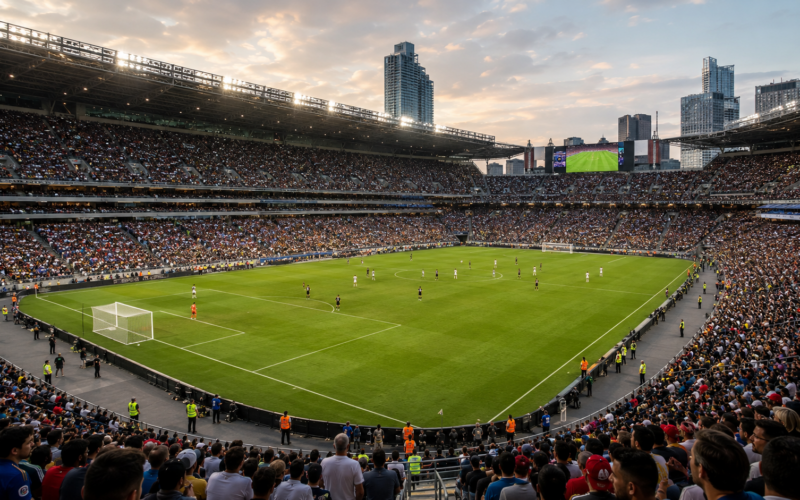
Ousmane Dembélé scored a first-half hat-trick as France defeated Norway 4-1 in their final FIFA World Cup 2026 Group I match at Boston Stadium in Foxborough, Massachusetts, on Friday, June 26, 2026. The match concluded during the early hours of June 27 in India and was watched by an official attendance of 64,146.
Dembélé opened the scoring in the seventh minute and added his second in the 20th, with Kylian Mbappé supplying both assists. Thelo Aasgaard responded for Norway one minute later, but Dembélé completed his hat-trick in the 32nd minute after receiving the ball from Aurélien Tchouaméni.
Norway had an opportunity to reduce the deficit early in the second half after Theo Hernández fouled Oscar Bobb inside the penalty area. Jørgen Strand Larsen took the spot kick, but Mike Maignan read the attempt and made a comfortable save.
Substitute Bradley Barcola created France’s fourth goal in the fourth minute of stoppage time, delivering a cross for Désiré Doué to head beyond Egil Selvik. France completed the group stage with three victories and nine points, while Norway progressed as runners-up despite the heavy defeat.
FIFA World Cup 2026 Norway 1-4 France full match scorecard and key incidents
How did Norway’s 10 starting changes leave their defensive structure exposed?
Norway had already secured qualification after victories over Iraq and Senegal. Ståle Solbakken therefore prioritised recovery and changed every starter except Leo Østigård, with Haaland, Ødegaard, Sander Berge, Julian Ryerson and Alexander Sørloth among the established players rested.
The decision was understandable because Norway had played a demanding 3-2 match against Senegal only four days earlier. However, the replacement lineup lacked the defensive coordination required against France’s rotating attacking unit.
Fredrik Bjørkan frequently became isolated against Dembélé, while Norway’s midfield failed to move across quickly enough when Mbappé dropped away from the centre-forward position. Dembélé repeatedly received the ball with time to face the defence and attack the same channel.
France issued a warning after approximately 20 seconds when Mbappé accelerated into the penalty area and struck the crossbar. Selvik then saved from Koné and Doué as Norway struggled to establish any control during the opening minutes.
Dembélé’s first goal followed the same structural weakness. Mbappé switched the ball towards the right, Dembélé attacked Bjørkan directly and created enough separation to drive his finish across the goalkeeper.
Why was Ousmane Dembélé able to score three similar goals in only 25 minutes?
Dembélé’s hat-trick was built on repetition that Norway failed to correct. The French winger repeatedly received on the right, moved onto his stronger left foot and targeted the far side of Selvik’s goal.
Mbappé created the second goal in the 20th minute by finding Dembélé near the edge of the penalty area. Norway allowed the winger to shift the ball away from pressure and curl another finish beyond Selvik.
Aasgaard reduced the deficit 79 seconds later, but the response did not change Norway’s defensive positioning. Dembélé continued receiving without an aggressive challenge from the full-back or supporting midfielder.
Tchouaméni supplied the third goal in the 32nd minute. Dembélé again created space inside and directed a low shot towards the same corner, completing his hat-trick before the match reached its first-half hydration break.
The three goals moved Dembélé to four for the tournament and into the Golden Boot race alongside Haaland and Mbappé. He also became only the third French player to score a FIFA World Cup hat-trick after Just Fontaine and Mbappé.
How did Kylian Mbappé dominate the match without scoring a goal?
Mbappé began centrally but regularly dropped into midfield or moved towards the left channel. Those movements prevented Norway’s centre-backs from holding a fixed defensive position and created direct passing lanes towards Dembélé.
His cross-field pass created the opening goal, while another progressive pass supplied Dembélé’s second. Mbappé finished the match with two assists and two shots on target despite being denied a goal.
The crossbar stopped his first opportunity before Norway had completed a controlled spell of possession. Mbappé later tested Selvik again and narrowly missed the top corner with a long-range effort during the second half.
France’s attack was particularly difficult to defend because Mbappé did not operate as a conventional striker. When he moved away from the centre, Doué, Michael Olise and Dembélé could attack the spaces he created.
Norway’s reserve defensive unit was therefore forced to choose between following Mbappé and leaving the central area open or remaining compact and allowing him to distribute without immediate pressure.
Why did Thelo Aasgaard’s goal fail to produce a sustained Norway comeback?
Norway responded quickly after Dembélé’s second goal. Schjelderup moved the ball infield from the left, and Aasgaard escaped Dayot Upamecano before driving a low finish beyond Maignan.
The goal demonstrated that France were not completely secure defensively. Norway could threaten whenever their wide players attacked quickly and avoided prolonged build-up against France’s counter-press.
The problem was that Norway did not protect the momentum. France immediately resumed controlling possession, and Dembélé restored the two-goal advantage 11 minutes later.
Aasgaard remained Norway’s most influential midfielder and later drew the challenge that produced Tchouaméni’s yellow card. However, the absence of Haaland and Ødegaard reduced the quality of Norway’s movement around the penalty area.
Strand Larsen worked hard as the central striker, but he rarely received the early service required to test France’s centre-backs before they could organise.
Why was Jørgen Strand Larsen’s missed penalty the decisive second-half moment?
Norway began the second half with greater aggression following the introductions of Pedersen and Thorsby. Bobb carried the ball into the penalty area and was caught by Hernández, giving Norway a clear route back into the contest.
Strand Larsen attempted to place the penalty towards Maignan’s right after using a delayed run-up. The shot lacked both power and placement, allowing the France goalkeeper to move across and save comfortably.
A successful penalty would have reduced France’s lead to 3-2 with approximately 40 minutes remaining. Norway’s confidence and the atmosphere inside Boston Stadium could have changed significantly.
Instead, France retained a two-goal cushion and began managing possession more conservatively. Norway continued creating occasional openings, but the missed penalty removed the strongest opportunity to turn the match into a genuine contest.
Maignan later denied Bobb in a one-on-one situation. Those saves prevented France’s defensive vulnerabilities from affecting the final result.
How did France adapt after Dembélé completed his first-half hat-trick?
France did not maintain the same attacking intensity throughout the second half. With first place effectively secured, the midfield reduced the speed of the game and prioritised possession.
Tchouaméni and Koné remained close enough to prevent Norway from building sustained pressure. Hernández and Jules Koundé also became more selective about advancing after the penalty incident.
Assistant coach Guy Stéphan, leading the team while Didier Deschamps was absent following a family bereavement, began protecting important attackers after the hour. Dembélé and Olise were replaced by Barcola and Cherki in the 65th minute.
The substitutions temporarily reduced France’s rhythm, but they also introduced fresh one-on-one quality against tiring defenders. Barcola’s speed created the final goal during stoppage time.
France’s ability to move from high-tempo attack to controlled possession was one of the most important features of the performance. The team did not need to maintain constant pressure to remain dangerous.
Why did Désiré Doué’s stoppage-time goal matter beyond the final score?
The fourth goal arrived after Norway had committed more players forward in search of a consolation. Barcola received possession on the left, reached the byline and delivered towards the far post.
Doué judged the flight of the cross and headed over Selvik into the top corner. It was his first goal of the tournament and ensured that France finished the group with 10 goals from three matches.
The goal also demonstrated the depth available to the French coaching staff. Barcola had entered from the bench, while Doué had started behind Mbappé and continued influencing the match after Dembélé and Olise were withdrawn.
France can select from Dembélé, Mbappé, Doué, Olise, Barcola, Cherki, Marcus Thuram and Jean-Philippe Mateta across the attacking positions. That depth allows tactical changes without a major reduction in individual quality.
Against Sweden, France may face a more compact defensive structure than Norway presented. The ability of substitutes to change the speed and width of the attack could become especially important.
How did the Senegal victory complete the final Group I standings?
France finished first with three victories, 10 goals scored and three conceded. Their perfect nine-point return ensured a Round of 32 match against Sweden.
Norway collected six points after defeating Iraq 4-1 and Senegal 3-2 before losing to France. They finished with eight goals scored and seven conceded, reflecting both their attacking power and defensive vulnerability.
Senegal recovered from two defeats by beating Iraq 5-0 in the simultaneous match. The victory lifted the African side to three points and a goal difference of plus two, which later secured qualification among the eight best third-placed teams.
Iraq finished without a point after conceding 12 goals across three matches. Their campaign ended with a heavy defeat against a Senegal team playing for its survival.
FIFA World Cup 2026 Group I final points table
What does France vs Sweden mean for the Round of 32?
France will face Sweden at New York New Jersey Stadium on Tuesday, June 30. Sweden finished third in Group F with four points after defeating Tunisia, losing heavily to the Netherlands and drawing with Japan.
Sweden possess dangerous attacking options in Alexander Isak, Viktor Gyökeres and Anthony Elanga. Their combination of physical power and direct running could test the spaces behind France’s advancing full-backs.
France will still begin as the stronger side because of their attacking depth and perfect group record. Dembélé’s movement from the right, Mbappé’s freedom across the front line and Doué’s ability to operate between midfield and defence create several different routes towards goal.
The principal warning from the Norway match was France’s second-half vulnerability. Aasgaard scored, Bobb won a penalty and later reached a one-on-one position, showing that France can be exposed when their midfield pressure becomes less coordinated.
Why could Norway’s decision to rest Haaland and Ødegaard benefit them against Ivory Coast?
Norway will face Ivory Coast at Dallas Stadium on Tuesday, June 30. The African champions finished second in Group E after defeating Ecuador and Curaçao and losing narrowly to Germany.
Solbakken accepted the risk of a heavy defeat because Norway had already qualified. Haaland, Ødegaard and several other starters will enter the knockout match without having played another physically demanding 90 minutes.
The calculation will be judged by the performance against Ivory Coast. Norway’s first-choice attack scored seven goals across the opening two matches, but the reserve defence showed how quickly the team can lose control without its established structure.
Ivory Coast possess fast wide players and a confident Nicolas Pépé, who scored twice against Curaçao. Norway will therefore need more disciplined protection around the full-backs while relying on Haaland to punish any space inside the Ivorian penalty area.
Key takeaways from Norway vs France at FIFA World Cup 2026
- France defeated Norway 4-1 and completed Group I with three victories from three matches.
- Ousmane Dembélé scored in the seventh, 20th and 32nd minutes to complete a 25-minute hat-trick.
- Kylian Mbappé assisted Dembélé’s first two goals and struck the crossbar inside the opening minute.
- Thelo Aasgaard scored Norway’s only goal after an assist from Andreas Schjelderup.
- Mike Maignan saved Jørgen Strand Larsen’s penalty early in the second half.
- Désiré Doué completed the scoring in stoppage time from Bradley Barcola’s cross.
- Norway made 10 starting changes and left Erling Haaland and Martin Ødegaard unused.
- France finished first in Group I with nine points, 10 goals scored and three conceded.
- Norway qualified in second place and will face Ivory Coast in the Round of 32.
- France will face Sweden, while Senegal also qualified through the best-third-place ranking.
Discover more from Business-News-Today.com
Subscribe to get the latest posts sent to your email.