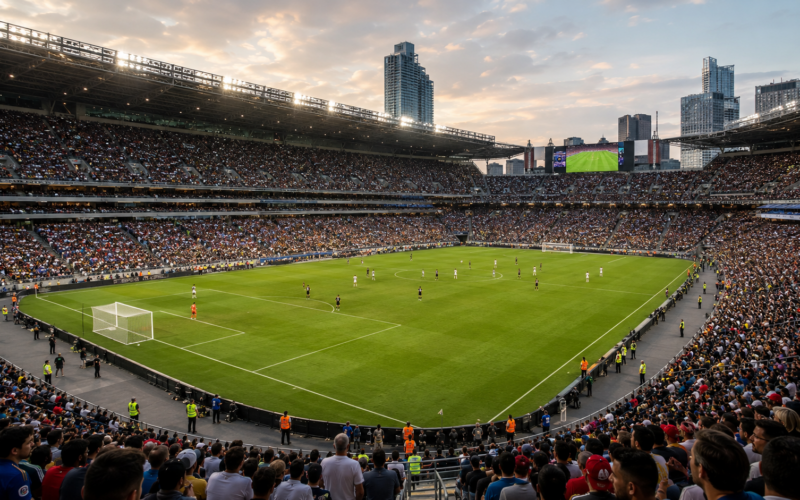
Senegal revived their FIFA World Cup 2026 campaign with a record-breaking 5-0 victory over Iraq at Toronto Stadium in Toronto, Canada, on Friday, June 26, 2026. The match concluded during the early hours of June 27 in India and was watched by an official attendance of 43,036.
Habib Diarra opened the scoring in the fourth minute by applying the decisive touch to Abdoulaye Seck’s goalbound header. Iraq’s task became substantially harder nine minutes later when Rebin Sulaka was sent off following a VAR review for denying Sadio Mané an obvious goalscoring opportunity.
Iraq resisted until half-time, but Senegal transformed the match after the interval. Ismaïla Sarr scored in the 56th minute, substitute Pape Gueye struck twice in the 59th and 71st minutes, and Iliman Ndiaye completed the five-goal victory in the 82nd.
The result left Senegal third in Group I with three points and a positive goal difference of plus two. Later results confirmed Pape Thiaw’s team as one of the eight best third-placed qualifiers, while Iraq finished last without a point and were eliminated from their first FIFA World Cup appearance in 40 years.
FIFA World Cup 2026 Senegal 5-0 Iraq full match scorecard and key incidents
How did Habib Diarra’s early goal and Rebin Sulaka’s red card reshape the match?
Senegal entered the match needing more than a routine victory. Defeats against France and Norway had left the Lions of Teranga without a point, meaning goal difference could decide whether a win was sufficient to survive through the third-place ranking.
The urgency was visible from the opening minutes. Senegal won an early corner, and Seck directed a header towards goal. Diarra reacted inside the six-yard area and supplied the decisive touch before Iraq’s defenders could clear.
The fourth-minute goal gave Senegal the ideal start, but the match’s structural turning point arrived in the 13th minute. Sulaka pulled Mané down approximately 20 yards from goal as the Senegal forward moved towards a clear scoring opportunity.
Referee Anthony Taylor initially showed a yellow card. VAR recommended an on-field review, after which the punishment was upgraded to a direct red card because Sulaka had denied an obvious goalscoring opportunity.
Iraq responded by withdrawing Ahmed Qasim and introducing Younus to restore a four-player defensive line. That decision helped Graham Arnold’s team survive the remainder of the first half, but it also removed an attacking player from a team already struggling to create chances.
Why did Senegal struggle before half-time despite playing against ten Iraqi players?
Senegal had numerical superiority for more than 30 minutes before half-time, but their attacking play initially became slower rather than more decisive. Iraq retreated into a narrow defensive block and allowed Senegal to possess the ball outside the penalty area.
Idrissa Gueye, Lamine Camara and Diarra circulated possession comfortably, yet Iraq protected the central route towards Mané. The wide players frequently received while standing still, allowing Doski and Frans Putros enough time to close crossing angles.
Mané came closest to adding the second goal with a free kick that Basil pushed away. Senegal also produced several corners, but the deliveries were either cleared at the first contact or directed into areas where Iraq retained numerical strength.
Iraq’s defensive effort deserves recognition. Arnold’s side had lost a centre-back, reorganised after only 16 minutes and then resisted a team possessing greater speed and technical quality.
The problem for Iraq was the physical cost of that resistance. Their midfielders and full-backs spent the first half moving laterally across the pitch, while Senegal retained 69% possession and forced them to defend repeated second phases.
How did Lamine Camara and Ismaïla Sarr finally unlock Iraq after the interval?
Senegal’s second-half improvement began with more aggressive counter-pressing. Rather than allowing Iraq to clear possession and reset, the midfield immediately surrounded the first receiver and recovered the ball closer to goal.
The second goal emerged from that pressure. Zidane Iqbal initially protected possession near Iraq’s penalty area, but Camara recovered the ball and accelerated into the space behind the defensive line.
Camara delivered across the six-yard area, where Sarr arrived ahead of the retreating defender and converted from close range. The goal ended Iraq’s resistance and gave Senegal the margin required to pursue a larger goal-difference swing.
Sarr’s movement was important throughout the match. He began on the right but repeatedly attacked the inside channel, forcing Doski to choose between protecting the touchline and following the forward towards goal.
The goal was Sarr’s fourth across his FIFA World Cup career, moving him ahead of Papa Bouba Diop as Senegal’s leading scorer at the tournament. He had previously scored at the 2022 competition and twice against Norway earlier in the 2026 group stage.
Why did Pape Gueye transform the match only 89 seconds after entering?
Thiaw made an aggressive triple substitution immediately after Sarr’s goal. Gueye, Ndiaye and Nicolas Jackson replaced Diarra, Ibrahim Mbaye and Camara, giving Senegal fresh movement against an exhausted defensive unit.
Gueye required only 89 seconds to make an impact. Sarr moved the ball into his path outside the penalty area, and the midfielder curled a powerful left-footed strike beyond substitute goalkeeper Hassan.
The goal was technically significant because Iraq had protected the central penalty area effectively. Gueye avoided the crowded zone entirely by shooting from distance before the midfield could close him.
His second goal in the 71st minute came through a different route. Ndiaye won the aerial contact and directed the ball towards Gueye, who attacked the space inside the penalty area and drove another left-footed finish into the bottom corner.
Gueye completed his contribution by assisting Ndiaye’s fifth goal. The substitute collected possession in midfield and released Ndiaye, who carried the ball forward before striking from outside the penalty area.
The midfielder therefore recorded two goals and one assist after entering in the 57th minute. His performance changed Senegal’s position from a team holding a modest 2-0 victory to one possessing the goal difference required for eventual qualification.
What did Iliman Ndiaye add to Senegal’s increasingly fluid second-half attack?
Ndiaye operated with greater freedom than Senegal’s starting wide players. He moved between the right channel, central midfield and the area behind Jackson, making it difficult for Iraq’s reduced defensive structure to assign a consistent marker.
His headed pass created Gueye’s second goal. Rather than attempting to control the ball under pressure, Ndiaye redirected it immediately into the midfielder’s forward path.
Ndiaye then scored the fifth goal in the 82nd minute. He received from Gueye, carried the ball approximately 20 yards and drove a right-footed shot beyond Hassan.
The goal completed Senegal’s largest FIFA World Cup victory and made them the first African team to score five times in a match at the competition. It also moved their overall group goal difference from negative to plus two.
Ndiaye’s impact strengthened his case for a starting place in the Round of 32. His ability to connect midfield and attack may become particularly valuable against a group winner capable of pressing Senegal’s deeper players.
Why did Sadio Mané remain influential despite finishing without a goal or assist?
Mané did not register a direct goal contribution, but his movement affected several decisive moments. Sulaka’s red card occurred because the defender could not recover after Mané accelerated beyond him towards goal.
The forward also remained involved in Senegal’s build-up, often moving towards midfield to create space for Sarr and Mbaye to attack behind the Iraqi full-backs.
Mané nearly scored during the second half when his looping effort struck the right post. By that stage, Iraq’s defensive block had collapsed and Senegal were creating opportunities from several different angles.
Thiaw later praised the experienced forward’s willingness to press, recover and contribute without requiring the attack to be built around him. That collective role will remain important if Senegal face a stronger opponent in the knockout stage.
Why did Iraq’s resistance collapse so quickly after the second Senegal goal?
Iraq’s defensive organisation had been built around maintaining narrow distances and protecting the penalty area. Once Sarr scored, Arnold’s players had to decide whether to continue defending deeply or move forward in search of an unlikely comeback.
The hesitation created larger gaps between midfield and defence. Senegal’s substitutes entered at exactly the right moment and attacked those spaces before Iraq could establish another compact line.
The change of goalkeeper also affected continuity. Basil had made several important first-half saves but was replaced by Hassan at half-time because of injury.
Hassan faced Senegal’s strongest attacking period immediately after entering. He conceded four times, although the quality of Gueye’s two strikes and Ndiaye’s finish left him with limited opportunity to intervene.
Iraq completed the match with only one shot on target and an expected-goals total below 0.20. Their attacking limitations meant Senegal could commit players forward without facing a substantial counterattacking threat.
What does the defeat mean for Iraq after returning to the FIFA World Cup?
Iraq qualified for the competition for only the second time and made their first appearance since 1986. The return carried considerable national significance, but the group exposed the gap between qualifying success and competing against established tournament teams.
Arnold’s side lost to France, Norway and Senegal, scoring once and conceding 12 goals. The early red card in Toronto made the final match especially difficult, but defensive errors had also affected the earlier defeats.
The campaign nevertheless gave players such as Iqbal, Ali Jasim, Ali Al-Hamadi and Doski experience at the highest level. Iraq’s next development cycle must convert that experience into stronger defensive decision-making and more controlled possession under pressure.
Arnold acknowledged that Sulaka’s challenge made an already difficult match substantially harder. Iraq’s immediate task will be reviewing how the team can retain its competitiveness without becoming overly dependent on deep defensive resistance.
How did Senegal qualify with only three points from the group stage?
Senegal lost 3-1 to France and 3-2 to Norway before defeating Iraq. Those results gave them three points, eight goals scored, six conceded and a goal difference of plus two.
The expanded FIFA World Cup format allows eight of the 12 third-placed teams to enter the Round of 32. Senegal’s five-goal victory therefore became more valuable than a narrow win because goal difference was the principal tiebreaker among teams finishing with the same points total.
Later results in Groups G and H ensured that enough third-placed teams finished below Senegal’s record. The Lions of Teranga consequently secured qualification despite losing their opening two fixtures.
The outcome demonstrated both the opportunity and the risk created by the expanded format. Senegal were close to elimination but transformed their position through one dominant performance against a reduced opponent.
FIFA World Cup 2026 Group I final points table
What does Senegal’s provisional Round of 32 route mean for Pape Thiaw’s team?
Senegal’s qualification was confirmed before Groups J, K and L had completed their final matches. The exact knockout allocation therefore remained subject to the final combination of third-placed qualifiers.
England were the provisional opponent while leading Group L. If that matchup is confirmed, Senegal would face a substantially different challenge from ten-player Iraq.
England possess greater midfield control, more dangerous runners between the lines and defenders capable of handling direct attacks. Senegal would need to reproduce the aggressive second-half tempo from Toronto without relying on numerical superiority.
Gueye’s performance has given Thiaw an important selection decision. The midfielder’s shooting and late forward movement may justify a starting place, while Ndiaye’s impact also strengthens his claim.
Senegal’s defensive structure will require equal attention. France scored three against them and Norway added another three, meaning the clean sheet against Iraq did not erase the vulnerabilities exposed earlier in the group.
Key takeaways from Senegal vs Iraq at FIFA World Cup 2026
- Senegal defeated Iraq 5-0 and later qualified for the Round of 32 as one of the best third-placed teams.
- Habib Diarra opened the scoring in the fourth minute after applying the decisive touch to Abdoulaye Seck’s header.
- Rebin Sulaka was sent off in the 13th minute after VAR upgraded his initial yellow card.
- Iraq resisted until half-time despite playing more than 30 minutes with ten players.
- Ismaïla Sarr scored Senegal’s second goal and became the country’s leading FIFA World Cup scorer.
- Pape Gueye entered in the 57th minute and scored twice within 14 minutes.
- Gueye also assisted Iliman Ndiaye’s fifth goal to finish with three direct goal contributions.
- Senegal attempted 28 shots, recorded 12 on target and controlled more than 69% possession.
- The 5-0 result became the largest FIFA World Cup victory recorded by an African national team.
- Iraq finished Group I without a point, while Senegal’s exact Round of 32 opponent awaited the final allocation.
Discover more from Business-News-Today.com
Subscribe to get the latest posts sent to your email.