



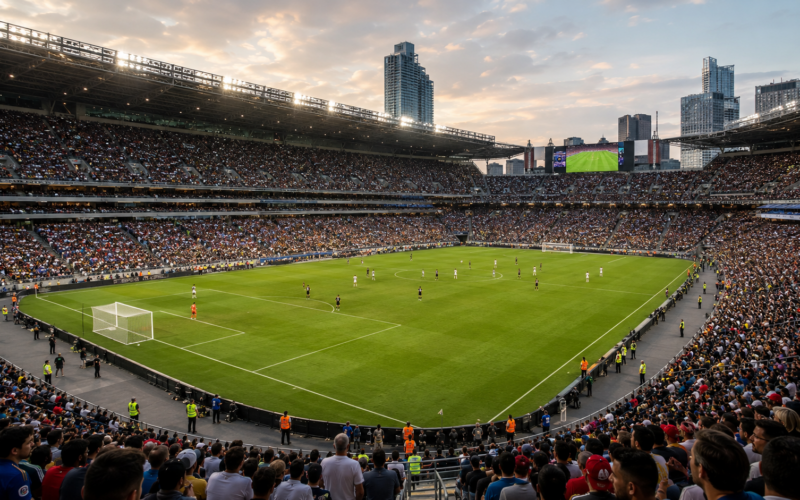
Cape Verde reached the FIFA World Cup knockout stage on their tournament debut after drawing 0-0 with Saudi Arabia at Houston Stadium in Houston, Texas, on Friday, June 26, 2026. The match concluded during the early hours of June 27 in India and was watched by an official attendance of 68,278.
The Blue Sharks created the clearer opportunities but could not convert 15 attempts into a goal. Mohammed Al Owais denied Jamiro Monteiro shortly after half-time and produced the match’s most important save against substitute Laros Duarte in the 74th minute.
Saudi Arabia required a victory to maintain a realistic qualification route but struggled to create sustained pressure. Mohamed Kanno tested Vozinha with a header during first-half stoppage time, while Abdullah Al-Hamdan’s late effort was held by the Cape Verde goalkeeper.
Spain’s simultaneous 1-0 victory over Uruguay ensured that Cape Verde finished second in Group H with three points from three draws. The result created a Round of 32 meeting with defending champions Argentina, while Uruguay and Saudi Arabia were eliminated.
FIFA World Cup 2026 Cape Verde 0-0 Saudi Arabia full match scorecard and key incidents
Why did Cape Verde play with greater attacking ambition than in their draw against Spain?
Cape Verde’s opening draw against Spain had been defined by deep defending, limited possession and goalkeeper Vozinha’s interventions. Against Saudi Arabia, Bubista asked his team to take greater control because victory would guarantee qualification without depending on the simultaneous result.
The change was visible in the positioning of Wagner Pina, João Paulo and the midfielders. Cape Verde’s wide players advanced earlier, while Deroy Duarte and Jamiro Monteiro attempted to receive beyond Saudi Arabia’s midfield rather than remaining close to their defenders.
Ryan Mendes and Willy Semedo also moved infield to support Dailon Livramento. Their rotations created shooting opportunities from the edge of the penalty area and forced the Saudi full-backs to defend narrower than they preferred.
Cape Verde consequently finished with more possession, more than twice as many attempts and 12 chances created. They no longer looked like a team attempting merely to survive against a higher-ranked opponent.
The weakness remained the final action. Only two of the 15 attempts reached Al Owais, preventing the Blue Sharks from converting territorial superiority into the victory their performance deserved.
How did Saudi Arabia’s early bookings shape their defensive approach?
Saud Abdulhamid received a yellow card after only four minutes, while Wagner Pina was booked for Cape Verde four minutes later. The early cautions created immediate restrictions for two players operating in important wide areas.
Abdulhamid could no longer challenge as aggressively when Semedo or Mendes attacked his side. Saudi Arabia therefore relied more heavily on Nasser Al Dawsari and Mohamed Kanno moving across to protect the full-back.
Cape Verde recognised the opportunity and regularly shifted possession towards that flank. Semedo cut inside for an early shot, while João Paulo and Monteiro supplied support around the edge of the penalty area.
Saudi Arabia committed 16 fouls, six more than Cape Verde. The figure reflected their difficulty stopping transitions cleanly whenever Cape Verde moved the ball beyond the first midfield challenge.
Nasser Al Dawsari was subsequently booked in the 67th minute, further reducing Saudi Arabia’s ability to press with physical intensity during the closing phase.
How did Hassan Al Tambakti’s injury affect Saudi Arabia’s defensive organisation?
Al Tambakti required treatment after approximately half an hour and was eventually carried from the field. Ali Lajami replaced him in the 33rd minute.
The enforced change interrupted Saudi Arabia during a phase when Cape Verde had begun controlling the match. Lajami had to enter without a prolonged warm-up and immediately organise alongside Abdulelah Al Amri.
Saudi Arabia protected the central area reasonably well despite the disruption. Cape Verde attempted eight shots off target and had another five blocked, showing that the defensive line continued placing bodies between the ball and Al Owais.
However, the injury reduced Saudi Arabia’s substitution flexibility. Georgios Donis had to use one change on the centre-back position before he could address his team’s lack of creativity in midfield and attack.
That limitation became more important after half-time, when Saudi Arabia needed a goal but Cape Verde increasingly controlled the dangerous spaces.
Why did Cape Verde’s clearest chances arrive immediately after the interval?
Cape Verde began the second half with greater urgency because news from Guadalajara showed Spain moving ahead against Uruguay. That result placed the Blue Sharks second in the live standings, but one Saudi goal could still have overturned their position.
Monteiro produced the first major chance in the 48th minute. Wagner Pina advanced on the right and delivered into the central area, where Monteiro’s first-time effort forced Al Owais to make a save.
Kevin Pina then shot narrowly over from outside the penalty area before Ryan Mendes had an effort blocked. Cape Verde’s passing had become quicker, and their midfielders were arriving around the penalty area before Saudi Arabia could establish a compact block.
Bubista strengthened that momentum by introducing Nuno da Costa and Hélio Varela in the 61st minute. The changes added greater physical presence through the centre and fresh running from the wide areas.
Cape Verde’s problem was that the strong phase did not produce a goal. Saudi Arabia remained within one successful attack of eliminating them until the final whistle.
Why was Mohammed Al Owais’ save from Laros Duarte the match’s decisive intervention?
Laros Duarte entered in the 71st minute and almost scored three minutes later. Nuno da Costa received possession between the Saudi midfield and defence before releasing Duarte through the centre.
Duarte reached the penalty area with only Al Owais to beat. The goalkeeper remained upright, reduced the shooting angle and blocked the effort with a strong central save.
The opportunity was recorded as Cape Verde’s only major missed chance. It also accounted for a substantial part of their expected-goals advantage.
Pico Lopes headed over from the resulting corner, extending a sequence in which Cape Verde repeatedly reached dangerous positions without applying the required finish.
Had Duarte scored, Cape Verde’s qualification would have been secured through their own victory. Instead, the players had to protect the draw and wait for confirmation that Spain had defeated Uruguay.
Why did Saudi Arabia create so little despite needing a victory to survive?
Saudi Arabia entered the final round knowing that a win could move them above Cape Verde and potentially into second place. Their attacking performance did not match the urgency of that requirement.
The midfield completed a reasonable number of passes but rarely moved Cape Verde’s defensive block out of position. Kanno and Abdullah Al Khaibari frequently received in front of the opposition midfield rather than beyond it.
Salem Al Dawsari was surrounded whenever he moved inside, while Feras Al Buraikan received limited service in central areas. Sultan Mandash also struggled to create separation against the Cape Verde defenders.
The first shot on target did not arrive until first-half stoppage time, when Kanno headed directly at Vozinha. Abu Al Shamat tested the goalkeeper after entering, but the attempt came from an angle that favoured the Cape Verde captain.
Saudi Arabia completed the tournament with only one goal from three matches. Their inability to create against Cape Verde therefore reflected a wider attacking problem rather than one poor evening.
How did Vozinha manage the pressure of another historic Cape Verde result?
Vozinha had been the central figure in Cape Verde’s opening draw against Spain, making several saves during a match dominated by the European champions. He faced less continuous pressure in Houston but still had to maintain concentration.
Kanno’s first-half header arrived after long periods in which the goalkeeper had little direct involvement. Vozinha positioned himself correctly and caught the attempt without creating a rebound.
His save from Abu Al Shamat required sharper movement, with the goalkeeper pushing across to stop a shot directed towards the upper corner. He then collected Al-Hamdan’s stoppage-time effort as Saudi Arabia attempted one final attack.
The 40-year-old completed the group stage with two clean sheets. His leadership also helped a defensive unit containing several players with limited exposure to football at this level.
Cape Verde’s achievement was not built on goalkeeper heroics alone. However, Vozinha’s reliability ensured that moments of pressure did not undo the collective organisation around him.
Why did three draws prove enough for Cape Verde to finish second in Group H?
Cape Verde began their first FIFA World Cup by holding Spain 0-0. They then recovered twice to draw 2-2 with Uruguay before completing the group with another stalemate against Saudi Arabia.
The three results gave them three points, two goals scored, two conceded and a neutral goal difference. Spain finished first with seven points after defeating Saudi Arabia and Uruguay.
Uruguay and Saudi Arabia both ended with two points. Uruguay placed third because of their superior goal difference, but two points were insufficient to progress through the best-third-place ranking.
Cape Verde therefore advanced automatically rather than depending on the third-place route. They also became one of the rare teams to reach the knockout stage without winning a group match.
More significantly, the island country became the smallest nation by population to reach the knockout phase of the men’s FIFA World Cup. A team representing roughly half a million people had finished above two countries with established tournament histories.
FIFA World Cup 2026 Group H final points table
What does the Argentina matchup mean for Cape Verde’s historic campaign?
Cape Verde will face Argentina at Miami Stadium on Friday, July 3. The match places the smallest country in the knockout bracket against the defending FIFA World Cup champions.
Bubista is unlikely to abandon the organisation that delivered three unbeaten performances. Cape Verde will defend with a compact central structure, protect the spaces around Lionel Messi and attempt to attack through Mendes, Hélio Varela and Livramento.
Argentina will present a different level of attacking movement from Saudi Arabia. Their midfield can circulate possession more quickly, while Messi’s ability to receive between defensive lines will test Cape Verde’s concentration.
Cape Verde’s opportunity may emerge during transitions. Argentina’s full-backs advance aggressively, and the Blue Sharks have shown they can counterattack through direct running and early forward passes.
Finishing will need to improve. Cape Verde cannot expect 15 attempts against the defending champions, meaning any opportunity created in Miami must be handled with greater composure than the chances missed in Houston.
Why does Saudi Arabia leave the tournament with major attacking questions?
Saudi Arabia collected draws against Uruguay and Cape Verde but suffered a 4-0 defeat to Spain. Their two points were not enough to escape the group.
The defensive performances against Uruguay and Cape Verde were competitive, yet Donis’ team rarely established control in the attacking third. One goal across three matches left no margin for defensive mistakes or unfavourable results elsewhere.
Al Dawsari remained the principal creative threat, but opponents could concentrate several defenders around him because the surrounding players offered insufficient movement. Al Buraikan also received too few passes inside high-value areas.
The Saudi federation must now determine whether the problem was primarily tactical or reflected the available attacking personnel. The team reached useful positions but lacked the speed, combination play and finishing required to convert possession into tournament victories.
Key takeaways from Cape Verde vs Saudi Arabia at FIFA World Cup 2026
- Cape Verde drew 0-0 with Saudi Arabia and qualified for the Round of 32 on their FIFA World Cup debut.
- The Blue Sharks finished second in Group H after recording three consecutive draws.
- Cape Verde attempted 15 shots and produced the higher expected-goals figure but could not score.
- Mohammed Al Owais denied Jamiro Monteiro shortly after half-time.
- Al Owais made the match’s decisive save from Laros Duarte during a one-on-one chance in the 74th minute.
- Vozinha saved Mohamed Kanno’s first-half header and protected the draw during Saudi Arabia’s late pressure.
- Hassan Al Tambakti was carried from the field and replaced by Ali Lajami in the 33rd minute.
- Spain’s 1-0 victory over Uruguay confirmed Cape Verde’s second-place finish.
- Cape Verde became the smallest nation by population to reach the men’s FIFA World Cup knockout stage.
- Cape Verde will face defending champions Argentina in Miami, while Saudi Arabia were eliminated.
Discover more from Business-News-Today.com
Subscribe to get the latest posts sent to your email.