






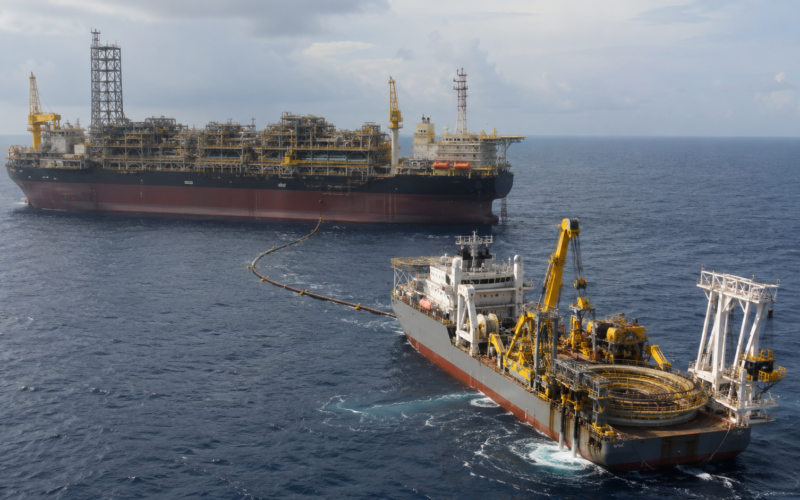
TechnipFMC plc (NYSE: FTI) has secured a contract valued within its $75 million to $250 million significant award category to design and manufacture flexible flowlines and risers for Azule Energy’s Greater PAJ development offshore Angola. The equipment will connect wells in water depths approaching 2,000 metres to a new floating production, storage and offloading vessel. The award will be recorded in TechnipFMC’s second-quarter 2026 inbound orders and provides another contribution toward management’s target of approximately $10 billion in Subsea orders during the year. More importantly, the contract attaches TechnipFMC to a $5.1 billion offshore development at final investment decision stage, strengthening its exposure to the emerging deepwater investment cycle across Angola and the wider West African market.
Why does TechnipFMC’s Greater PAJ contract matter beyond its disclosed value range?
The financial value of TechnipFMC’s Greater PAJ award is deliberately presented as a broad range. Under TechnipFMC’s contract classification system, a significant award can be worth between $75 million and $250 million. That means the precise revenue contribution, margin profile and delivery schedule will remain unclear until the work progresses through the company’s backlog.
Even at the upper end, the award is not large enough by itself to transform the valuation of a company with a market capitalisation approaching $27 billion. Its strategic value instead comes from customer continuity, regional positioning and the potential to secure related work as Greater PAJ moves from engineering into construction, installation, commissioning and eventual operating support.
TechnipFMC already has an established relationship with Azule Energy through previous flexible pipe and subsea production system contracts in Angola. The latest award therefore reflects repeat business rather than an isolated market entry. Repeat awards can carry better commercial characteristics because engineering knowledge, project interfaces, customer requirements and regional execution processes are already familiar to both parties.
The timing is also important. Greater PAJ has moved through final investment decision, substantially reducing the risk that the contract remains attached to a project that never progresses. Final investment approval does not eliminate schedule or funding risk, but it converts Greater PAJ from a prospective opportunity into a sanctioned development with defined production infrastructure, contractors and a targeted start-up date.
For TechnipFMC, the immediate benefit is additional backlog visibility. The deeper value lies in being selected for a technically critical component of a project that could reinforce Angola’s offshore supply chain for the remainder of the decade.
How does the $5.1 billion Greater PAJ development reshape Angola’s offshore strategy?
Greater PAJ represents Angola’s first integrated development connecting resources across two adjacent offshore concessions. The project combines the Palas, Astraea and Juno discoveries in Block 31 with the Urano and Dione fields in Block 31/21, creating a larger development rather than treating each discovery as a separate investment decision.
This model can improve capital efficiency by spreading the cost of an FPSO, gas export infrastructure, subsea equipment and offshore installation across a wider reserve base. It also provides Angola with a practical route to commercialising discoveries that might struggle to justify standalone production facilities.
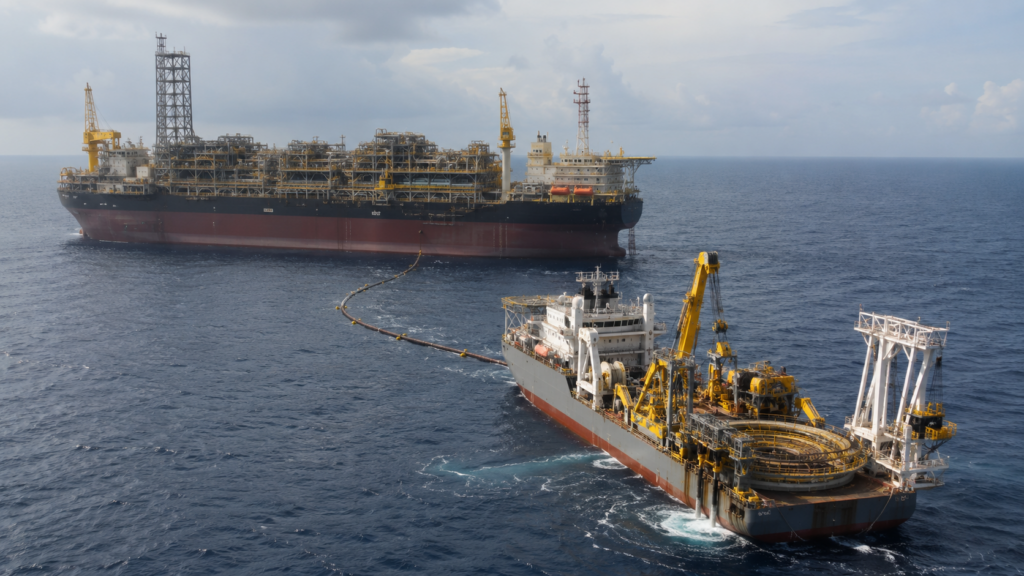
The development will comprise 17 wells connected to a new FPSO with capacity to process approximately 95,000 barrels of oil per day. The facility will also have gas export capacity of around 70 million standard cubic feet per day, with gas expected to move through a new export line connected to the existing Block 31 network and onward to the Angola LNG system.
That gas component is strategically relevant. Angola is attempting to sustain crude production while also monetising gas that might previously have been reinjected, flared or left undeveloped. Greater PAJ therefore supports both oil production and improved utilisation of existing LNG infrastructure.
First oil is targeted for the first half of 2029. Achieving that timetable would give Angola additional production as mature offshore fields continue to decline. It would also demonstrate whether the country’s revised fiscal and regulatory approach can convert discovered resources into sanctioned projects quickly enough to stabilise national output.
The broader signal is that Angola remains capable of attracting multibillion-dollar deepwater investment despite competition from Brazil, Guyana, the Gulf of Mexico and other offshore provinces. Greater PAJ will not reverse national production decline on its own, but it could become an important bridge between existing output and the next generation of offshore developments.
What does the award reveal about TechnipFMC’s subsea order pipeline and margin quality?
TechnipFMC entered 2026 with substantial revenue visibility. At the end of the first quarter, company backlog stood at approximately $16.47 billion, up from about $15.82 billion one year earlier. First-quarter revenue reached $2.49 billion, while adjusted EBITDA increased to $466 million and the adjusted EBITDA margin expanded to 18.7%.
Those numbers show that the investment case has moved beyond simple order accumulation. Investors are increasingly focused on whether TechnipFMC can convert its backlog into higher-margin revenue, stronger free cash flow and shareholder distributions without allowing project complexity or manufacturing constraints to erode returns.
The Greater PAJ contract supports the order side of that equation. Its maximum disclosed value would represent around 2.5% of TechnipFMC’s $10 billion annual Subsea order objective, while the lower end would contribute less than 1%. The contract is therefore useful rather than decisive, but a series of awards in this range can materially improve annual intake and extend manufacturing visibility.
Contract mix will matter as much as contract volume. A flexible pipe supply award provides a different risk profile from a full integrated engineering, procurement, construction and installation contract. TechnipFMC controls the design and manufacturing scope, but the company is not carrying every element of offshore installation, FPSO delivery and field integration within this particular announcement.
That narrower scope can reduce some execution exposure, although it also limits the total addressable contract value. The balance may still be attractive because flexible pipe technology represents a specialised, technically demanding product with fewer qualified suppliers than more commoditised offshore equipment.
The strongest interpretation is that Greater PAJ reinforces TechnipFMC’s ability to win selective, technology-led work while maintaining a large integrated subsea portfolio elsewhere. That mix can help protect margins if management remains disciplined when allocating manufacturing capacity and bidding for projects.
Why is flexible pipe technology critical for Greater PAJ’s 2,000-metre water depths?
Flexible flowlines transport produced fluids between subsea wells, manifolds and processing facilities, while flexible risers connect seabed infrastructure to floating production systems. At Greater PAJ, these systems must operate in water depths approaching 2,000 metres while accommodating pressure, temperature, vessel movement and long-term fatigue.
The flexible design allows the system to respond to movement from the FPSO and changing offshore conditions. This is particularly important in deep water, where rigid connections may require different installation configurations and additional engineering to manage dynamic loads.
The engineering challenge is not limited to depth. Materials must withstand the chemical composition of the produced fluids, external hydrostatic pressure and internal operating conditions throughout the field’s intended life. Manufacturing tolerances, qualification testing and interface management will therefore be critical to long-term reliability.
A failure after installation could be expensive because repairs in ultra-deep water require specialised vessels, complex intervention campaigns and production downtime. That places a premium on design assurance and manufacturing quality before the pipe leaves the factory.
TechnipFMC’s value proposition rests partly on reducing these lifecycle risks rather than merely supplying pipe by length. The company must demonstrate that its system can be manufactured on schedule, integrated with equipment supplied by other contractors and installed without creating delays for the wider development.
The accelerated project timetable increases that pressure. First oil in the first half of 2029 leaves less than three years to complete engineering, manufacturing, FPSO work, subsea fabrication, offshore installation, well activity and commissioning. Flexible pipe delivery must therefore remain aligned with several other workstreams that TechnipFMC does not fully control.
How will Saipem’s $1 billion installation scope shape TechnipFMC’s execution exposure?
Saipem has secured a separate contract worth approximately $1 billion covering engineering, fabrication, transportation and installation services for Greater PAJ. Saipem’s work includes around 180 kilometres of rigid pipelines and subsea facilities, together with the transportation and installation of flexible flowlines, jumpers and umbilicals.
This division of responsibilities creates a major project interface. TechnipFMC will design and manufacture flexible systems, while Saipem will handle significant offshore transportation and installation activities. The two contractors must align engineering specifications, delivery dates, vessel campaigns, handling procedures and offshore readiness.
The arrangement limits TechnipFMC’s direct exposure to construction vessel availability and offshore installation productivity. However, it does not completely separate the company from installation risk. Delays in pipe delivery could disrupt Saipem’s vessel schedule, while installation difficulties could trigger technical reviews, additional engineering or disputes over responsibility.
Saipem plans to use its FDS and Castorone construction vessels and will conduct fabrication activity through its Ambriz yard in Angola. The local fabrication component supports Angola’s domestic-content strategy and could help maintain political and regulatory support for the project.
For TechnipFMC, successful coordination would strengthen its credentials as a specialist supplier capable of integrating with major offshore contractors. Poor interface management would have the opposite effect, particularly because Greater PAJ is being delivered on an accelerated timetable.
The procurement structure also shows how large offshore projects are increasingly divided among technology suppliers, subsea specialists, installation contractors and FPSO providers. No single contractor carries the entire development, but every major package remains dependent on the others.
What does TechnipFMC’s recent stock performance say about investor expectations?
TechnipFMC shares closed at $67.39 on June 22, 2026, rising 3.41% during the session in which the Greater PAJ contract was announced. The stock remained below its 52-week high of $77.78 but substantially above its 52-week low of $31.88.
Over the five trading sessions from June 12 to June 22, TechnipFMC shares declined by approximately 4.8%. Compared with the May 22 closing price, the stock was about 5.1% lower over the preceding month. However, the shares remained up by more than 50% for 2026, indicating that investors had already rewarded the company for improving margins, cash generation and subsea market strength.
The strong one-day rise should not be attributed entirely to the Greater PAJ contract. A contract valued between $75 million and $250 million is not sufficiently large to explain a multibillion-dollar change in market value without other market factors. The announcement nevertheless reinforced an existing investment narrative centred on sustained offshore customer spending.
The valuation also raises the performance bar. When a stock has already delivered substantial gains, investors tend to demand evidence that new orders will translate into profitable revenue rather than merely expand backlog. TechnipFMC must therefore continue demonstrating pricing discipline, manufacturing efficiency and cash conversion.
Recent analyst positioning has generally remained constructive, but target-price ranges are wide enough to show disagreement over how much offshore growth is already reflected in the shares. The bullish case depends on continued Subsea order strength and margin expansion. The cautious case centres on project timing, customer capital discipline and the possibility that expectations have moved ahead of near-term earnings.
Greater PAJ supports the positive case, but it should be treated as one contract within a much larger portfolio. The more decisive stock catalysts will be second-quarter order intake, updated Subsea guidance, backlog conversion and evidence that TechnipFMC can sustain margins as activity increases.
Which risks could disrupt Greater PAJ’s 2029 first-oil target and contract economics?
The most immediate risk is schedule coordination. Greater PAJ requires a new FPSO, 17 wells, subsea production infrastructure, rigid pipelines, flexible systems, umbilicals, gas export facilities and multiple offshore installation campaigns. A delay in any critical package could affect the wider sequence.
Inflation and supply-chain pressure remain relevant even when a contract has been awarded. Specialist steel, polymers, manufacturing capacity, engineering labour and offshore vessels can become constrained when several large deepwater projects progress simultaneously. Contract protections may limit TechnipFMC’s exposure, but they cannot remove every productivity or delivery risk.
Angola also presents regulatory, logistical and local-content requirements that must be managed throughout execution. Local participation can create economic and political value, although it requires careful coordination across fabrication yards, imported components, workforce development and quality assurance.
Commodity prices represent an indirect risk. Greater PAJ has passed final investment decision, making cancellation less likely than during the concept stage. A prolonged decline in oil prices could nevertheless encourage spending deferrals, design changes or tighter cost control from project partners.
Technical performance remains the most important long-term risk for TechnipFMC. Flexible flowlines and risers must operate reliably after installation in ultra-deepwater conditions. Manufacturing defects or unexpected fatigue behaviour could result in warranty exposure, remediation costs and reputational damage.
The opportunity is correspondingly significant. A successful project would deepen TechnipFMC’s relationship with Azule Energy, reinforce its West African track record and improve its position for future subsea awards. Greater PAJ may therefore generate strategic returns beyond the value of the initial pipe contract, provided execution remains disciplined.
Key takeaways on TechnipFMC, Greater PAJ and Angola’s deepwater investment cycle
- TechnipFMC has secured a Greater PAJ contract within its $75 million to $250 million significant award category.
- The contract will contribute to second-quarter 2026 inbound orders and support TechnipFMC’s $10 billion Subsea order target.
- Greater PAJ’s $5.1 billion final investment decision substantially improves the commercial certainty surrounding the award.
- The project combines five fields across Blocks 31 and 31/21, marking Angola’s first integrated cross-block development.
- The planned FPSO will process approximately 95,000 barrels of oil per day and export gas into existing Angolan infrastructure.
- TechnipFMC’s flexible pipe scope carries specialised manufacturing value but less installation exposure than a full integrated contract.
- Saipem’s separate $1 billion installation award creates critical schedule and engineering interfaces with TechnipFMC.
- TechnipFMC shares remain below their April 2026 high but have delivered substantial year-to-date gains, raising expectations for profitable backlog conversion.
- Greater PAJ strengthens TechnipFMC’s position in Angola and could improve its access to future West African subsea opportunities.
- The main risks are accelerated scheduling, multi-contractor coordination, supply-chain constraints and ultra-deepwater technical performance.
Share this:
Discover more from Business-News-Today.com
Subscribe to get the latest posts sent to your email.
