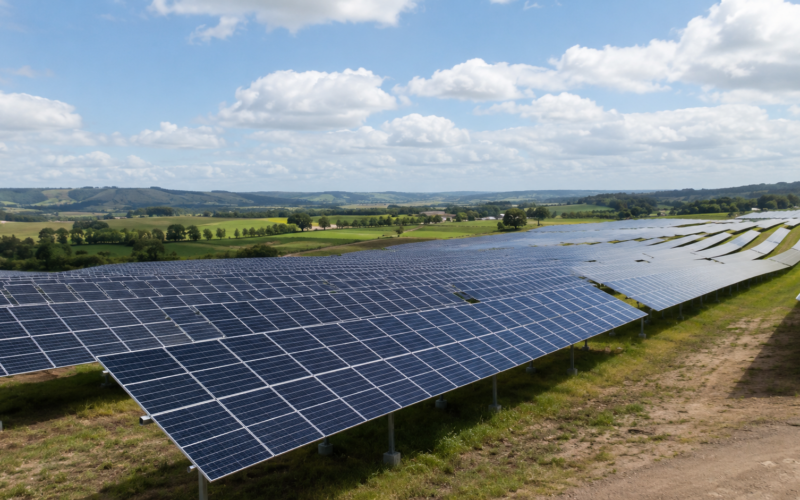
Contact Energy Limited (NZX: CEN, ASX: CEN) and Lightsource bp, a wholly owned BP p.l.c. (NYSE: BP) company, have reached financial close on the 171 MWdc, 150 MWac Glorit solar farm north of Auckland. The partners’ 50:50 joint venture has secured NZ$285 million of non-recourse financing from a five-bank lending group and appointed a joint venture between INTEC Energy Solutions and COMPLANT to deliver the project. Construction can now begin, with commercial operation targeted for the second half of 2028. Glorit is expected to generate approximately 285 GWh annually, with Contact Energy purchasing 80% of the output under a 15-year power purchase agreement. The project tests whether large-scale, project-financed solar can meet rising Upper North Island electricity demand while limiting the amount of capital Contact Energy must commit directly from its balance sheet.
Why does Glorit’s financial close materially improve the project’s construction prospects?
Financial close changes Glorit from a consented development opportunity into a funded infrastructure project. Before this milestone, the joint venture still faced uncertainty over lending terms, interest rates, foreign-exchange exposure and the amount of equity each partner would need to contribute. Securing NZ$285 million of non-recourse financing means lenders have completed sufficient technical, commercial and legal due diligence to support construction under the agreed capital structure.
The banking group includes ANZ, Mizuho Bank, Bank of China New Zealand, China Construction Bank New Zealand and DZ Bank. This diverse lender base spreads exposure across institutions with experience in infrastructure and energy financing, while reducing dependence on a single domestic bank. The facility also demonstrates that international lenders are prepared to finance New Zealand solar assets when revenue is supported by a long-term offtake arrangement and experienced project sponsors.
Contact Energy previously estimated Glorit’s total project cost at approximately NZ$305 million, excluding NZ$42 million of indirect overhead and financing costs. With more than 70% of the investment funded through project debt, the 50:50 joint venture structure significantly reduces Contact Energy’s immediate equity requirement. This allows the utility to retain capital for geothermal, battery storage and other generation investments without carrying the entire solar project on its own balance sheet.
Non-recourse financing does not remove all shareholder risk. Lenders primarily rely on the project’s contracts and future cash flow, but Contact Energy and Lightsource bp still face construction delays, cost overruns and the possibility that performance falls below expectations. The financial structure works only when the engineering, power purchase agreement and operating assumptions remain sufficiently robust throughout the project’s life.

How does the 15-year Contact Energy power purchase agreement support Glorit’s bankability?
Contact Energy has agreed to purchase approximately 80% of Glorit’s expected output under a 15-year power purchase agreement. That equates to roughly 230 GWh of the project’s estimated 285 GWh of annual generation, leaving the remaining electricity available for merchant sale through the joint venture.
The contract provides lenders with a predictable revenue base rather than forcing them to rely entirely on future wholesale electricity prices. Long-term contracted income increases debt capacity because financial institutions can model project cash flows with greater confidence and establish repayment schedules around expected generation.
The offtake structure also serves Contact Energy’s retail and commercial portfolio. The company has contracted more than 500 GWh of new summer-weighted electricity demand, including customers seeking to replace fossil-fuel use with electricity. Solar generation is naturally aligned with daytime and summer consumption, making Glorit commercially useful even though it cannot provide continuous output.
Contact Energy is effectively participating on both sides of the arrangement. It owns half of the generating project while also purchasing most of its output. This gives the company access to joint-venture returns and a margin opportunity when the electricity is resold to customers.
The structure still leaves exposure to generation performance. A solar farm producing less than forecast may have less contracted electricity available, while a stronger-than-expected year can increase merchant volumes. The eventual return will depend on irradiance, equipment availability, grid constraints and the difference between power purchase agreement pricing and the value Contact Energy captures from end users.
Why is Glorit’s location north of Auckland strategically important for grid economics?
Glorit will be built on the Kaipara Coast north of Kaukapakapa, close to major electricity demand centres in the Upper North Island. Locating new generation nearer Auckland can reduce dependence on electricity transported over long distances from hydro and geothermal stations elsewhere in the country.
New Zealand’s renewable portfolio is geographically uneven. Large hydro assets are concentrated in the South Island, while substantial geothermal generation is located in the central North Island. Auckland and surrounding regions contain major residential, commercial and industrial loads but comparatively limited local generation.
Glorit will connect to Transpower’s 220 kV network through a dedicated connection of approximately 1.5 kilometres. Contact Energy has described the connection point as relatively strong, which should reduce some of the grid-upgrade complexity that can delay renewable projects.
Proximity to customers can also improve the generation-weighted average price received by the project. Electricity produced in a constrained region can be more valuable than identical generation located behind an export bottleneck. Contact Energy expects the Upper North Island location to support settlement economics under the power purchase agreement.
The project will not eliminate transmission constraints or guarantee supply during winter peaks. Solar output is strongest during daylight hours and typically weaker during shorter winter days, while New Zealand’s most challenging electricity periods can occur during cold, dark and dry conditions. Glorit’s value therefore comes from adding regional generation and diversifying supply, not from replacing firm hydro, geothermal, thermal or battery capacity.
Can the consented battery system eventually make Glorit a more dependable power asset?
Glorit has been consented to include a direct-current-coupled battery energy storage system. The approved concept provides a route for solar electricity to be stored before conversion and exported later when the grid or electricity market places greater value on the energy.
A direct-current-coupled configuration can reduce conversion losses and allow the battery to capture electricity that might otherwise be clipped when solar output briefly exceeds inverter capacity. It can also make use of the same grid connection, creating potential capital efficiencies compared with a completely separate storage site.
The battery has not yet been included in the announced construction financing or confirmed as part of the initial investment decision. Lightsource bp has described the consent as future storage and firming capability rather than confirming that the battery will be installed alongside the first solar phase.
That distinction matters because the initial Glorit project remains a solar development with merchant and contracted generation exposure. Storage could improve the ability to shift electricity into evening periods, but it would require additional capital, equipment procurement, operating strategy and revenue assumptions.
Contact Energy already has grid-scale battery projects within its broader development programme. The company is constructing storage at Glenbrook and has proposed a larger second-stage battery. It may therefore evaluate Glorit storage as part of its portfolio rather than as an isolated asset.
The battery option has strategic value even before investment approval. Securing consent now can avoid a lengthy permitting process later and allows the joint venture to respond if intraday electricity-price spreads, network constraints or customer demand make co-located storage more attractive.
Why does Contact Energy expect an investment return above 12% from Glorit solar?
Contact Energy has targeted a project return above 12%, including its share of joint-venture profits and the margin associated with purchasing and reselling Glorit’s electricity. The return is not based only on selling solar generation into the wholesale market.
The 50:50 ownership model means Contact Energy participates in equity distributions generated by the project. The 15-year power purchase agreement gives it access to approximately 230 GWh annually, which can be matched against commercial and industrial customer demand.
Contact Energy estimates annual operating expenditure and stay-in-business capital expenditure at approximately NZ$20 per MWh in real terms. Solar farms have no fuel expense and relatively limited moving equipment, supporting lower operating costs than conventional thermal generation.
The project’s estimated capital cost of about NZ$2 million per MWac is substantial but partially offset by the high level of project financing. Debt allows the sponsors to earn returns on a smaller equity contribution, although interest and financing costs must be serviced before shareholder distributions.
The more than 12% target is not guaranteed. The calculation depends on construction staying close to budget, generation matching forecasts, operating costs remaining controlled and Contact Energy realising the expected customer margin.
A delayed commercial start would weaken returns by increasing financing expenses and postponing revenue. Lower solar resource, equipment degradation or unexpected grid curtailment could also reduce lifetime generation.
In my assessment, Glorit’s strongest economic advantage is the combination of project leverage and contracted demand rather than solar technology alone. Contact Energy has designed the commercial structure to match electricity supply with customers it already expects to serve, which reduces speculative merchant exposure.
What construction risks must INTEC Energy Solutions and COMPLANT manage before 2028?
A joint venture between INTEC Energy Solutions and COMPLANT has been appointed as engineering, procurement and construction contractor. The EPC arrangement places responsibility for design, procurement, installation and delivery within one contracting group, reducing interface risk for the project owners.
The contractors must manage module and inverter procurement, mounting systems, civil works, electrical cabling, grid connection, substations and testing. Equipment orders may involve foreign currencies, meaning exchange-rate movements and shipping conditions can affect project costs even after financing has closed.
Weather and ground conditions will influence construction productivity. Large solar sites require extensive piling, trenching and cable installation, and delays can emerge when rainfall or geotechnical conditions differ from assumptions.
Grid works are another critical interface. The solar farm may be mechanically complete but unable to generate revenue until the transmission connection, protection systems and metering arrangements have been tested and approved.
The second half of 2028 operating target provides a reasonable construction period, but project sequencing will be important. Long-lead electrical equipment must arrive before energisation, while module deliveries must be timed to avoid excessive storage and handling costs.
Quality control will determine lifetime output. Poor installation can create cable faults, tracker misalignment, water ingress or module damage that may not become obvious during initial commissioning.
The comprehensive EPC contract provides a degree of schedule and cost protection, but the effectiveness of that protection depends on contractual caps, exclusions and contractor financial strength. If a subcontractor fails or supply-chain costs rise sharply, the project owners may still face delays even when contractual remedies are available.
How does Glorit support Contact Energy’s broader renewable development strategy?
Glorit is part of a 50:50 joint venture established by Contact Energy and Lightsource bp to develop, construct and operate utility-scale solar assets across New Zealand. The partners have agreed to extend the venture, signalling that the relationship is intended to continue beyond Glorit and Kōwhai Park.
Kōwhai Park, a 168 MWdc solar farm at Christchurch Airport, is nearing energisation and is expected to become fully operational during 2026. Glorit gives the partnership a second large project and shifts the geographic focus from the South Island to the Upper North Island.
The two developments allow the partners to reuse procurement experience, engineering standards and operating processes. Repetition can reduce development costs and improve negotiating leverage with equipment manufacturers and lenders.
For Lightsource bp, the joint venture provides access to Contact Energy’s local market knowledge, retail customers and electricity-trading expertise. For Contact Energy, Lightsource bp contributes global solar-development, construction and asset-management capabilities.
Contact Energy’s wider strategy includes geothermal generation, hydroelectricity, grid-scale batteries and flexible thermal assets. Solar is therefore being added as one part of a diversified portfolio rather than treated as a standalone replacement for firm generation.
This portfolio approach is important in New Zealand, where electricity prices can rise sharply during dry hydro years or periods of constrained gas supply. Solar adds low-operating-cost electricity, while geothermal, hydro, batteries and thermal plants provide different forms of reliability and flexibility.
The company’s capital allocation challenge is to advance several projects without overextending its balance sheet. Project financing and joint ventures allow Contact Energy to increase generation while sharing construction capital and risk.
What does Contact Energy’s recent share performance suggest about investor sentiment?
Contact Energy shares traded near NZ$9.50 on June 23, 2026. The stock had declined about 0.7% from its June 16 close of NZ$9.57 but remained approximately 1.6% above its May 22 close of NZ$9.35.
The shares were trading within a 52-week range of NZ$8.71 to NZ$9.99, placing Contact Energy roughly 5% below its annual high and about 9% above its annual low. Its market capitalisation remained close to NZ$10.2 billion.
The relatively modest share movement indicates that financial close was expected and had already been incorporated into investor assumptions. Contact Energy disclosed detailed Glorit economics during its February capital raise, including the cost, expected generation, financing structure and return target.
Investors are therefore more likely to focus on construction performance and eventual earnings contribution than on the financing announcement alone. Glorit is strategically important, but it remains one development within a much larger generation and retail portfolio.
BP American depositary shares traded around $39.53 on June 23. The stock was down approximately 4% from its June 16 close and nearly 11% below its May 22 level, while remaining within a 52-week range of $29.58 to $48.27.
BP’s share performance reflects oil prices, upstream production, refining, debt and shareholder-return expectations rather than the Glorit solar project. Lightsource bp supports BP’s broader renewable platform, but a NZ$305 million joint-venture project is not large enough to materially affect the group’s near-term valuation.
What milestones will determine whether Glorit becomes a successful project-finance template?
The first milestone will be full construction mobilisation. Site preparation, equipment procurement and early civil work will demonstrate that financial close has translated into physical execution.
The second will be delivery of major electrical equipment and confirmation that the transmission connection remains aligned with the solar farm’s schedule. Grid delays can postpone revenue even when panel installation is complete.
The third will be evidence that construction spending remains near the NZ$305 million project-cost assumption. Material overruns would weaken the targeted return and may require additional equity from the joint-venture partners.
The fourth will be successful energisation and performance testing. Glorit must demonstrate output, protection-system compliance and reliable communication with Transpower before commercial operation.
The fifth will be annual generation relative to the 285 GWh forecast. Solar-resource variation is normal, but persistent underperformance would weaken project distributions and the economics of Contact Energy’s offtake agreement.
The sixth will be Contact Energy’s ability to convert the purchased electricity into attractive retail and commercial margins. The project’s return depends partly on the value created after generation leaves the solar farm.
The seventh will be a decision on the consented battery. Adding storage could improve dispatchability, but it must compete for capital against other Contact Energy projects.
Glorit has now crossed one of the largest development barriers by securing non-recourse financing. The remaining challenge is straightforward to describe and much harder to execute: build the project on schedule, keep capital costs controlled and generate enough electricity to justify the promised returns.
What are the key takeaways from the Glorit solar farm financial close?
- Contact Energy and Lightsource bp have secured NZ$285 million of non-recourse financing for the 150 MWac Glorit solar farm.
- Total project cost is expected to be approximately NZ$305 million, excluding NZ$42 million of financing and indirect overhead costs.
- The 50:50 joint venture structure and more than 70% project financing reduce Contact Energy’s direct capital requirement.
- Glorit is expected to generate approximately 285 GWh annually after commercial operation begins in the second half of 2028.
- Contact Energy will purchase 80% of the project’s output, or about 230 GWh annually, under a 15-year power purchase agreement.
- The project’s Upper North Island location places new generation close to Auckland-area demand and a strong transmission connection.
- Contact Energy is targeting a return above 12%, supported by joint-venture income and margin on purchased electricity.
- INTEC Energy Solutions and COMPLANT will deliver the project under a joint EPC structure.
- Glorit has consent for future battery storage, but storage is not yet confirmed as part of the initial funded construction phase.
- Construction cost, grid readiness, generation performance and Contact Energy’s customer margins will determine whether the project meets its investment case.
Discover more from Business-News-Today.com
Subscribe to get the latest posts sent to your email.